Category Archives: Midrash

Yehoshua and the Origins of Christianity

This week’s Torah portion is Pinchas, named after the grandson of Aaron, who stemmed the tide of immorality that followed the Moabite and Midianite ploy to bring Israel to sin. For his efforts, God blessed Pinchas with an everlasting blessing of peace. In the past, we explored the nature of this blessing, and how it resulted in Pinchas’ apparent immortality, as well as his eventual rebirth as Elijah the Prophet. This week, we will explore another critical figure in the Torah: Yehoshua, better known as Joshua.

Midway through this week’s parasha we read how God commanded Moses to officially appoint Yehoshua as Moses’ successor. Yehoshua is described as a person within whom rests the spirit of God. Although there are a number of Torah figures who are described as possessing some sort of Divine Spirit, Yehoshua is one of only two who are described as having the spirit within them. In most cases throughout the Bible, the spirit of God is said to rest upon an individual (‘alav in Hebrew), or to have temporarily filled an individual (mal’e or timal’e in Hebrew). With regards to Yehoshua, it says that the spirit was within him. The only other person in the Torah who is described in such a way is Yehoshua’s direct forefather Yosef (Genesis 41:38).

An even more peculiar detail about Yehoshua is that he is called “Yehoshua bin Nun”. Every other person in the Bible is referred to by their name, as well as by their father’s name, with the designation ben – “son of” – in the middle. Yehoshua alone is called bin Nun instead of the regular ben Nun. Moreover, a person named Nun cannot be found anywhere in the Torah, and unlike most other Torah figures, Yehoshua’s genealogy is not given (although one is provided in the Book of I Chronicles, written many centuries after the Torah). Other than the fact that Yehoshua stems from the tribe of Ephraim, nothing else of his origins is divulged.

Out of a Fish

There happens to be an obscure Midrash that fills in some of the details about Yehoshua’s early life. There are a few variations of the story, with one particularly tragic version that seems to
mirror the Greek myth of Oedipus. According to this Midrash, Yehoshua was left by his parents, possibly placed in the Nile River like Moses was. Miraculously, a large fish swallowed him
up, and Yehoshua was later saved by fishermen. This is the meaning of bin nun, since nun means “fish” in Aramaic. Thus, Nun is not the name of his father at all, explaining why he is not
called ben Nun. Rather, bin Nun refers to his origins from the fish, with his true genealogy unknown.

In the controversial “Oedipus” version of the story, Yehoshua is saved by the Pharaoh’s fisherman, and thus grows up in the palace, becoming the court executioner. He tragically
ends up putting his own father to death, as was originally prophesized when Yehoshua was conceived (which is why his parents abandoned him to begin with). I prefer to think of it more in the style of Moses, where Yehoshua was placed in the Nile just as Moses was, to avoid the Pharaoh’s decree of slaughtering all the male-born. By also growing up in the palace, alongside Moses (though he would have been younger), the two would have been well-acquainted, and that might explain why Yehoshua is so close to Moses throughout the Torah narrative.

Whatever the case, Yehoshua grows up to be a holy man, the personal servant of Moses, one of just two righteous spies, and the leader that finally brought the people into the Holy Land. The Sages describe him as the moon to Moses’ sun, and the key link in the chain of Jewish Oral Tradition.

The Origins of Christianity
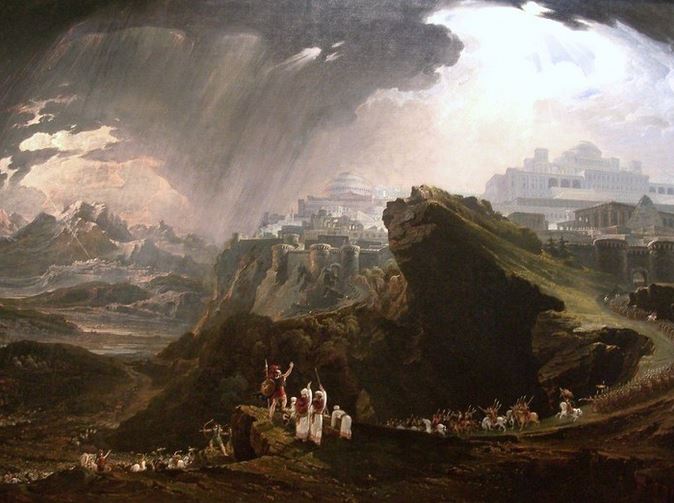
'Joshua Commanding the Sun to Stand Still upon Gibeon' by John Martin

‘Joshua Commanding the Sun to Stand Still upon Gibeon’ by John Martin

When looking at the life story of Yehoshua, it is hard to miss the connection to Christianity. Like Yehoshua, Jesus is a Jew said to have had a miraculous birth, spent time growing up in Egypt, and was described as having the spirit of God within him. Like Yehoshua, Jesus is symbolized by a fish, and is seen as a sort-of successor to Moses (as suggested by his supposed “Transfiguration”, where he ascends to be blessed by Moses and Elijah). In the same way that Yehoshua stems from Joseph, Jesus’ “earthly father” is said to be Joseph. Jesus is described as a miracle-worker, just as Yehoshua facilitated a number of miracles, such as making the sun and moon stand still at Gibeon, and stopping the flow of the Jordan River. Of course, Jesus’ original name as pronounced in his day was Yeshu, the Aramaic version of Yehoshua.

The similarities don’t end there. Strangely, the Torah makes no mention of Yehoshua’s wife or children (even the genealogy given in I Chronicles ends with Yehoshua himself). Jesus, too, failed to marry or have kids. The Talmud (Megillah 14b) suggests that Yehoshua did later marry Rachav, the harlot that assisted the Israelites in the conquest of the Holy Land. Rachav had repented and become a righteous woman. Similarly, Jesus had close encounters with Mary Magdalene, also described as a harlot, and also controversially rumoured to have possibly married Jesus!

It is important to remember that there is absolutely no evidence for the existence of Jesus outside of the New Testament. It is well-known that the New Testament was written long after Jesus would have lived, and is full of contradictions about the details of his life. Many have challenged the historicity of Jesus, with more and more scholars suggesting that he likely did not exist at all.

Considering all that, it isn’t hard to imagine how early Christians would have put together the mythology of Jesus based on previous Torah ideas and narratives: a miraculously-born baby with the spirit of God, whose very name means “salvation”; celibate and childless, a humble, Godly servant bringing others to repentance, and leading the Israelites to the Promised Land… This is the story of the Torah’s Yehoshua, and the story that was adapted to fit the mold of a new religion a couple of millennia ago.

The Jewish Sages did always view Yehoshua as a prototype of Mashiach. After all, he is the one that defeated the embodiment of evil known as Amalek, and the one that ended the exile of the Jews, returning the people to their land. So, it isn’t surprising that Christians used Yehoshua as a prototype for their own supposed Messiah. Ironically, though, not only did Jesus fail to defeat evil, and fail to bring an end to the exile, he was also indirectly responsible for inspiring the murder of countless people thanks to all the holy wars, inquisitions, and crusades fought in his name. Jesus’ own message may have been peace, but his followers used him incessantly for war and bloodshed. Two millennia have passed, and the world is still far from perfect. We continue to await the arrival of the true Messiah. May we all merit to see his coming soon.


The article above is adapted from Garments of Light – 70 Illuminating Essays on the Weekly Torah Portion and Holidays. Click here to get the book!

Bilaam: The Last Prophet

This week’s Torah portion, Balak, is named after the Moabite king who sought to curse the Jewish people in the Wilderness. Seeing how the Hebrew nation had grown so large and powerful, and had earned God’s favour, Balak feared the Jews. He knew that taking them on physically would fail, so he decided on a spiritual solution to his problem. He summoned Bilaam (or Balaam), the greatest prophet among the gentiles, to curse the Jewish people in return for vast riches. Bilaam, however, refused the generous offer, knowing that there was no way he could curse the Jews if God did not wish it. Bilaam admitted that as a genuine prophet, he could only pronounce what Hashem would put in his mouth, and nothing more. Nonetheless, Balak continued to entice Bilaam until the prophet acquiesced, and agreed to give it a shot. Every single one of his attempts failed, and each time that Bilaam would open his mouth to curse the Jews, a blessing would emerge instead. Frustrated, Balak and Bilaam give up.

The story does not end there, though. Having failed to curse the Jews, Balak and Bilaam come up with another plan. Knowing that God’s favour only rests upon the Jews when they act righteously and in a holy manner, the two realized that they could tempt the Jews towards sin. Once the people are mired in sin, God’s divine protection would be lost, and the nation would in effect be cursed. This time, their plan worked like a charm.

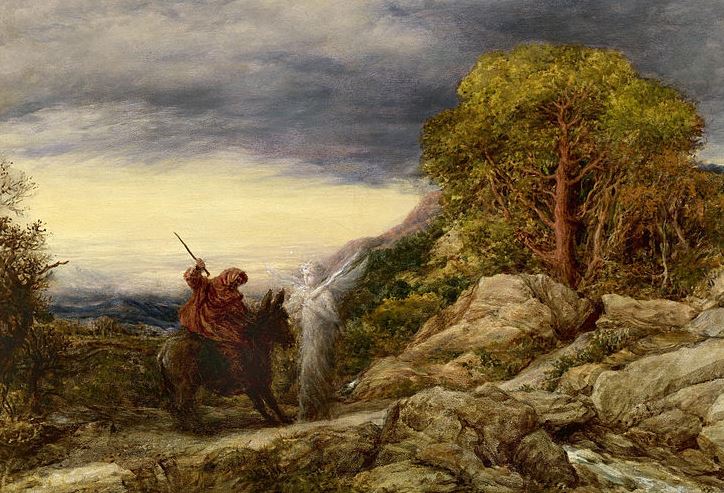
'Balaam and the Angel' by John Linnell

‘Balaam and the Angel’ by John Linnell

Balak and Bilaam sent a great number of gentile women to bring the Jewish men into sexual immorality and licentiousness. From there, they enticed them further into idolatry. Everything spins out of control, and Moses seems powerless to stop the endless cycle of sin. This reaches a climax when Zimri, the prince of the tribe of Shimon, publicly engages in sexual acts with a Midianite woman.

It is Pinchas, the grandson of Aaron, who finally steps in to end the tragedy. He slays Zimri, shocking the nation and waking the people. Pinchas is given an everlasting blessing for bringing an end to the immorality. According to some opinions, he later slays Bilaam as well. The Talmud (Sanhedrin 106a) states that it was precisely when Bilaam went to redeem his reward that he was killed.

Interestingly, all of the ancient texts agree that Bilaam was a true prophet, and was even equal in prophecy to Moses! How did Bilaam attain the merit for prophecy, and how did he fail so miserably?

The Origins of Bilaam

The Midrash relates how the gentiles brought a complaint against God. They argued that had God given them a leader like Moses, they too would have surely become holy and righteous nations. So, God did indeed send them a prophet like Moses. This was Bilaam.

In fact, the Arizal states that Moses and Bilaam stem from the same spiritual root: they were both reincarnations of Abel, the son of Adam (Sha’ar HaGilgulim, ch. 29). The spiritual spark corresponding to the letter Hei in Abel’s name (הבל) was given to Moses (משה), while the sparks corresponding to the letters Bet and Lamed in Abel’s name (הבל) were given to Bilaam (בלעם). So, it isn’t surprising that the two are often described as being of equal greatness in prophecy.

Unfortunately, the gentiles’ request for a prophet did not bring the result they had expected. Instead of using their prophet as a leader for goodness, they adopted him to further their own evil ends.  And this began long before Balak summoned him.

The Talmud (ibid.) recounts how Bilaam was once one of the three main advisors and soothsayers to the Pharaoh in Egypt. The other two were Iyov (Job) and Yitro (Jethro). When Pharaoh’s astrologers saw that the Redeemer of the Hebrews would soon be born, it was Bilaam who advised that all the male firstborn be drowned. Job was against the idea, but remained silent. For this, he was so severely punished (as described in the Book of Job). Jethro was the only one who spoke up and tried to avert the decree. For his opposition to the Pharaoh, he was forced to flee the kingdom. In poetic fashion, the very redeemer he was trying to save at birth ended up being his own son-in-law! Bilaam, meanwhile, ended up working with Balak to try and finish the job he started over a century earlier. Once again, he failed.

A Balance in the Universe

The Midrash (Tanchuma on Balak, Passage 1) elaborates that for every great leader, king, or prophet that God had sent the Jews, he equally sent one to the non-Jews. King Solomon’s counterpart was Nebuchadnezzar. While the former used his talents to build the First Temple, a House for God and a place of holiness and unity, the latter used those same talents to destroy that very same holy place. King David’s counterpart was Haman. Both were blessed with wealth and success. The former used these resources to bring the people together and unify all the tribes, bringing peace to the region; the latter used his resources to incite a genocide. Moses’ counterpart was Bilaam. The former used his prophecy to bring God’s message of holiness, peace and goodness; the latter used his prophecy for idolatry, destruction, and immorality. The passage in the Midrash concludes that God subsequently took away all forms of prophecy from non-Jews. Bilaam was the last true prophet among the gentiles.

Moses and Korach, Abel and Cain, Water and Ice

This week’s Torah reading is named after Moses’ cousin, Korach, and describes his rebellion against the leader of the Jewish people. Rashi’s commentary quotes a number of Midrashic texts to explain Korach’s motivation. Korach was a very wealthy and very wise man. Yet, despite being a distinguished member of the community, and Moses’ cousin, he was not appointed to any prominent roles. The high priesthood was bestowed upon Aaron, while the leadership of the Kohatithes (one of the major divisions of the Levites) was given to Elitzaphan, who was younger than Korach.

Upset by these developments, Korach gathered 250 others and protested: “…the entire congregation, all of them, are holy, and God is in their midst, so why do you raise yourselves above God’s assembly?” (Numbers 16:3) Korach essentially accused Moses of nepotism: putting his own favourites in holy positions to rule over the people, when in reality all the people should be on a high and exalted level, as they are all equally part of God’s assembly.

This was a very good argument, and many were swayed by Korach. After all, God had said to the people that “… you will be a kingdom of priests, and a holy nation” (Exodus 19:6). Amazingly, Rashi writes that Moses himself agreed with Korach! Moses said:

“Among the nations, there are many forms of worship and many priests, and they do not all gather in one temple. We, however, have only one God, one ark, one Torah, one altar, and one High Priest, but you two hundred and fifty men are all seeking the High Priesthood! I, too, would prefer that. Here, take for yourselves the service most dear [to God] of all: it is the incense, more cherished than any other sacrifice, but it contains deadly poison, by which Nadav and Avihu were burnt, so be warned…” (Rashi on 16:6)

The Incense Offering

The ketoret, or incense offering, was the greatest of Temple services, and could only be performed by the High Priest. It is said that anyone else who attempted it (including the High Priest if he was not in the highest state of purity) would die immediately. The Torah already relayed the story of Nadav and Avihu, the sons of Aaron who tried to bring their own incense, and perished.

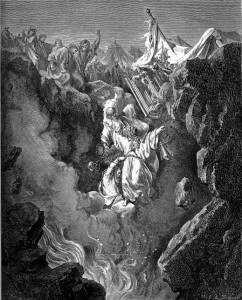
"Death of Korah, Dathan, and Abiram" by Gustave Doré

“Death of Korah, Dathan, and Abiram” by Gustave Doré

So, Moses told Korach and his supporters that he would have loved for everyone to be at the level of high priesthood. This is how God had originally intended it after all, and one day in the future it would be so. At the present moment, though, the people were simply not ready for it. If they indeed thought they were all capable of being the High Priest, Moses suggested for them to each bring their own incense. He warned them, though, not to forget what had happened to Nadav and Avihu.

The narrative continues with Korach and his supporters bringing their own incense offering, with the result being utter failure, and every one of them losing their life for it (16:35). Korach himself, together with his main supporters Datan and Aviram, was given a more severe punishment: they were swallowed up by the earth. Interestingly, this specific punishment was decreed by Moses. Why did Moses specifically want Korach to be swallowed up by the earth?

Cain and Abel

The Arizal explains that Moses and Korach were reincarnations of Abel and Cain (Sha’ar HaGilgulim, Ch. 29 and 32). Cain had risen up against Abel, argued with him, and then murdered him. The text states that the earth had “opened its mouth” to receive Abel’s blood (Genesis 4:11). This time around, Cain’s soul (within Korach) again rose up against Abel’s soul (within Moses) and quarreled with him. Now, to complete the spiritual rectification, measure for measure, it was Abel that buried Cain in the earth, with the text once again saying that the earth had “opened its mouth” (16:32).

Water and Ice

Practically speaking, Moses and Korach represent two types of people, indicated by their names. Moses, Moshe, was a name given by the Pharaoh’s daughter, who said ki min hamayim meshitihu, “For I drew him out of the water.” Korach, on the other hand, has the exact same Hebrew spelling as kerach, ice. Moses represents water; Korach represents ice. The latter is cold, hard, and unyielding, expanding ever larger as it freezes, symbolic of an inflating ego. The former is fluid, life-giving, and always flows to the lowest possible point, symbolic of humility. The lesson here is for each person to emulate the watery traits of Moses, and not the frozen qualities of Korach.