
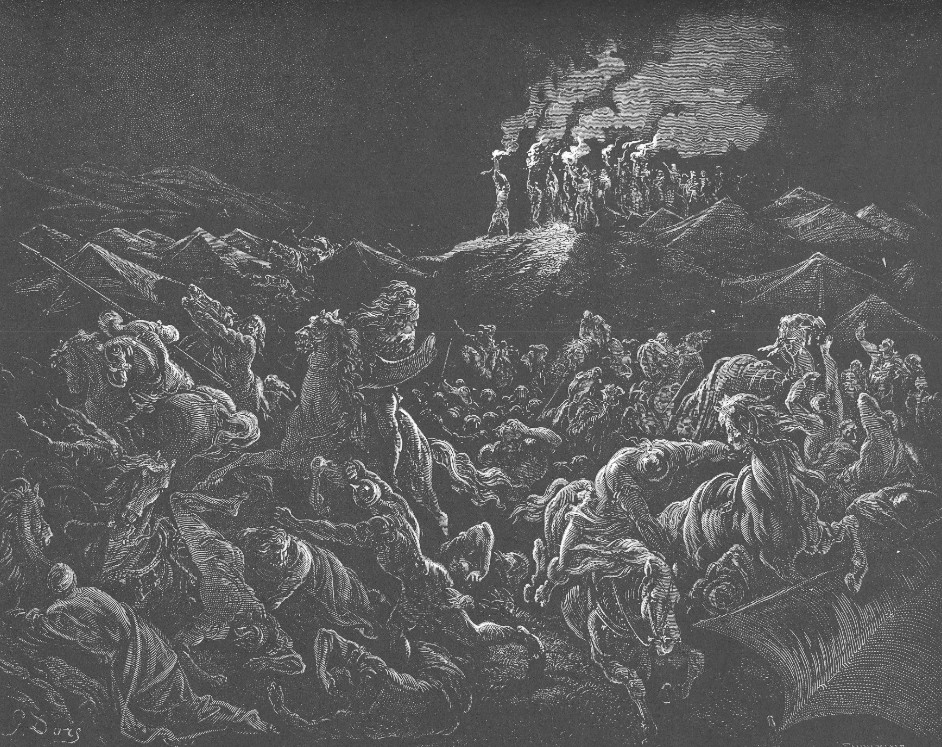
‘The Midianites Put to Flight’ by Gustav Doré
One of the difficult passages in this week’s double parasha, Matot-Massei, which closes the Book of Numbers, is where God seemingly commands a complete massacre of a neighbouring people, the Midianites. This is actually God’s final command to Moses, saying “Take revenge for the Israelites against the Midianites. Afterwards, you will be gathered to your people.” (Numbers 31:2) The next and final book of the Torah is Moses’ own account of his leadership, and was relayed over the last 37 days of his life.
The Israelites go on to slaughter every male Midianite (31:7), take the women and children captive (31:9), then burn down all the cities and take plunder (31:10-11). Still, the Israelites are chastised for letting the adult women live (31:15), as they were the very ones that tempted Israel into various sexual sins beforehand. Understandably, this is one of the most troubling passages in the whole Torah—how could a holy nation seem to behave in a manner more like the violent and bloodthirsty nations we condemn? Unfortunately, passages like this have also turned many away from the Torah, and generated numerous atheists. One such atheist is Richard Dawkins, who summarized it this way in his book, The God Delusion (ch. 2):
The God of the Old Testament is arguably the most unpleasant character in all fiction: jealous and proud of it; a petty, unjust, unforgiving control-freak; a vindictive, bloodthirsty ethnic cleanser; a misogynistic, homophobic, racist, infanticidal, genocidal, filicidal, pestilential, megalomaniacal, sadomasochistic, capriciously malevolent bully.
Dawkins once sat down for an interview with Ben Stein for the latter’s 2008 documentary on Intelligent Design, called Expelled: No Intelligence Allowed. When Stein challenged Dawkins about his atheism, Dawkins responded by quoting the above passage from his book. Stein then countered that, at the same time, God is presented as loving, compassionate, kind and forgiving, too. (It’s worth watching their conversation, and the conclusion where Dawkins surprisingly admits that humanity may have had a Creator!)
Indeed, while there are certainly a handful of incidents in the Torah where God is vindictive and smiting, and he is sometimes called a “jealous God” (El Kanah), more often God is teaching us to take care of each other, to protect and support widows and orphans, donate generously to the poor; not to oppress the disadvantaged, not to engage in criminal activity, nor to destroy the environment; to love one another, and not bear grudges or seek vengeance; to build educated and peaceful societies, and so on.

The Ten Sefirot
The reality is that God has many faces, and reveals Himself in a variety of different ways. The Kabbalists speak of ten major aspects, embodied by the Sefirot. The first is Keter, which literally means “crown”. In fact, the Zohar refers to all Ten Sefirot as ten ketarim, “crowns”, for each is a way that Hashem is “king” over a particular domain. Keter is God as supreme king of the cosmos, the origin of all things. Then comes Chokhmah, “wisdom”, God as the bringer of divine information. Chokhmah is also called Abba, God as our Heavenly “father”. Opposite this is Binah, “understanding”, God as the master craftsman of the cosmos, and its endless complexities and cosmic mysteries. Binah is also called Ima, God as a “mother” figure. That rounds out the first three Sefirot, called the Mochin, the higher, more “intellectual” powers.
Then come the seven “lower” Middot qualities. Chessed is “kindness”, God revealing Himself as loving, kind, and forgiving. But opposite this is Gevurah, “strength” or “severity”, also known as Din, “judgement”, with God as supreme judge, meting out punishment as necessary, measure for measure. And, yes, smiting those who deserve it. While Chessed symbolizes life-giving water, Gevurah is burning fire. Tiferet is “beauty” and “balance”, the source of truth, representing God as the revealer of truth, the giver of Torah. It also shares a root with “healing”, refuah, and symbolizes God as healer, as He declares ani Hashem rofekha, “I, God, am your healer.” (Exodus 15:26) Keep in mind that most illnesses are a result of some kind of imbalance in the body, therefore healing is really all about restoring that balance, hence the connection to Tiferet.
The next row of Sefirot starts with Netzach, “victory”, and represents God as a triumphant warrior. One of the most common descriptions of God throughout Tanakh is that He is a “God of War” or “Man of War” (Exodus 15:3), riding war chariots and commanding legions. He “mounts a cherub and flies” triumphantly on the wings of the winds, “thundering from the Heavens” with punishing hail and flaming canon balls (Psalms 18:12-14). One of the ten main names of God is Hashem Tzva’ot, “God of Legions”, and the Kabbalists parallel that name specifically with the Sefirah of Netzach.
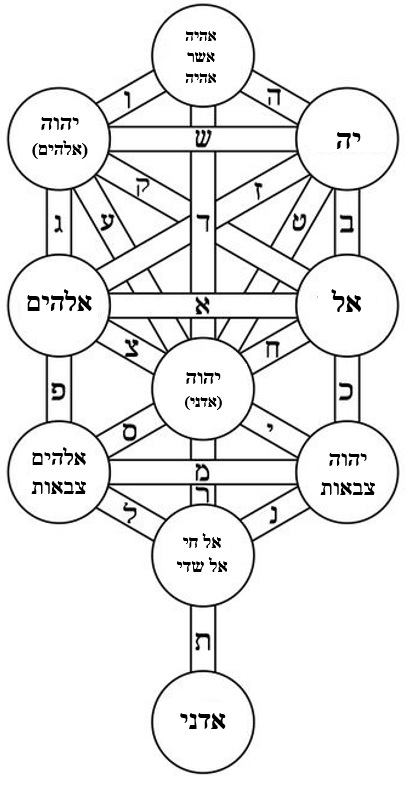
How the major names of God correspond to the Sefirot
Hod is “splendour” and “majesty”, but also “gratitude” for God’s abundance. Relatedly, Yesod is the place of fertility and blessing. The Kabbalists connect it to the name El Chai, literally “Living God” or, more accurately, “God of Life”, as well as to the name El Shaddai, which can be read as “God of divine beings”, but also as the “Sufficient One”, and literally having the same root as “breasts” (shaddaim) to denote nourishing all life. Finally, Malkhut is “Kingdom” and is always described in feminine terms, as a “queen” or “princess”, and identified with the Shekhinah, God’s manifesting presence on Earth.
Interestingly, when we look at ancient pagan pantheons, they often have distinct “gods” embodying these very same aspects and qualities. Most feature some combination of a fatherly sky god and an earthly mother goddess, a god of wisdom and a god of war, a god of love and a goddess of fertility, a god of agricultural abundance, a god of judgement, a god of fire and a god of water. One of the key goals of the Torah is to uproot ancient idolatrous paganism and replace it with monotheism. So, naturally, Hashem takes on all the qualities of the pagan gods, and is described in similar terms. The idea is to get people to recognize that Hashem is all of these things, and there is truly only one Creator and one Master to the cosmos. And that’s why the Torah presents the very same God in so many different ways, with so many faces and names and personas.
Yes, He is the God of Legions, a god of war that commands military conquest, sometimes ruthlessly (like in this week’s parasha). And He is God of Water, master of the seas. He can bring about a global flood, and He can split the Sea, and He alone controls the rains. In fact, the Talmud (Gittin 56b) says that the Roman emperor Titus—who had previously destroyed the Jerusalem Temple—reasoned that Hashem is equivalent to his god Neptune (or Poseidon), god of the seas, and therefore has power only over water. So, Hashem made sure to punish Titus on land, using a tiny “gnat” that devoured his brain.
Meanwhile, God is also a “consuming fire” (Deuteronomy 4:24), and ignites flames with the breath of His nostrils (Deuteronomy 32:22). He is associated with volcanic mountains and makes Sinai burn and smoke like a furnace (Exodus 19:18). It is interesting to note that the famous Roman god of blacksmiths, the first metalworker, is called Vulcan, giving rise to the word “volcano”, since his furnace was the Mt. Etna volcano in Sicily. Meanwhile, the Torah says that Tuval-Cain was the first blacksmith and metalworker (Genesis 4:22). Vulcan and Tuval-Cain are one and the same! The former is a pagan deity, the latter simply a historical descendant of Cain. One is an idolatrous counterfeit of the other.
The same is true for many other Torah figures, who transformed into full-blown pagan gods later in history. Noah became Deucalion for the Greeks, who survived a global flood sent by Zeus by taking refuge in a special chest. The same Noah became Utnapishtim for the Sumerians, Manu in Hinduism, and Nu-u for the Hawaiians. Noah’s son Yefet, forefather of European peoples, became the Greek progenitor of mankind named Iapetus, son of sky god Uranus and earth goddess Gaia. The Greeks believed they came from Iapetus the same way the Torah says they came from Yefet! More specifically, Iapetus’ son was Prometheus, grandfather of Hellen, forefather of all Greek (or Hellenic) peoples. One of Hellen’s grandsons was Ion, forefather of the Ionian Greeks. Of course, Ion is one and the same as Yavan (easy to see in Hebrew: יון). Another of Hellen’s grandsons was Makednos, forefather of Macedonians like Alexander the Great, who is featured countless times in Talmud and Midrash, usually called Alexander Mokdon.
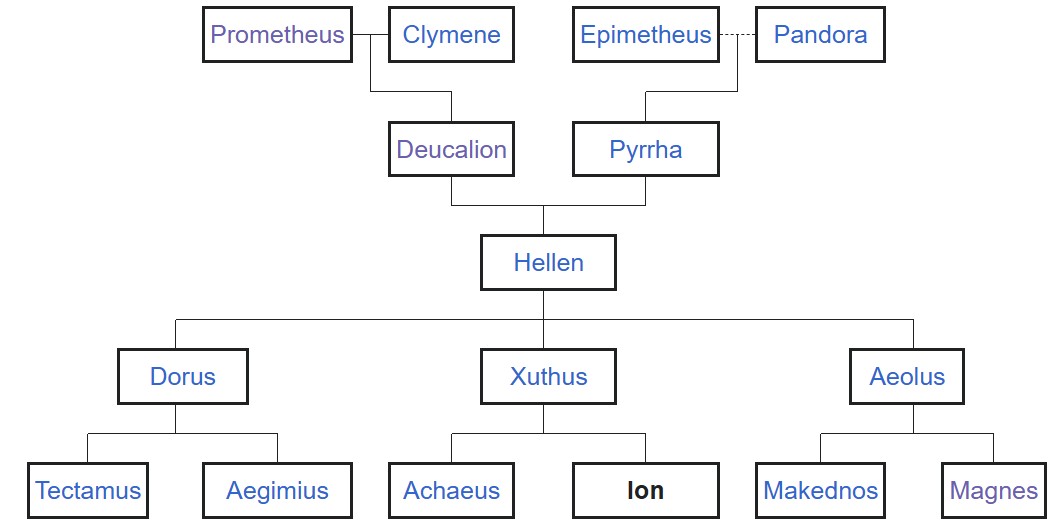
Genealogy of the Greek peoples, according to Greek legend
God of Love, God of Trickery
Ancient myths are full of gods of love and passion, including Aphrodite and Eros, Ishtar and Bastet, Venus and Cupid. And one of the most common appellations for God in Tanakh is that He is a God of passionate love. The first descriptor in the 13 Attributes of Mercy is El Rachum, which means “Compassionate God” in Hebrew, but in Aramaic would mean “God of Love”. In the Torah, Hashem is often called El Kanah, a God of “Jealous Love”. Even the Tetragrammaton, YHWH, is linked by scholars to the ancient Arabic-Midianite root hawaya, meaning “love” and “passion”. The ancient Midianites (and more specifically, the Qurayya people) did indeed worship a mountainous god of love and passion with that name, and these people were also closely associated with metalworking in the Arabian Peninsula.
Tying it back to this week’s parasha, the Midianites were commanded to be executed because they had previously tempted the Israelites into various gross sexual sins, including a public display of debauchery by Zimri and Cozbi (Numbers 25). That may well be because their chief idol was a promiscuous deity, and their priests and priestesses may have been engaged in such behaviour, too. It would also explain why the Torah refers to prostitutes as kadeshot, which strangely shares a root with “holy” (kadosh). Some believe it derives directly from such promiscuous pagan priestesses.
That Hashem plays a role as “God of Love” is clear throughout Tanakh, which is full of stories of love and passion, both good and bad. Of course, there is an entire book of Tanakh devoted to love and passion, the very sensual Shir haShirim (“Song of Songs”), which some of our Sages were so uncomfortable with they sought to ban it (Yadayim 3:5). Rabbi Akiva countered that the Torah is holy, but the Song of Songs is the holy of holies! Sometimes, Hashem even plays the role of the hidden matchmaker. One classic example is the case of Judah and Tamar, of which the Midrash (Beresheet Rabbah 85:8) says:
וַיִּרְאֶהָ יְהוּדָה וַיַּחְשְׁבֶהָ לְזוֹנָה כִּי כִסְּתָה פָּנֶיהָ׃ (בראשית לח, טו) … אָמַר רַבִּי יוֹחָנָן בִּקֵּשׁ לַעֲבֹר וְזִמֵּן לוֹ הַקָּדוֹשׁ בָּרוּךְ הוּא מַלְאָךְ שֶׁהוּא מְמֻנֶּה עַל הַתַּאֲוָה, אָמַר לוֹ, יְהוּדָה, הֵיכָן אַתָּה הוֹלֵךְ מֵהֵיכָן מְלָכִים עוֹמְדִים, מֵהֵיכָן גְּדוֹלִים עוֹמְדִים. (בראשית לח, טז): וַיֵּט אֵלֶיהָ אֶל הַדֶּרֶךְ, בְּעַל כָּרְחוֹ שֶׁלֹא בְטוֹבָתוֹ
“Judah saw her and thought her to be a harlot…” (Genesis 38:15) Rabbi Yochanan said: He sought to pass by, but the Holy One blessed be He dispatched to him the angel that is responsible for desire. He said to him: “Judah, where are you going? From where will kings be produced, from where will the prominent ones be produced?” And so, “He turned to her by the road” (Genesis 38:16) despite himself, against his will.
God orchestrated a strange (and technically inappropriate!) encounter, from which Mashiach will ultimately emerge. This ties right into another common type of god in ancient myth:
In many pantheons we find a speedy and cunning god of trickery, like Hermes in the Greek, or Loki in the Norse. We find Hashem described in stories of such cunning and trickery in the Torah as well, including what looks like setting people up for failure (as with Judah above). It’s right at the start of the Torah, too, where Hashem puts Adam and Eve in the Garden, and then puts a beautiful and tempting tree right at the centre of the Garden which He warns them not to eat from. And they actually don’t eat it, until God sends the very Serpent that He Himself created to get them to eat it! King Solomon wrote that “a snake does not bite without a whisper from the snake-charmer” (Ecclesiastes 10:11), and the Zohar (II, 68a) comments on this that it secretly refers to Hashem, “the snake charmer” in the Garden of Eden, whispering instructions to the Serpent!
The same Hashem promises a long-awaited child to Abraham, then seemingly commands that Abraham sacrifice him! He tells Moses to strike a rock to bring water (Exodus 17:5-6), but then punishes Moses for striking a rock to bring water a second time (Numbers 20:11-12). He tells Jacob to “not be afraid to go down to Egypt for I will make you a great nation there” (Genesis 46:3) but omits that tiny little detail of his family first being brutally enslaved there. Joseph is sold into slavery in Egypt, only to later become viceroy of Egypt; while Moses the redeemer who will bring the Egyptian empire to its knees is raised by Egyptian royalty! Jacob, of course, is a master trickster, whose very name means “trickery”, and is able to cunningly dance around his brother Esau and his father-in-law Laban, as well as the people of Shechem, and others. The Tanakh is full of ironies and upside-down stories, humour and trickery. Again, there is a whole book devoted to it, Megillat Esther, the central theme of which is all the characters wearing masks while God is pulling the strings behind the scenes, and everything is ironically nahafokh hu, upside-down (Esther 9:1).
God of Nature, and the First Cause
Ancient pantheons also had gods of harvest and agriculture, and there were specific gods associated with different harvest festivals. The Torah unifies them all towards service of Hashem alone. The first fruits were brought to the Temple for offerings, as were wine libations, while barley sheaves were waved towards Hashem during the Omer, and the Four Species waved during Sukkot. One oft-forgotten festival was Tu b’Av, which the Tanakh describes as among the most ancient (Judges 21:19) and the Talmud says was the happiest day of the year in ancient times (Ta’anit 30b-31a). Tu b’Av was the grape harvest, so naturally it came with a big party that involved speed-dating and mass weddings. It sounds quite similar to festivals like that of Dionysus or Bacchus, god of wine and pleasure.
Finally, there are gods and goddesses of fertility and childrearing. As we saw above, God is called El Shaddai, too, explicitly connected to fertility, and typically used in the Torah when there’s a blessing for fertility given (such as in Genesis 17 and 35). And then there are goddesses representing women and femininity, along with the circle of life and death. It could be Artemis (in Greek) or Diana (in the Roman) or Kali (in Hinduism) or Frigga and Freyja (in Norse). One could argue that these are simply pagan versions of the concept of the Shekhinah, the “feminine” presence of God in this world, corresponding to Malkhut, called Nukva, the “feminine”. These entities are often associated with the moon, just as we say that Malkhut is represented by the moon. The male counterpart to the moon is, of course, the sun, which in mystical texts is paralleled to Tiferet. (In fact, the Arizal taught that 365 lights emerge from Tiferet, corresponding to the 365 days of the solar year.)
The feminine is also strongly linked to mother earth goddesses, and nature goddesses or gods. It is interesting to note that the Name of God associated with Binah, the “Mother” Sefirah, is when the Tetragrammaton (YHWH) is pronounced as “Elohim”. There is a well-known gematria that the value of Elohim (אלהים) is 86, equal to hateva (הטבע), literally “the nature”, since Elohim is most closely associated with God’s mastery over all nature, and His control over all laws of nature. That’s why the first chapter of the Torah records the account of nature’s creation by mentioning only the name Elohim, and no other. Thus, in those instances where YHWH is pronounced “Elohim”, the meaning is to recognize that all the seemingly disparate forces of nature, the various powers or Elohim (which is plural), are all emanations of the one God, YHWH.
Now, the truth is that even pagan peoples recognized that, ultimately, there has to be one infinite origin to all things, including the pantheon. Where had all the “gods” come from? The logical conclusion is that there must be one First Cause. To the ancient Greeks, that was Chronos (not be confused with the titan Kronos) or Aion (referred to by later philosophers as Aion Teleos, which is deeply connected to the mystical notion of Ain Sof, as explained in this class). To the ancient Egyptians, it was Nun (which gives a whole new meaning to Yehoshua bin Nun’s name!) To Hindus both ancient and modern, it is Brahman (which may well be connected to Abraham, as explained here). There is only one God, so there is no need to worship other entities, be they human-like idols, or demi-gods, or saints, or rabbis, or celebrities, or athletes. The Torah seeks to eliminate all forms of idolatry, which are counterproductive and take away from one’s direct relationship with the Creator. Israel (ישראל) is literally Yashar-El (ישר-אל) to remind us to have a straight and unadulterated connection to Hashem, with no intermediaries or distractions in between.
And that’s one reason why the Torah takes elements of all kinds of other “gods” and deities and shows that they are all nothing but manifestations of the one true God. Everything else is a misunderstanding, or mythologizing, or manipulation of the truth. That might explain why God is referred to as Elohei haElohim, the “God of gods”, or Adonei haAdonim, “Lord of lords” (Psalm 136:2-3). He is Malkhei haMelakhim, the “King of kings”, while other divine beings, Bnei Elim, are inferior to Him and bow down to Him (Psalm 29:1-2). It is worth remembering that at least 45 of the 613 commandments of the Torah deal with various prohibitions around idolatry. The Rambam (Rabbi Moshe ben Maimon, 1138-1204) went so far as to say that even the Torah’s sacrificial laws were given only to slowly wean the Israelites off of idolatry (as explored in this class). And at the End of Days, all peoples of the world will finally abandon all of their various idolatries, intermediaries, and spiritual distractions to recognize that there is only one God—as Zechariah 14:9 says, “On that day, God will be one and His name one.”