Tag Archives: King David

The Year 5778: Apex of the Messianic Era

The stars of this week’s parasha, Vayeshev, are Joseph and Judah. We are told how the sons of Jacob were envious (and suspicious) of Joseph, and ended up throwing him in a pit while deliberating what to do with him. Shimon wished to kill him, Judah to sell him, and Reuben to save him. Meanwhile, Midianite merchants found the helpless Joseph and abducted him, later selling him to Ishmaelites who brought Joseph down to Egypt. There, Joseph enters into servitude in the home of a well-to-do Egyptian family.

The Torah diverges from this narrative to describe what happens to Judah. Judah marries and has three sons. The elder Er marries Tamar and dies because of his sinful ways, as does the second son Onan after fulfilling the law of levirate marriage and marrying his former sister-in-law. After Judah fearfully avoids another levirate marriage for Shelah, his last son, Tamar seduces Judah and becomes pregnant. She gives birth to twins, Peretz and Zerach.

Peretz would go on to be a forefather of King David, and thus a forefather of Mashiach. As is known, there are actually two messianic figures (or two aspects to Mashiach): Mashiach ben David, and Mashiach ben Yosef—one from the line of Judah and one from the line of Joseph. In fact, it is in this week’s parasha where the spiritual origins of the two messiahs begin.

Samson and the Messiahs

Mashiach ben Yosef is the first messiah. He is the warrior that battles evil in the “End of Days”. Unfortunately, he is destined to die in these battles. The Talmud (Sukkah 52a) states how the entire nation will mourn his tragic death. However, it will not be too long before Mashiach ben David arises. As the direct descendant of the royal line, he re-establishes the rightful throne and restores the holy Kingdom of Israel. The Third Temple is built thereafter, and according to some Mashiach ben David reigns for forty years, as did his progenitor King David (Sanhedrin 99a, Midrash Tehillim 15).

We have already discussed why Mashiach ben Yosef must die in the past (see ‘Secrets of the Akedah’ in Garments of Light). How he will die is not exactly clear. What will bring him to his death? It appears that Mashiach ben Yosef will be sold out by his own people. This is what happened to one of the earliest prototypes of Mashiach ben Yosef: the Biblical judge Shimshon (Samson).

As is well known, when Jacob blessed his children, he concluded the blessing to Dan with the words “I hope for Your salvation, Hashem” (Genesis 49:18) which Rashi says refers to Samson, a descendent of Dan. Samson was the potential messiah of his generation. He was a warrior fighting the oppressive Philistines. Yet, the people of Judah did not appreciate the “trouble” he was causing, and apprehended him (Judges 15:11-12):
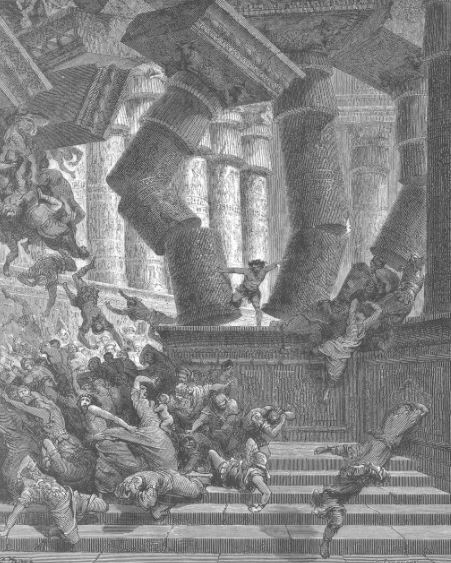
“Death of Samson”, by Gustav Doré

Then three thousand men of Judah went down to the cleft of the rock of Eitam, and said to Samson: “Do you not know that the Philistines are rulers over us? What then is this that you have done to us?” And he said to them: “As they did to me, so have I done to them.” And they said to him: “We have come to bind you, that we may deliver you into the hand of the Philistines.”

Samson turned himself in voluntarily, but with God’s help smote the Philistine oppressors and freed himself. He would be betrayed again by Delilah, but would manage to defeat the Philistines for good, though at the cost of his own life. Like Mashiach ben Yosef, Samson sacrifices himself.

The text above specifically states that three thousand men of Judah came for Samson. What is the significance of this numeric detail?

The Evil 3000

At the Exodus, the Torah states there was a “mixed multitude” (erev rav) of three thousand men among the Israelites. They, too, accepted the Torah at Mt. Sinai, only to instigate the Golden Calf incident forty days later. It is said that the same will happen at the End of Days, with an “erev rav” among the Jews who will instigate all sorts of problems for the nation from within (see, for example, Zohar I, 25 or Sha’ar HaGilgulim, ch. 39). Like Samson’s three thousand men of Judah, Mashiach ben Yosef is sold out by three thousand “Jewish” individuals.

And the fact that they are men of Judah is all the more significant. It was Judah in this week’s parasha who proposed selling Joseph. And to whom did he want to sell him?

And Judah said to his brothers: “What is the gain if we slay our brother and cover up his blood? Come, let us sell him to the Ishmaelites, but our hand shall not be upon him, for he is our brother, our flesh.” (Genesis 37:26-27)

Judah wanted to sell his brother to the Ishmaelites. In speaking of the battles of Mashiach ben Yosef and the End of Days, it is often the Ishmaelites (or the Ishmaelites banded together with Esau) that are implicated (see, for example, Pirkei d’Rabbi Eliezer, ch. 30). Today, of course, the modern “Philistines” are Ishmaelites, and among their biggest supporters are the descendants of Esau.

In The Era of Mashiach

This discussion is particularly timely in light of what’s currently happening in the Middle East. It seems the region is preparing for a massive war, one that would inevitably engulf the entire Ishmaelite sphere, if not the whole world. We’ve written before that we are undoubtedly in the “footsteps of the Messiah” and here is another intriguing point:

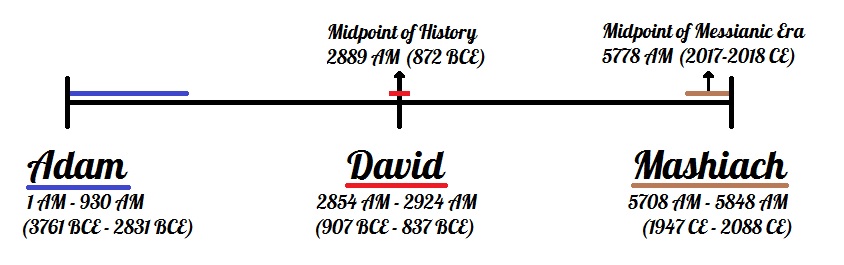
God originally intended for Adam to live 1000 years. Yet, we see in Genesis that Adam lived only 930 years. This is because, as is well known, Adam foresaw that David would be stillborn, and donated 70 years of his life to him. Indeed, David went on to live exactly 70 years. The Arizal saw in the name Adam (אדם) an acronym for three figures: Adam, David, Mashiach. These are the first, middle, and last major figures of human history. Based on this, Rabbi Yitzchak Ginsburgh teaches that David is supposed to be the literal midpoint of history. If that’s the case, then we only need to see when David lived to calculate the era of Mashiach.

The traditional lifetime for David is 2854-2924 AM (Anno Mundi, Hebrew calendar years, corresponding to about 907-837 BCE). To find the time period for the End of Days we must simply multiply David’s years by two. This gives 5708-5848, or 1947/1948-2087/2088 CE. That’s quite amazing, considering that Israel officially became a state in 5708 (the UN vote to create Israel took place in November 1947, and Israel declared independence in May 1948—both dates fall within the Jewish year 5708). And what would be the midpoint, or perhaps the apex, of the “End of Days” period? None other than 5778, the year which we are currently in.

Stay tuned.

The above essay is adapted from Garments of Light, Volume Three.
Get the book here! 
 

Bilaam: The Last Prophet

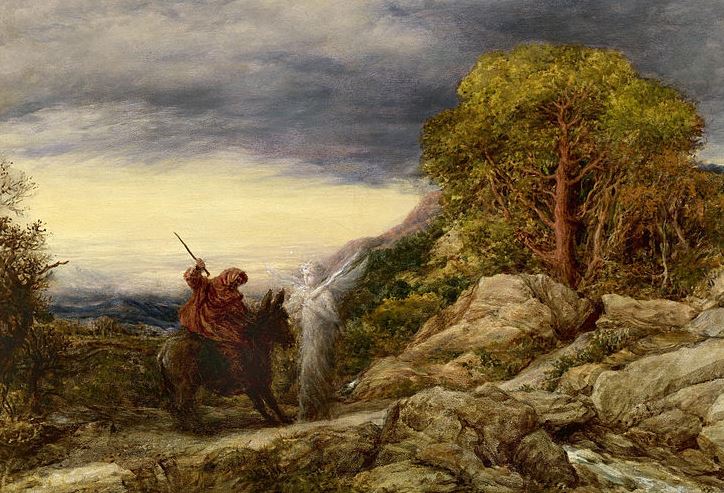
This week’s Torah portion, Balak, is named after the Moabite king who sought to curse the Jewish people in the Wilderness. Seeing how the Hebrew nation had grown so large and powerful, and had earned God’s favour, Balak feared the Jews. He knew that taking them on physically would fail, so he decided on a spiritual solution to his problem. He summoned Bilaam (or Balaam), the greatest prophet among the gentiles, to curse the Jewish people in return for vast riches. Bilaam, however, refused the generous offer, knowing that there was no way he could curse the Jews if God did not wish it. Bilaam admitted that as a genuine prophet, he could only pronounce what Hashem would put in his mouth, and nothing more. Nonetheless, Balak continued to entice Bilaam until the prophet acquiesced, and agreed to give it a shot. Every single one of his attempts failed, and each time that Bilaam would open his mouth to curse the Jews, a blessing would emerge instead. Frustrated, Balak and Bilaam give up.

The story does not end there, though. Having failed to curse the Jews, Balak and Bilaam come up with another plan. Knowing that God’s favour only rests upon the Jews when they act righteously and in a holy manner, the two realized that they could tempt the Jews towards sin. Once the people are mired in sin, God’s divine protection would be lost, and the nation would in effect be cursed. This time, their plan worked like a charm.

'Balaam and the Angel' by John Linnell

‘Balaam and the Angel’ by John Linnell

Balak and Bilaam sent a great number of gentile women to bring the Jewish men into sexual immorality and licentiousness. From there, they enticed them further into idolatry. Everything spins out of control, and Moses seems powerless to stop the endless cycle of sin. This reaches a climax when Zimri, the prince of the tribe of Shimon, publicly engages in sexual acts with a Midianite woman.

It is Pinchas, the grandson of Aaron, who finally steps in to end the tragedy. He slays Zimri, shocking the nation and waking the people. Pinchas is given an everlasting blessing for bringing an end to the immorality. According to some opinions, he later slays Bilaam as well. The Talmud (Sanhedrin 106a) states that it was precisely when Bilaam went to redeem his reward that he was killed.

Interestingly, all of the ancient texts agree that Bilaam was a true prophet, and was even equal in prophecy to Moses! How did Bilaam attain the merit for prophecy, and how did he fail so miserably?

The Origins of Bilaam

The Midrash relates how the gentiles brought a complaint against God. They argued that had God given them a leader like Moses, they too would have surely become holy and righteous nations. So, God did indeed send them a prophet like Moses. This was Bilaam.

In fact, the Arizal states that Moses and Bilaam stem from the same spiritual root: they were both reincarnations of Abel, the son of Adam (Sha’ar HaGilgulim, ch. 29). The spiritual spark corresponding to the letter Hei in Abel’s name (הבל) was given to Moses (משה), while the sparks corresponding to the letters Bet and Lamed in Abel’s name (הבל) were given to Bilaam (בלעם). So, it isn’t surprising that the two are often described as being of equal greatness in prophecy.

Unfortunately, the gentiles’ request for a prophet did not bring the result they had expected. Instead of using their prophet as a leader for goodness, they adopted him to further their own evil ends.  And this began long before Balak summoned him.

The Talmud (ibid.) recounts how Bilaam was once one of the three main advisors and soothsayers to the Pharaoh in Egypt. The other two were Iyov (Job) and Yitro (Jethro). When Pharaoh’s astrologers saw that the Redeemer of the Hebrews would soon be born, it was Bilaam who advised that all the male firstborn be drowned. Job was against the idea, but remained silent. For this, he was so severely punished (as described in the Book of Job). Jethro was the only one who spoke up and tried to avert the decree. For his opposition to the Pharaoh, he was forced to flee the kingdom. In poetic fashion, the very redeemer he was trying to save at birth ended up being his own son-in-law! Bilaam, meanwhile, ended up working with Balak to try and finish the job he started over a century earlier. Once again, he failed.

A Balance in the Universe

The Midrash (Tanchuma on Balak, Passage 1) elaborates that for every great leader, king, or prophet that God had sent the Jews, he equally sent one to the non-Jews. King Solomon’s counterpart was Nebuchadnezzar. While the former used his talents to build the First Temple, a House for God and a place of holiness and unity, the latter used those same talents to destroy that very same holy place. King David’s counterpart was Haman. Both were blessed with wealth and success. The former used these resources to bring the people together and unify all the tribes, bringing peace to the region; the latter used his resources to incite a genocide. Moses’ counterpart was Bilaam. The former used his prophecy to bring God’s message of holiness, peace and goodness; the latter used his prophecy for idolatry, destruction, and immorality. The passage in the Midrash concludes that God subsequently took away all forms of prophecy from non-Jews. Bilaam was the last true prophet among the gentiles.

The Eighth Day of Pesach: Isaac, the Afikoman, and Mashiach ben Yosef

Of the three patriarchs, the holiday of Passover is most intimately tied to Isaac. According to tradition, Isaac was born on Passover. Commenting on Genesis 18:10, Rashi explains that the angels’ visit to Abraham and Sarah occurred on Passover, and the angels promised a son to be born – Isaac – exactly one year from that time. This important detail helps to solve a key chronological problem. Earlier, God had told Abraham that his offspring would be subjugated for 400 years. However, when one makes an accounting of the timeline, they will find that the Jews were only in Egypt for a total of 210 years! How could this be?

Commenting on that verse (Genesis 15:13), Rashi calculates how the Exodus occurred exactly 400 years from the birth of Isaac. Thus, God’s word was perfectly fulfilled, since Isaac was the very first of Abraham and Sarah’s offspring. Although Isaac was not subjugated in the sense that the Jews in Egypt were, nonetheless he was certainly troubled by the Canaanites and Philistines, as the Torah records, and was considered a “foreigner” in the Holy Land throughout his life, since God had not yet officially granted the land to the Jews, nor did Isaac settle it permanently.

Digging further, if Isaac was born on the first day of Passover, then his brit milah (circumcision) would have been on the eighth day of Passover. Though the eighth day is not celebrated in Israel, it is celebrated in the diaspora. According to Chassidic custom, as initiated by the Baal Shem Tov (the founder of Chassidism) the eighth day of Passover is associated with Mashiach. In fact, it is customary to hold a Seudat Mashiach, a “Mashiach Feast” on the final afternoon of the holiday, complete with matzahs and four cups of wine. Just as Passover celebrates the First Redemption (led by Moses), the last day of Passover is meant to represent the Final Redemption (led by Mashiach). And it is only commemorated in the diaspora since, after all, it is diaspora Jewry that needs the Final Redemption and the Ingathering of the Exiles more than anyone.

Finally, during the Pesach seder we have three matzahs to go along with the Pesach platter. It is taught that these three matzahs represent the three patriarchs: Abraham, Isaac, and Jacob. One of the fifteen steps in the seder is yachatz, where the middle of the three matzahs is broken in half. The larger half is covered and hidden as the afikoman, while the smaller half remains at the seder table. Thus, the matzah which we break is specifically the one associated with Isaac.

So then, what is the deeper connection between Mashiach and the Redemption, Passover and the Afikoman, and the forefather Isaac?

Who is Mashiach?

The Jewish mystics teach that there are actually two messiahs: Mashiach ben Yosef, and Mashiach ben David. This is derived from a number of texts and principles. One of these is the fact that the Tanakh has a clear pattern when it comes to major national events: first comes a descendant of the matriarch Rachel to usher it in, and then comes a descendant of the matriarch Leah to complete the mission. For example, Yosef (a son of Rachel) came to Egypt first to set the stage, and then came Yehuda (a son of Leah) to prepare the land for the actual arrival of the rest of the family (see Genesis 46:28). First, Joshua (of the tribe of Ephraim, and a descendant of Rachel) brought the Jews into the land of Israel following the Exodus, then Othniel (from the tribe of Yehuda) finished the job of conquering and settling the land. The first king of Israel was Saul (from the tribe of Benjamin, and a descendant of Rachel) and only then came King David (again of Yehuda). Thus, in every major event, we see clearly that first comes a descendant of Rachel to prepare the way and fight the battles, and only afterwards comes a descendant of Leah to finish the job.

In the same way, the Sages teach that first comes Mashiach ben Yosef (a descendant of Rachel), whose mission is to fight all the battles on behalf of Israel, and only after this comes Mashiach ben David (a descendant of Leah), who completes the messianic role. And who is Mashiach ben Yosef? Amazingly, the Sages say that this is none other than Isaac, reincarnated!

Of all the patriarchs and major Torah figures, Isaac is spoken of the least in Scripture. Hardly anything is said of him. It is explained that this is because Isaac has not completed his mission, and his story is not over. He has yet to fight many battles. The Sages permute his name – Itzchak (יצחק) – into the words Ketz Chai (קץ חי), literally that he “will live [again] at the End”. This is one reason why Itzchak (which means “will laugh”) is in the future tense. Isaac is Mashiach ben Yosef, who will come at the End to fight the final battles. Beautifully, the gematria of Itzchak (יצחק) is 208, equivalent to Ben Yosef (בן יוסף), also 208.

This brings us back to Passover and the afikoman. The middle matzah is broken in half. One half – the one associated with the patriarch Isaac – remains on the seder plate, together with the other matzahs that symbolize the other patriarchs. The other half – the larger one – is hidden away, only to be revealed at the very end. This is symbolic of Isaac’s final role as that of Mashiach, whose arrival is also concealed until the very ‘End of Days’. And on the eighth and final day of the Passover holiday – the day on which Isaac was circumcised and entered into the Covenant – we hold a ‘Mashiach Feast’ to celebrate the coming Final Redemption, may it arrive speedily and in our days.

Chag sameach!