Tag Archives: Garden of Eden

Will There Be Sacrifices in the Third Temple?

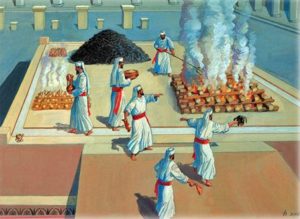
Offerings on the Altar (Courtesy: Temple Institute)

Offerings on the Altar (Courtesy: Temple Institute)

This week’s Torah reading is Acharei, focusing on the details of the priestly procedure performed on Yom Kippur in the Temple (or Tabernacle). God instructs Aaron to take two goats and one bull. One of the goats is to be sacrificed, while the other is to be sent to “Azazel” (the identity of which we have discussed in the past). Meanwhile, the bull is also to be sacrificed, and its blood sprinkled on the Holy Vessels within the innermost chamber of the Temple, the Holy of Holies. The third book of the Torah, Vayikra (Leviticus), often details such lengthy sacrificial procedures. To the modern reader, these passages tend to be quite difficult to read, with rituals that seem unnecessarily bloody and distasteful. Does God really want us to sacrifice animals? And when the Third Temple is rebuilt, will we once again be responsible for performing such rituals?

Back to the Garden of Eden

When God initially created the world, he placed man in a perfect environment where there was absolutely no death or bloodshed of any kind. Man was instructed only to consume fruits and plant matter. In fact, it wasn’t until the time of Noach that God reluctantly agreed to allow mankind to consume meat.

From a Kabbalistic perspective, this was done only for the purposes of tikkun, spiritual rectification (see Sha’ar HaMitzvot on parashat Ekev, and Sha’ar HaPesukim on Beresheet). The sinful souls of the flood generation were reincarnated into animals, and through their slaughter and consumption, those souls could be rectified and returned to the Heavenly domain. This is clearly hinted to in the phrasing of the Torah’s text: the animals that Noach took unto the Ark to be saved were initially described as zachar v’nekeva, “male and female” (Genesis 6:19). However, we are later told that some of the animals, particularly those to be slaughtered following the flood, were ish v’ishto, literally “man and woman”, or “husband and wife” (Genesis 7:2)!

We can deduce from this that sacrifices—and the consumption of meat in general—is a temporary phenomenon, for the purposes of tikkun, and not what God intended in His ideal conception of the world. Indeed, God often states in Scripture that He neither wants, nor requires, any sacrifices. He even states, perplexingly, that He never commanded them to begin with:

So said Hashem, Lord of Hosts, the God of Israel: “You add burnt offerings onto your sacrifices, and eat flesh, which I did not speak unto your forefathers, nor did I command them on the day that I took them out of Egypt, concerning burnt offerings and sacrifices. Rather, it is this that I commanded them: Listen to My voice, and I shall be for you a God, and you shall be for me a people, and you shall walk in all my ways that I shall command you, that it may be well for you.” (Jeremiah 7:21-23)

The Rambam explains that when taking the Israelites out of Egypt, God could not forbid them from offering sacrifices. This is because in that time period, offering sacrifices was the most common form of divine worship among the masses, and this is what the Israelites were familiar with. Thus, God allow the Israelites to bring sacrifices temporarily, as a means to slowly wean them off the practice:

The Israelites were commanded to devote themselves to His service… But the custom which was in those days general among all men, and the general mode of worship in which the Israelites were brought up, consisted in sacrificing animals in those temples which contained certain images, to bow down to those images, and to bum incense before them; religious and ascetic persons were in those days the persons that were devoted to the service in the temples erected to the stars, as has been explained by us. It was in accordance with the wisdom and plan of God, as displayed in the whole of Creation, that He did not command us to give up and to discontinue all these manners of service; for to obey such a commandment it would have been contrary to the nature of man, who generally cleaves to that which he is used to; it would in those days have made the same impression as a prophet would make at present if he called us to the service of God and told us in His name, that we should not pray to Him, not fast, not seek His help in time of trouble; that we should serve Him in thought, and not by any action. For this reason God allowed these kinds of service to continue; He transferred to His service that which had formerly served as a worship of created beings, and of things imaginary and unreal, and commanded us to serve Him in the same manner; namely, to build unto Him a temple; “And they shall make unto me a sanctuary” (Exodus 25:8); to have the altar erected to His name; “An altar of earth you shall make me” (Exodus 20:21); to offer the sacrifices to Him; “If any man of you bring an offering unto the Lord” (Leviticus 1:2), to bow down to Him and to bum incense before Him… By this Divine plan it was affected that the traces of idolatry were blotted out, and the truly great principle of our faith, the Existence and Unity of God, was firmly established. This result was thus obtained without deterring or confusing the minds of the people by the abolition of the service to which they were accustomed and which alone was familiar to them…

The Rambam goes on to elaborate on this point in more detail, and to thoroughly prove his argument, which is quite a fascinating read (Guide for the Perplexed, Part III, Ch. 32). He is clear on the fact that sacrifices were not God’s original intention, as we see in the Garden of Eden and through the words of the Prophet Jeremiah, but only a temporary necessity.

Sacrifices in the Third Temple?

Having said that, the Rambam does, somewhat paradoxically, write in his Mishneh Torah that sacrifices will resume in the Third Temple. It appears that the Rambam publicly went with the mainstream Orthodox approach but, in private, held that sacrifices will not be performed ever again. The Rambam writes that prayer is a far greater mode of worship than sacrifice, an idea that goes back to the prophet Hoshea, who declared “…we shall offer the cows with our lips.” (Hoshea 14:3)

More recently, Rabbi Avraham Itzchak Kook, the first Ashkenazi Chief Rabbi of Israel, similarly appeared to vacillate on the issue. In one place, he suggests that only grain offerings will be reinstated, and not animal offerings. (This is based on Malachi 3:4, which only mentions a restoration of grain offerings.) The Midrash suggests that only one type of offering will return, the voluntary Todah, or “thanksgiving” offering (see Vayikra Rabbah 9:7). Others propose that sacrifices will return for a short period of time only before being permanently abolished.

Ultimately, if God intended a perfect world with no death—as was His original plan for the Garden of Eden—and the future Redemption is essentially a global return to a state of Eden, then we certainly shouldn’t expect any more (animal) sacrifices in the future. It should be mentioned that the Sages teach that Adam did bring an animal sacrifice to God (Avodah Zarah 8a). However, this was not inside the Garden of Eden, but after he had already been banished, and due to his fear that the previously-decreed death sentence was upon him. Within Eden itself there could not be any death whatsoever. And so, if the world is set to return to an idyllic Eden-like state, there will certainly be no place for sacrifices.


The above is adapted from Garments of Light, Volume Two. Get the book here

What Are the Jewish People “Chosen” For?

This week’s very powerful Torah portion is Va’etchanan. In it, Moses continues his farewell speech to the nation before his death. Among other important points, he recaps the Ten Commandments, and proclaims the text of the Shema. Included in this speech are a number of significant prophecies and statements.

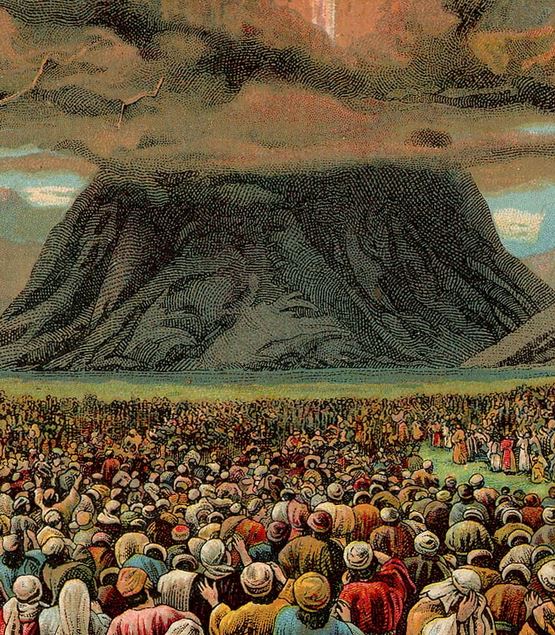
Moses reminds the people that what they witnessed at Mt. Sinai was a totally unique, once-in-history event, where God brought forth a divine revelation to the entire nation, with every single individual experiencing a prophetic vision. Moses tells us to always remember that this has never happened elsewhere in history (Deuteronomy 4:32-34). Although modern Biblical critics will immediately point out that there is no proof that such a national revelation ever took place, Moses tells us that no other people has ever even claimed such a thing! To this day, there is no nation or religion that claims to have started with a national revelation. Strangely, only the Jewish people make such a claim.

National Revelation at Sinai (Providence Lithograph Company, 1907)

A 1907 Illustration of the National Revelation at Sinai

(Although some point out that the Aztecs seem to have a similar story of their god guiding them through a Wilderness to their very own promised land in Mexico, most modern scholars agree that this myth is very recent, adopted from the Jewish story in the Torah. The Aztecs picked it up from Christian missionaries and made it their own.)

Another prophecy in this week’s portion is that the Jewish people will be scattered around the world, and will always remain small in number (4:27). Three thousand years later, the prophecy still holds true, with just 0.2% of the world’s population being Jewish. That’s quite amazing, as it defies normal growth patterns. There are roughly two billion Christians in the world, and their religion emerged over a thousand years after Judaism. The number of Muslims is also steadily nearing two billion, and they came around even later, roughly 1400 years ago. Hindus, Buddhists, Sikhs, and virtually all other major religions outnumber the Jews. Even the Bahai faith, which started just 160 years ago is quickly catching up, and will soon outnumber Judaism, too.

Moses suggests that it is precisely because we are small in number that God chose us (7:7). Perhaps this can be explained with simple economics of supply and demand. The more of something that there is, the less value it is perceived to have. (Note the word perceived; all human life is of course equal.) The sworn enemies of the Jews seem to agree: Hamas thought it was totally fair to demand 1000 Palestinians to be freed in exchange for one Jew – Gilad Shalit!

The big question is: why did God “choose” us?

The Chosen People

To understand why God chose the Jewish people, and what exactly we are chosen for, one must look back to the beginning of the whole story. Originally, there were no Jews and no Torah. There were only Adam and Eve, in a perfect world, living with God’s revealed presence. The problem of this “perfect” world was that Adam and Eve were essentially unable to truly enjoy it. Having never experienced anything “bad”, they had no concept of what is “good” either. Life was just bland.

In the middle of Eden, God placed the Tree of Knowledge of Good and Evil. By consuming of its fruit, Adam and Eve would be introduced to these new concepts. They would now have to experience hardship and confront evil, but measure for measure, they would now also be able to enjoy goodness and pleasure. After all, it is only because we have had negative experiences that we can truly understand, appreciate, and strive for the positive ones.

Adam and Eve had a choice. They chose the Tree of Knowledge. With that, their perfect world was over. However, this was only temporary. God’s intention was for mankind to live in a world of goodness, not one of suffering. Yet, in order to make the most of the Garden of Eden, mankind first had to experience evil, overcome it, and transcend it. Ever since Adam and Eve were banished from the Garden, their mission has been to remove evil from their midst, restore goodness, and finally return to that Garden.

Adam and Eve were unable to do this, and neither were their children, or grandchildren. As humans multiplied, they only become more and more sinful, pushing themselves further away from Godliness and goodness. After ten generations, God hit the “restart” button to try again with Noah. Noah ultimately failed as well, and once more each passing generation only fell further into immorality. It took another ten generations before things started to change.

Abraham’s Revolution

Abraham was the first person to properly recognize what the universe was all about. He understood that the current state of the world was wrong. Life was never meant to be this way. Abraham thus made it his life’s mission to repair the world. He travelled across the Middle East and spread monotheism, righteousness, and Godliness wherever he went. Abraham embodied all of the traits necessary to restore the world to a state of Eden. And so, it wasn’t so much that God chose Abraham, but rather, that Abraham chose God.

To complete the task of repairing the world would require more than just one man. This huge mission would require a nation. Thankfully, Abraham’s son Isaac continued in his father’s path, as did Jacob the grandson, and his own twelve sons. From these twelve sons an entire nation was born – a nation whose mission would be to restore the world to the Garden of Eden.

History shows that the Jewish people have indeed done so. The Jews’ moral contributions to the world have been vast, and described in books like Ken Spiro’s WorldPerfect – The Jewish Impact on Civilization and Thomas Cahill’s The Gifts of the Jews, among others. The Jews’ contributions to science, medicine, and technology may be even greater. Some of the most important minds behind breakthroughs like the personal computer and the internet, the cellphone and lasersvaccines and automobiles were Jews, as were some of the greatest figures in biology, chemistry, mathematics, and physics. It is also important not to forget the immeasurable spiritual contributions of the Jews to the world.

Of course, Jews are not perfect. The Torah itself attests to this many times, even in this week’s parasha that admonishes the nation on multiple occasions. At the end of the day, the name of our nation is Israel, which literally translates as “struggles with God.” Our history has been a difficult one, full of struggles and challenges. It is clear, though, that we are nearing the end of this period, and we will soon see the restoration of the Garden of Eden, as God originally intended.


The article above is adapted from Garments of Light – 70 Illuminating Essays on the Weekly Torah Portion and Holidays. Click here to get the book!

An Honest Look at Death and the Afterlife

This week we once again read a double Torah portion, combining the parashot of Behar and Bechukotai to complete the book of Leviticus. The main themes of these parashas are the Sabbatical and Jubilee years, as well as God’s rewards and punishments for those who follow His ways and those who do not.

One interesting thing that the reader will note is that there is no mention of any kind of afterlife. All of the rewards and punishments that are listed are described in wholly physical terms: ample rains and abundant harvests, military victories and secure borders, good food and the feeling of God’s presence – and the opposite of these if the people are sinful. Why is it that the Torah does not mention any kind of reward and punishment in the afterlife? After all, we are accustomed to hearing that this world is nothing but a transient “hallway”, so to speak, while the next world is the real deal, where people receive what they deserve.

More puzzling is the fact that the Torah essentially never mentions the afterlife in explicit fashion. Everything appears to happen in this physical world. Yet, there is certainly a discussion of souls, and many spiritual entities. So, what is the real Torah conception of the afterlife?

The Garden of Eden

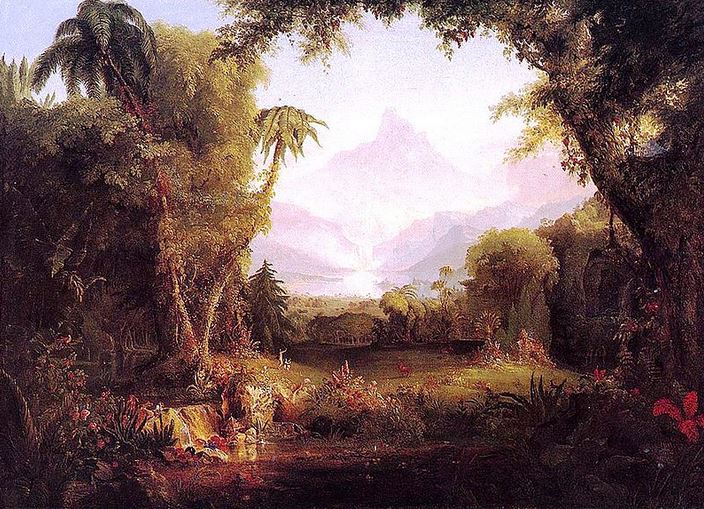
'Garden of Eden', by Thomas Cole

‘Garden of Eden’, by Thomas Cole

Typically, it is common to think that those who have passed away are now in the “Garden of Eden”, and this is indeed how Hebrew-speakers often refer to the dead, wishing them menucha (rest) in Gan Eden. But where exactly is this “Gan Eden”?

The Torah is quite clear on the fact that God created the Garden of Eden right here on Earth. The Genesis account describes God’s creation of the world, and all of its inhabitants, and concludes with the planting of a garden in Eden, where the first man and woman are placed. After their sin of consuming the fruit, Adam and Eve are banished from the Garden, and continue their lives elsewhere on Earth. There is no mention anywhere in the Torah of a spiritual Garden of Eden located somewhere in the Heavens!

Conversely, it is common for people to refer to an afterlife of damnation in a place called Gehinnom, typically translated as “hell”. Again, there is no explicit mention of a “hell” in Scripture. Gehinnom itself simply means “the Valley of Hinnom” (or the Valley of the Son of Hinnom, Gei Ben Hinnom) which is discussed in the Tanakh as a place right outside the Old City walls of Jerusalem. This is described as a place of sinners and idolaters, outcasts that were expelled from the Holy City. Once again, we see that the place usually thought of as hell is simply a physical place here on Earth.

As Above, So Below

By the times of the Talmudic period, the Jewish Sages had developed a unique cosmic worldview. They saw this material world as only a reflection of the spiritual world. What happened down here reflected, in some way, much greater cosmic events that were happening in the Heavens. Thus, just as there was a Jerusalem down here on Earth, there was a Jerusalem shel ma’alah, a “Jerusalem Above” (see, for example, Ta’anit 5a).

Similarly, just as there was a Garden of Eden – a place of utmost peace and pleasure – here on Earth, there must be a similar one above in the Heavens. And just as there was a Gehinnom – a deep valley of evil – here on Earth, there must be such a place in the Heavens, too.

It appears that the idea of righteous souls moving on to a Heavenly Gan Eden, or wicked souls to a Heavenly Gehinnom, came from this view on the nature of God’s universe.

The Big Afterlife Problem

However, this brings about a very large problem: both the Garden of Eden and Gehinnom are described in physical terms. But, after the body dies and decays, only the soul lives on, and how can the soul experience physical pleasures or pains? Additionally, the soul is described as pure and eternal. Why is it the soul that must suffer for the sins accrued by the body? And why should the soul suffer infinitely for a body that had only such a short, finite existence?

This problem was presented to Rabbi Yehuda haNasi by the Roman Emperor Antoninus nearly two millennia ago (Sanhedrin 91a-b).

Antoninus said to Rabbi: “The body and the soul can both free themselves from judgment. Thus, the body can plead: ‘The soul has sinned, since from the day it left me I lie like a dumb stone in the grave.’ While the soul can say: ‘The body has sinned, since from the day I departed from it I fly freely in the air like a bird.’”

He replied: “I will tell you a parable. To what may this be compared? To a human king who owned a beautiful orchard which contained splendid figs. Now, he appointed two watchmen, one lame and the other blind. [One day] the lame man said to the blind, ‘I see beautiful figs in the orchard. Come and take me upon your shoulders, that we may procure and eat them.’ So the lame strode the blind, procured and ate them. Some time after, the owner of the orchard came and inquired of them, ‘Where are those beautiful figs?’ The lame man replied, ‘Do I have feet to walk with?’ The blind man replied, ‘Do I have eyes to see with?’ What did he do? He placed the lame upon the blind and judged them together. So will the Holy One, blessed be He, bring the soul, place it in the body, and judge them together…”

Rabbi Yehuda replied with a wonderful parable, and concluded that God brings the body and soul together again, and only then judges the person, and bestows upon them their due rewards or punishments.

So, if the body and soul go back together again after death, then there is no “Garden of Eden” or “Gehinnom” in the sense that we might commonly think.

Gate of Reincarnations

The only way that the body and soul can go back together again is if, following death, the soul returns into bodily form. This is the definition of reincarnation. Roughly 500 years ago, the great kabbalist Rabbi Isaac Luria, better known as the Arizal, revealed many secrets of reincarnation, and these teachings were recorded by his primary disciple, Rabbi Chaim Vital, in a text called Sha’ar HaGilgulim (Gate of Reincarnations).

This text describes reincarnations in great detail, and affirms that those who have lived sinful lives are reincarnated into new lives that are very challenging, and in this way have to make reparations for the mistakes of their past. The righteous, too, are reincarnated, since no one goes through life without making some mistakes, and even the most minute of these errors must be repaired. However, such people will enjoy much better lives, and be given the opportunity to fix those minor details from their past.

Of course, proper repentance can nullify any trials that a person must bear due to a mishap from a past life. Thus, free will ultimately trumps everything else. And what happens to those who have completely fulfilled their missions? In that case, there is indeed a “Garden of Eden” of sorts.

(For more on reincarnation, click here to read ‘Everything You Wanted to Know About Reincarnation in Judaism’.)

Resurrection of the Dead

One form of afterlife that Scriptures do mention explicitly is the Resurrection of the Dead. It is taught that sometime after the coming of Mashiach, all of the righteous souls will miraculously come back to life. They will then enjoy the world as it was always meant to be: a Garden of Eden.

Ultimately, this is the role of Mashiach: to return the world to that perfect, primordial state. It is interesting to note how the figure responsible for driving mankind out of the Garden was the Serpent, Nachash (נחש) in Hebrew, a word which has a numerical value of 358; and the figure responsible for returning mankind to the Garden is Mashiach (משיח), a word which also has a gematria of 358 – measure for measure. Thus, the final step for each soul, once its mission is complete, is to be resurrected in the restored Garden of Eden, right here in a new Earth, following the arrival of Mashiach.

We can now understand why Bechukotai does not speak of any spiritual rewards or punishments in an afterlife. All of the rewards and punishments are right here in this world, where body and soul unite as one, as Rabbi Yehuda told Antoninus. We can now also see why no “Heaven” or “Hell” is ever explicitly mentioned in Scripture, and why we never even mention them in our prayers. The Amidah prayer recited thrice daily makes no reference to souls in some Heavenly realm, but does have a blessing for techiyat ha’metim, the Resurrection of the Dead in a future, perfected world.

May we merit to see it speedily and in our days.


The article above is adapted from Garments of Light – 70 Illuminating Essays on the Weekly Torah Portion and Holidays. Click here to get the book!