Tag Archives: History

The Year 5778: Apex of the Messianic Era

The stars of this week’s parasha, Vayeshev, are Joseph and Judah. We are told how the sons of Jacob were envious (and suspicious) of Joseph, and ended up throwing him in a pit while deliberating what to do with him. Shimon wished to kill him, Judah to sell him, and Reuben to save him. Meanwhile, Midianite merchants found the helpless Joseph and abducted him, later selling him to Ishmaelites who brought Joseph down to Egypt. There, Joseph enters into servitude in the home of a well-to-do Egyptian family.

The Torah diverges from this narrative to describe what happens to Judah. Judah marries and has three sons. The elder Er marries Tamar and dies because of his sinful ways, as does the second son Onan after fulfilling the law of levirate marriage and marrying his former sister-in-law. After Judah fearfully avoids another levirate marriage for Shelah, his last son, Tamar seduces Judah and becomes pregnant. She gives birth to twins, Peretz and Zerach.

Peretz would go on to be a forefather of King David, and thus a forefather of Mashiach. As is known, there are actually two messianic figures (or two aspects to Mashiach): Mashiach ben David, and Mashiach ben Yosef—one from the line of Judah and one from the line of Joseph. In fact, it is in this week’s parasha where the spiritual origins of the two messiahs begin.

Samson and the Messiahs

Mashiach ben Yosef is the first messiah. He is the warrior that battles evil in the “End of Days”. Unfortunately, he is destined to die in these battles. The Talmud (Sukkah 52a) states how the entire nation will mourn his tragic death. However, it will not be too long before Mashiach ben David arises. As the direct descendant of the royal line, he re-establishes the rightful throne and restores the holy Kingdom of Israel. The Third Temple is built thereafter, and according to some Mashiach ben David reigns for forty years, as did his progenitor King David (Sanhedrin 99a, Midrash Tehillim 15).

We have already discussed why Mashiach ben Yosef must die in the past (see ‘Secrets of the Akedah’ in Garments of Light). How he will die is not exactly clear. What will bring him to his death? It appears that Mashiach ben Yosef will be sold out by his own people. This is what happened to one of the earliest prototypes of Mashiach ben Yosef: the Biblical judge Shimshon (Samson).

As is well known, when Jacob blessed his children, he concluded the blessing to Dan with the words “I hope for Your salvation, Hashem” (Genesis 49:18) which Rashi says refers to Samson, a descendent of Dan. Samson was the potential messiah of his generation. He was a warrior fighting the oppressive Philistines. Yet, the people of Judah did not appreciate the “trouble” he was causing, and apprehended him (Judges 15:11-12):
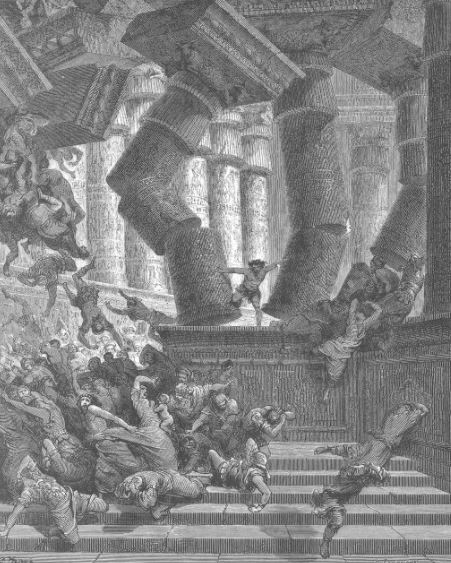
“Death of Samson”, by Gustav Doré

Then three thousand men of Judah went down to the cleft of the rock of Eitam, and said to Samson: “Do you not know that the Philistines are rulers over us? What then is this that you have done to us?” And he said to them: “As they did to me, so have I done to them.” And they said to him: “We have come to bind you, that we may deliver you into the hand of the Philistines.”

Samson turned himself in voluntarily, but with God’s help smote the Philistine oppressors and freed himself. He would be betrayed again by Delilah, but would manage to defeat the Philistines for good, though at the cost of his own life. Like Mashiach ben Yosef, Samson sacrifices himself.

The text above specifically states that three thousand men of Judah came for Samson. What is the significance of this numeric detail?

The Evil 3000

At the Exodus, the Torah states there was a “mixed multitude” (erev rav) of three thousand men among the Israelites. They, too, accepted the Torah at Mt. Sinai, only to instigate the Golden Calf incident forty days later. It is said that the same will happen at the End of Days, with an “erev rav” among the Jews who will instigate all sorts of problems for the nation from within (see, for example, Zohar I, 25 or Sha’ar HaGilgulim, ch. 39). Like Samson’s three thousand men of Judah, Mashiach ben Yosef is sold out by three thousand “Jewish” individuals.

And the fact that they are men of Judah is all the more significant. It was Judah in this week’s parasha who proposed selling Joseph. And to whom did he want to sell him?

And Judah said to his brothers: “What is the gain if we slay our brother and cover up his blood? Come, let us sell him to the Ishmaelites, but our hand shall not be upon him, for he is our brother, our flesh.” (Genesis 37:26-27)

Judah wanted to sell his brother to the Ishmaelites. In speaking of the battles of Mashiach ben Yosef and the End of Days, it is often the Ishmaelites (or the Ishmaelites banded together with Esau) that are implicated (see, for example, Pirkei d’Rabbi Eliezer, ch. 30). Today, of course, the modern “Philistines” are Ishmaelites, and among their biggest supporters are the descendants of Esau.

In The Era of Mashiach

This discussion is particularly timely in light of what’s currently happening in the Middle East. It seems the region is preparing for a massive war, one that would inevitably engulf the entire Ishmaelite sphere, if not the whole world. We’ve written before that we are undoubtedly in the “footsteps of the Messiah” and here is another intriguing point:

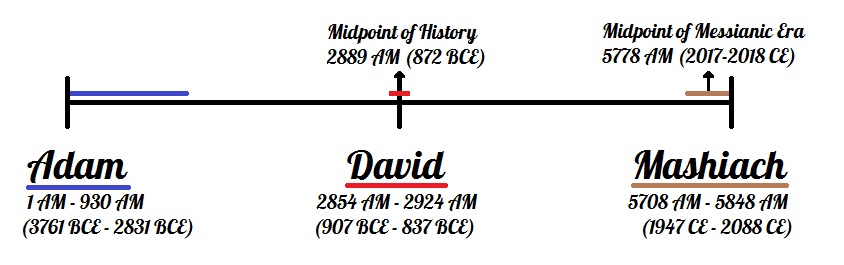
God originally intended for Adam to live 1000 years. Yet, we see in Genesis that Adam lived only 930 years. This is because, as is well known, Adam foresaw that David would be stillborn, and donated 70 years of his life to him. Indeed, David went on to live exactly 70 years. The Arizal saw in the name Adam (אדם) an acronym for three figures: Adam, David, Mashiach. These are the first, middle, and last major figures of human history. Based on this, Rabbi Yitzchak Ginsburgh teaches that David is supposed to be the literal midpoint of history. If that’s the case, then we only need to see when David lived to calculate the era of Mashiach.

The traditional lifetime for David is 2854-2924 AM (Anno Mundi, Hebrew calendar years, corresponding to about 907-837 BCE). To find the time period for the End of Days we must simply multiply David’s years by two. This gives 5708-5848, or 1947/1948-2087/2088 CE. That’s quite amazing, considering that Israel officially became a state in 5708 (the UN vote to create Israel took place in November 1947, and Israel declared independence in May 1948—both dates fall within the Jewish year 5708). And what would be the midpoint, or perhaps the apex, of the “End of Days” period? None other than 5778, the year which we are currently in.

Stay tuned.

The above essay is adapted from Garments of Light, Volume Three.
Get the book here! 
 

The Most Important Torah Reading

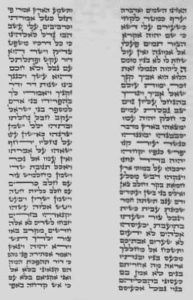
Two columns of parashat Ha’azinu in a Torah scroll

This Shabbat we will be reading Ha’azinu, a unique parasha written in two poetic columns. Ha’azinu is a song; the song that God instructed Moses to teach all of Israel: “And now, write for yourselves this song, and teach it to the Children of Israel. Place it into their mouths, in order that this song will be for Me as a witness for the children of Israel.” (Deut. 31:19) Of course, the entire Torah is a song, chanted with specific ta’amim, musical cantillations. In fact, the mitzvah for each Jew to write a Torah scroll of their own (one of the 613) is derived from the verse above, where God commands the Children of Israel to write this song for themselves. While the simple meaning is that God meant to write the song of Ha’azinu, our Sages interpreted it to refer to the entire Torah. (Since most people are unable to write an entire kosher Torah scroll by themselves, the mitzvah can be fulfilled by writing in a single letter, or by financially contributing to the production of a Torah scroll.)

Why is the song of Ha’azinu so special that God commanded Moses to ensure it will always remain in the mouths of Israel? A careful reading shows that Ha’azinu essentially incorporates all of the central themes of the Torah. We are first reminded that God is perfect, “and all His ways are just” (32:4). While it is common for people to become angry at God and wonder why He is seemingly making life so difficult for them, Ha’azinu reminds us that there is no injustice in God, and that all suffering is self-inflicted (32:5). The Talmud reminds us that hardships are issurim shel ahavah, “afflictions of love”, meant to inspire us to change, grow, repent, learn, and draw us closer to God. Isaac Newton said it well:

Trials are medicines which our gracious and wise Physician gives because we need them; and the proportions, the frequency, and weight of them, to what the case requires. Let us trust His skill and thank Him for the prescription.

History is the Greatest Proof

In the second aliyah, we are told to “remember the days of old and reflect upon the years of previous generations” (32:7). Is there any greater proof for God and the truth of the Torah than Jewish history? Despite all the hate, persecution, exile, and genocide, the Jewish people are still alive and well, prospering as much as ever.

Does it make sense that 0.2% of the world’s population wins over 20% of the world’s Nobel Prizes? (Out of 881 Nobels awarded thus far, 197 were awarded to Jews, who number just 14 million or so. Compare that to the 1.8 billion Muslims in the world—roughly 25% of the world’s population—who have a grand total of three Nobel Prizes in the sciences.) Does it make sense that a nation in exile for two millennia can return to its ancestral homeland, defeat five professional armies that invade it simultaneously (and outnumber it at least 10 to 1), and go on to establish a flourishing oasis in a barren desert in just a few short decades? Does it make sense that tiny Israel is a global military, scientific, democratic, and economic powerhouse? And yet, does it make any sense that the United Nations has passed more resolutions against Israel than all of the rest of the world combined?

There is no greater proof for God’s existence, for the truth of His Torah, and the distinctiveness of the Jewish people than history itself. It is said that King Louis XIV once asked the French polymath and Catholic theologian Blaise Pascal for proof of the supernatural, to which the latter simply replied: “the Jews”. Although Pascal—who was not a big fan of the Jews—probably meant it in a less than flattering way, he was totally correct.

The Consequences of Forgetting God

From the third aliyah onwards, Ha’azinu describes what the Jewish people have unfortunately experienced through the centuries: God gives tremendous blessings, which eventually leads to the Jews becoming “fat and rebellious”. They forget “the God who delivered” them (32:18). This is precisely when God hides His face (32:20), and just as the Jews provoked God with their foolishness and assimilation, God in turn “provokes [them] with a foolish nation”. God sends a wicked foreign nation to punish the Jews—whether Babylonians or Romans, Cossacks or Nazis—to remind the Jews who they are supposed to be: a righteous, Godly people; a light unto the nations. If the Jews will not be righteous and divine, God has no use for them.

Having said that, this does not exonerate those Cossacks and Nazis, for they, too, have been judged. They are a “foolish nation”, a “non-people”, who themselves merit destruction, and God “will avenge the blood of His servants” (32:43). The song ends with a promise: Israel will atone and fulfil its role, its enemies will be defeated, and God will restore His people to their land.

The Spiritual Power of Ha’azinu

The song of Ha’azinu beautifully summarizes the purpose and history of the Jewish people, and elegantly lays down the responsibilities, benefits, and consequences of being the nation tasked with God’s mission. Not surprisingly then, God wanted all of Israel to know Ha’azinu very well, and meditate upon this song at all times. This is why it was given in the format of a song, since songs are much easier to memorize and internalize then words alone. Music has the power to penetrate into the deepest cores of our souls.

In fact, the Zohar on this parasha writes that music is the central way to elevate spiritually, and can be used to attain Ruach HaKodesh, the prophetic Divine Spirit. Elsewhere, the Zohar goes so far as to say that Moses’ prophecy was unique in that all other prophets needed music to receive visions, while Moses alone could prophesy without the help of song!

Today, we have scientific evidence that music deeply affects the mind. It triggers the release of various neurotransmitters, and can rewire the brain. It has a profound impact on mood and wellbeing, and can be used to induce all sorts of mental and emotional states. Music is powerful.

And so, the Torah concludes with a song. After relaying Ha’azinu, the Torah says that “Moses finished speaking all of these words to Israel” (32:45). The lyrics were the last of the Torah’s instructions. Indeed, Ha’azinu is the last weekly Torah reading in the yearly cycle. (Although there is one more parasha, it is not read on its own Shabbat, but on the holiday of Simchat Torah, at which point we jump right ahead to Beresheet, the first parasha.)

So important is Ha’azinu that it is always read during the High Holiday period, usually on Shabbat Shuvah, the Sabbath of Repentance, or Return. So important is Ha’azinu that it is most often the first parasha read in the New Year. And so important is Ha’azinu that it was commonly believed the entire Torah is encoded within it. When our Sages derived the mitzvah of writing the Torah from the command of writing Ha’azinu, they literally meant that Ha’azinu encapsulates the whole Torah! The Ramban went so far as to teach that all of history, including the details of every individual, is somehow encrypted in Ha’azinu. This prompted one of the Ramban’s students, Rabbi Avner, to abandon Judaism and become an apostate. In a famous story, the Ramban later confronts Avner, and proves that Avner’s own name and fate is embedded in one of Ha’azinu’s verses.

In past generations, many people customarily memorized Ha’azinu. The Rambam (Hilkhot Tefillah 7:13) cites another custom to recite Ha’azinu every morning at the end of Shacharit, and the Talmud (Rosh Hashanah 31a) states that in those days it was read every Shabbat. This Shabbat, take the time to read Ha’azinu diligently, and see why it was always considered the most important Torah reading. Perhaps you will even find your own life encoded in its enigmatic verses.


The above essay is adapted from Garments of Light, Volume Three.
Get the book here! 
Did the Jews Build the Pyramids?

The second book of the Torah, Shemot, begins by recounting the Israelite bondage in Egypt, and the Exodus that followed. One often overlooked question is: when did all of this actually happen? The Torah itself never gives any years or specific dates for its events. The accepted Jewish tradition is that the Exodus took place in the Hebrew year 2448, which corresponds to roughly 1312 BCE. What might archaeology and the historical record reveal?

City of Ramses

The Torah tells us that one of the major cities that the Israelites built was Ramses (Exodus 1:11). The historical record shows that this city was, not surprisingly, built by the pharaoh Ramses II (the Great). However, his reign spanned 1279-1213 BCE, too late for the Jewish dating of the Exodus. Perhaps it was Ramses’ grandfather, Ramses I – the founder of Egypt’s famous 19th dynasty – that began building a new capital city to be named after him. Ramses I reigned 1292-1290 BCE; still too late to coincide with Jewish tradition.

The Torah never identifies the names of any pharaohs it mentions. It describes at least three different ones: the pharaoh that dealt with Abraham, and the one that appointed Joseph many decades later, as well as the “new pharaoh” that forgot about Joseph’s contributions (Exodus 1:8). The pharaoh at the time of the Exodus was likely a different pharaoh altogether, too. The description we have of Ramses II actually parallels the Torah’s Exodus pharaoh quite well.

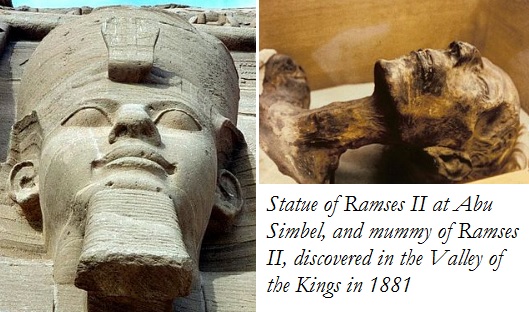
Ramses II was Egypt’s longest-reigning monarch (66 years!) and had over 100 children. He vastly expanded Egypt’s wealth, and stretched its territory and influence as far as the lands of Canaan and Syria. We see that he was a prolific builder, commissioning – among many other projects – a massive temple complex known as the Ramesseum, which still stood over 1000 years later when it marvelled the Greek historian Diodorus. His city of Ramses (or Pi-Ramses) was located in northeastern Egypt, in the land of Goshen, precisely where the Torah says the Israelites dwelled.

The Hyksos

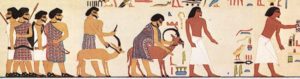
Images of Semites in Egypt, discovered in a Twelvth Dynasty tomb, dated to c. 1900 BCE

The historical record shows that a few centuries before Ramses, a mysterious Semitic tribe migrated to Egypt en masse and ended up taking over the kingdom. They were called heqa khaseshet, “foreign rulers”, which gave rise to the term “Hyksos”. Eventually, the Egyptians fought back and regained control from the foreigners. Most were expelled, many were killed, and it is likely that some were enslaved.

The ancient Jewish historian Josephus wrote that “Hyksos” comes from hekw shasu, “shepherd kings”. Of course, the Torah describes in detail how the Hebrews came down to Egypt and made sure everyone knew they were shepherds, a trade frowned upon in Egypt. Josephus cites historical sources suggesting that 480,000 Hyksos were ultimately expelled, and he concludes that these were the ancient Israelites!

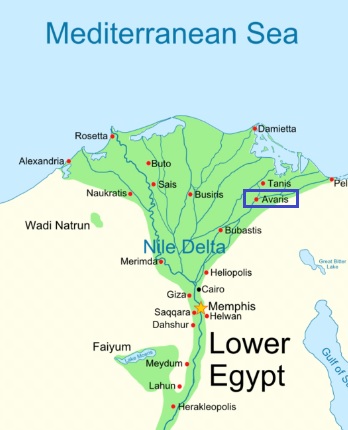
The city of Ramses was discovered 30 kilometres south of Tanis, which is right by Avaris!

It is interesting to point out that the Hyksos’s capital city was also in the northeastern region of Goshen. The city was named Avaris, or Hawara. These sound quite similar to the way the Egyptians refer to the Hebrews in the Torah: ivri.

Historians date the Hyksos period from 1638 to 1530 BCE, totalling just about 110 years. Amazingly, the Zohar (I, 212a-b) states that the Israelites ruled over Egypt for 110 years, then spent the remaining 290 years of their time in Egypt as slaves. This would mean that the Exodus happened 290 years after the end of the Hyksos period. Doing the math, 290 years after 1530 BCE takes us to 1240 BCE – right in the heart of the reign of Ramses II!

Solar Eclipse

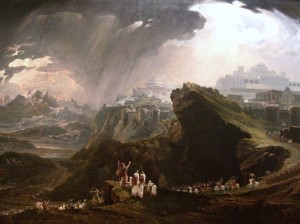
‘Joshua Commanding the Sun to Stand Still upon Gibeon’ by John Martin

All of the above suggests that the Exodus happened closer to the middle of the 13th century BCE. Recently, Israeli scientists discovered what may have been Joshua’s famous “stopping of the Sun” at the Battle of Gibeon (as described in the Book of Joshua, chapter 10). Interpreting this event as a solar eclipse, scientists at Ben Gurion University used NASA data to find any solar eclipses that may have been seen in the area between 1500 and 1000 BCE. They found exactly one, which took place on October 30, 1207 BCE.

This is incredible because the Battle of Gibeon would have happened roughly 40 years after the Exodus (since the Israelites spent 40 years in the Wilderness before Joshua led them to the Promised Land). If the Exodus took place around 1240 BCE, as we suggested above, then the dating of Joshua’s battle and the solar eclipse is right on target!

Reconciliation

The major issue now is that 1240 BCE seems to contradict the traditional Jewish dating of 1312 BCE. The truth is that Ancient Egyptian chronology is notoriously inaccurate. Scholars admit that discrepancies do exist, and are off by anywhere from 30 to 300 years. The discrepancy in our case is only about 70 years, well within the margins of errors.

Compared to the many foggy lists that scholars use to put together Egyptian chronology, the Torah’s chronology is fairly consistent and straight-forward. The years are added up based on peoples’ lifespans and the ages at which they had children, which are explicitly recorded. Historians might therefore want to take another look at Jewish chronology (as brought down in Seder Olam) if they wish to resolve some of their own conflicts.

And did the Jews build the pyramids? They may have built some pyramids (although by that time, pyramids had gone out of style). However, the famous Great Pyramid of Giza was completed by the middle of the third millennium BCE, long before any Israelites were on the scene.


The above article is adapted from Garments of Light: 70 Illuminating Essays on the Weekly Torah Portion and Holidays. Click here to get the book!