Tag Archives: Jeremiah

The Incredible History and Absurd Politics of Rachel’s Tomb

In this week’s parasha, Vayishlach, we read about Jacob’s return to the Holy Land after twenty years in Charan. After some time, Jacob and the family make a stop in Beit El, where Jacob first encountered God decades earlier. God appears to Jacob once more, and promises that “the land which I gave to Abraham and to Isaac, I will give to you and to your seed after you” (Genesis 35:12). God makes it clear that the Holy Land is designated solely for the descendants of Jacob—not the descendants of Esau, and not the descendants of Ishmael, or any other of Abraham’s concubine sons. It is the land of Israel, the new name that Jacob receives in this week’s parasha.

In fact, in this parasha we see mention of many Israelite sites, both ancient and modern, such as Hebron and Bethlehem. In our day, all of these are unfortunately within the political entity typically referred to as the “West Bank”. This title comes from the fact that the area is geographically on the west side of the Jordan River. Initially, the British Mandate for Palestine included both sides of the Jordan River, before the British gave the east to the Arabs to create the state of Jordan. This was the original “partition plan” for Palestine, with the eastern half meant to serve as the Arab state and the western half to become a Jewish one. Many have forgotten this important detail.
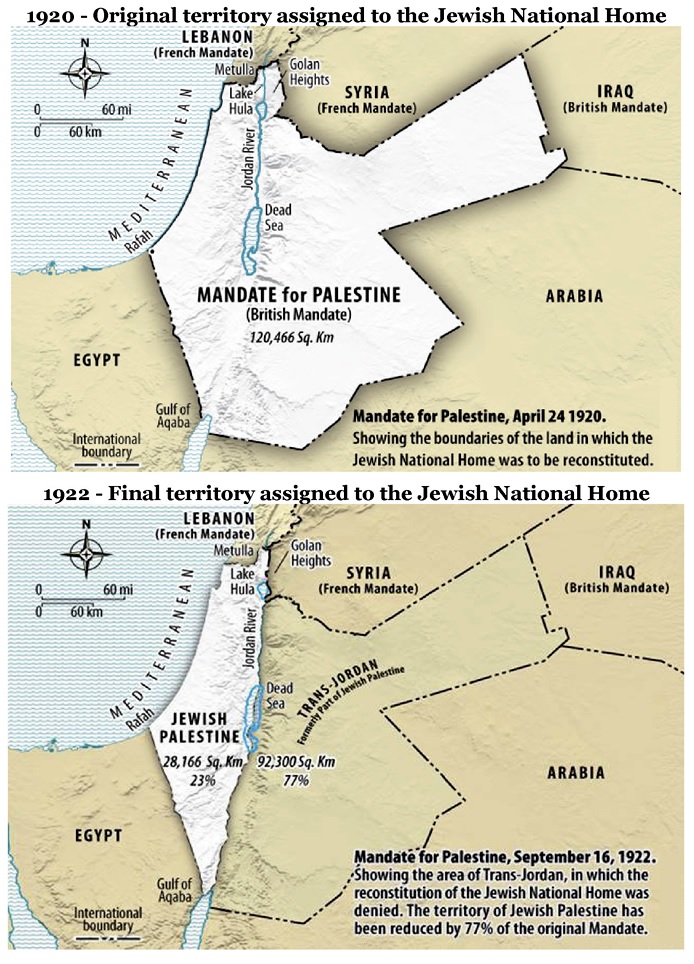
British Mandate for Palestine – Before and After (Credit: Eli E. Hertz)
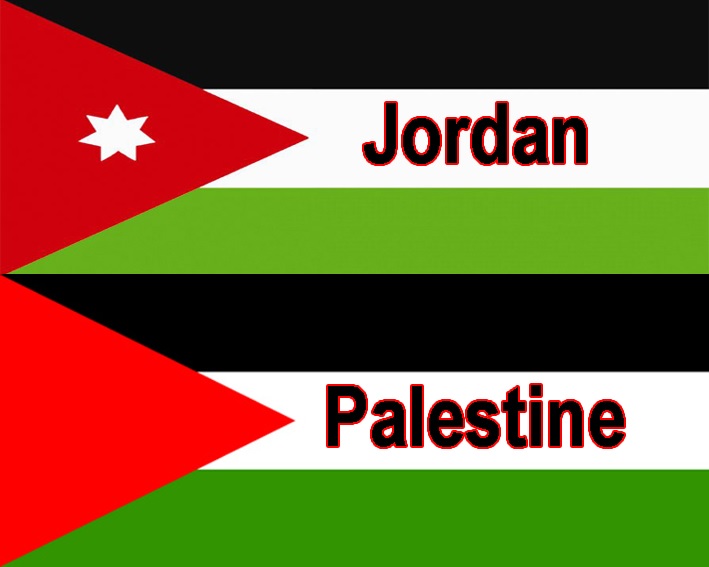
The current flags of the state of Jordan and the Palestinian movement. It is estimated that about half of Jordan’s current population of 9.5 million is Palestinian Arab.

Nonetheless, the unsuitable title of “West Bank” has stuck ever since. Some rightly avoid using the term in favour of the more appropriate “Judea and Samaria”. Truthfully, even this title is not entirely accurate, for the region is nothing less than the very heartland of Israel, the location of the vast majority of Biblical events, and the home of a plethora of Jewish holy sites. Among them is the tomb of Rachel, as we read in this week’s parasha (Genesis 35:16-20):

And they journeyed from Beit El, and there was still some distance to come to Ephrath, and Rachel gave birth, and her labor was difficult… So Rachel died, and she was buried on the road to Ephrath, which is Bethlehem. And Jacob erected a monument on her grave; that is the tombstone of Rachel until this day.

Throughout history, Rachel’s tomb was one of the most venerated sites in Judaism, and is often described as the Jewish people’s third-most holiest site (after the Temple Mount/Western Wall and Cave of the Patriarchs). As early as the 4th century CE the historian Eusebius already wrote of Rachel’s tomb being a holy site for Jews and Christians. Keep in mind that this is two centuries before anyone even whispered Islam. Not that it really matters, since Islam does not consider this a particularly special place. The Arab-Muslim historian and geographer of the 10th century, Al-Muqaddasi, doesn’t even mention Rachel’s tomb in his descriptions of Muslim-controlled Israel and its holy sites.
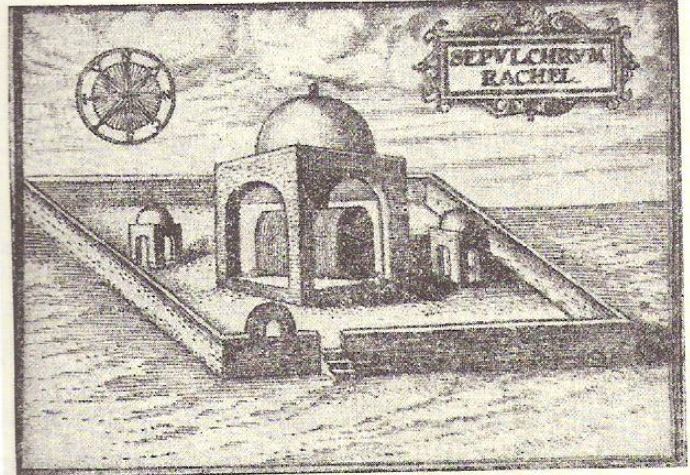
1585 Illustration of Rachel’s Tomb

Meanwhile, the Jewish traveler and historian Benjamin of Tudela (1130-1173) describes Rachel’s tomb in detail as being a domed structure resting upon four pillars, with Jewish pilgrims regularly visiting and inscribing their names on the surrounding eleven stones (representing the Tribes of Israel, less the tribe of Benjamin, as Rachel died giving birth to him). The earliest Muslim connection to the tomb is in 1421, when Zosimos mentions a small mosque at the site. (“Zosimos the Bearded” was a Russian Orthodox deacon famous for proposing the Moscow-Third Rome principle—which may be of great significance for calculating the time of Mashiach’s coming, as we’ve written in the past.)

The Ottomans originally transferred ownership of the site to the Jewish community (in 1615) but later reneged on the promise and even built walls to prevent Jews from going there, according to the British priest and anthropologist Richard Pococke (1704-1765). Pococke writes that the Ottomans used the area as a cemetery. Nonetheless, Jews could not be kept away from their millennia-old holy site, and continue to make pilgrimages. Christian writers G. Fleming and W.F. Geddes note in their 1824 report that “the inner wall of the building and the sides of the tomb are covered with Hebrew names, inscribed by Jews.”
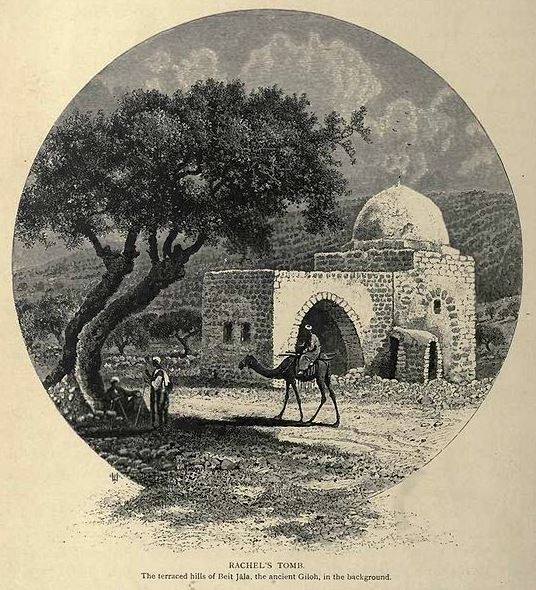
1880 Illustration of Rachel’s Tomb

Six years later, the Ottomans officially recognized Rachel’s tomb as a Jewish holy site again, and ten years later the site was purchased by famous Sephardic Jewish financier and philanthropist Moses Montefiore. Montefiore rebuilt the crumbling tomb, and even constructed a small adjacent mosque to appease the local Muslims. Around this time, British writer Elizabeth Anne Finn, who lived in Jerusalem while her husband was the consul there, wrote that Jerusalem’s Sephardic Jews never left the Old City unless to pray at Rachel’s tomb. Similarly, the Missionary Society of Saint Paul the Apostle wrote in 1868 that Rachel’s tomb

has always been held in respect by the Jews and Christians, and even now the former go there every Thursday, to pray and read the old, old history of this mother of their race. When leaving Bethlehem for the fourth and last time, after we had passed the tomb of Rachel, on our way to Jerusalem, Father Luigi and I met a hundred or more Jews on their weekly visit to the venerated spot.

Later, Jewish businessman Nathan Straus (of Macy’s fame) purchased even more land around the site that Montefiore had purchased. (Interestingly, Montefiore’s own tomb in England is a replica of Rachel’s tomb.)

Under the British Mandate, Jewish groups applied on multiple occasions for permission to repair the site, but were denied because of Muslim opposition. The Muslims themselves didn’t bother repairing it, of course. Conversely, many of them were (and still are) happy to attack the site whenever an opportunity presents itself:

Throughout the 1800s, the local e-Ta’amreh Arab clan had blackmailed the Jews to pay up 30 pounds a year or else they would destroy the tomb. In 1995, Arabs—led by a Palestinian Authority governor—attacked Rachel’s tomb and tried to burn it down. In 2000, they laid a 41-day siege on the site during the Second Intifada. In light of this, it made total sense when UNESCO declared in 2015 that Rachel’s tomb is a Muslim holy site that is “an integral part of Palestine”. The laughable resolution only confirms the senselessness and irrelevance of the United Nations.

Had they bothered to look at the historical record, they would have seen that Rachel’s tomb is, was, and always will be a Jewish holy site of immeasurable significance. Countless Jewish pilgrims have experienced miracles there, particularly for health and fertility. According to tradition, Rachel is the only matriarch to be buried outside of the Cave of the Patriarchs so that her spirit can weep and pray for her children in exile. Her prayers are successful, for we are in the midst of the exile’s final end, as prophesied by Jeremiah (31:14-16):

Thus said Hashem: “A voice is heard in Ramah, in lamentation and bitter weeping.” It is Rachel, weeping for her children. She refuses to be comforted for her children, because they are not. Thus said Hashem: “Refrain your voice from weeping, and your eyes from tears, for your work shall be rewarded,” said Hashem. “And they shall return from enemy lands. And there is hope for your future,” said Hashem. “And the children shall return to their borders…”


The above essay is adapted from Garments of Light, Volume Three.
Get the book here! 
Should Jews Believe in Astrology?

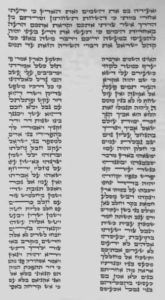
This week’s parasha, the second last of the Torah, is Ha’azinu. This parasha is unique in that it consists almost entirely of one lengthy song – clearly visible when looking at a Torah scroll, where the text of Ha’azinu is split into two narrow columns. Moses sang this prophetic song to the nation right before his passing.

Two columns of parashat Ha'azinu

Two columns of parashat Ha’azinu

In the verses that introduce it (Deut. 31:19), we see God commanding Moses to write the song and “teach it to the Children of Israel. Place it in their mouths so that this song will be for Me a witness for the Children of Israel.” God wanted Moses to diligently teach this song to the entire nation. In fact, the actual wording of the verse has God commanding everyone – each member of the nation – to write the song for themselves. It is based on this verse that the Sages drew the mitzvah of writing a Torah scroll (or participating in writing one), even though the plain text of the verse states only to write this particular song, Ha’azinu.

Perhaps because of this, the Ramban taught that Ha’azinu contains the entire Torah within it. Moreover, he believed that every detail of every person’s life is somehow encoded within this song! In one famous story, when a student of the Ramban, a man named Avner, heard this teaching, he was so baffled by it that he left Judaism entirely, converted to another religion, and became a prominent anti-Semite. When Avner later confronted the Ramban, the Rabbi showed him how one verse in the song did indeed accurately point to this man’s life. Avner was so ashamed that he disappeared, never to be heard from again.

Heavenly Princes

And so, each and every one of the song’s 43 verses has a great deal to teach us. The eighth verse begins by telling us that God gave each nation their lot, and the ninth verse says that “Hashem’s portion is His people, the lot of His inheritance.” The Zohar comments on these words that while God established Heavenly “princes” to watch over every nation in the world, Israel is watched over by God Himself. The Ramban (in his Discourse on Rosh Hashanah) elaborates:

He gave each and every nation… some known star or constellation, as is known by means of the science of astrology… Higher above [the constellations] are the angels of the Supreme One, whom He appointed as “princes” over them… It is further written, “So shall you be My people, and I will be your God, and you will not be subject to other powers at all.” (Jeremiah 11:4)

When we often say that Hashem is our God (as we do in the daily Shema), or when the Tanakh writes that we are God’s people, this does not mean that gentiles cannot have a relationship with God, or that there are other gods out there for the non-Jewish world. Rather, it means that while God oversees absolutely everything in His universe, and has created all people, He has also appointed various Heavenly (or astrological) forces above each nation – except Israel. These forces are not independent in their own right, as they are subject to the angels above them, and these angels ultimately serve God. As such, the nations of the world have various Heavenly intermediaries between themselves and Hashem. Israel, however, has a direct connection to Him. In fact, this is the hidden meaning within the name “Israel” (ישראל), which can be read as yashar El. (ישר-אל), “straight to God”.

Ain Mazal L’Israel

Long before the Ramban, the Sages of the Talmud debated whether the constellations had an effect on people (Shabbat 156a). The consensus of the Rabbis was that constellations do impact people, but Jews are free from this influence. They learn this from the prophet Jeremiah, who prophesied: “Thus said Hashem: Learn not the way of the nations, and be not dismayed at the signs of heaven, for the nations are dismayed at them.” (10:2) God tells Israel not to draw meaning from heavenly signs as the other nations do. The Talmud goes on to tell us a story about Abraham, who cried out to God: “Master of the Universe! I have looked at the constellations and find that I am not fated to have children.” To this, God replied: “Stop your star-gazing! Israel has no constellations.”

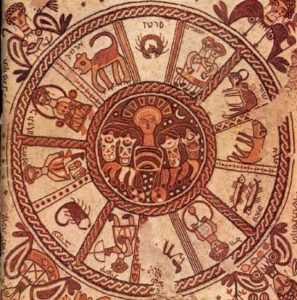
Hebrew Zodiac from a 6th Century Synagogue

Hebrew Zodiac from a 6th-Century Synagogue

Elsewhere, the Talmud tells us that Abraham was once a powerful astrologer, and great men from around the world came to consult with him about their fortunes (Bava Batra 16b). When Abraham looked into his own fate, he saw that he would not have children. God commanded him to desist from astrology, for the Jewish people have the power to transcend the stars. Of course, Abraham went on to have many children.

Later on, Moses would record in the Torah the prohibition for Jews to consult various fortune-tellers and astrologers. The Rambam codifies the law in this way:

It is forbidden to tell fortunes. [This applies] even though one does not perform a deed, but merely relates the falsehoods which the fools consider to be words of truth and wisdom. Anyone who performs a deed because of an astrological calculation or arranges his work or his journeys to fit a time that was suggested by the astrologers is [liable for] lashes, as [Leviticus 19:26] states: “Do not tell fortunes.”
(Sefer HaMadda, Hilchot Avodah Zarah, Chapter 11, Halacha 9)

Transcending Nature

We see from the above that various Heavenly forces, angels, and constellations do exist, and certainly do influence the world. Astrological signs can be potent forces. Ironically, earlier in his discourse, the Ramban points out how astrology is intricately tied into the Jewish calendar: it is no coincidence that Pesach is celebrated in the month of Nisan, the sign of which is Aries (the ram, or sheep), since the main mitzvah of Pesach was to sacrifice a lamb; and it is no coincidence that Rosh Hashanah – judgement day, when each person is put on trial – is in the month of Tishrei, the sign of which is Libra, the scales of justice. The Midrash (Yalkut Shimoni, Shemot 418) even tells us how each of the 12 Tribes of Israel corresponds to one of the 12 astrological signs of the zodiac!

And yet, all the sources are clear: Jews are not to dabble in astrology, for we have no need for intermediaries, and we have all the power to break free from the influence of the constellations. It is precisely when we believe in astrology that it becomes real, just as Abraham had no children as long as he believed in the heavenly signs that he saw. Every Jew must realize that we are Israel, yashar El, and that Hashem alone is our astrological sign. There is no need to believe in what the Rambam calls “emptiness and vanity”. The Rambam ends his laws on this subject by telling us to live up to the Torah’s call (Deut. 18:13) to be of “perfect faith with Hashem, your God.” When one has perfect faith in the Master of the Universe, anything is possible, and this is how God finished his rebuke to Abraham:

“Stop your star-gazing! Ain mazal l’Israel. What is your calculation? Is it because Jupiter stands in the West? Then I will turn it back and place it in the East!”


The article above is an excerpt from Garments of Light: 70 Illuminating Essays on the Weekly Torah Portion and Holidays. Click here to get the book! 

Will There Be Sacrifices in the Third Temple?

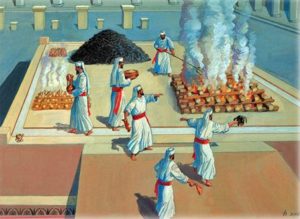
Offerings on the Altar (Courtesy: Temple Institute)

Offerings on the Altar (Courtesy: Temple Institute)

This week’s Torah reading is Acharei, focusing on the details of the priestly procedure performed on Yom Kippur in the Temple (or Tabernacle). God instructs Aaron to take two goats and one bull. One of the goats is to be sacrificed, while the other is to be sent to “Azazel” (the identity of which we have discussed in the past). Meanwhile, the bull is also to be sacrificed, and its blood sprinkled on the Holy Vessels within the innermost chamber of the Temple, the Holy of Holies. The third book of the Torah, Vayikra (Leviticus), often details such lengthy sacrificial procedures. To the modern reader, these passages tend to be quite difficult to read, with rituals that seem unnecessarily bloody and distasteful. Does God really want us to sacrifice animals? And when the Third Temple is rebuilt, will we once again be responsible for performing such rituals?

Back to the Garden of Eden

When God initially created the world, he placed man in a perfect environment where there was absolutely no death or bloodshed of any kind. Man was instructed only to consume fruits and plant matter. In fact, it wasn’t until the time of Noach that God reluctantly agreed to allow mankind to consume meat.

From a Kabbalistic perspective, this was done only for the purposes of tikkun, spiritual rectification (see Sha’ar HaMitzvot on parashat Ekev, and Sha’ar HaPesukim on Beresheet). The sinful souls of the flood generation were reincarnated into animals, and through their slaughter and consumption, those souls could be rectified and returned to the Heavenly domain. This is clearly hinted to in the phrasing of the Torah’s text: the animals that Noach took unto the Ark to be saved were initially described as zachar v’nekeva, “male and female” (Genesis 6:19). However, we are later told that some of the animals, particularly those to be slaughtered following the flood, were ish v’ishto, literally “man and woman”, or “husband and wife” (Genesis 7:2)!

We can deduce from this that sacrifices—and the consumption of meat in general—is a temporary phenomenon, for the purposes of tikkun, and not what God intended in His ideal conception of the world. Indeed, God often states in Scripture that He neither wants, nor requires, any sacrifices. He even states, perplexingly, that He never commanded them to begin with:

So said Hashem, Lord of Hosts, the God of Israel: “You add burnt offerings onto your sacrifices, and eat flesh, which I did not speak unto your forefathers, nor did I command them on the day that I took them out of Egypt, concerning burnt offerings and sacrifices. Rather, it is this that I commanded them: Listen to My voice, and I shall be for you a God, and you shall be for me a people, and you shall walk in all my ways that I shall command you, that it may be well for you.” (Jeremiah 7:21-23)

The Rambam explains that when taking the Israelites out of Egypt, God could not forbid them from offering sacrifices. This is because in that time period, offering sacrifices was the most common form of divine worship among the masses, and this is what the Israelites were familiar with. Thus, God allow the Israelites to bring sacrifices temporarily, as a means to slowly wean them off the practice:

The Israelites were commanded to devote themselves to His service… But the custom which was in those days general among all men, and the general mode of worship in which the Israelites were brought up, consisted in sacrificing animals in those temples which contained certain images, to bow down to those images, and to bum incense before them; religious and ascetic persons were in those days the persons that were devoted to the service in the temples erected to the stars, as has been explained by us. It was in accordance with the wisdom and plan of God, as displayed in the whole of Creation, that He did not command us to give up and to discontinue all these manners of service; for to obey such a commandment it would have been contrary to the nature of man, who generally cleaves to that which he is used to; it would in those days have made the same impression as a prophet would make at present if he called us to the service of God and told us in His name, that we should not pray to Him, not fast, not seek His help in time of trouble; that we should serve Him in thought, and not by any action. For this reason God allowed these kinds of service to continue; He transferred to His service that which had formerly served as a worship of created beings, and of things imaginary and unreal, and commanded us to serve Him in the same manner; namely, to build unto Him a temple; “And they shall make unto me a sanctuary” (Exodus 25:8); to have the altar erected to His name; “An altar of earth you shall make me” (Exodus 20:21); to offer the sacrifices to Him; “If any man of you bring an offering unto the Lord” (Leviticus 1:2), to bow down to Him and to bum incense before Him… By this Divine plan it was affected that the traces of idolatry were blotted out, and the truly great principle of our faith, the Existence and Unity of God, was firmly established. This result was thus obtained without deterring or confusing the minds of the people by the abolition of the service to which they were accustomed and which alone was familiar to them…

The Rambam goes on to elaborate on this point in more detail, and to thoroughly prove his argument, which is quite a fascinating read (Guide for the Perplexed, Part III, Ch. 32). He is clear on the fact that sacrifices were not God’s original intention, as we see in the Garden of Eden and through the words of the Prophet Jeremiah, but only a temporary necessity.

Sacrifices in the Third Temple?

Having said that, the Rambam does, somewhat paradoxically, write in his Mishneh Torah that sacrifices will resume in the Third Temple. It appears that the Rambam publicly went with the mainstream Orthodox approach but, in private, held that sacrifices will not be performed ever again. The Rambam writes that prayer is a far greater mode of worship than sacrifice, an idea that goes back to the prophet Hoshea, who declared “…we shall offer the cows with our lips.” (Hoshea 14:3)

More recently, Rabbi Avraham Itzchak Kook, the first Ashkenazi Chief Rabbi of Israel, similarly appeared to vacillate on the issue. In one place, he suggests that only grain offerings will be reinstated, and not animal offerings. (This is based on Malachi 3:4, which only mentions a restoration of grain offerings.) The Midrash suggests that only one type of offering will return, the voluntary Todah, or “thanksgiving” offering (see Vayikra Rabbah 9:7). Others propose that sacrifices will return for a short period of time only before being permanently abolished.

Ultimately, if God intended a perfect world with no death—as was His original plan for the Garden of Eden—and the future Redemption is essentially a global return to a state of Eden, then we certainly shouldn’t expect any more (animal) sacrifices in the future. It should be mentioned that the Sages teach that Adam did bring an animal sacrifice to God (Avodah Zarah 8a). However, this was not inside the Garden of Eden, but after he had already been banished, and due to his fear that the previously-decreed death sentence was upon him. Within Eden itself there could not be any death whatsoever. And so, if the world is set to return to an idyllic Eden-like state, there will certainly be no place for sacrifices.


The above is adapted from Garments of Light, Volume Two. Get the book here