
What is the true meaning of the name “Jerusalem”? How is it different from “Zion”? Why is Jerusalem also called Ariel, “Lion of God”? How will the Third Temple be built, and what will happen to the Dome of the Rock? Find out in this class where we also explore the past lives of King David, some of the most profound mysteries of Creation, and the fulfilment of numerous ancient prophecies, including the incredible prophecy of the Six-Day War.
Tag Archives: Jerusalem Temple
Physical Blemishes & Spiritual Heights
In this week’s parasha, Emor, we read:
Speak to Aaron and say: No man of your offspring throughout the ages who has a defect shall be qualified to offer the food of his God. No one at all who has a defect shall be qualified: no man who is blind, or lame, or has a limb too short or too long; no man who has a broken leg or a broken arm; or who is a hunchback, or a dwarf, or who has a growth in his eye, or who has a boil-scar, or scurvy, or crushed testes. No man among the offspring of Aaron the priest who has a defect shall be qualified to offer to God by fire; having a defect, he shall not be qualified to offer the food of his God. (Leviticus 21:17-21)
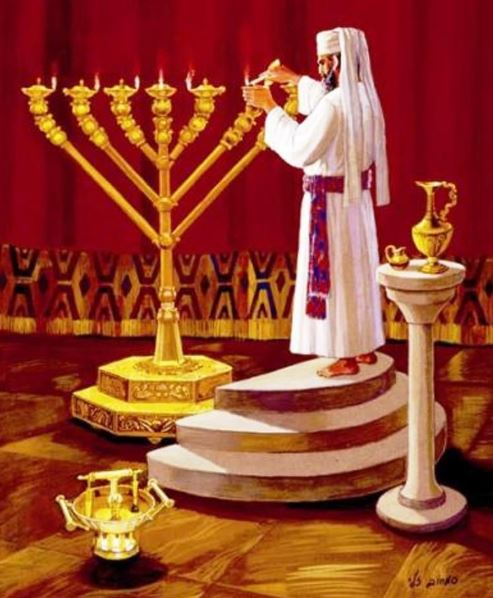
Kohen Lighting Temple Menorah (Courtesy: Temple Institute)
The Torah seems to be saying that any kohen with a physical disability or serious blemish is disqualified from serving God. Some are understandably distraught by this—after all, is it a person’s fault that they were born lame, or with dwarfism, or have a cancerous growth, or suffered a serious injury resulting in a disability? Why should this disqualify a person from serving God? Are they somehow “less” because of a disability? Why the apparent discrimination?
This position appears to be exacerbated by a Talmudic teaching that “the Shekhinah only rests upon a person who is wise, strong, wealthy, and of great statute.” (Shabbat 92a) A similar teaching elsewhere is that “the Holy One, Blessed be He, rests His Shekhinah only upon one who is strong, and wealthy, and wise, and humble.” (Nedarim 38a) So, does that mean that if one is not physically strong or healthy, they cannot merit to have the Shekhinah dwell upon them? How do we make sense of these perplexing statements? Continue reading
Understanding the Second Temple Era (Video)
I was recently a guest on Ari Lieberman’s Sparks of History podcast, and we discussed the “classical era” of Jewish history, including the Second Temple, Cyrus the Great, the last prophets of Israel; the Samaritans, Pharisees, Sadducees, and Essenes; Herod and the Hasmoneans, as well as Second Temple era messianism and what it means for us today.