
This week’s parasha, Tetzave, continues in describing the design of the objects used in the Mishkan, the Holy Tabernacle. The focus turns to the vestments of the kohen gadol. We see again that the most notable fibres used in sewing these clothes were tekhelet, argaman, and tola’at shani—blue, purple, and red wool. Our Sages taught (Menachot 43b) that tekhelet is sea-blue, and the sea reflects the sky, which is symbolic of God’s Throne, as per Exodus 24:10, where the nation saw that “there was under His feet the likeness of sapphire stone, and the likeness of clear skies…” (Similarly, Isaiah 66:1 has God declaring that “the skies are My throne, and the Earth is My footstool…”)
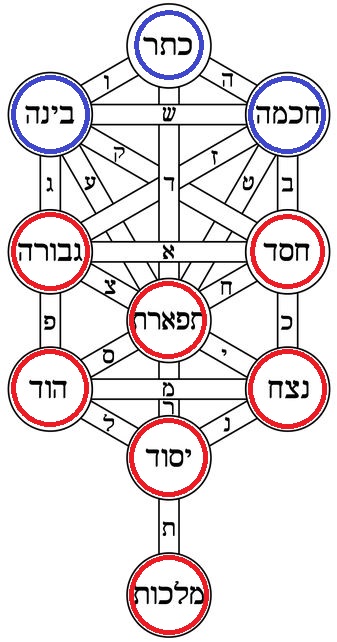
Among other things, blue is associated with water, which is in turn associated with life. In Kabbalah, blue is one of the colours of Chessed, lovingkindness. Red is its polar opposite, the colour of blood and fire, representing Gevurah, judgement and severity. Combining red and blue gives purple, the balance between them, Tiferet, seat of truth and beauty. On a mystical level, the purple argaman (ארגמן) also represents the chief angels Uriel (אוריאל), Raphael (רפאל), Gabriel (גבריאל), Michael (מיכאל), and Nuriel (נוריאל).
At first glance, the colours of the three key Sefirot of Chessed, Gevurah, and Tiferet appear to be blue, red, and purple, respectively. However, this is not always the case. In varying sources, the colours of the Sefirot are presented differently. While it is undoubtedly true that in Judaism multiple opinions can be correct simultaneously, can we nonetheless put together a definitive colour spectrum for the Sefirot? Today, we have a great deal of scientific knowledge of light and colour that can greatly assist us in this endeavour. So, which colours correspond to the Sefirot? Continue reading
 There are actually two mitzvahs here: not taking the mother together with her children (a negative mitzvah), and sending away the mother bird before taking the children (a positive mitzvah). The Torah does not explain the rationale here, but for most of history the message seemed quite obvious: don’t be cruel! It was so obvious that the Mishnah (Berakhot 5:3) states we should stop people from requesting in their prayers that since God has mercy on birds, He should also have mercy on us. The Rambam (Rabbi Moshe ben Maimon, 1138-1204) comments here that the reason one shouldn’t pray this way is because it is seemingly giving a reason for the mitzvah, yet we do not know the true reason for the mitzvah, except that it is God’s Will. Moreover, the Rambam points out that if it is a matter of mercy, then God should have commanded us not to slaughter or eat any animals at all!