Tag Archives: Moses

Should Jews Believe in Astrology?

This week’s parasha, the second last of the Torah, is Ha’azinu. This parasha is unique in that it consists almost entirely of one lengthy song – clearly visible when looking at a Torah scroll, where the text of Ha’azinu is split into two narrow columns. Moses sang this prophetic song to the nation right before his passing.
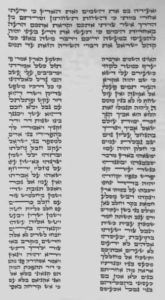
Two columns of parashat Ha'azinu

Two columns of parashat Ha’azinu

In the verses that introduce it (Deut. 31:19), we see God commanding Moses to write the song and “teach it to the Children of Israel. Place it in their mouths so that this song will be for Me a witness for the Children of Israel.” God wanted Moses to diligently teach this song to the entire nation. In fact, the actual wording of the verse has God commanding everyone – each member of the nation – to write the song for themselves. It is based on this verse that the Sages drew the mitzvah of writing a Torah scroll (or participating in writing one), even though the plain text of the verse states only to write this particular song, Ha’azinu.

Perhaps because of this, the Ramban taught that Ha’azinu contains the entire Torah within it. Moreover, he believed that every detail of every person’s life is somehow encoded within this song! In one famous story, when a student of the Ramban, a man named Avner, heard this teaching, he was so baffled by it that he left Judaism entirely, converted to another religion, and became a prominent anti-Semite. When Avner later confronted the Ramban, the Rabbi showed him how one verse in the song did indeed accurately point to this man’s life. Avner was so ashamed that he disappeared, never to be heard from again.

Heavenly Princes

And so, each and every one of the song’s 43 verses has a great deal to teach us. The eighth verse begins by telling us that God gave each nation their lot, and the ninth verse says that “Hashem’s portion is His people, the lot of His inheritance.” The Zohar comments on these words that while God established Heavenly “princes” to watch over every nation in the world, Israel is watched over by God Himself. The Ramban (in his Discourse on Rosh Hashanah) elaborates:

He gave each and every nation… some known star or constellation, as is known by means of the science of astrology… Higher above [the constellations] are the angels of the Supreme One, whom He appointed as “princes” over them… It is further written, “So shall you be My people, and I will be your God, and you will not be subject to other powers at all.” (Jeremiah 11:4)

When we often say that Hashem is our God (as we do in the daily Shema), or when the Tanakh writes that we are God’s people, this does not mean that gentiles cannot have a relationship with God, or that there are other gods out there for the non-Jewish world. Rather, it means that while God oversees absolutely everything in His universe, and has created all people, He has also appointed various Heavenly (or astrological) forces above each nation – except Israel. These forces are not independent in their own right, as they are subject to the angels above them, and these angels ultimately serve God. As such, the nations of the world have various Heavenly intermediaries between themselves and Hashem. Israel, however, has a direct connection to Him. In fact, this is the hidden meaning within the name “Israel” (ישראל), which can be read as yashar El. (ישר-אל), “straight to God”.

Ain Mazal L’Israel

Long before the Ramban, the Sages of the Talmud debated whether the constellations had an effect on people (Shabbat 156a). The consensus of the Rabbis was that constellations do impact people, but Jews are free from this influence. They learn this from the prophet Jeremiah, who prophesied: “Thus said Hashem: Learn not the way of the nations, and be not dismayed at the signs of heaven, for the nations are dismayed at them.” (10:2) God tells Israel not to draw meaning from heavenly signs as the other nations do. The Talmud goes on to tell us a story about Abraham, who cried out to God: “Master of the Universe! I have looked at the constellations and find that I am not fated to have children.” To this, God replied: “Stop your star-gazing! Israel has no constellations.”
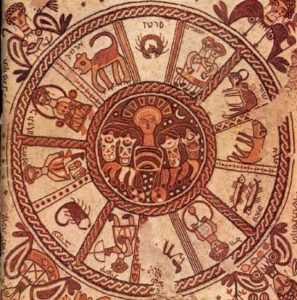
Hebrew Zodiac from a 6th Century Synagogue

Hebrew Zodiac from a 6th-Century Synagogue

Elsewhere, the Talmud tells us that Abraham was once a powerful astrologer, and great men from around the world came to consult with him about their fortunes (Bava Batra 16b). When Abraham looked into his own fate, he saw that he would not have children. God commanded him to desist from astrology, for the Jewish people have the power to transcend the stars. Of course, Abraham went on to have many children.

Later on, Moses would record in the Torah the prohibition for Jews to consult various fortune-tellers and astrologers. The Rambam codifies the law in this way:

It is forbidden to tell fortunes. [This applies] even though one does not perform a deed, but merely relates the falsehoods which the fools consider to be words of truth and wisdom. Anyone who performs a deed because of an astrological calculation or arranges his work or his journeys to fit a time that was suggested by the astrologers is [liable for] lashes, as [Leviticus 19:26] states: “Do not tell fortunes.”
(Sefer HaMadda, Hilchot Avodah Zarah, Chapter 11, Halacha 9)

Transcending Nature

We see from the above that various Heavenly forces, angels, and constellations do exist, and certainly do influence the world. Astrological signs can be potent forces. Ironically, earlier in his discourse, the Ramban points out how astrology is intricately tied into the Jewish calendar: it is no coincidence that Pesach is celebrated in the month of Nisan, the sign of which is Aries (the ram, or sheep), since the main mitzvah of Pesach was to sacrifice a lamb; and it is no coincidence that Rosh Hashanah – judgement day, when each person is put on trial – is in the month of Tishrei, the sign of which is Libra, the scales of justice. The Midrash (Yalkut Shimoni, Shemot 418) even tells us how each of the 12 Tribes of Israel corresponds to one of the 12 astrological signs of the zodiac!

And yet, all the sources are clear: Jews are not to dabble in astrology, for we have no need for intermediaries, and we have all the power to break free from the influence of the constellations. It is precisely when we believe in astrology that it becomes real, just as Abraham had no children as long as he believed in the heavenly signs that he saw. Every Jew must realize that we are Israel, yashar El, and that Hashem alone is our astrological sign. There is no need to believe in what the Rambam calls “emptiness and vanity”. The Rambam ends his laws on this subject by telling us to live up to the Torah’s call (Deut. 18:13) to be of “perfect faith with Hashem, your God.” When one has perfect faith in the Master of the Universe, anything is possible, and this is how God finished his rebuke to Abraham:

“Stop your star-gazing! Ain mazal l’Israel. What is your calculation? Is it because Jupiter stands in the West? Then I will turn it back and place it in the East!”


The article above is an excerpt from Garments of Light: 70 Illuminating Essays on the Weekly Torah Portion and Holidays. Click here to get the book! 
1909: End of the “Jewish Curse” and Fulfilment of Prophecy

Towards the end of this week’s parasha, Ki Tavo, we read a long list of horrifying curses with which God threatens the Jewish people if they stray from the path of righteousness. What’s more shocking than reading this terrible list is realizing that the Jewish people have experienced just about every one of these curses in our long history: oppression, destruction, injustice, fear, poverty, starvation, exile, genocide, desperation, forced conversion, captivity, expulsion, and utter annihilation. The Torah says that these travails will be so extensive that the Jewish people “will become an astonishment, an example, a byword among all the peoples to whom Hashem will lead you.” (Deut. 28:37) Israel will become the very epitome of curses and suffering. Indeed, history has confirmed this unfortunate prophecy.

Thankfully, the prophecies don’t end there. The haftarah for this parasha is a passage from the prophet Isaiah. Isaiah prophesies the very opposite, and says that a time will come when all of these curses will be reversed into blessings. Whereas Moses says God “will scatter you among all the nations, from one end of the earth to the other,” (28:64), Isaiah says that “all have gathered, they have come to you; your sons shall come from afar, and your daughters shall be raised…” (60:4). While Moses warns that “your skies above you will be copper, and the earth below you iron” (28:23), Isaiah says that “Instead of the copper I will bring gold, and instead of the iron I will bring silver.” (60:17) God confirms that He has put us through many trials in the past, and while this was long in duration, it was nonetheless only temporary, for “in My wrath I struck you, and in My grace I have had mercy on you.” (60:10)

Amazingly, we are living the fulfilment of Isaiah’s prophecies. The Jewish people have returned en masse to the Promised Land, have made the barren deserts bloom once more, and have miraculously defended their borders time and again. In the span of just several decades, the State of Israel has transformed into an agricultural, technological, and military powerhouse – despite very few natural resources, a small landmass, and a tiny population. As Isaiah predicted “…the abundance of the west shall be turned over to you, the wealth of the nations will come to you.” (60:5) Now, all that remains to be seen is the last part of Isaiah’s promises:

Violence shall no longer be heard in your land, neither robbery nor destruction within your borders, and you shall call your walls “salvation”, and your gates “praise”… And your people, all of them righteous, shall inherit the land forever, a scion of My planting, the work of My hands in which I will glory. The smallest shall become a thousand and the least a mighty nation; I am Hashem, in its time I will hasten it. (60:18, 21-22)

Israel will finally have true peace, with the world no longer questioning the indigenous Jewish people’s legitimacy to inhabit their Holy Land. The very last verse of this prophecy then says that when that time finally comes, God will “hasten” its arrival. This is quite the perplexing statement, and one that has kept rabbis and scholars thinking for millennia. The problem is as follows: If something is being hastened, then it is obviously coming before its time, and if it is coming on time, then it hasn’t been hastened!

Another way of looking at it is that one makes haste when they are already late. Few would disagree that this final redemption is long overdue. Since it is so late in coming, God will make haste to bring it about. An even simpler explanation is that when the time comes, God will hasten the series of events to bring about that happy ending. Recent history has shown that this is exactly what has happened.

In the late 1800s, the thought of an independent Jewish state in the Holy Land was still a very distant dream. The “first aliyah” began in 1882, and though as many as 35,000 Jews migrated to Israel by 1903, some scholars estimate that up to 90% of them left Israel soon after because of unfavourable conditions.

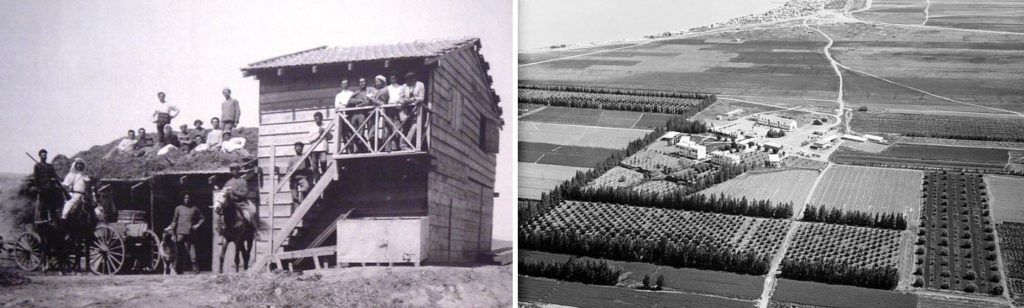
Then came 1909. In that year, a group of ten men and two women established a unique collective near the Galilee which would become the first kibbutz. The model of the kibbutz proved successful, and expanded from twelve people in 1909 to four thousand people living in thirty kibbutzim across the country by 1929. The kibbutz became one of the most significant factors in the rebirth of Israel, playing a key role in defending the land, driving agricultural innovation, and inspiring the “Israeli dream”.

Degania Alef, the first kibbutz, in 1910 (Left), and in 1931 (Right)

Degania Alef, the first kibbutz, in 1910 (Left), and in 1931 (Right)

Around the same time in 1909, a group of 66 families parceled out a plot of land outside of Jaffa (which was previously purchased by a wealthy Dutch Jew named Jacobus Kann). By 1922, this little settlement had become the bustling city of Tel-Aviv, with a population hitting 34,000 just a few years later. It would only take two more decades for the declaration of independence to be proclaimed from that city, and two more to liberate all of Jerusalem.

66 Families Parcel Out Tel-Aviv in 1909 (Left), the city in 1922 (Middle), and Tel-Aviv today (Right)

66 Families Parcel Out Tel-Aviv in 1909 (Left); the city in 1922 (Centre); and Tel-Aviv today (Right)

Events have certainly progressed very quickly, and a glance at today’s geopolitical situation shows that they continue to rapidly accelerate. The spark for it all appears to have been lit in 1909 by those two seminal events – the first kibbutz and the first city – which propelled the rebirth of Israel and the fulfilment of Biblical prophecy. What’s most interesting is that this special number – 1909 – is precisely the gematria (numerical value) of that final cryptic verse of Isaiah: “The smallest shall become a thousand and the least a mighty nation; I am Hashem, in its time I will hasten it.”


The above is adapted from Garments of Light: 70 Illuminating Essays on the Weekly Torah Portion and Holidays. Click here to get the book! 
Why Tu B’Av Is More Important Than Yom Kippur

This week’s Torah portion is Va’etchanan, which begins with Moses’ many prayers to God, and famously includes both an account of the Ten Commandments, and the Shema. It also happens that this Friday we celebrate the little-known holiday of Tu B’Av (literally, the fifteenth day of the month of Av). Upon closer examination, the parasha and the holiday are quite deeply related.

The Talmud (Ta’anit 26b) states:

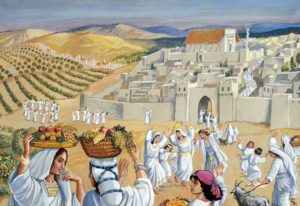
Rabban Shimon ben Gamaliel said: there were no days more joyful in Israel than the fifteenth of Av and Yom Kippur. On these days, the daughters of Jerusalem used to go out in white garments, which they borrowed in order not to put to shame anyone who had none… The daughters of Jerusalem came out and danced in the vineyards exclaiming at the same time, “Young man, lift up your eyes and see what you choose for yourself. Do not set your eyes on beauty, but set your eyes on [good] family…”

Young Girls Dancing on Tu B'Av (Courtesy: Temple Institute)

Young Ladies Dancing on Tu B’Av (Courtesy: Temple Institute)

In ancient times, Tu B’Av was a day of speed-dating, matchmaking, and engagements. It is easy to see why Tu B’Av has become associated with love and romance, and is often referred to today as a “Jewish Valentine’s Day”. While this is true, a careful reading will reveal that the holiday actually has far more to do with the fact that the daughters of Jerusalem loved one another, going out in the same white garments to avoid shaming each other. Tu B’Av celebrates a much greater power of love, one that holds the cure for the ails of the solemn Tisha B’Av that was commemorated just days earlier.

Why is Tu B’Av Special?

The Talmud (Ta’anit 30b-31a) asks: why does the Mishnah above compare Tu B’Av to Yom Kippur? We can understand why Yom Kippur is a special day – since it was then that God forgave the Israelites for the sin of the Golden Calf and gave a new set of Tablets – but why Tu B’Av? The question is answered with a list of significant historical events that happened on the 15th of Av.

First among them is the day when the prohibition for people of different Israelite tribes to marry each other was repealed. Initially, during the settlement of the Holy Land, people married only within their own tribe to avoid situations where parcels of land might unfairly be transferred to a different tribe. Eventually, this ban was lifted, allowing anyone to marry whomever they wanted. Once again, we see the theme of love associated with Tu B’Av.

The Talmud goes on to list a number of other events, the most salient of which is that on this day, the “generation of the Wilderness ceased to die out.” After the sin of the Spies, God decreed that the Israelites would wander in the Wilderness for forty years until the entire adult male generation passed away. In the fortieth year, the last of that generation passed away on the fifteenth of Av, allowing the nation to finally move on from the sin of the Spies. (Some say the last group of men was actually spared from death on Tu B’Av, turning that day into a celebration.)

Here, the Talmud cites a teaching that ever since the sin of the Spies, God had stopped speaking to Moses directly. Instead, Moses received visions from God just like any other prophet. On Tu B’Av, after nearly forty years, God once more resumed speaking to Moses “face-to-face”. Tu B’Av was the day Moses reclaimed his status as the greatest of prophets, the only one who spoke to God in a fully conscious state.

Where in the Torah do we see that God resumed speaking to Moses in this way? The Pnei Yehoshua comments that this happened in our weekly parasha, Va’etchanan. After Moses’ incessant prayers, God finally reappeared to him. And so, we see yet again the theme of love on Tu B’Av; this time, though, not love between people, but between God and man.

One Love

It is in this week’s parasha that we are commanded to “love Hashem, your God, with all of your heart…” Earlier in Leviticus we were given the mitzvah to “love your fellow as yourself.” While the latter is understandable, how exactly is one supposed to love God? God is the eternal, all-encompassing, omnipotent, omniscient, omnipresent force within all of Creation, and everything that infinitely lies beyond. The Kotzker Rebbe once rightly observed that “one who does not see God everywhere, does not see God anywhere.” How does one love such a transcendent Being?

Our Sages teach something incredible. The full verse in Leviticus states, “And you shall love your fellow as yourself, I am Hashem.” Why finish with “I am Hashem”? The verse would have stood well on its own without that last part! The juxtaposition of words can teach us that that loving your fellow is loving Hashem. In fact, the numerical value of the whole verse (ואהבת לרעך כמוך אני יי) is 907, equivalent to “love Hashem, your God” (ואהבת את יי אלהיך)! If God is found within each person, and within each creation, then loving every person and every creation is loving God.

This is all the more important on Tu B’Av which, not coincidentally, comes immediately after Tisha B’Av, a day commemorating a Temple destroyed because of sinat chinam, baseless hatred, and absence of love between fellows. When the Jews of the Second Temple period stopped loving each other, it was clear that they had stopped loving God, and God destroyed His Temple.

Tu B’Av is the antidote to Tisha B’Av. It is quite ironic that while many mourn and wail on Tisha B’Av, few pay much attention to the far more significant message of Tu B’Av. It is Tu B’Av that should be carefully observed and loudly celebrated. After all, the Mishnah goes so far as to place Tu B’Av on the same pedestal as Yom Kippur! That makes it even more ironic, as the majority of Jews observe Yom Kippur in some way, yet have little knowledge of Tu B’Av which, in reality, is just as important as Yom Kippur, and perhaps even more so:

The Mishnah ends by suggesting that while the Temple was destroyed on Tisha B’Av, it will be rebuilt on Tu B’Av, for just as the “daughters of Zion” would go out on Tu B’Av, they will go out once more in the “day of the building of the Temple, may it be rebuilt speedily and in our days.”


The article above is adapted from Garments of Light – 70 Illuminating Essays on the Weekly Torah Portion and Holidays. Click here to get the book!