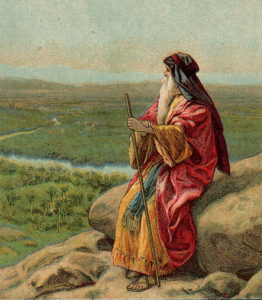
‘The Death of Moses’ (Illustration from the Providence Lithograph Company)
In this week’s double parasha, Nitzavim-Vayelekh, Moses relays the famous words lo bashamayim hi, that the Torah “is not in Heaven”. It comes within Moses’ final inspiring speech to the nation. He tells his people, again, to serve God “with all your heart and all your soul”, and to always remember that Torah law is “not concealed from you, nor is it far away. It is not in Heaven, that you should say ‘Who will go up to Heaven for us and fetch it for us, to relay it to us, so that we can fulfill it?’ Nor is it across the ocean…” (Deuteronomy 30:10-13) The Torah is right here for us, available to all, clear and straight-forward.
This notion seems somewhat at odds with what we are typically told that Jewish law is really complicated, and requires rabbis and scholars to elucidate it for us. Indeed, the Torah does also say that Moses appointed wisemen to help him adjudicate cases and interpret Torah law for the nation (Exodus 18), and that Moses gathered seventy elders to guide the people (Numbers 11)—the basis for the Sanhedrin. And one of the most famous disputes in the Sanhedrin of the 2nd Century CE ended with Rabbi Yehoshua quoting Moses’ words from this week’s parasha: “It is not in Heaven!”
The Talmudic passage in question begins at the bottom of Bava Metzia 59a. Continue reading →
