Tag Archives: Passover

Chanukah: Did the Jews Really Defeat the Greeks?

“No two cities have counted more with mankind than Athens and Jerusalem. Their messages in religion, philosophy and art have been the main guiding light in modern faith and culture. Personally, I have always been on the side of both…”

– Winston Churchill

Chanukah is perhaps the most famous of Jewish holidays. The nine-branched candelabrum, the chanukiah, is instantly recognized by people around the world. One reason for this is because of the halakhah of pirsumei nissah, literally “publicising the miracle”. Although just about every Jewish holiday revolves around some kind of miracle, it is particularly with regards to Chanukah that there is a special mitzvah to publicize its wonder. And so, one can find a glowing, public chanukiah on display in pretty much every major city on the planet.

Chanukah Around the World

The purpose of the chanukiah is well-known: after defeating the Greeks and recapturing Jerusalem, and its Holy Temple, the Jewish warriors led by the Maccabees discovered only one cruse of oil for the Temple menorah (this one with seven branches, as the Torah commands). Although the oil was meant to last only for one day, it miraculously burned for eight, the amount of time necessary to produce a fresh batch of olive oil.
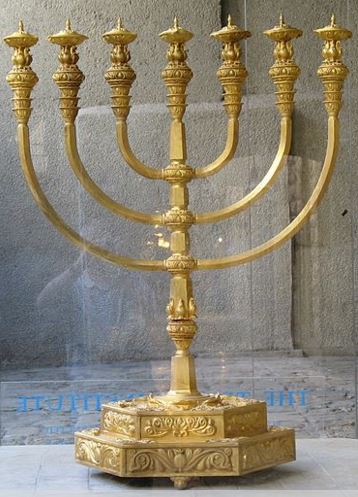
Temple Menorah Replica by Jerusalem's Temple Institute

Temple Menorah Replica by Jerusalem’s Temple Institute

This is the story as recounted in the Talmud. However, the more ancient Book of Maccabees (which is part of the apocrypha, scriptural texts that did not make it into the official Biblical canon) provides a different reason for the eight-day festival. Here, we are told that since the Temple was still in the hands of the Greeks two months earlier, the Jewish nation was unable to celebrate the Torah festival of Sukkot. Of all the Torah-mandated holidays, Sukkot is most associated with the Temple, and was celebrated with many offerings on the altar, along with water libations, and eight days of revelry. Since the people were unable to commemorate Sukkot properly in the month of Tishrei, they decided to commemorate it in the month of Kislev instead, now that the Temple was back in Jewish hands. So, they kept an eight-day festival, with offerings, libations, and revelry, both in honour of the belated Sukkot, and to celebrate their victory over the Greeks.

A David and Goliath Story

Chanukah is a beautiful underdog narrative. The mighty Syrian-Greeks (better known as the Seleucids, to differentiate them from the mainland Greeks in Europe) are imposing their Hellenism upon the conquered and impoverished Jewish people, still struggling to rebuild after the decimation of the First Temple period. The Greek king, Antiochus, demands the sacrifice of a pig upon a Jewish altar, and the Jews refuse. Well, at least some of them do.
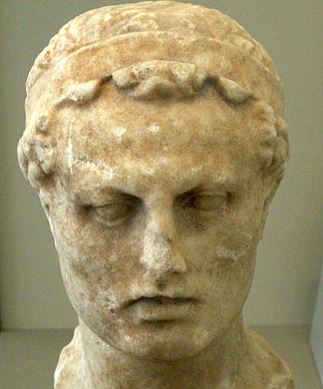
Bust of Antiochus IV Epiphanes, of Chanukah fame, at the Altes Museum in Berlin (Credit-Jniemenmaa)

Bust of Antiochus IV Epiphanes, of Chanukah fame, at the Altes Museum in Berlin (Credit: Jniemenmaa)

At the time, there were many Hellenized, assimilated Jews among the masses that were very much okay with a pig on the altar. (It seems that history repeats itself: the first graduation ceremony in 1883 of Hebrew Union College, a Reform seminary, consisted of frog legs, crabs, and shrimp, among other non-kosher foods, earning it the nickname, “the treif banquet”.) Matityahu the High Priest wouldn’t have any of it, and together with his five sons—soon to be known as the “Maccabees”—started a revolution.

More than anything else, this was a civil war between traditional Jews and the Hellenized ones. Of course, the Hellenized Jews had support from the Greek government, which soon brought in some 60,000 troops, together with war elephants, according to the Book of I Maccabees (4:28-29). The Maccabee forces managed to scramble 10,000 mostly-untrained, guerrilla warriors. Ultimately, the 10,000 overpower the professional Greek army. The Seleucid Empire would never be the same again, and less than a century later, would totally come to an end.

Spiritual vs. Physical

Today, the Chanukah story often carries the same message: the Greeks were materialistic, promiscuous, Godless people, while the Jews were moral, spiritual, and God-fearing. Chanukah, then, celebrates the triumph of righteousness over licentiousness, religion over secularism, spirituality over physicality.

While the above description of the Seleucid-Syrian-Greeks may be true, it presents a false image of the Greeks as a whole, and one that isn’t at all consistent with traditional Jewish holy texts, especially the Talmud. In truth, the great Jewish sages of the Talmud valued and respected the Greeks. They stated (Megillah 8b) that it is forbidden to translate the Torah into any language, except Greek, which the rabbis considered a rich and beautiful tongue. The rabbis also adopted the Greek style of democratic government, with elected officials sitting on the Sanhedrin, from the Greek root synedrion, meaning “sitting together”.

One of the earliest known synedrions was established by Alexander the Great, made up of representatives from across his vast empire to assist him in government. The Talmudic sages spoke highly of Alexander the Great. According to legend, Alexander saw a vision of the Jewish High Priest before coming to conquer Jerusalem. There are several versions of this story, but all agree that Alexander was grateful to the High Priest, and spared Israel from his destructive conquests (as well as from paying tribute, according to some sources). In turn, the rabbis adopted “Alexander” as an honorary Jewish name. Indeed, one of the sages of the Talmud is Rabbi Alexandri, and many other rabbis have Greek names, such as Hyrcanus, Teradion, Antigonus, Dosa, Papa, Symmachus, and Tarfon.

These rabbis gathered in various learning academies across Israel and Persia (producing the Jerusalem and Babylonian Talmuds, respectively). Their academies were very similar to the Greek academy. In fact, the successors of a Greek academy spoke very much like the rabbis of the Talmud, quoting teachings from previous generations and debating them, while citing an uninterrupted chain of tradition all the way back to Plato, much the same way that rabbis cite an uninterrupted tradition back to Moses. Many of their modes of reasoning and dialectics were the same, too, even lesser-used forms such as gematria, another Greek word adopted by Judaism. The Greeks had also used their alphabet for numerology (an art that they called isopsephy).

Greek traditions appear to have even found their way into Jewish holidays. In ancient Greece, families would get together for symposia, parties in which they would recount the history of Greece and its great victories. According to the Greek philosophers, it was best to drink three cups of wine at a symposium, while drinking five cups was considered excessive and inappropriate. Thus, most people drank four cups. They would lie on couches, specifically on their left side. Recounting history while drinking four cups of wine and lying on one’s left—sound familiar? Let’s not forget that afikoman is itself a Greek word (epikomon, literally “that which comes after” or “that which comes last”, referring to either dessert or the concluding festive songs).

While the ancient Greeks certainly held onto a number of abhorrent beliefs and practices, to suggest that all the Greeks were atheistic, unjust, or not spiritual is certainly untrue. Socrates was killed for criticizing Athenian injustice, Plato preached how illusory this physical world is, and Aristotle described metaphysics and theology as the “first philosophy” and most important of subjects. One of the earliest known preachers of reincarnation was Pythagoras, who also wrote of three souls, much like the Jewish conception of nefesh, ruach, and neshamah. Nor is it a secret that some of the angels mentioned in the Talmud bear Greek titles, among them Sandalfon and Metatron.

So, did the Jews really defeat the Greeks? We certainly defeated the immoral and oppressive Seleucid Greeks in battle, but definitely not the Greek spirit as a whole. In fact, some might argue that Judaism is the best preservation of ancient Greek culture in the modern world! Whereas the rest of society has moved on to other methods of education, we still have a yeshiva system like the ancient Academy. While others celebrate their holidays with gifts and formal dinners, we gather in symposia, reliving the words of our Sages, who openly bore their Greek names. And of course, while most of society is primarily concerned with what’s happening on television, we’re still trying to be philosophers, debating the finest points of reality.

The Greeks had a profound impact on all of civilization, and Judaism was not immune from it. Perhaps this is why, over time, the holiday became less about defeating Greeks and more about the miracle of light. Chanukah is a holiday celebrating Jewish resilience, and symbolizing the power of light over darkness, and hope over despair. It is a lesson in resisting assimilation and being true to ourselves; in standing up for what’s right and upholding our customs; and most importantly, in the longest, blackest nights of winter, Chanukah teaches us that although the world may be full of evil, one tiny flame can break through all the darkness.

[This is part one of a three-part series. See here for part two.]


The article above is adapted from Garments of Light: 70 Illuminating Essays on the Weekly Torah Portion and Holidays. Click here to get the book! 
The Eighth Day of Pesach: Isaac, the Afikoman, and Mashiach ben Yosef

Of the three patriarchs, the holiday of Passover is most intimately tied to Isaac. According to tradition, Isaac was born on Passover. Commenting on Genesis 18:10, Rashi explains that the angels’ visit to Abraham and Sarah occurred on Passover, and the angels promised a son to be born – Isaac – exactly one year from that time. This important detail helps to solve a key chronological problem. Earlier, God had told Abraham that his offspring would be subjugated for 400 years. However, when one makes an accounting of the timeline, they will find that the Jews were only in Egypt for a total of 210 years! How could this be?

Commenting on that verse (Genesis 15:13), Rashi calculates how the Exodus occurred exactly 400 years from the birth of Isaac. Thus, God’s word was perfectly fulfilled, since Isaac was the very first of Abraham and Sarah’s offspring. Although Isaac was not subjugated in the sense that the Jews in Egypt were, nonetheless he was certainly troubled by the Canaanites and Philistines, as the Torah records, and was considered a “foreigner” in the Holy Land throughout his life, since God had not yet officially granted the land to the Jews, nor did Isaac settle it permanently.

Digging further, if Isaac was born on the first day of Passover, then his brit milah (circumcision) would have been on the eighth day of Passover. Though the eighth day is not celebrated in Israel, it is celebrated in the diaspora. According to Chassidic custom, as initiated by the Baal Shem Tov (the founder of Chassidism) the eighth day of Passover is associated with Mashiach. In fact, it is customary to hold a Seudat Mashiach, a “Mashiach Feast” on the final afternoon of the holiday, complete with matzahs and four cups of wine. Just as Passover celebrates the First Redemption (led by Moses), the last day of Passover is meant to represent the Final Redemption (led by Mashiach). And it is only commemorated in the diaspora since, after all, it is diaspora Jewry that needs the Final Redemption and the Ingathering of the Exiles more than anyone.

Finally, during the Pesach seder we have three matzahs to go along with the Pesach platter. It is taught that these three matzahs represent the three patriarchs: Abraham, Isaac, and Jacob. One of the fifteen steps in the seder is yachatz, where the middle of the three matzahs is broken in half. The larger half is covered and hidden as the afikoman, while the smaller half remains at the seder table. Thus, the matzah which we break is specifically the one associated with Isaac.

So then, what is the deeper connection between Mashiach and the Redemption, Passover and the Afikoman, and the forefather Isaac?

Who is Mashiach?

The Jewish mystics teach that there are actually two messiahs: Mashiach ben Yosef, and Mashiach ben David. This is derived from a number of texts and principles. One of these is the fact that the Tanakh has a clear pattern when it comes to major national events: first comes a descendant of the matriarch Rachel to usher it in, and then comes a descendant of the matriarch Leah to complete the mission. For example, Yosef (a son of Rachel) came to Egypt first to set the stage, and then came Yehuda (a son of Leah) to prepare the land for the actual arrival of the rest of the family (see Genesis 46:28). First, Joshua (of the tribe of Ephraim, and a descendant of Rachel) brought the Jews into the land of Israel following the Exodus, then Othniel (from the tribe of Yehuda) finished the job of conquering and settling the land. The first king of Israel was Saul (from the tribe of Benjamin, and a descendant of Rachel) and only then came King David (again of Yehuda). Thus, in every major event, we see clearly that first comes a descendant of Rachel to prepare the way and fight the battles, and only afterwards comes a descendant of Leah to finish the job.

In the same way, the Sages teach that first comes Mashiach ben Yosef (a descendant of Rachel), whose mission is to fight all the battles on behalf of Israel, and only after this comes Mashiach ben David (a descendant of Leah), who completes the messianic role. And who is Mashiach ben Yosef? Amazingly, the Sages say that this is none other than Isaac, reincarnated!

Of all the patriarchs and major Torah figures, Isaac is spoken of the least in Scripture. Hardly anything is said of him. It is explained that this is because Isaac has not completed his mission, and his story is not over. He has yet to fight many battles. The Sages permute his name – Itzchak (יצחק) – into the words Ketz Chai (קץ חי), literally that he “will live [again] at the End”. This is one reason why Itzchak (which means “will laugh”) is in the future tense. Isaac is Mashiach ben Yosef, who will come at the End to fight the final battles. Beautifully, the gematria of Itzchak (יצחק) is 208, equivalent to Ben Yosef (בן יוסף), also 208.

This brings us back to Passover and the afikoman. The middle matzah is broken in half. One half – the one associated with the patriarch Isaac – remains on the seder plate, together with the other matzahs that symbolize the other patriarchs. The other half – the larger one – is hidden away, only to be revealed at the very end. This is symbolic of Isaac’s final role as that of Mashiach, whose arrival is also concealed until the very ‘End of Days’. And on the eighth and final day of the Passover holiday – the day on which Isaac was circumcised and entered into the Covenant – we hold a ‘Mashiach Feast’ to celebrate the coming Final Redemption, may it arrive speedily and in our days.

Chag sameach!

Eliyahu’s Immortality, Passover, and Shabbat HaGadol

This week’s Torah reading is Tzav, detailing many of the priestly laws that applied to the Kohanim. It begins with God telling Moses to instruct Aaron (the first Kohen) and his children in the proper sacrificial rites, starting with the olah, a type of offering that is wholly consumed by the flames (as opposed to being roasted and eaten). Rashi comments that the term “tzav” – command – has the connotation of commanding not just Aaron, but all of his future descendants, and all generations of kohanim.

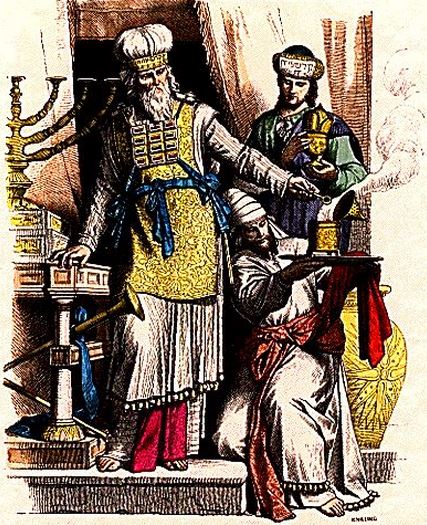
Kohen Gadol (High Priest) and Levites. (Braun & Schneider)

Kohen Gadol (High Priest) and Levites. (Braun & Schneider)

One of those descendants is Pinchas, the grandson of Aaron (through his son Elazar). For his heroic efforts, as described in Numbers 25, God blessed him with an eternal priesthood. Pinchas is mentioned as the Kohen Gadol (High Priest) in the book of Joshua (who was the first of the Biblical Judges). According to the Sages, he remained in this role until the times of Yiftach, one of the last Judges. This would mean he served as the High Priest for several hundred years! The Sages suggest that when God promised him an “eternal priesthood”, He literally meant it.

Due to the scandal that concluded the story of Yiftach (Judges 11-12), the commentaries state that Pinchas resigned as the High Priest. He then disappears from the narrative, only to reappear again a couple of centuries down the road. This time, he comes back as Eliyahu HaNavi, Elijah the prophet, as the Sages state: Pinchas ze Eliyahu, “Pinchas is Eliyahu”. The Arizal (Sha’ar HaGilgulim, 33, 2b) explains that Eliyahu was the reincarnation of Pinchas, while many others say it was literally one and the same person, since God’s blessing connoted everlasting life.

Eliyahu himself never passed away, further proving the point that Pinchas was meant to live forever. The Tanakh describes how Eliyahu was taken up to Heaven alive in a whirlwind of flames (II Kings 2:11). It is said that Eliyahu transformed into an angel, and thus lives on. This is why he appears (spiritually speaking) at certain times in the Jewish calendar and life cycle, including during a brit, and for the fifth cup during the Passover seder. Ultimately, it is prophesized that he will return in physical form once more at the End of Days to herald the coming of Mashiach, as it says: “Behold, I will send you Eliyahu the prophet before the coming of the Day of Hashem, the great and awesome” (Malachi 3:23).

The commentary of Abudraham (or Abu Dirham, Rabbi David ben Yosef of 14th century Spain) explains that this is why the Sabbath before Passover is called Shabbat HaGadol, “the Great Sabbath”. The verse in Malachi ends by saying “the great and awesome”, hagadol v’hanora. After all, this passage from Malachi is the Haftarah portion that we read at the synagogue on Shabbat HaGadol!

The basic purpose of Shabbat HaGadol is to get us into the “Pesach spirit” and prepare us for Passover. On this Sabbath, It is customary to review the Haggadah and the pertinent laws of the holiday. Similarly, the Haftarah portion is also designed to get us into the Passover mindset. The Haftarah ends by juxtaposing the first redemption under Moses with the coming redemption ushered in by Eliyahu:

“Remember the Law of Moses, My servant, whom I commanded at Horev [Mt. Sinai] for all Israel, statutes and ordinances. Behold, I will send you Eliyahu the prophet before the coming of the Day of Hashem…” (Malachi 3:23-24)

The Sages tell us that after the final redemption we will no longer need to recall the first redemption, which will pale in comparison. This is based on the verse in Jeremiah 23:7 which prophesizes that in the End of Days, people will no longer describe God as the One who took the children of Israel out of Egypt, but as the One who saved Israel from oppression all over the world, and restored them to their Promised Land.

This is one reason why during the Pesach seder, while commemorating the first redemption, we end by pouring a fifth cup for Eliyahu, who will come to usher in the final redemption. Is it then that Jews will no longer be misunderstood and oppressed, our exile will end, and we will all return to live in the Holy Land in peace, as we say at the conclusion of the seder: “Next year in Jerusalem”.