On December 31st, much of the world’s population stays up past midnight to commemorate the start of the new calendar year. This event is considered to be the most widely-celebrated public holiday in the world. Yet every year, many Jews wonder if they should be participating in these celebrations. Some answer with a quick no, since January 1st is associated with the circumcision of Jesus (as it is the 8th day following Christmas, December 25th). Others may say yes, since, among other reasons, we all use the Gregorian calendar, and January 1st is simply a secular holiday, having lost any past religious affiliations. As is often the case, the truth lies somewhere in the middle.
Back to the Roman Calendar
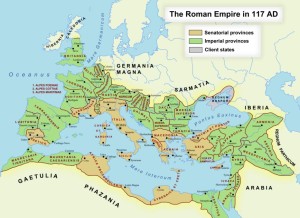
Roman Empire (Credit: Ancient History Encyclopedia)
Today’s Gregorian calendar is based on the older Julian calendar, introduced by Julius Caesar. Historical records show that by the time of Julius Caesar, the Romans celebrated their new year on January 1st. In fact, “January” is named after the Roman god Janus, the deity of beginnings and ends, doors and gateways. Janus is always depicted as a double-headed god, with one head looking back into the past, and the other gazing into the future.
January 1st was also the start of the consular year in Rome, when the two highest-ranking elected officials, the consuls, took up their office for a single year term. From this information, we see that January 1st was already celebrated as a new year long before the time of Jesus.
Was Jesus Circumcised on the 1st of January?
Today, some Christian denominations still commemorate January 1st as the “Feast of the Circumcision”. The math is simple: if Christmas is the holiday of Jesus’ birth, then like all Jews he would have been circumcised on the eight day following his birth – January 1st. The question is: was Jesus actually born on the 25th of December?
Of course, many are aware of the fact that Jesus was certainly not born on the 25th of December. The New Testament does not mention the date of his birth at all, and suggests it was sometime in the summer, since it mentions people going to take a census (always done in the summer months), and that the shepherds were out watching their flocks (which they probably wouldn’t do in the cold winter nights of December). Early Christian leaders gave various dates to the birth of Jesus, ranging from March 28th to November 18th. Today, scholars believe it was likely the end of September.
Ironically, early Christian leaders actually mocked those who celebrated birthdays of any kind, especially that of Jesus, and considered it a pagan ritual. Alas, this is where Christmas actually comes from. Originally, December 25th was around the time of the pagan Roman holiday of Saturnalia. Later, it was also instituted as a holiday in honour of the birth of Sol Invictus, the solar deity. This comes from an ancient tradition to celebrate the “birth of the sun”, since the days start getting longer around this time of the year, hence the “solar rebirth”. To make Christianity more palatable to pagans, Christian leaders eventually switched “birth of the sun” to “birth of the Son”, ie. Jesus. And so, Jesus was not born on the 25th of December, and certainly wasn’t circumcised on the 1st of January.
(That is, of course, if Jesus had existed at all. More and more scholars are agreeing that Jesus probably never existed to begin with. Click here to read more about this.)
Celebrating the New Year on the 1st of January
Most European countries actually adopted January 1st as the start of a new year quite recently. The British Empire celebrated the New Year on March 25th until 1752! Similarly, many calendars continue to celebrate a new year sometime in the spring, including the Iranian, Assyrian, and several Indian calendars. Others have New Year’s days at other times, most famously the Chinese New Year in late January/early February. Nonetheless, most of these places, including China, also commemorate January 1st as the start of an international new year. Today, January 1st is definitely devoid of any real religious significance, and is perhaps the one truly global celebration. Having said that, it may still be tied to a historical bitterness for the Jewish people.
Sylvester’s Day
In several European countries, New Year’s Eve is called “Sylvester” or “St. Sylvester’s Day”. In Israel, too, December 31st is called “Sylvester”. This is the day of the passing of Pope Sylvester I, later canonized as a saint. Essentially nothing is known of this pope, though various legends arose over the centuries. Historical records suggest that it was during his reign that the Roman Emperor Constantine proclaimed the Edict of Milan which, among other things, stripped Jews of various rights and forbade them from living in Jerusalem.
Yet, Sylvester has nothing to do with New Year’s Eve itself; it is simply a coincidence of dates. Besides, many churches mark Sylvester’s Day on January 2nd, not December 31st. Either way, few people commemorate Sylvester’s Day at all, and most people have never even heard of it. (If Sylvester really was so bad for the Jews, maybe we should celebrate the day of his death!)
New Year’s in the Talmud
Amazingly, the Talmud (Avodah Zarah 8a) actually discusses New Year’s, calling it by its Roman name, Kalenda, or Kalends. The Mishnah here begins by listing it among the holidays of idol worshippers. However, it then goes on to explain that Kalenda originates in the Torah!
The Rabbis explain that following the consumption of the Forbidden Fruit, Adam soon noticed that the days were gradually getting shorter. (Since he was created on Rosh Hashanah – in the autumn – and consumed the Fruit that very same day.) Adam mistakenly thought that the days must be getting shorter because of his sin, and the world was descending into eternal darkness. He started to fast in repentance, and after eight days of fasting, the winter solstice came, and Adam noticed that the days were once again getting longer. In celebration, Adam established an eight-day feast (to balance out his eight-day fast). The following year, Adam commemorated both the winter solstice (around December 25th) and the day that marked the end of his eight-day feast (January 1st). The Talmudic sages conclude: “However, [Adam] established them for the sake of Heaven, but the [heathens] appropriated them for the sake of idolatry.”
So perhaps, if we have the sake of Heaven in mind, we may just be able to celebrate New Year’s in some way after all.