

Tag Archives: Shulchan Arukh

Understanding Hair Covering for Women in Jewish Law

“Death of Korah, Dathan, and Abiram” by Gustave Doré

This week’s parasha, Korach, has a hidden theme: hair. In fact, the name of the villain himself, Korach (קרח), is spelled exactly the same way as kere’ach, “bald”. As we shall see below, Korach’s rebellion began when he saw himself bald-headed following his initiation ritual as a Levite. Hair comes up again in the famous story of one of Korach’s co-conspirators, a man named On ben Pelet. On is strangely mentioned right at the beginning of the parasha (Numbers 16:1), and never again. The Talmud (Sanhedrin 109b-110a) explains that he was saved thanks to his wife: She told her husband that he had nothing to gain from joining the rebellion; now he was subservient to Moses, and if the rebellion would be successful he would just become subservient to Korach!

On understood, but worried that he had already agreed to join the group. So, his clever wife got him drunk and sleepy, and On passed out in bed. Meanwhile, she went out to the entrance of their tent and “exposed her hair”. When Korach’s collaborators approached, the Talmud says they turned away due to the immodest sight of the woman. By the time On recovered from his drunken stupor, the whole episode was over, and he was spared. This story implies that Jewish women cover their hair, and for a woman to expose her hair publicly is immodest. Yet, nowhere in the Torah is there an explicit command for a Jew to cover their hair at all times (male or female). Hair-covering is not listed among the 613 mitzvot! If it isn’t a Torah mitzvah, where did it come from? Continue reading
On Mixing Fish and Meat

This week’s parasha, Re’eh, contains one of three instances in the Torah prohibiting the consumption of meat and dairy together (Deuteronomy 14:21). There is another prohibition strongly linked to this one in Jewish tradition that has no source in the Torah itself: consuming meat and fish together. Unlike meat and dairy, meat and fish can be consumed at the same meal, but sequentially and not combined in the same dish. Where did this restriction come from, and what might be the deeper meaning behind it? Continue reading

On Eating Bugs

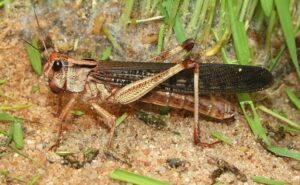
The Locusta migratoria species, with its two “jumping legs” clearly visible.

In this week’s parsha, Shemini, we are presented with the Torah’s extensive dietary laws. All bugs and insects are forbidden for consumption except those that are winged and have two large jumping legs in addition to their four other legs, ie. locusts (Leviticus 11:21-22). The Torah names four families of such locust species which are kosher. Rashi comments that we no longer know how to identify these species, so for practical purposes no one eats such insects anymore (although a small minority of Mizrachi and Sephardi communities did consume locusts until recently).

The bigger issue today is the broader prohibition of consuming bugs, and how it applies to inadvertent consumption of tiny bugs in fruits and vegetables. It has become common to hear extremely negative language regarding such accidental consumption, with people saying (untrue) things like inadvertently eating bugs on poorly-washed lettuce or strawberries is “five times worse” than consuming pork, and with reputable kashrut organizations pushing more and more stringent requirements for washing produce—using bright lamps and magnifying glasses and even doing “laboratory testing”. Is any of this actually required? What does Jewish law actually say about washing produce and consuming errant bugs? Continue reading