Tag Archives: Sukkot

Netanyahu and Yirmiyahu

This week’s parasha, Bechukotai, contains an infamous list of curses that could befall the Jewish people, has v’shalom, if they stray from God’s ways. Jewish history shows that we have indeed experienced such tragic curses over the millennia every so often, and not just in the distant past but recently on October 7. As difficult and inexplicable such events may be, we have to keep in mind that while they come at the hands of various political entities and ethnoreligious groups, ultimately the source of the pain is God Himself. As the parasha tells us, the tragedies are both an unfortunate retribution for our transgressions, and a wake-up call to be better.
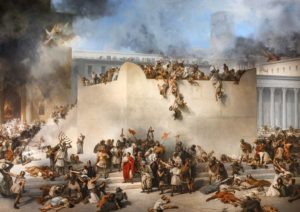
‘Destruction of the Temple in Jerusalem’ by Francesco Hayez (1867)

One of the first such unspeakable catastrophes took place roughly twenty-five centuries ago, at the hands of Nebuchadnezzar and the Babylonians. They massacred tens of thousands of Jews, enslaved and exiled many more, destroyed Jerusalem, and burned down the Holy Temple. Yet, the prophet Jeremiah quotes Hashem saying Nebuchadnezzar is His “servant” (Jeremiah 43:10), His instrument in bringing about punishment. The sad reality is that history’s wicked tormentors were tools of God. They would not arise had we not deserved it. We read in Isaiah 45:7 that “I am God, and there is no other; I form light and create darkness; I make peace and create evil, I am Hashem, doing all of these things.” If it is God’s Will to do such things, what does that make of the free will of the human tormentors?

Our Sages teach that when a person ascends to a high political position, and holds the lives of many in their hands, God limits that person’s free will. God will occasionally “harden their hearts” (as He did with Pharaoh) and steer their choices if necessary. This was described long ago by King Solomon when he said “Like channeled water is the heart of a king in God’s Hand; He directs it wherever He wishes.” (Proverbs 21:1) The Talmud cites this verse in saying that each person should pray “for a good king”, meaning we should pray that God direct political leaders to act justly and kindly with the populace (Berakhot 55a). God can cause a political leader to do more good, or to bring about punishment. And this takes us right back to October 7:

Everyone is puzzled by the fact that the Israeli government missed all the warning signs, was paralyzed by inaction on the morning of, and seemingly allowed the October 7 massacre to happen. It appears to be totally inexplicable and, not surprisingly, has given rise to multiple conspiracy theories. Did the government deliberately allow the massacre to happen? Did they want a serious external conflict to end the civil unrest that was taking place in the months prior to October 7? Did they have a hand in planning the attack? Did they purposely keep the border unguarded, or move military units away from the border, or give an abnormally large number of soldiers holiday vacations, or jam communication channels, or change permits to move the Nova festival from its original location right to the Gaza border? The theories are numerous, each more sinister than the next. Personally, I find them hard to believe, and although I am no fan of the government, it feels absurd to suggest that anyone could deliberately allow something like this to happen to their own people.

But then I was reading Jeremiah—the same Jeremiah that refers to Nebuchadnezzar as God’s servant, and the same Jeremiah from whom we read this week’s Haftarah. We find something quite amazing in the Book of Jeremiah: it is the one place in the Tanakh that describes a family called “Netanyahu”. (Another is briefly mentioned in a list in I Chronicles 25:12.) Jeremiah first speaks of a righteous court official named Yehudi ben Netanyahu (36:14). Yehudi delivers a scroll bearing Jeremiah’s gloomy prophecy to the king, and reads it before him. Judea’s King Yehoyakim refuses to heed the warning and thinks he is safe from the Babylonians. He scoffs and burns the prophetic scroll of Jeremiah. We hear no more of Yehudi ben Netanyahu after this.

We then read how Jeremiah’s prophecy was tragically fulfilled. The Babylonian armies arrived, destroying Jerusalem and the Temple and starting the grim period of the Babylonian Captivity. However, the Babylonians did not expel all the Jews from the Holy Land, and even allowed the Jews some autonomy to continue governing themselves. They appointed a Jewish leader named Gedaliah ben Ahikam as governor of Judea. Gedaliah reassured the remaining Jews that everything would be okay; to stay in the Holy Land and rebuild.

Here we are introduced to another Jewish leader, called Ishmael ben Netanyahu (40:8). A descendant of the Davidic monarchy, he had dreams of becoming king and making himself the undisputed leader of Israel. Gedaliah, of course, stood in his way. Ishmael made a secret alliance with the king of Ammon (same place as today’s Amman, capital of the Palestinian state of “Jordan”) to assassinate Gedaliah. Gedaliah was warned of Ishmael’s sinister plans, but dismissed the rumours, thinking no self-respecting Jew could ever stoop so low.
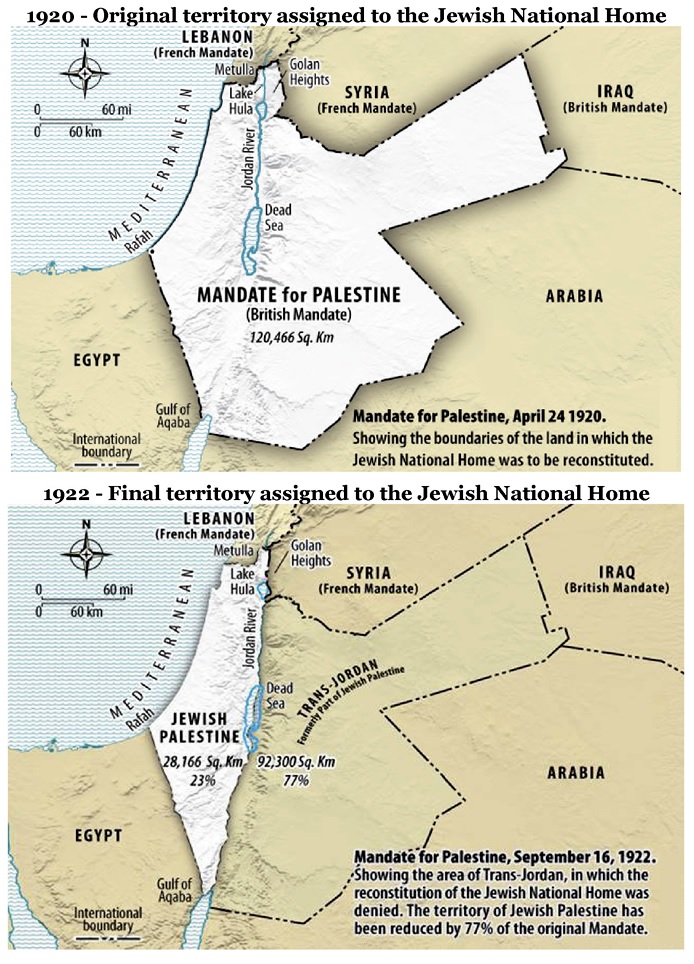
Although the entire British Mandate for Palestine was originally promised to the Jewish people, the British suddenly gave away more than two-thirds to the Arabs to form a new Palestinian state now called “Jordan”. (Credit: Eli E. Hertz)

But then, “in the seventh month” (Tishrei), Gedaliah was having a holiday feast and Ishmael joined him for the yom tov meal (41:1). Wicked Ishmael suddenly struck down Gedaliah “and all the Jews who were with him” (41:3). The next day, pilgrims “came from Shechem, Shiloh, and Samaria” to bring holiday offerings. Ishmael came out to greet them and invited them into town before turning on them and slaughtering them, too (41:7). Ishmael threw all the corpses into a cistern. He didn’t stop there:

Ishmael carried off all the rest of the people who were in Mizpah, including the daughters of the king—all the people left in Mizpah, over whom Nebuzaradan, the chief of the guards, had appointed Gedaliah son of Ahikam. Ishmael son of Netanyah carried them off, and set out to cross over to the Ammonites. (41:10)

Ishmael took hostages and fled back to Ammon. A Judean general named Yochanan ben Kareach finally figured out what’s going on and chased after Ishmael with his men, managing to free the hostages. Ishmael, however, escaped and we don’t know what happened to him afterwards.

In the aftermath of the massacre, the frightened and traumatized Judeans feared the Babylonians would come back to punish them for the death of the Babylon-appointed governor Gedaliah. Despite Jeremiah’s protests and assurances that all would be fine, the remnant of Jews decided to flee to Egypt. The result of Ishmael’s treachery was that the Holy Land lost its last Jews, along with its semi-autonomous Jewish government. The last traces of the Kingdom of Judea were officially obliterated.

For this terrible tragedy, we still observe the “Fast of Gedaliah” today every year immediately following Rosh Hashanah. Though the Tanakh doesn’t say exactly which holiday it was, according to tradition the Gedaliah massacre occurred on Rosh Hashanah. Since we don’t fast on holidays, the fast is observed on the third of Tishrei. However, a careful reading of the Tanakh suggests that the holiday may have been Sukkot, hence the pilgrims that came the following day to bring offerings. Altogether, the narrative is eerily similar to what we experienced last Sukkot in Tishrei, when Ishmaelites came into the land and slaughtered Jews peacefully celebrating a holiday, while taking other Jews hostage.

Strangely, the villain in the Jeremiah narrative (also recounted in II Kings 25) is a power-hungry Jewish leader named Ishmael ben Netanyahu. It would be another millennium before an Ishmaelite by the name of Muhammad would arise, and henceforth “Ishmael” would always be associated with the Muslims. If this episode in Tanakh is not only historical, but prophetic, I wonder what it might mean for all of us today.

I am reminded of the fact that our own Netanyahu was all too kind to the Ishmaelites, giving record-high work permits to Gazans to enter Israel (the Bennett government gave 10,000 before Netanyahu came back to power last year and doubled it to 20,000), transferring Qatari suitcases of cash to support them, and refusing pre-emptive strikes when warned by military officials. The same Netanyahu has yet to fulfil a single objective in the current war. Nearly eight months later, most of Hamas’ tunnel infrastructure is still in place, their leaders still at large, rockets still being fired on Israel, and worst of all, a multitude of hostages still in captivity. The government of Israel is paralyzed, the Knesset remains a circus of corruption (on both sides left and right, secular and “religious”), and “there is no one to rely on but our Father in Heaven.” (Sotah 49b)

Will today’s Netanyahu be more like the righteous Yehudi ben Netanyahu—who supported Jeremiah the Prophet and sought to lead people towards truth and repentance, while confronting the corrupt government of Yehoyakim—or is he more like Ishmael ben Netanyahu, a power-hungry manipulator and a collaborator with Israel’s enemies, a facilitator of Jewish massacres? Will he go down in history as a real “Yehudi”, or as an imposter “Ishmael”? I hope time will prove the former to be the case, but I fear the reality is fast-approaching the latter. If Benjamin Netanyahu does not make some dramatic changes for himself and his country, he may well end up like Ishmael ben Netanyahu long before him; shamefully fleeing his country, remembered for centuries thereafter as a villain.

Whatever happens, Jeremiah in this week’s Haftarah reminds us of a critical principle never to lose sight of: “Cursed is the man who trusts in man… Blessed is the man who trusts in God; and God shall be his security.” (17:5-7)
Ushpizin & Anti-Ushpizin

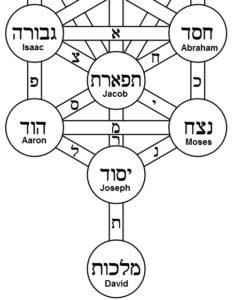
Over the course of Sukkot, we are graced with the spiritual presence of the “Seven Shepherds of Israel”: Abraham, Isaac, Jacob, Moses, Aaron, Joseph, and David. These Heavenly guests are commonly known as the ushpizin. Interestingly, the root ushpiz or oshpiz, “guest”, actually comes from the Latin hospis, as in the English “hospitality”! What is the origin of the notion of Seven Shepherds? Where did the practice of inviting the ushpizin come from? And who are the mysterious “anti-ushpizin” that oppose the Seven Shepherds?

Origins of Ushpizin

‘Micah Extorting the Israelites to Repentance’, by Gustave Doré

The idea of Seven Shepherds of Israel comes from the Tanakh, from the prophet Micah. The fifth chapter of his book begins by telling us that an ancient soul of Judah, mikedem mimei olam, will emerge out of Bethlehem of Efrat to be moshel b’Israel, a ruler of Israel. The next verse tells us it will come at a time of great desperation for Israel, following a series of “birth pangs”. This leader will be righteous, and serve in the name of God. We might think this is referring to Mashiach, but the chapter continues to warn that Assyria will invade and drive Israel into exile. It’s quite clear that Micah is speaking about the near future, and the Judean leader he envisions is the righteous Hezekiah, who drove away the Assyrian invasion and miraculously saved Jerusalem. Indeed, the Talmud (Sanhedrin 98b) records an opinion that all of the Messianic prophecies of the Tanakh were referring to Hezekiah!

Nonetheless, this chapter of Micah is seen as a “double-level” (or “dual-fulfilment”) prophecy, one that spoke of the near future in Micah’s own days, and also cryptically referred to a future time at the End of Days. This is how Rabbi Shimon bar Yochai read it, for instance, and saw “Assyria” here as secretly referring to Persia at the End of Days, who will invade Israel in the final apocalyptic war (Eichah Rabbah 1:41). Whatever the case, Micah 5:4 says that God will raise up “seven shepherds and eight princes of men” against the invaders. Again, the Midrash (Bamidbar Rabbah 14:1) wonders if this means there will be seven or eight messianic figures in the End of Days, and concludes that there will actually be four:

There is a great debate with regards to how many messiahs there will be. Some say there will be seven, as it is said “then shall we raise against him seven shepherds…” (Micah 5:4) And some say there will be eight, as it is said, “and eight princes of men.” And it is neither of these, but actually four, as it is said, “And the Lord showed me four craftsmen…” (Zechariah 2:3)

And David came to explain who these four craftsmen are [Psalms 60:9 and 108:9, where God declares: “Gilead is mine, Menashe is mine; Ephraim also is the defence of my head; Judah is my sceptre”]: “Gilead is mine” refers to Elijah, who is from the land of Gilead; “Menashe is mine” refers to the messiah who comes from the tribe of Menashe… “Ephraim is the defence of my head” refers to the Warrior Messiah who comes from Ephraim… “Judah is my sceptre” refers to the Great Redeemer, who is a descendant of David.

That said, the seven shepherds must refer to other figures. The Talmud (Sukkah 52b) explains: “Who are these seven shepherds? David is in the middle; Adam, Seth, and Methuselah are to his right; Abraham, Jacob, and Moses are to his left. And who are the eight princes among men? They are Yishai, Saul, Samuel, Amos, Zephaniah, Zedekiah, Mashiach, and Elijah.” The Sages seem to suggest that alongside Mashiach and Eliyahu, the souls of thirteen other great figures of the past come back to help them. Glaringly missing from the list of seven shepherds is Isaac. Why is he the only one of the Forefathers not included? Any why include Seth? Are there not greater figures of that era, like Noah and Enoch?

Some would explain Isaac’s omission from the shepherds by pointing out that, well, Isaac wasn’t really a shepherd! The Torah describes him digging wells and irrigating farms, his blessed crop producing me’ah she’arim, hundred-fold yields. A deeper explanation is given by the Arizal, who says that Itzhak (יצחק) is an anagram of ketz chai (קץ חי), “lives at the End”, as he will come back at the End of Days in the form of Mashiach ben Yosef, the “Warrior Messiah” mentioned above. The name Itzhak itself is in the future tense, meaning “he will laugh”—in the future when he is victorious in battle. The Arizal even proves it mathematically, as the value of Itzhak (יצחק) is 208, equal to Ben Yosef (בן יוסף)! (See Sha’ar haPesukim on Lech Lecha, for instance, and also the Ba’al haTurim on Deuteronomy 7:21.)

Noah was not a shepherd either, but a farmer. Enoch was a scribe and scholar, and transformed into an angel. That leaves Adam, Seth, and the longest-living Methuselah to represent the pre-Flood generations. Aaron was not a shepherd in Egypt, and served as high priest after the Exodus. Joseph was a shepherd-in-training in his teens, but did not return to that profession in Egypt. Instead, he oversaw all of Egypt’s farming operations and granaries. That leaves us with David, Abraham, Jacob, and Moses.

The lower 7 Sefirot correspond to the 7 Shepherds of Israel

The Zohar (III, 103b) comes in and tells us that holy figures of the past visit us on Sukkot, and this is the source for ushpizin. However, the Zohar only states “Abraham and five other tzadikim”, followed by another opinion that it’s “Abraham and five other tzadikim, plus David”. The Zohar doesn’t say who those five others are directly, but does quote Isaac and Jacob speaking. The whole passage itself comes from the mouth of Ra’aya Mehemna, the “Faithful Shepherd”, who is Moses. Right before this, Aaron is mentioned, for it was in his merit that the Clouds of Glory—which the sukkah is likened to—appeared in the Wilderness. The only one missing is Joseph. However, the Zohar always parallels such things to the Sefirot, and the six righteous figures are meant to correspond to the six Sefirot of Zeir Anpin, from Chessed to Yesod. The figure that always stands in for Yesod is Yosef haTzadik. David, meanwhile, is always paralleled to the seventh Sefirah of Malkhut. In this way, we find our Seven Shepherds, as we know them, in the Zohar.

The Anti-Ushpizin

Elsewhere, the Zohar (Sitrei Otiyot on Beresheet) says that the world endures in the merit of these Seven Shepherds of Israel. Opposing them are seven shepherds that stem from the “Left Side” or “Other Side”, the Sitra Achra. They seek to shepherd Israel away from God and towards idolatry. This is the meaning behind Jeremiah 15:9 which reads “She who bore seven is forlorn, utterly disconsolate; her sun has set while it is still day, she is shamed and humiliated. The remnant of them I will deliver to the sword, to the power of their enemies—declares God.” The Zohar lists the “anti-ushpizin”: Jeroboam, Ba’asha, Ahab, Yehu, Pekah, Menachem ben Gaddi, and Hoshea ben Elah. Who are these people?

Recall that Yerovam ben Nevat, “Jeroboam”, was the first king of the northern Kingdom of Israel after the split following King Solomon’s reign. Afraid to lose his throne and grip on power, he set up roadblocks so that his Israelites wouldn’t go to Jerusalem for the pilgrimage festivals. Instead, he built two idolatrous temples with golden calves. For this, the Sages say he has no share in the World to Come (Sanhedrin 10:2).

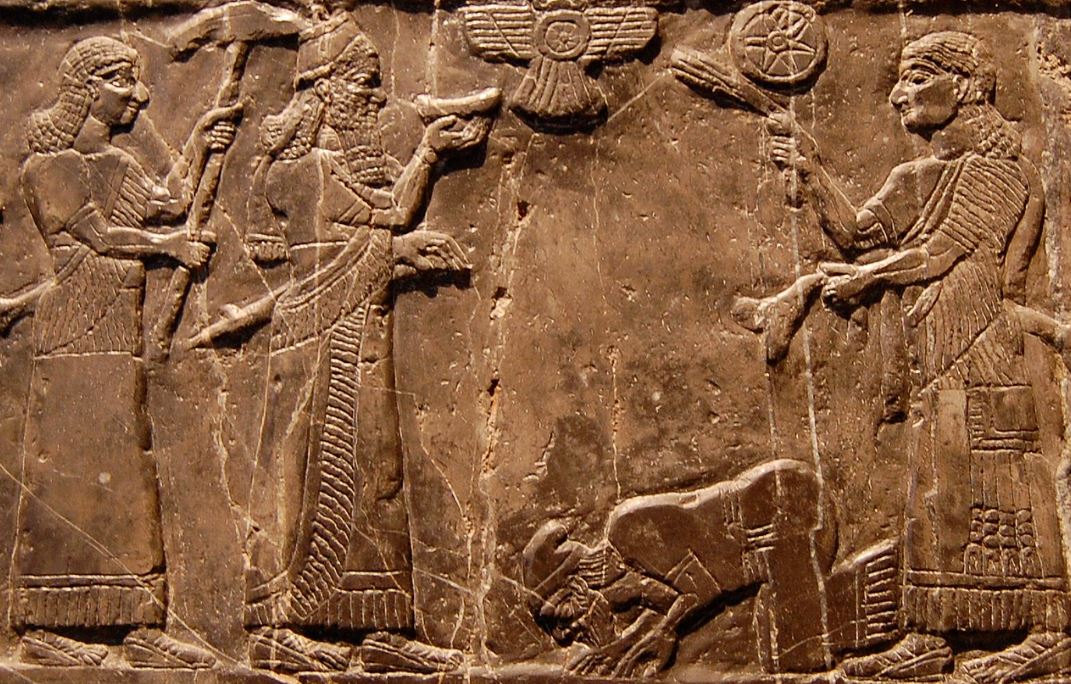
Ba’asha ben Achiya was the third king of Israel. He spent his reign at war with the Kingdom of Judah, and even allied with Aram at one point. He continued the wicked ways of Jeroboam, so God declared he would obliterate Ba’asha just as he did Jeroboam (I Kings 16:3). King Ahab is well-known, being the husband of the wicked idolatrous Queen Jezebel, and the tormenter of Eliyahu. His dynasty was destroyed by Yehu ben Nimshi, originally a military general. Yehu was used as an instrument by God to carry out Ahab’s punishment. However, Yehu went a step too far and bloodily massacred countless people in the Valley of Jezreel. Although God initially rewarded him with a multi-generational dynasty, He did declare that He would eliminate Yehu’s dynasty for the cruelty at Jezreel (Hosea 1:4). Amazingly, we have archaeological evidence clearly confirming Yehu and his story, from the Assyrian Black Obelisk.

King Yehu of Israel giving tribute to King Shalmaneser III of Assyria, on the Black Obelisk of Shalmaneser III from Nimrud (circa 827 BC), currently in the British Museum.

Menachem ben Gaddi was another such general-turned-king. We know little about him. So was Pekah ben Remalyahu. He allied with King Rezin of Aram to attack Jerusalem. The Judeans were terrified, and it was in the context of this that Isaiah relayed his famous prophecy about the miraculous birth of a saviour child (Isaiah 7). Although it is abundantly clear that the passage is speaking about Hezekiah—who did go on to save Judea and Jerusalem as a young, righteous ruler—Christians infamously interpreted the prophecy to refer to the birth of Jesus (reading the word almah, a “young lady”, as “virgin”). Their argument that this, too, is a “double-level” or “dual-fulfilment” prophecy speaking about both contemporary times and future times cannot be the case. A double-level prophecy must not give a specific time, in order to allow interpretation for the present and the future. This prophecy clearly states the events are supposed to happen “in 65 years” (Isaiah 7:9). A specific time is given, leaving no ambiguity. The Tanakh continues to relay how the prophecy was fulfilled.

Pekah was assassinated by Hoshea ben Elah. The Assyrian King Tiglath-Pileser III then appointed Hoshea as the new (and final) king of Israel. An Assyrian inscription confirms this, too, stating that the Israelites rebelled and “overthrew their king Pekah and I placed Hoshea as king over them. I received from them 10 talents of gold, 1,000 talents of silver as their [tri]bute and brought them to Assyria.” Hoshea didn’t last long. One of Tiglath-Pileser’s successors soon destroyed the northern Kingdom of Israel and exiled the tribes.

The souls of these seven idolatrous kings stand in opposition to the souls of the holy Seven Shepherds. We find that the Seven Shepherds of Israel were all about unity, bringing people together to serve God and inspire righteousness. The anti-shepherds, meanwhile, were power-hungry and vindictive, instigators of division and civil war, propagators of idolatry, and collaborators with Israel’s enemies. On Sukkot, we welcome in the spirit of the righteous ones as we bring people together in our huts. And we hope to expel the spirit of idolatry and divisiveness, of the wickedness stemming from “the Left Side”. This is all the more important to keep in mind and meditate on as we see what is happening all around us today in the Holy Land and the world at large.

Chag sameach!


More Sukkot learning resources:

Medicinal Properties of Arba Minim
Russia, Iran, and Gog u’Magog
What is Happiness?

Things You Didn’t Know About Samaritans

In this week’s parasha, Ki Tavo, we read how God commanded that when the Israelites cross into the Holy Land, they should first make a stop upon two special mountains: Mount Gerizim and Mount Eval (Deuteronomy 27:12-13). The Tribes of Israel should split between the two mountains; six of them would set up on Mount Gerizim and six on Mount Eval. Then, a series of blessings would be proclaimed from atop Mount Gerizim, and a series of curses from atop Mount Eval. The people would answer “amen!” to signify their agreement. This would serve as one final reminder of their covenant with God before they settle down in their apportioned lands and get on with their new lives.

Har Gerizim in 1912

Today, that mountain of blessing, Mount Gerizim, is still venerated by the world’s last community of Samaritans, numbering less than 1000 people. About half of them live in the Israeli city of Holon, and the other half live around Mount Gerizim itself, in the village of Kiryat Luza, once part of the Biblical site of Shechem and currently the Palestinian town of Nablus (an Arabic corruption of the Roman title Neapolis). For the Samaritans, Mount Gerizim is the holiest place on Earth. They believe this is supposed to be the true location of the Holy Temple. They believe this is where Abraham bound Isaac during the Akedah. They believe this is the mountain upon which the Mishkan first rested, and where sacrifices to Hashem were originally brought. In other words, Gerizim is the Samaritan “Jerusalem”. Who, exactly, are the Samaritans? Continue reading