
Tag Archives: Ten Commandments

Why Tu B’Av Is More Important Than Yom Kippur

This week’s Torah portion is Va’etchanan, which begins with Moses’ many prayers to God, and famously includes both an account of the Ten Commandments, and the Shema. It also happens that this Friday we celebrate the little-known holiday of Tu B’Av (literally, the fifteenth day of the month of Av). Upon closer examination, the parasha and the holiday are quite deeply related.

The Talmud (Ta’anit 26b) states:

Rabban Shimon ben Gamaliel said: there were no days more joyful in Israel than the fifteenth of Av and Yom Kippur. On these days, the daughters of Jerusalem used to go out in white garments, which they borrowed in order not to put to shame anyone who had none… The daughters of Jerusalem came out and danced in the vineyards exclaiming at the same time, “Young man, lift up your eyes and see what you choose for yourself. Do not set your eyes on beauty, but set your eyes on [good] family…”
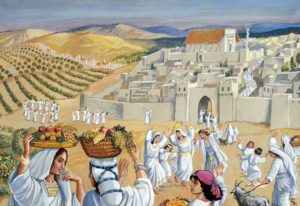
Young Girls Dancing on Tu B'Av (Courtesy: Temple Institute)

Young Ladies Dancing on Tu B’Av (Courtesy: Temple Institute)

In ancient times, Tu B’Av was a day of speed-dating, matchmaking, and engagements. It is easy to see why Tu B’Av has become associated with love and romance, and is often referred to today as a “Jewish Valentine’s Day”. While this is true, a careful reading will reveal that the holiday actually has far more to do with the fact that the daughters of Jerusalem loved one another, going out in the same white garments to avoid shaming each other. Tu B’Av celebrates a much greater power of love, one that holds the cure for the ails of the solemn Tisha B’Av that was commemorated just days earlier.

Why is Tu B’Av Special?

The Talmud (Ta’anit 30b-31a) asks: why does the Mishnah above compare Tu B’Av to Yom Kippur? We can understand why Yom Kippur is a special day – since it was then that God forgave the Israelites for the sin of the Golden Calf and gave a new set of Tablets – but why Tu B’Av? The question is answered with a list of significant historical events that happened on the 15th of Av.

First among them is the day when the prohibition for people of different Israelite tribes to marry each other was repealed. Initially, during the settlement of the Holy Land, people married only within their own tribe to avoid situations where parcels of land might unfairly be transferred to a different tribe. Eventually, this ban was lifted, allowing anyone to marry whomever they wanted. Once again, we see the theme of love associated with Tu B’Av.

The Talmud goes on to list a number of other events, the most salient of which is that on this day, the “generation of the Wilderness ceased to die out.” After the sin of the Spies, God decreed that the Israelites would wander in the Wilderness for forty years until the entire adult male generation passed away. In the fortieth year, the last of that generation passed away on the fifteenth of Av, allowing the nation to finally move on from the sin of the Spies. (Some say the last group of men was actually spared from death on Tu B’Av, turning that day into a celebration.)

Here, the Talmud cites a teaching that ever since the sin of the Spies, God had stopped speaking to Moses directly. Instead, Moses received visions from God just like any other prophet. On Tu B’Av, after nearly forty years, God once more resumed speaking to Moses “face-to-face”. Tu B’Av was the day Moses reclaimed his status as the greatest of prophets, the only one who spoke to God in a fully conscious state.

Where in the Torah do we see that God resumed speaking to Moses in this way? The Pnei Yehoshua comments that this happened in our weekly parasha, Va’etchanan. After Moses’ incessant prayers, God finally reappeared to him. And so, we see yet again the theme of love on Tu B’Av; this time, though, not love between people, but between God and man.

One Love

It is in this week’s parasha that we are commanded to “love Hashem, your God, with all of your heart…” Earlier in Leviticus we were given the mitzvah to “love your fellow as yourself.” While the latter is understandable, how exactly is one supposed to love God? God is the eternal, all-encompassing, omnipotent, omniscient, omnipresent force within all of Creation, and everything that infinitely lies beyond. The Kotzker Rebbe once rightly observed that “one who does not see God everywhere, does not see God anywhere.” How does one love such a transcendent Being?

Our Sages teach something incredible. The full verse in Leviticus states, “And you shall love your fellow as yourself, I am Hashem.” Why finish with “I am Hashem”? The verse would have stood well on its own without that last part! The juxtaposition of words can teach us that that loving your fellow is loving Hashem. In fact, the numerical value of the whole verse (ואהבת לרעך כמוך אני יי) is 907, equivalent to “love Hashem, your God” (ואהבת את יי אלהיך)! If God is found within each person, and within each creation, then loving every person and every creation is loving God.

This is all the more important on Tu B’Av which, not coincidentally, comes immediately after Tisha B’Av, a day commemorating a Temple destroyed because of sinat chinam, baseless hatred, and absence of love between fellows. When the Jews of the Second Temple period stopped loving each other, it was clear that they had stopped loving God, and God destroyed His Temple.

Tu B’Av is the antidote to Tisha B’Av. It is quite ironic that while many mourn and wail on Tisha B’Av, few pay much attention to the far more significant message of Tu B’Av. It is Tu B’Av that should be carefully observed and loudly celebrated. After all, the Mishnah goes so far as to place Tu B’Av on the same pedestal as Yom Kippur! That makes it even more ironic, as the majority of Jews observe Yom Kippur in some way, yet have little knowledge of Tu B’Av which, in reality, is just as important as Yom Kippur, and perhaps even more so:

The Mishnah ends by suggesting that while the Temple was destroyed on Tisha B’Av, it will be rebuilt on Tu B’Av, for just as the “daughters of Zion” would go out on Tu B’Av, they will go out once more in the “day of the building of the Temple, may it be rebuilt speedily and in our days.”


The article above is adapted from Garments of Light – 70 Illuminating Essays on the Weekly Torah Portion and Holidays. Click here to get the book!
An Honest Look at the Film ‘Exodus: Gods and Kings’

This week we start a new book of the Torah, Shemot, known in English as ‘Exodus’. This volume is primarily concerned with the period of Israelite slavery in Egypt, and the subsequent salvation following the ten plagues and the Splitting of the Sea, climaxing with the revelation at Mt. Sinai, and the start of the transmission of the bulk of the Torah’s laws.

Coincidentally, not long ago was released Ridley Scott’s new film, Exodus: Gods and Kings, and I finally had a chance to see it this week. Though it appeared to show a little bit of promise at the start, the movie soon unravelled into a bizarre re-invention of the Biblical story. Of course, there is nothing wrong with some artistic liberties when adapting an ancient text for a modern film, nor is it too much of a problem to fill in some of the gaps in the Torah’s narrative. However, Exodus: Gods and Kings presented a completely twisted version that did not even slightly stick to the basic story of the Torah. It would take an entire tome to cover all the mistakes in the film, but perhaps we can offer just a few of the most blatant ones.

From the very beginning, we see that Moses seems to be completely unaware that he is not Egyptian. That’s quite odd: Semites and Egyptians had a totally different appearance. Take a look at this depiction of Semitic tribes, as discovered in the 12th dynasty tomb of Egyptian Khnumhotep II, official of the pharaoh Senusret II:

IbschaEgyptSemites

The Semites have a different skin tone, different hair styles, clothes, and so on. The filmmakers clearly knew this, as they show Moses bearded and sporting a nice hairdo, while all the other Egyptian royals are clean-shaven and bald. His eyes look different, and he wears clothes of a completely different style than all the others. How come? Didn’t he ever question why he doesn’t look anything like his “royal brethren”?

More importantly, the Torah clearly says that Moses was initially raised by his true birth mother, Yocheved (Exodus 2:7-9). Only after he was fully weaned did Yocheved present Moses to his new step-mother, the Pharaoh’s daughter (v. 10). It is totally inconceivable that Moses did not know he was a Hebrew! The Torah states that when Moses grew up, he “went out to his brothers and looked at their burdens” (2:11). He knew full-well that he was going out to his people.

At this point, when he saw an Egyptian taskmaster violently beating a Jew, he stepped in to save the victim, killing the Egyptian in the process. In the movie, this heroic act is replaced with an enraged Moses killing an Egyptian guard who was doing nothing terrible at all. The kind, compassionate Moses, described by the Torah as the humblest man that ever lived, is turned into a violent brute who kills indiscriminately. No wonder that Christian Bale, the actor who plays Moses, said of his character that he was “likely schizophrenic and was one of the most barbaric individuals that I ever read about in my life.” Makes sense if all he ever read about Moses was in the script for the film.

If Christian Bale did indeed read about Moses, perhaps he missed the whole part where Moses selflessly led his people for forty years in the wilderness. Where he literally sat from morning to evening to counsel the people and help them (Exodus 18:13). Or when he refused to abandon his people, even when God offered to make an entirely new nation out of Moses (Exodus 32:10). The many occasions where he convinced God to avert His just decrees and forgive the nation for their sins. The time where his sister Miriam transgressed severely against Moses, yet he did not hold even the tiniest of grudges or ill-will, and immediately prayed to God to heal Miriam and have mercy on her (Numbers 12:13). Or the simple fact that Moses led the revolution that brought monotheism (together with a higher sense of morality, starting with a set of Ten Commandments) to over two-thirds of the world’s population.

Worse than its depiction of Moses, though, was the film’s depiction of God: an irrational, pointlessly vengeful, literally childish figure. The film made it seem like the Ten Plagues were nothing more than God’s desire to kill as many people as possible. The reality, of course, was that the Ten Plagues were meant to be a measure-for-measure retribution for what the Egyptians had done; nothing more than cosmic karma. For example, just as the whole story begins with Pharaoh ordering the male-born to be drowned in the Nile, it ends with Pharaoh’s own male soldiers drowning in the Red Sea, measure for measure. Nor was God happy about any of this. The Talmud (Sanhedrin 39b) beautifully says that at the Splitting of the Sea, when the Egyptians drowned, the angels began to sing a joyous song, mimicking the Jews that were singing as well – but God immediately stopped them. He rebuked the angels, saying sadly: “My creations are drowning, and you are singing?”

When one studies the texts and commentaries, it becomes clear that each of the Plagues was specifically tailored towards the sins of the Egyptians, and was designed to bring the rightful justice that was due. Nowhere is this fact even hinted to in the movie. Most telling was after the plague of the firstborn, when Pharaoh confronts Moses demanding an answer as to why they suffered such a tragedy. The latter gives no logical reply, saying only that no Hebrews died. Perhaps the scriptwriter should have had something along the lines of: “Hey Pharaoh, did you forget all the countless babies that you slaughtered? Or the many warnings you were given that this was coming, and to stop your evil ways?” The scene almost makes Pharaoh seem like the victim, and Moses the villain. It appears that the main aim of the movie was to cast Moses (and God) in a bad light. It really seems like the filmmakers went out of their way to do this.

Moses is shown carelessly abandoning his family when he goes back to Egypt to save his people. His wife and son are angry, emotionally-scarred, losing their faith – and Moses does nothing about it. What was the point of making this shift from the Torah’s original version, which clearly states “Moses took his wife and sons, mounted them upon the donkey, and returned to the land of Egypt…” (Exodus 4:20)? He never abandoned his family, but took everyone with him!

It therefore appears quite evident that the purpose of Exodus: Gods and Kings was to turn one of the most beautiful and enduring stories into an ugly, twisted, and corrupt tale. The sheer number of mistakes is both inexcusable and inexplicable. One who wishes to experience a far truer (and more entertaining) version need only to open and read this week’s Torah portion.

The Soul of Abraham

In this week’s parasha we get a true glimpse into the character and soul of Abraham. The Kabbalists teach that Abraham stems from the sefirah of chessed – kindness. (The sefirot, or sefirah in the singular, are the ten central energies present in Creation, with which God formed the entire Universe. They are said to imbue all things, and directly parallel the Ten Commandments, the Ten Plagues of Egypt, and essentially all other “tens” in the Torah. All things emanate from the sefirot, including the spiritual anatomy of each individual.)

The parasha begins by telling us that Abraham was sitting at the entrance of his tent on a very hot day, and God appeared to him. As always, the question that must be asked is: why the details? The Torah could have simply said that God appeared to Abraham. Why does it mention that the day was very hot and that Abraham was sitting at the opening of his tent?

The commentaries explain that this was the third day since Abraham was circumcised (which is how the last parasha concluded), and the third day is the most painful. God wished to make it a little easier on Abraham, so He made it a very hot day, forcing people to stay home. As we know, Abraham constantly entertained guests, setting up his tent at a busy intersection to meet as many people as possible. On this day, the guests were not showing up. This is why Abraham was sitting at the entrance of his tent, hoping for a visitor. The Sages explain that for Abraham the pain of not having guests was even greater than the pain of the circumcision!

Suddenly, Abraham spots a trio of travelers in the distance. Despite his recent circumcision, he immediately jumps up and runs after them, begging them to take a rest at his home. Little does he know that these are angels sent by God, bringing him the news of the coming birth of Isaac. Abraham immediately springs into action, giving his visitors a place to relax, and water to wash their feet, then hurrying to make food. He asks his wife Sarah to bake various breads and cakes, while he goes off to prepare a calf. For just three visitors, Abraham took an entire calf, which would have a couple of hundred pounds of meat. Meanwhile, he asked Sarah to use three se’im of flour. A se’ah is a Biblical unit of volume that equals nearly seven and a half litres. This means that Sarah took about twenty two litres of flour – almost a hundred cups!

It is beyond evident that Abraham embodied generosity and kindness. We continue to see these traits throughout the parasha. The very next scene shows Abraham “bargaining” with God in an attempt to prevent the destruction of Sodom. Though Abraham knew very well how evil Sodom was, he hoped that there was a better way than simply eliminating them; perhaps they can be brought to repentance? Once again we see why Abraham merited to be the very first Jew and patriarch: his passion to make the world a better place. Not to destroy, but to build. Not to combat the darkness, but to bring in more light.