 In this week’s parasha, Beha’alotcha, we read how a year had passed since the Israelites had left Egypt, and God was now reminding the nation to commemorate Pesach. However, some people were spiritually impure at Pesach time because they had handled a corpse and were unable to take part in the Paschal offering. They approached Moses and asked “why should we be excluded so as not to bring the offering of the Lord in its appointed time, with all the children of Israel?” (Numbers 9:7) Moses was not sure how to answer them, so he took the case up to God, after which God told Moses about Pesach Sheni, the “second Passover” that could be done a month later in Iyar for those who had missed Passover in Nisan.
This episode is one of five times in the Torah when Moses was “stumped” by a question and had to consult God. The first was in Leviticus 24:11-12 with the case of the man who had blasphemed (nokev) God’s Name. The Pesach Sheni question posed above was the second. The third was the case of the mekoshesh etzim, the “wood-gatherer” on Shabbat (Numbers 15:32), followed by the Midianite episode when Zimri and Kozbi were involved in a public display of indecency (Numbers 25). The last was with the five daughters of Tzelofchad who wondered about their inheritance (Numbers 27).
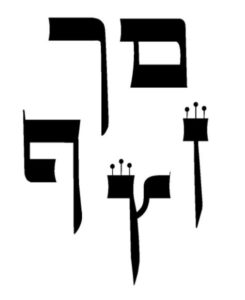
These five questions (mekoshesh, nokev, tzelofchad, pesach sheni, kozbi) correspond to the five special Hebrew letters that have a distinct symbol when they appear at the end of a word: The “open” mem (מ) becomes a “closed” mem sofit (ם) while the “bent” nun (נ) becomes a “straight” nun sofit (ן), just as the “bent” tzadi (צ) becomes a “straight” tzadi sofit (ץ). The “coiled” pei (פ) and khaf (כ) unravel into the straight pei sofit (ף) and khaf sofit (ך). Together, these five unique letters are referred to by the acronym מנצפ״ך, “mantzepach”, and carry a tremendous amount of meaning. What is the origin and purpose of these special letters? Continue reading →