
Author Archives: Efraim Palvanov

Who Entered the Holy Land?

In this week’s parasha, Shlach, we read about the infamous incident of the Spies and the resulting decree that Israel would have to wander in the Wilderness for forty years:

In this desert, your corpses shall fall; your entire number, all those from the age of twenty and up, who were counted, because you complained against Me. You shall [not] come into the Land concerning which I raised My hand that you would settle in it, except Caleb the son of Yefuneh and Joshua the son of Nun… Your children shall wander in the desert for forty years and bear your defection until the last of your corpses has fallen in the desert. According to the number of days which you toured the Land forty days, a day for each year, you will bear your iniquities for forty years; thus you will come to know My alienation. (Numbers 14:29-34)

The plain reading suggests that of all the adults—those over the age of twenty—only Caleb and Joshua merited to enter the Holy Land. Yet, we see from other verses and sources that a number of additional people merited this as well. Who actually entered the Holy Land after the forty years in the Wilderness? Continue reading
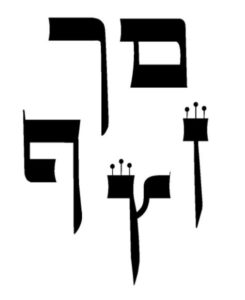
Secrets of the Five Special Sofit Letters

In this week’s parasha, Beha’alotcha, we read how a year had passed since the Israelites had left Egypt, and God was now reminding the nation to commemorate Pesach. However, some people were spiritually impure at Pesach time because they had handled a corpse and were unable to take part in the Paschal offering. They approached Moses and asked “why should we be excluded so as not to bring the offering of the Lord in its appointed time, with all the children of Israel?” (Numbers 9:7) Moses was not sure how to answer them, so he took the case up to God, after which God told Moses about Pesach Sheni, the “second Passover” that could be done a month later in Iyar for those who had missed Passover in Nisan.

This episode is one of five times in the Torah when Moses was “stumped” by a question and had to consult God. The first was in Leviticus 24:11-12 with the case of the man who had blasphemed (nokev) God’s Name. The Pesach Sheni question posed above was the second. The third was the case of the mekoshesh etzim, the “wood-gatherer” on Shabbat (Numbers 15:32), followed by the Midianite episode when Zimri and Kozbi were involved in a public display of indecency (Numbers 25). The last was with the five daughters of Tzelofchad who wondered about their inheritance (Numbers 27).

These five questions (mekoshesh, nokev, tzelofchad, pesach sheni, kozbi) correspond to the five special Hebrew letters that have a distinct symbol when they appear at the end of a word: The “open” mem (מ) becomes a “closed” mem sofit (ם) while the “bent” nun (נ) becomes a “straight” nun sofit (ן), just as the “bent” tzadi (צ) becomes a “straight” tzadi sofit (ץ). The “coiled” pei (פ) and khaf (כ) unravel into the straight pei sofit (ף) and khaf sofit (ך). Together, these five unique letters are referred to by the acronym מנצפ״ך, “mantzepach”, and carry a tremendous amount of meaning. What is the origin and purpose of these special letters? Continue reading

The Mystery and Mysticism of the Essenes

On the festival of Shavuot it is customary to stay up all night learning Torah and showing our devotion to God’s Word. Previously, we traced the origins of this custom to the Kabbalists of Tzfat in the 16th century, based on the teachings of the Zohar that date back to Rabbi Shimon bar Yochai in the 2nd century CE. However, there is actually one more historical mention for a tikkun leil Shavuot, of sorts, that predates Tzfat, the Zohar, and even Rashbi. The first-century Jewish sage and philosopher, Philo of Alexandria (c. 20 BCE – 50 CE), describes a ritual where certain Jews would stay up all night on Shavuot:

And after the feast they celebrate the sacred festival during the whole night; and this nocturnal festival is celebrated in the following manner: they all stand up together, and in the middle of the entertainment two choruses are formed at first, the one of men and the other of women, and for each chorus there is a leader and chief selected, who is the most honourable and most excellent of the band. Then they sing hymns which have been composed in honour of God in many metres and tunes, at one time all singing together, and at another moving their hands and dancing in corresponding harmony and, uttering in an inspired manner, songs of thanksgiving…

The ideas were beautiful, the expressions beautiful, and the chorus-singers were beautiful; and the end of ideas, and expressions, and chorus-singers was piety; therefore, being intoxicated all night till the morning with this beautiful intoxication, without feeling their heads heavy or closing their eyes for sleep, but being even more awake than when they came to the feast, as to their eyes and their whole bodies, and standing there till morning, when they saw the sun rising they raised their hands to heaven, imploring tranquillity and truth, and acuteness of understanding. (On the Contemplative Life, XI, 83-89)

Philo calls this sect of Jews the Essenes, or the Therapeutae, the “Healers”. They have become more well-known in recent decades because of their association with the Dead Sea Scrolls. Who were the Essenes? What did they believe? Why did they stay up all night on Shavuot? And how did they come to influence Kabbalah and other mystical movements? Continue reading