Category Archives: Holidays

Why Tu B’Av Is More Important Than Yom Kippur

This week’s Torah portion is Va’etchanan, which begins with Moses’ many prayers to God, and famously includes both an account of the Ten Commandments, and the Shema. It also happens that this Friday we celebrate the little-known holiday of Tu B’Av (literally, the fifteenth day of the month of Av). Upon closer examination, the parasha and the holiday are quite deeply related.

The Talmud (Ta’anit 26b) states:

Rabban Shimon ben Gamaliel said: there were no days more joyful in Israel than the fifteenth of Av and Yom Kippur. On these days, the daughters of Jerusalem used to go out in white garments, which they borrowed in order not to put to shame anyone who had none… The daughters of Jerusalem came out and danced in the vineyards exclaiming at the same time, “Young man, lift up your eyes and see what you choose for yourself. Do not set your eyes on beauty, but set your eyes on [good] family…”
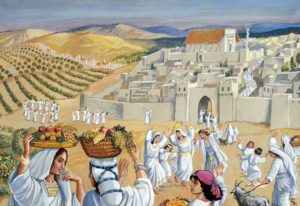
Young Girls Dancing on Tu B'Av (Courtesy: Temple Institute)

Young Ladies Dancing on Tu B’Av (Courtesy: Temple Institute)

In ancient times, Tu B’Av was a day of speed-dating, matchmaking, and engagements. It is easy to see why Tu B’Av has become associated with love and romance, and is often referred to today as a “Jewish Valentine’s Day”. While this is true, a careful reading will reveal that the holiday actually has far more to do with the fact that the daughters of Jerusalem loved one another, going out in the same white garments to avoid shaming each other. Tu B’Av celebrates a much greater power of love, one that holds the cure for the ails of the solemn Tisha B’Av that was commemorated just days earlier.

Why is Tu B’Av Special?

The Talmud (Ta’anit 30b-31a) asks: why does the Mishnah above compare Tu B’Av to Yom Kippur? We can understand why Yom Kippur is a special day – since it was then that God forgave the Israelites for the sin of the Golden Calf and gave a new set of Tablets – but why Tu B’Av? The question is answered with a list of significant historical events that happened on the 15th of Av.

First among them is the day when the prohibition for people of different Israelite tribes to marry each other was repealed. Initially, during the settlement of the Holy Land, people married only within their own tribe to avoid situations where parcels of land might unfairly be transferred to a different tribe. Eventually, this ban was lifted, allowing anyone to marry whomever they wanted. Once again, we see the theme of love associated with Tu B’Av.

The Talmud goes on to list a number of other events, the most salient of which is that on this day, the “generation of the Wilderness ceased to die out.” After the sin of the Spies, God decreed that the Israelites would wander in the Wilderness for forty years until the entire adult male generation passed away. In the fortieth year, the last of that generation passed away on the fifteenth of Av, allowing the nation to finally move on from the sin of the Spies. (Some say the last group of men was actually spared from death on Tu B’Av, turning that day into a celebration.)

Here, the Talmud cites a teaching that ever since the sin of the Spies, God had stopped speaking to Moses directly. Instead, Moses received visions from God just like any other prophet. On Tu B’Av, after nearly forty years, God once more resumed speaking to Moses “face-to-face”. Tu B’Av was the day Moses reclaimed his status as the greatest of prophets, the only one who spoke to God in a fully conscious state.

Where in the Torah do we see that God resumed speaking to Moses in this way? The Pnei Yehoshua comments that this happened in our weekly parasha, Va’etchanan. After Moses’ incessant prayers, God finally reappeared to him. And so, we see yet again the theme of love on Tu B’Av; this time, though, not love between people, but between God and man.

One Love

It is in this week’s parasha that we are commanded to “love Hashem, your God, with all of your heart…” Earlier in Leviticus we were given the mitzvah to “love your fellow as yourself.” While the latter is understandable, how exactly is one supposed to love God? God is the eternal, all-encompassing, omnipotent, omniscient, omnipresent force within all of Creation, and everything that infinitely lies beyond. The Kotzker Rebbe once rightly observed that “one who does not see God everywhere, does not see God anywhere.” How does one love such a transcendent Being?

Our Sages teach something incredible. The full verse in Leviticus states, “And you shall love your fellow as yourself, I am Hashem.” Why finish with “I am Hashem”? The verse would have stood well on its own without that last part! The juxtaposition of words can teach us that that loving your fellow is loving Hashem. In fact, the numerical value of the whole verse (ואהבת לרעך כמוך אני יי) is 907, equivalent to “love Hashem, your God” (ואהבת את יי אלהיך)! If God is found within each person, and within each creation, then loving every person and every creation is loving God.

This is all the more important on Tu B’Av which, not coincidentally, comes immediately after Tisha B’Av, a day commemorating a Temple destroyed because of sinat chinam, baseless hatred, and absence of love between fellows. When the Jews of the Second Temple period stopped loving each other, it was clear that they had stopped loving God, and God destroyed His Temple.

Tu B’Av is the antidote to Tisha B’Av. It is quite ironic that while many mourn and wail on Tisha B’Av, few pay much attention to the far more significant message of Tu B’Av. It is Tu B’Av that should be carefully observed and loudly celebrated. After all, the Mishnah goes so far as to place Tu B’Av on the same pedestal as Yom Kippur! That makes it even more ironic, as the majority of Jews observe Yom Kippur in some way, yet have little knowledge of Tu B’Av which, in reality, is just as important as Yom Kippur, and perhaps even more so:

The Mishnah ends by suggesting that while the Temple was destroyed on Tisha B’Av, it will be rebuilt on Tu B’Av, for just as the “daughters of Zion” would go out on Tu B’Av, they will go out once more in the “day of the building of the Temple, may it be rebuilt speedily and in our days.”


The article above is adapted from Garments of Light – 70 Illuminating Essays on the Weekly Torah Portion and Holidays. Click here to get the book!

Tisha B’Av: Why Are We Still Mourning?

This week’s Torah portion is Devarim, which begins the fifth and final book of the Torah. This book (Deuteronomy), is written from the perspective of Moses, and summarizes much of what the Torah discussed earlier. At the same time, it also introduces many new mitzvot, and reveals deeper insights into the Torah’s previous narratives. For example, while the book of Numbers told us that Moses was forbidden to enter the Holy Land because he disobeyed God in striking the rock, here we are told that Moses was forbidden to enter the Land because of the incident of the Spies! (1:22-38) How do we reconcile these differences? The answer can actually be found in next week’s parasha, Va’etchanan.

Va’etchanan (literally “and I beseeched”) describes how Moses begged God to allow him to enter the Holy Land. The Talmud (Berachot 32b) states that Moses prayed so much that God actually relented and forgave him for striking the rock. However, it would have been wrong for Moses to enter the Holy Land at that time, considering that the rest of the men were condemned to perish in the Wilderness because of the sin of the spies. After all, Moses was their leader. Could a shepherd abandon his flock? Would a captain abandon his sinking ship? So, Moses didn’t enter the land not because of the rock, but because of the spies.

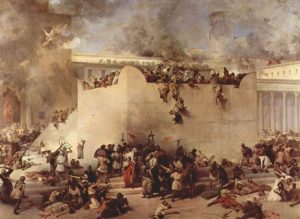
'Destruction of the Temple of Jerusalem' by Francesco Hayez (1867)

‘Destruction of the Temple of Jerusalem’ by Francesco Hayez (1867)

This is all the more pertinent now with Tisha B’Av right around the corner. Tisha B’Av commemorates the destruction of both Holy Temples in Jerusalem, along with a handful of other tragedies said to have happened on, or around, that date – the ninth of the month of Av. According to tradition, the origins of Tisha B’Av lie in the incident of the spies. It was on that day that the spies returned from the land of Israel, and reported negatively about the people’s chances of conquering the land. The faithless nation feared and cried needlessly on that day so, it is said, God subsequently gave the nation many good reasons to truly fear and cry on that day throughout history.

The Problem with the 9th of Av

There are many problems with this classic narrative. First of all, why would God punish generations far in the future for the sins of that one generation long ago? Deuteronomy 24:16 itself states clearly that “Parents shall not be put to death because of their children, nor children because of their parents. Each person shall be put to death for their own crime.” While the Torah does also mention a number of times that God “carries over the iniquity of the fathers onto the children to the third and fourth generations”, the phrase concludes by saying this is only true to those that “hate Him”. In any case, it is only to the third and fourth generations, not millennia into the future! Even so, the Talmud (Makkot 24a) says the prophet Ezekiel came and repealed this divine decree anyway:

Said Rabbi Yose bar Chanina, “Moses pronounced four decrees upon Israel, which four prophets came and cancelled.”
…Moses said, “carries over the iniquity of the fathers onto the children…” (Exodus 34:7) Ezekiel came and cancelled it: “The one who sins will die.” (Ezekiel 18:14)

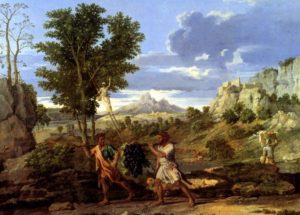
'The Spies With The Grapes Of The Promised Land' by Nicolas Poussin (1664)

‘The Spies With The Grapes Of The Promised Land’ by Nicolas Poussin (1664)

Second of all, did the spies really return on the 9th of Av? The Talmud (Ta’anit 29a) calculates that the spies went forth on the 29th of Sivan and returned forty days later on the 9th of Av. However, the Torah tells us that the spies went to Israel at the start of the grape harvest (Numbers 13:20) and the same tractate of Talmud (Ta’anit 30b) states that the grape harvest season lasted from the 15th of Av until Yom Kippur! How could the spies have returned on the 9th of Av when the grape harvest only began on the 15th? (A simple Google search reveals that the ideal time for grape harvest is September-October, which is right between the 15th of Av and Yom Kippur.)

On the same note, when exactly were the Temples destroyed? The Tanakh tells us that “in the fifth month, on the seventh day of the month, which was the nineteenth year of King Nebuchadnezzar, king of Babylon, came Nebuzaradan, the captain of the guard, a servant of the king of Babylon, to Jerusalem. And he burned the house of Hashem, and the king’s house…” (II Kings 25:8-9) This verse suggests the First Temple was destroyed on the 7th of Av.

Another verse in the Tanakh tells us that “in the fifth month, in the tenth day of the month, which was the nineteenth year of King Nebuchadnezzar, king of Babylon, came Nebuzaradan, the captain of the guard, who stood before the king of Babylon, to Jerusalem; and he burned the house of Hashem, and the king’s house…” (Jeremiah 52:12-13) The verse is nearly identical, except that this one says Nebuzaradan came on the 10th and destroyed the Temple.

We have the 7th of Av and the 10th of Av, but no 9th! The Talmud (Ta’anit 29a) notes this contradiction and tries to reconcile it this way: “On the seventh the heathens entered the Temple and ate therein and desecrated it throughout the seventh and eighth, and towards dusk of the ninth they set fire to it and it continued to burn the whole of that day [the tenth].” Rabbi Yochanan goes on to say that if it were up to him, the mourning day would be the 10th of Av, not the 9th, since this is when the Temple was mostly destroyed.

And what about the Second Temple? Josephus lived through its destruction, and later wrote about it in detail. He says that it was destroyed on the 10th of Av, and writes that the Jews mourn its destruction on the same day that they mourn the destruction of the First Temple. However, he seems to admit that he is uncertain about the exact dates that the Temples fell.

What does the Talmud say? It, too, is uncertain, but concludes that since “good things tend to happen on good days, and bad things on bad days,” it is assumed that the Second Temple was destroyed on the same day as the First Temple!

Postponing, Abolishing, or Redefining?

This year, Tisha B’Av falls on Shabbat, so the fast is postponed, appropriately, to the 10th. While Rabbi Yochanan felt that the 10th is the correct day to fast anyway, Rabbi Yehudah HaNasi – the great redactor of the Mishnah – wanted to have the fast of Tisha B’Av abolished completely! Some say this was only when Tisha B’Av falls on Shabbat and needs to be postponed, while others say he wanted it gone entirely (Megillah 5b).

This idea has been echoed in modern times. The primary reason for mourning on Tisha B’Av is because of Jerusalem’s destruction and the Jewish people’s exile. Today, the Jewish people have returned to the Holy Land and have rebuilt Jerusalem. While there’s no Temple just yet, we are free to travel to, and settle in, the Holy City whenever we wish. Why are we still mourning?

Perhaps Rabbi Yehudah felt the same way. In his day, Jews had also returned to Jerusalem and enjoyed relatively good terms with the Romans. Rabbi Yehudah himself was friends with the Caesar known in the Talmud as ‘Antoninus’ (possibly the Emperor Marcus Aurelius, or maybe a local Roman governor).

Meanwhile, far worse tragedies have befallen the Jewish people since then: crusades, inquisitions, pogroms, the Holocaust, and the list goes on. Why focus on the temples and Jerusalem when there are more recent, greater tragedies? Indeed, former Israeli Prime Minister Menachem Begin intended to combine all the days of commemoration, and move Holocaust Remembrance Day and Israel’s Memorial Day to Tisha B’Av.

Perhaps this is what Tisha B’Av should be: one day to remember all of the suffering that has troubled the Jewish people, and all the suffering that continues to plague the world. A day to remind us that Mashiach has not come yet, the Temple is not yet rebuilt, and the world is not yet whole. A day to ask ourselves: what exactly are we doing to hasten the arrival of that magnificent, forthcoming time? What are we doing that will finally put an end to all the mourning? Tisha B’Av should be a day not about drowning in the sad tears of the past, but about actively working towards the happy tears of the future.

And this is precisely what Rabbi Akiva told his colleagues when they saw the ruins of the Temple. While Rabban Gamliel, Rabbi Elazar ben Azariah, and Rabbi Yehoshua ben Chananiah immediately fell into a bout of weeping, Rabbi Akiva was laughing. Surprised, they asked him to explain himself. He told them that while they were dwelling on the destruction of the first and second temples, he was dwelling on the vision of the coming Third Temple. The rabbis responded – and with this the tractate ends – “Akiva, you have consoled us! Akiva, you have consoled us!”

Yom Ha’Atzmaut: Uniting the Secular and the Religious

The 5th of Iyar is Yom Ha’Atzmaut, Israel’s Independence Day. It was on this day in 1948 that David Ben-Gurion proclaimed the establishment of the State of Israel. Immediately, the armies of three neighbouring Arab states—Egypt, Jordan, and Syria—declared war and invaded. Iraq and Saudi Arabia sent in additional forces. Lebanon assisted them, too. Yemen, Pakistan, and Sudan sent even more fighters. On top of that, there were fighters of the Holy War Army, essentially a local Arab militia composed of over 1,300 troops, as well as the Arab Liberation Army, with over 6,000 troops from various Arab states. Despite being completely surrounded, outnumbered, and outgunned, the nascent State of Israel miraculously destroyed its enemies in just under ten months.

The miracles did not stop there. In 1967, Egypt, Syria, Jordan, and Iraq amassed 550,000 troops to “drive Israel into the sea.” With less than half of those numbers, Israel launched a pre-emptive strike that decimated the Arab forces in six days. Jerusalem was reclaimed, allowing Jews to visit their most holy sites for the first time in centuries. The miracles continued through the Yom Kippur War of 1973, and even through the 1991 Gulf War (which Israel did not directly take part in), and continue to this day. Ben-Gurion’s famous words are fitting: “In Israel, in order to be a realist, you must believe in miracles.”

Despite the fact that Jews once more have an independent state that is strong and prosperous (for the first time since the Maccabees defeated the Greeks and established the Hasmonean kingdom over 2000 years ago) there have been some, particularly in the Ultra-Orthodox Jewish world, that have opposed the State. This opposition comes in various degrees, from those that simply don’t support the secular government; to those that refuse to participate in state programs, military or national service, and the like; to those that completely side with anti-Israel groups bent on annihilating the State. Although, of course, the State of Israel is far from perfect, and its secularization often takes reprehensible forms, opposing the State makes little sense, particularly in light of what Jewish holy texts tell us.

Meanwhile, the ultra-secular elements in Israel, who strive to expunge Judaism, make even less sense, considering that the only claim Jews have to the land is tied to the Torah—the fact that God gave us this land, and we are its indigenous people, inhabiting it since Biblical times. Without the Tanakh, what claim does a secular person have to live in Israel? Moreover, many secular Israelis are blinding themselves to the miracle that is Israel, failing to see God’s hand in every step of its history.

By properly exploring Israel’s miraculous existence, perhaps the gap between the secular and the religious may be bridged. The former can come to see the validity and truth of God and His Torah, while the latter can come to see the State of Israel as a fulfilment of Biblical prophecy.

Prophecy Fulfilled

A look through history makes it clear: if it were not for God’s incredible miracles, the State of Israel would have never gotten off its feet, nor would it have survived to this day. God promises us in the Torah that “five of you shall chase a hundred, and a hundred of you shall chase ten thousand; and your enemies shall fall before you by the sword.” (Leviticus 26:8) This is precisely what has happened in every single war that Israel has participated in. In 1948, Israel tragically suffered 6,000 casualties, while the Arabs suffered over 20,000. In 1967, Israel suffered as many as 983, but the Arabs over 24,000. In 1973, Israel was surprise-attacked on Yom Kippur, completely unprepared for battle, faced with an invasion that had over one million troops from literally all over the world, including nearly 4,000 from Cuba! In comparison, Israel had 400,000 at best, reservists included. The highest estimates place 2,800 Israeli casualties, compared to 20,000 for the attackers.

In one well-known incident from this war, 150 Syrian tanks went up against just 7 remaining Israeli tanks left with no ammo in the “Valley of Tears” of the Golan Heights. Just as Israeli commander Avigdor Ben-Gal prepared to send a message saying his forces could no longer hold on, the Syrians suddenly retreated in a panic. All in all, Israel lost around 60 tanks in the Valley of Tears; the Syrians lost over 500. To this day, military analysts are puzzled by the Syrian withdrawal. Many theories have been proposed, including that the Syrians thought it must be an ambush, or even that higher up in the government Israel had threatened Syria with a nuclear strike. One Syrian soldier would later reveal what may have been the real reason: they thought they had been swarmed by an army of angels!

It isn’t just in military victories that God has clearly blessed the State. In under 70 years, Israel has flourished and is among the most developed and prosperous countries in the world. Isaiah prophesized:

The wilderness and the parched land shall be glad; and the desert shall rejoice, and blossom as the rose. It shall blossom abundantly, and rejoice… they shall see the glory of Hashem, the excellency of our God. (Isaiah 35:1-2)

Indeed, Israel and its once-parched lands have blossomed abundantly. Israel is now self-sufficient in its food production (meaning no one will starve if Israel stops all imports of food) and exports over $1.3 billion in food every year.

Israel famously exports a great deal of innovation and technology, too, and is a global leader in science. Its high-tech sector, nicknamed “Silicon Wadi”, is second only to Silicon Valley. Despite its short existence, Israel ranks 12th in per capita Nobel Prizes—higher than Canada and the US, Germany, France, and the entire European Union for that matter. There are nearly 400 million Muslim Arabs across 22 countries, and altogether they account for just 7 Nobel Prizes (of which two were “peace” prizes for terrorist-sponsors Anwar Sadat and Yasser Arafat!) while some 6 million Jews in Israel alone have won 12 Nobel Prizes. There is no doubt that Israel, with God’s blessing, has lived up to the Biblical ideal of being a “light unto the nations.” (Isaiah 42:6)

History makes it clear that the establishment and survival of the State of Israel is nothing short of a divine miracle, and would not happen were it not for God’s support and supervision. Before Moses passed away, he sang his final song to the people, and told them: “Remember the days of old, understand the years of past generations.” (Deuteronomy 32:7) Consider the historical facts: does history not make it so plainly obvious? “How could one chase away a thousand… if not for Hashem who delivers them up?” (Deuteronomy 32:30) Is it logical that 7 tanks can scare off 150? That a million invaders can be subdued by mere thousands? That a nation so soon back from the brink can rebuild such a prosperous state in a barren desert so quickly? And that it was all prophesied long ago, as Ezekiel foresaw that “in the End of Years” the Jews people shall return to their land, coming back from “the sword, gathered from among many peoples, [returning] upon the mountains of Israel, which have been a continual waste…” (Ezekiel 38:8) Is it not obvious that God is pulling the strings?

Uniting in Righteousness

Finally, the Torah also tells us a well-known principle: the land of Israel is holy, and “vomits out” anyone who does not deserve to live there. In light of this, the great Moroccan sage Rabbi Avraham Azulai (c. 1570-1643) wrote in his Chessed L’Avraham (Ma’ayan 3, Nahar 12):

And you should know, every person who lives in the Land of Israel is considered a tzadik, including those who do not appear to be tzadikim. For if he was not righteous, the land would expel him, as it says “a land that vomits out its inhabitants.” (Leviticus 18:25) Since the land did not vomit him out, he is certainly righteous, even though he appears to be wicked.

Thus, as a general rule, all Israelis—secular and religious—are deemed righteous in their own way, and for any one side to label the other as “wicked” is incorrect. We mustn’t forget that the Holy Temple was destroyed because of sinat hinam, baseless hatred and incessant infighting. Instead of opposing one another, we should all strive to support one another, to understand each other, and make Israel—the one homeland that we all have—the best that it can be. Then we will be able to realize the prophecy of Isaiah:

I will set your stones in fair colours, and lay your foundations with sapphires. And I will make your pinnacles of rubies, and your gates of carbuncles, and all your border of precious stones. And all your children shall be disciples of God, and great shall be the peace of your children… (Isaiah 54:11-13)


The above is an excerpt from Garments of Light, Volume Two. Get the book here