Category Archives: Mysteries & Origins

The Legend of Azazel: Scapegoat, or Fallen Angel?

The parashot of Acharei Mot and Kedoshim are typically read together. The major part of Acharei deals with various sacrificial services, most notably those concerning Yom Kippur, the Day of Atonement. Kedoshim begins by telling us that it is every person’s mission in life to become holy, just as God Himself is holy. This parasha is concerned with ethics, morality, and the path to righteousness, and includes the famous dictum to “Love your fellow as yourself” (Leviticus 19:18).

Perhaps the most peculiar item in this week’s portion is the mention of Azazel. As part of the atonement procedure on Yom Kippur, God commands Aaron to select (through a random lottery) two goats: one to be sacrificed, and another to be sent “to Azazel, in the wilderness” (Lev. 16:10). Aaron would place his hands on the goat to Azazel, and confess all of the people’s sins, as if transferring them to the animal (v. 21). The goat was then sent off into the wilderness.

The Rambam (Moreh Nevuchim, Part III, Ch. 46) writes that this act is completely symbolic. It does not mean that the High Priest literally transferred the people’s sins onto the goat, but that witnessing this act was meant to inspire a sense of repentance in the people, “as if to say, we have freed ourselves of our previous deeds, have cast them behind our backs, and removed them from us as far as possible.”
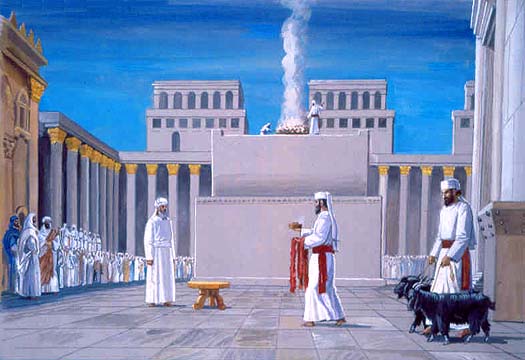
Temple Priests Bringing the Two Goats on Yom Kippur

Temple Priests Bringing the Two Goats on Yom Kippur

But what exactly is “Azazel”? What does the word mean? And why was the goat that symbolized sin sent towards it? The Talmud (Yoma 67b) maintains that the word Azazel can be broken down to mean “hardest of mountains”. This may be why some believe that the goat was sent off the edge of a mountainous cliff down to its death. The Talmud then presents the opinion of the school of Rabbi Ishmael: Azazel is a contraction of two names: Aza (or Uza) and Aza’el, and the goat atones for their sins. Other than this short allusion, this page of Talmud says nothing more.

Who were Aza and Aza’el?

The Fallen Angels

The origins of Aza and Aza’el are described in the Midrash (Yalkut Shimoni, Beresheet 44). When speaking of midrashic literature, it is important to remember the old adage that goes something like: one who believes that midrash is not true is a heretic, but one who believes that midrash is literally true is a fool. After all, the midrash corresponds to the third level of Torah study, referring to the metaphorical and allegorical level. (The other levels are peshat, the literal meaning; remez, the sub-textual meaning; and sod, esoteric/metaphysical secrets.)

Aza’el and Aza (also known as Shemhazai) were angels who saw the terrible sins of the people in the pre-Flood generation and scoffed at the pathetic humans. God told them that if they had been on Earth and given free will, they would succumb to their evil inclination far worse than people do. The angels wanted to prove God wrong, and asked Him to send them down to Earth into a physical body. God complied, and just as He had said, the angels quickly fell into all forms of evil.

Firstly, they could not hold back from the beautiful women, and this is what Genesis 6:2 means when it refers to divine beings mating with humans. The Midrash continues to say that it was these angels that taught women the art of makeup and provocative dress in order to entice men into further sin. These angels helped to bring the sword to the world, increasing bloodshed and warfare, as well as the consumption of animal meat, which was at this point forbidden, as God had only permitted Adam and Eve to consume fruits and vegetables.

Ultimately, the Midrash tells us that Shemhazai recognized his evil ways, and began a long process of repentance. No longer on Earth, but still not welcome back in the Heavenly realms, Shemhazai was suspended between the two worlds. Aza’el, on the other hand, refused to repent, and continued his evil ways. Thus, the Midrash concludes that the High Priest, in an act of repentance, would symbolically send the people’s sins towards Azazel, the one who taught mankind a new level of sinfulness, and refused to repent.

More details can be found in the Apocrypha. The Apocrypha refers to various ancient books which were not officially included in the Tanakh. Their origins are unclear, as is their authenticity. Nonetheless, they appear to have been well-known among the Jewish Sages, and are referenced in Talmud, Midrash, and Kabbalistic writings. One of the most famous of the apocryphal books is the Book of Enoch, which describes the journeys of Enoch (Hanoch, in Hebrew), who is briefly mentioned in Genesis 5:22. In the Book of Enoch, it is recorded that God sent the angel Raphael to apprehend Aza’el and stop his evil ways. Aza’el was chained to the “hardest of mountains” in the wilderness, as the Talmud quoted above explained. His painful imprisonment was a punishment, and the goats sent his way were a form of atonement for his sins. It is written there that at the End of Days, his time will come to an end, and Aza’el will finally be gone for good.


The above article is an excerpt from Garments of Light: 70 Illuminating Essays on the Weekly Torah Portion and Holidays. Click here to get the book! 
The Guardian Angels and Hybrid Beasts Known as Cherubs

Terumah relays God’s instructions to the Israelites for constructing the Mishkan, the Holy Tabernacle. The most important part of this elaborate structure was undoubtedly the Aron HaKodesh, the Ark of the Covenant. Throughout the centuries, this gold-plated Ark has often been depicted in art, history, and even film (most notably with Indiana Jones in Raiders of the Lost Ark). However, what the Ark actually looked like is hard to discern. The Ark disappeared two and a half thousand years ago when the First Temple was destroyed. Since then, many different versions and interpretations for its appearance have been proposed, both by Jewish Sages and secular scholars.

The issue is not so much with the Ark itself, since the Torah is pretty clear on its description: a box two and a half cubits long, one and a half cubits wide, and one and a half cubits high, made of wood and plated with gold from the inside and out. (A cubit is roughly two feet long.) What’s not so clear is the Ark’s cover, with its two golden Cherubs.

What is a “Cherub” (kruv, in Hebrew)? The only descriptor the Torah gives is that the Cherubs had wings. Rashi, drawing from the Talmud, comments on Exodus 25:18 that they had the face of a child. The Torah describes the two as being set on the cover ish el echav, literally “a man facing his brother”. This suggests a human form to the Cherubs, along with their child-like face and wings. Indeed, this is how the Cherubs are generally depicted. The reality may be quite different, though. A look at the historical and Biblical evidence may shed some more light as to the true identity of the Cherubs.

The Evidence

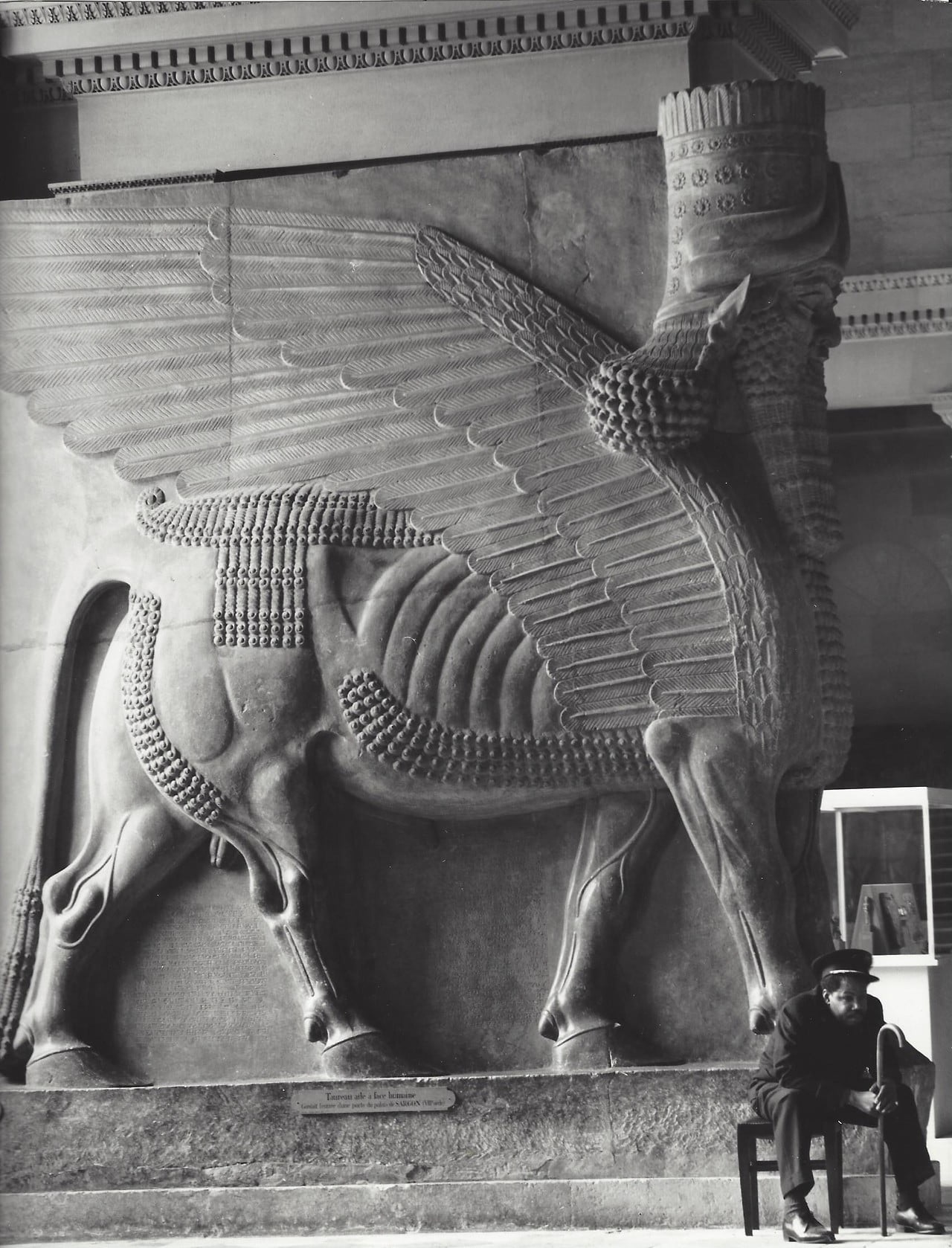
A similar word for the Hebrew term kruv is found across the languages of the Ancient Near East: kuribu in Akkadian, karabu or kirubu in Babylonian and Assyrian. These refer to very large statues placed at entrances to important venues which served as guardians. They had the body of a bull or lion, with wings, and a human head. At times, they were worshipped as guardian deities.

This parallels the Torah’s original description of Cherubs. The very first time Cherubs appear is in Genesis 3:24. Following Adam and Eve’s banishment from the Garden of Eden, God placed Cherubs to guard the entrance to Eden so that man could not return. Like the Mesopotamian kuribu, the Cherubs are guarding an entrance.

All of this is reminiscent of a famous passage in the Tanakh: Ezekiel’s Vision of the Chariot.This could be why the Cherubs were placed atop the Ark, again as guardians of the holy vessel. When the Tanakh describes how King Solomon built the Temple in Jerusalem (I Kings, chapter 6), it states that Solomon had two massive ten-cubit high Cherubs placed at the entrance to the Holy of Holies (the room in which the Ark of the Covenant was kept). The following chapter describes them as kruvim arayot, “Cherub-Lions” (7:36). Not only do we once again see the Cherubs as guarding an entrance, but we now have some evidence that the Cherubs had a lion-like appearance, just as the Mesopotamian kuribu (or lamassu) often had.

Kuribu were also known as lamassu. This is a photo by Kees Scherer, taken in the Louvre Museum in 1968, of a massive lamassu statue from King Sargon II’s palace, dated back to the 8th century BCE. It is from nearly the same time period as King Solomon’s giant Cherubs, which would have been about the same size.

Ezekiel’s Chariot

In the first chapter of the Book of Ezekiel, we are given a detailed description of the Merkavah, the Divine Chariot:

And I looked, and, behold, a stormy wind came out of the north, a great cloud, with a fire flashing up, a brightness was all around it; and from within the appearance of electrum, out of the midst of the fire. And from within it came the likeness of four living creatures. And this was their appearance: they had the likeness of a man. And every one had four faces, and every one of them had four wings. And their feet were straight feet; and the sole of their feet was like the sole of a calf’s foot… As for the likeness of their faces, they had the face of a man; and all four had the face of a lion on the right side; and all four had the face of an ox on the left side; all four had also the face of an eagle.”
(Ezekiel 1:4-10)

Ezekiel describes his angelic vision, with winged figures that have attributes of a lion, an ox, an eagle, and the appearance of a man. The figures are part of the Divine Chariot, again serving as sentries or guardians.

This description allows us to potentially synthesize the Torah’s description of Cherubs with the historical and Biblical evidence: human-like winged creatures with aspects of a lion and a bull or ox. Although Cherubs are not explicitly mentioned in Ezekiel’s account, the Merkavah shares the same root letters (k-r-v or r-k-v) as Cherubs, kruvim.

We can draw further proof from the Psalms 18:11, which states that God “rode upon a Cherub, and flew, and swooped down upon the wings of the wind,” as well as from II Samuel 22:11, which says God “rode upon a Cherub, and flew, and was seen upon the wings of the wind.” Clearly, the Cherubs are associated with the Divine Chariot upon which God rides, as described by Ezekiel.

So, are the Cherubs innocent child-like, winged angels—as commonly depicted in artwork—or are they powerful Heavenly guardians with the hybrid qualities of various majestic beasts?


The above is an excerpt from Garments of Light, Volume Two. Get the book here

Yosef and Yuya: Does Archaeological Evidence Prove the Biblical Narrative of Joseph?

In 1905, British Egyptologist James Quibell discovered a new tomb in the famed Valley of the Kings, where many of Egypt’s greatest mummified pharaohs were found. In this tomb were the bodies of two highly-preserved mummies, one male and one female: Yuya and Tjuyu. Scholars were astounded at the grand way in which Yuya was described: “the king’s lieutenant”, “master of the horse”, “superintendent of cattle”, and even, strangely, “father of the god”. Most amazingly, though, was the fact that Yuya was buried in the Valley of the Kings, despite never having been a pharaoh! Yuya was a unique and puzzling archaeological find. Who was he?

Father of the King

Parashat Miketz (Genesis 41:1-44:17) describes how Joseph rose to power in Egypt. It begins with Pharaoh’s bizarre string of nightmares, which none of his soothsayers were able to interpret. The royal cupbearer then informs Pharaoh that while he was in prison, a “Hebrew youth” was able to precisely interpret his dreams. Pharaoh summons the Hebrew youth – Joseph – who is indeed able to properly interpret Pharaoh’s dreams. The Sages tell us that Joseph’s interpretation was unique: it not only interpreted the dreams, but simultaneously offered the ideal solution for the problems that the dreams presented. Highly impressed, Pharaoh appointed Joseph as the prime minister of Egypt:

And Pharaoh said to his servants: “Can another man like this be found, in whom the spirit of God rests?” Then Pharaoh said to Joseph, “Since God has let you know all this, there is no one as understanding and wise as you. You shall be [head] over my house, and through your command all my people shall be nourished; only [with] the throne will I be greater than you… I have appointed you over the entire land of Egypt.” And Pharaoh removed his ring from his hand and placed it on Joseph’s hand, and he clothed him with garments of fine linen, and he placed the golden chain around his neck. And he had him ride in his secondary chariot, and they called out before him, “Avrekh!” appointing him over the entire land of Egypt. (Genesis 41:39-43)

Rashi explains that the term Avrekh is a contraction of av, “father”, and rikha, “king”, in other words, Joseph was called aba malka, “father of the king”, or “father of the pharaoh”.

We are then told how Joseph stockpiled food during the seven years of plenty, carefully mapping out a strategy to survive the coming years of famine. Not only did he plan for Egypt’s survival, but he ensured that Egypt would have enough to sell to all of the neighbouring nations and kingdoms that would also be affected by the great famine. Through this, he was able to make Egypt the wealthiest empire on the planet, turning what should have been seven years of hardship into seven years of immense prosperity.

No doubt, such a person would certainly be immortalized in Egypt’s history as one of its greatest leaders. In fact, the archaeological record appears to suggest that he may have been after all.

The Mystery of Yuya

Historians have uncovered a great deal of information about Yuya since the discovery of his tomb in 1905. He lived during the Eighteenth Dynasty of Egypt (1543-1292 BCE), and was an influential minister in the Pharaoh’s court. Strangely, his name is not of Egyptian origin, nor is his appearance. Many scholars believe he must have been a foreigner. He is described as being in charge of the horses and chariots, as well as the cattle. He is also titled “father of the god”, or more accurately, “father of the pharaoh” (since the pharaohs considered themselves gods). It isn’t difficult to see that Yuya is described in terms almost identical to the way that Joseph is described in the Torah.

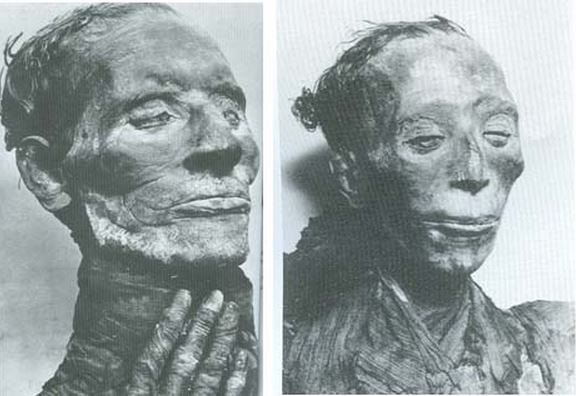
Egyptian journalist and author Ahmed Osman published a controversial book in 1987 about Yuya’s identification with Joseph, titled Stranger in the Valley of the Kings. He pointed out how Yuya’s mummy has Semitic features, evidence of a beard worn in the Hebrew style, and is the only mummy found to have its hands under its chin as opposed to across its chest. Moreover, the description of “father of the god/pharaoh” parallels Joseph’s description as Avrekh. Could the two really be the same person?

The mummies of Yuya and Tjuyu

The mummies of Yuya and Tjuyu

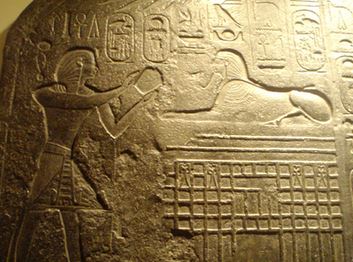
The historical record suggests that Yuya was the minister of the Pharaoh Thutmose IV, who reigned around 1400 BCE. This is not too far from the lifetime of Joseph. More amazingly, archaeologists have found a stele (an inscribed stone) commissioned by Thutmose IV that describes one of his dreams! Like Joseph’s pharaoh in the Torah, Yuya’s pharaoh Thutmose also derived great significance from his dreams.

It is further interesting to point out that Yuya was found entombed with his wife Tjuyu, who is known to have come from a royal family with priestly origins. Similarly, the Torah states that Joseph married the daughter of an Egyptian priest (Genesis 41:45).

And what of Yuya being a mummy? The Torah states: “And Joseph died at the age of one hundred and ten years, and they embalmed him and placed him in a sarcophagus in Egypt.” (Genesis 50:26) Joseph, too, was mummified!

The "Dream Stele" of Pharaoh Thutmose IV

The “Dream Stele” of Pharaoh Thutmose IV

Having said all that, the Torah also states that Joseph’s tomb was later taken out during the Exodus from Egypt (Exodus 13:19), and eventually brought to rest in Israel. This would make it very difficult for his mummy to be found in the Valley of the Kings. On top of this, historians have presented a number of other issues with the identification of Yuya with Joseph. So, perhaps Yuya is not Joseph after all.

Whatever the case may be, the amazing archaeological find of Yuya does give us proof that a foreigner could rise up through the highest ranks of Egyptian royalty, and even become “father to the pharaoh”. It gives us proof that the Torah’s account is quite accurate in its details, and in its terminology. And it certainly makes a compelling case for historical evidence of the Biblical narrative of Joseph.

The Origins of Monotheism

There are two more points that make the connection between Yuya and Joseph all the more fascinating. Historians see the root of the name “Yuya” as yw, which means “reed-leaf” in Ancient Egyptian. Meanwhile, Joseph’s name is יוסף, sharing a root with סוף, which also means “reeds” in Hebrew! The presence of “Ya”, a common appendage in Hebrew names to denote God’s name, makes it even more interesting.

Finally, the historical record shows that Yuya’s daughter married the pharaoh. They had a son, who became the pharaoh Akhenaten. Akhenaten was Yuya’s grandson. And he went down in history for doing one major thing for Egypt: destroying all of its idolatry to make the nation monotheistic. Unfortunately, his attempt to turn Egyptian society and religion monotheistic ultimately failed, and the kingdom reverted to its idolatry. But it wasn’t long after that the Jewish people left Egypt, beginning the spread of monotheism to the entire world.


The above is an excerpt from Garments of Light: 70 Illuminating Essays on the Weekly Torah Portion and Holidays. Click here to get the book!