Category Archives: Torah & Science

Mystery of the Shamir

This week’s parasha, Terumah, describes the construction of the mobile sanctuary, the Mishkan. While the Mishkan was designed to accompany the Israelites in their travels, the Haftarah for this week’s parasha describes how King Solomon finally built the permanent holy sanctuary in Jerusalem, the Beit haMikdash. The Haftarah tells us that the Temple “was built of stone finished at the quarry, and there was neither hammer nor axe nor any tool of iron heard in the house, while it was in building.” (I Kings 6:7) God did not permit the use of iron tools in constructing the Temple, for iron is an implement of war, and the Temple was a house of peace. So, how were the builders able to cut the stones without any iron tools?

The simplest explanation is that the stones were cut “at the quarry”, as the verse above states, and iron tools were only forbidden “in the house” itself. When God commanded not to use “hewn stones” for the altar (Exodus 20:23), it only meant not to cut the stones or bring iron tools directly onto the holy Temple Mount. The stones could, however, be cut elsewhere and brought to the Temple Mount. This suggestion is further supported by I Kings 5:31, where we read that “The king [Solomon] ordered huge blocks of choice stone to be quarried, so that the foundations of the house might be laid with hewn stones.”

Having said that, Jewish tradition holds that the stones for the Temple were cut entirely without the use of iron implements. Instead, our Sages teach that King Solomon had a unique tool called a Shamir, described as some kind of “worm” or “stone” that was able to penetrate even the toughest materials with laser-like precision. What, exactly, was the Shamir, and what might modern science reveal about this mysterious object?

Shamir in Tanakh and Talmud

The earliest source to mention the Shamir is the prophet Isaiah. In foretelling the destruction of Jerusalem, he said how the city “will be a desolation, it will not be pruned or hoed, and it shall be overgrown with shamir and thistles…” (Isaiah 5:6) This suggests that the Shamir is something organic and can grow. The notion is confirmed by the next source that discusses it, Jeremiah, who proclaimed that “The sin of Judah is inscribed with an iron stylus, engraved with tzipporen shamir…” (Jeremiah 17:1) Here we see the Shamir described as a tzipporen, loosely translated as a “fingernail” or “talon”. Again, it implies something organic, as opposed to the iron stylus it is juxtaposed with in the same verse.

We next see the Shamir in God’s message to the prophet Ezekiel, when He tells Ezekiel that He will make him like the Shamir, “harder than flint” (k’shamir chazak mitzor). Here we learn the Shamir is a substance of incredible strength. Rashi comments on this verse that the Shamir is a worm that splits rocks, or perhaps a type of hard flintstone, or even a particularly strong alloy of iron. The final direct mention of Shamir in the Tanakh is in Zechariah 7:12, where the nation is said to have hardened their hearts like the Shamir.*
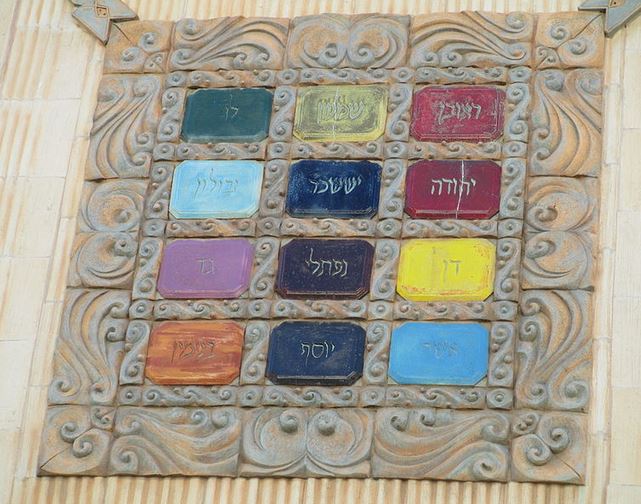
Modern Rendition of the Choshen, the High Priest’s Breastplate

Next, we learn in the Mishnah that God created ten special, mystical things on the eve of the first Sabbath, at the very end of Creation (Avot 5:6). In this list is included the miracle-working staff of Moses, the Two Tablets of Law, and the Shamir. Rabbi Ovadiah of Bartenura (c. 1445-1515) comments here that the builders would draw a line on a stone, and the Shamir worm would crawl along the line and split the stone. He also points out that it was with the Shamir that Moses created the choshen and ephod, the Priestly Breastplate, and engraved the names of the Tribes of Israel into the precious stones on that breastplate. The source for this is the Talmud:

In Gittin 68a, we learn that Solomon was unsure of how to build the Temple without iron tools, and consulted with the Sanhedrin at the time. They told him: “There is a Shamir that Moses used to cut the stones for the ephod.” Solomon then asked the Sages where to find the Shamir, and this leads to a lengthy story about how he acquired it. (In fact, this is the longest story in the whole Talmud!) The puzzling narrative requires an in-depth analysis of its own, and is beyond the scope of the present discussion. Suffice it to say that it involves the great warrior Benayahu ben Yehoyada, a confrontation with Ashmedai, the “prince of demons”, and the angelic “Prince of the Sea”.

The Midrash (Yalkut Shimoni II, 182) has a slightly different account: Solomon knew how to speak to animals (I Kings 5:13), and he asked them where the Shamir might be found, at which point an eagle flew to the Garden of Eden and brought it to him! He then asked the Sages how to use the Shamir, and they directed him to Ashmedai. The Midrash also notes that the Shamir was so powerful it had to be wrapped in wool and kept in a special lead box filled with barley. The same teaching is found in the Talmud (Sotah 48b), too, where we also learn that the Shamir was the size of a barley grain, and that it ceased to exist following the destruction of the First Temple.

The big mystery is how the tiny Shamir, whether a “worm” or a “stone”, was able to penetrate hard substances and cut them with laser-like precision. While one could simply relegate this to a miracle, we generally hold that even God works through derekh hateva, natural ways, in most cases. Could there be a scientific explanation for the Shamir? Thankfully, our Sages left us a major clue that might help solve the mystery.

Shamir in Science

Our Sages taught that the Shamir had to be kept specifically in a box of lead to avoid danger. We have all probably received an x-ray exam at some point in our lives, and the technician always makes sure to put a lead jacket on the parts of the body not being scanned. This is because lead is an excellent blocker of dangerous radiation. This little detail strongly suggests that the Shamir was likely radioactive. Perhaps it used some kind of high-energy radiation to cut through stone. In fact, today we have nuclear-pumped lasers which use radioactive uranium fragments to create ultra-powerful light rays. Though such lasers are not commercially available at the moment, they have been proposed for use in manufacturing for precision deep-cutting and welding!

(Interestingly, renowned Jewish physicist Edward Teller, often called the “father of the hydrogen bomb”, proposed using such nuclear-pumped lasers in a space defense system that would shoot down enemy nuclear missiles. His “Project Excalibur” was soon scrapped and never realized.)

And then there’s the lithoredo. In 2019, scientists in the Philippines discovered a new species of shipworm, named Lithoredo abatanica. Unlike other shipworms which eat and bore into wood, the lithoredo eats and bores into limestone! They have special tiny teeth to grind away rock. Here is a worm that is actually able to eat through stone, and quite precisely, too. Could the Shamir have been a special version of the lithoredo, or a related species that is now extinct?

There is another tiny organism on the planet that is bizarrely able to withstand incredible conditions, including deadly radiation, dehydration, and even the freezing vacuum of outer space. This organism is the tardigrade, also known as a “water bear”. The hardiest creature on the planet, it can suspend its metabolism and literally go decades without any food or water at all. Uniquely, the DNA of tardigrades is protected by a special protein that blocks radiation, allowing them to survive levels of radiation hundreds of times greater than what would be lethal for humans. Could the Shamir have been some kind of special hybrid organism with qualities of both the tardigrade, capable of living many decades and withstanding immense radiation; and of the lithoredo, able to eat, digest, and cut through stone? Did the Shamir contain radioactive material in its body, or generate something laser-like? It is certainly within the realm of the scientifically-possible.

A real microscopic image (colour-enhanced) of a tardigrade. (Credit: Eye of Science)

Ultimately, we may never know the true nature of the Shamir, for there are those who hold the future Third Temple will not require the Shamir in its construction. The Lubavitcher Rebbe, for instance, taught that since in the messianic era “swords will be beaten into plowshares” (Isaiah 2:4), iron will no longer be considered an implement of war and will therefore be allowed in the building of the Third Temple. Others hold that the Third Temple will not require building at all, and will descend fully-formed from the Heavens (see Rashi at the end of Sukkah 41a). Whatever the case might be, may we merit to see it speedily and in our days!
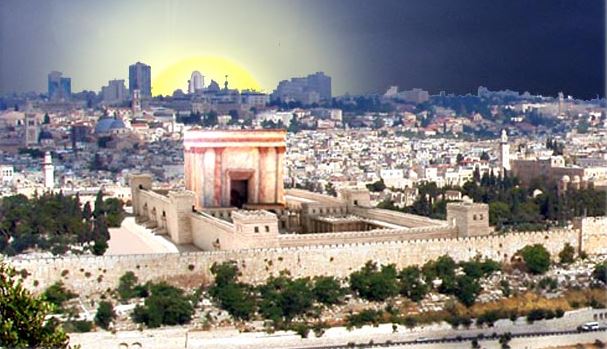
Courtesy: Temple Institute


*For Marvel comics fans: the word shamir was translated into Greek as adamas, and then to Latin as adamans, and to English as “adamant”, the origin of “adamantium”, that super-hard element injected into Wolverine’s skeleton, and that made up the body of Ultron. (For more on Judaism and comic books, see here.) The Shamir was also the inspiration for the adopted last name of Israeli prime minister Yitzhak Shamir.

Kefitzat HaDerekh: Wormholes in the Torah

This week’s parasha, Vayetze, begins with Jacob setting forth towards his mother’s hometown in Haran. We read that on his way he suddenly “bumped into” a special place (Genesis 28:11) that turned out to be Beit El, the “House of God”. Jacob was surprised to find himself there (28:16), presumably the site of the future House of God, the Temple in Jerusalem. The Sages (Sanhedrin 95b) explain what happened:

“And Jacob went out from Be’er Sheva, and went to Haran…” is followed by “and he happened upon the place, and tarried there all night, because the sun was set.” For when he reached Haran, he said: “Shall I have passed through the place in which my fathers prayed, without doing so likewise?!” He wished therefore to return, but no sooner had he thought of this than the earth instantly contracted and he “happened upon” that place.

Our Sages state that a miracle occurred after Jacob had reached Haran. He regretted not stopping by at the site of the future Temple Mount, where Abraham and Isaac had prayed, so the earth beneath his feet seemingly “contracted” and he was suddenly teleported to Jerusalem. In fact, the Sages state that such a miracle occurred for three people in the Tanakh: first was Eliezer, Abraham’s servant, then Jacob in this week’s parasha, and finally King David’s general Avishai. There is Scriptural proof for each one. For instance, when Eliezer had arrived in Haran he declared “I came today to the well” (Genesis 24:42), implying he had set out on his journey that same day. Eliezer was miraculously able to go from Be’er Sheva to Haran, a significantly long journey, in under a day.

This phenomenon would later become known as kefitzat haderekh, “jumping the path”, and would appear in Rabbinic narratives as well. Angels have a similar ability to seemingly teleport across vast distances. In one story, Rav Kahana was once selling some wares and a female customer tried to seduce him (Kiddushin 40a). He quickly fled in distress and ran to the nearest window and jumped! The angel-prophet Eliyahu appeared and caught him, complaining that he had to instantly travel a distance of “four hundred parasangs” to save him. A parasang, or parsa, is the average distance a person walks in 72 minutes—generally thought to be about 5 kilometres. So, Eliyahu flew some 2000 kilometres in a flash to catch the rabbi. Rav Kahana apologized and lamented that due to his poverty he had to resort to being a salesman. Eliyahu gave him a vessel full of money to free him from his job.

Meanwhile, the Zohar (I, 4b-5a) states that the malevolent angel Samael can traverse as much as 6000 parsas in a single moment. This number is not arbitrary, for the Talmud calculates that the Earth’s circumference is 6000 parsas (Pesachim 94a). This is an incredible piece of Talmudic science, considering how little of the globe was known then. Today, we know that Earth’s exact circumference is 40,075 km at the equator, a value close to that of our Sages. In fact, if making the correct assumption that the Sages must have been exact in their knowledge, we might be able to properly identify the length of a Talmudic parsa.

Although it is generally calculated in halakhah that a parsa is between 4 and 5 kilometres, by dividing 40,075 km by 6000 we can conclude that a parsa must be closer to 6.68 kilometres. This is also more in line with the notion that a parsa is a distance of 72 minutes: The average walking speed of humans is 5 km per hour (1.42 metres per second, according to the most precise measurements), so defining a parsa as 6.68 km is much closer to the scientific reality.

Jacob’s Ladder through Spacetime

The Talmud (Chullin 91b) calculates that the distance of the Heavenly Ladder that Jacob saw in his vision was a whopping 8000 parsas, which would be over 50,000 km. The word used by our Sages is rochav, meaning “width”. A superficial reading of the Talmud suggests that each angel is 2000 parsas wide (based on Daniel 10:6), and since Jacob saw four angels, the width of the Ladder must have been 8000 parsas. However, this does not make sense if taken literally, for why would an angel’s form be 2000 parsas wide? And if it was, how could Jacob even capture the sight of an angel in his limited field of view? The Talmud must be teaching something else. The big question here is why use the language of width as opposed to length or height, as might be expected?

When it comes to understanding the cosmos, we always speak of a “fabric of spacetime”. Perhaps the greatest achievement of Albert Einstein is pioneering the science behind it, proving that the three dimensions of space and the dimension of time are not separate, but interwoven together. With this, he was able to explain gravity a lot more accurately, demonstrating that larger bodies make a bigger “dip” in the fabric, pulling objects towards them kind of like a penny rolling around a funnel. And because they are integrated, strong gravitational effects can warp both space and time. We typically visualize spacetime as a flat “fabric”, with celestial objects scattered all over it. In fact, today we know that the universe does indeed appear to be flat (with a margin of error of about 0.4%). This is of tremendous significance.

In the Torah, the term aretz can refer to both Earth proper, and the wider physical universe at large. When we read that in the beginning God created et shamayim v’et ha’aretz, we do not define it simply as the “sky” and the “earth”, for those were not created until Days Two and Three. Rather, God created the entire spiritual realm (shamayim) and the entire physical universe (aretz). Our Sages noted long ago that the root of aretz (ארץ) is the same as ratz (רץ), “running”, since everything in this universe is in perpetual motion. More incredibly, today we know that the universe is constantly expanding, and we see distant stars “running away” from us. As such, when the Tanakh uses an idiom like kanfot ha’aretz, the “corners” or “edges” of the universe, it may be read quite literally. For a long time, there were people who understood these Torah statements as implying a flat Earth, when in reality they could have been alluding to a deeper scientific understanding regarding the “flatness” of the entire universe.

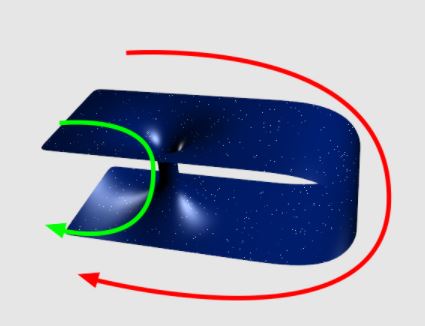
And that brings us back to the precise Talmudic language of rochav, “width”, in a place where we might have expected height. Of course, we do have a dimension of height. However, when zooming out to a “flat” universe, we really only visualize it in terms of width, as if on a two-dimensional plane. Going further, Einstein later showed, together with another Jewish scientist named Nathan Rosen, that it would be theoretically possible to “bend” spacetime and connect two points that are vastly far apart. It would be like folding over the fabric and then poking a hole through both layers. Such an “Einstein-Rosen bridge”, better known as a wormhole, would allow travel across extremely vast distances in a very short period of time. In other words, it would be very much like kefitzat haderekh!  

A wormhole shortens the trip by bending spacetime and forming a bridge.

So, what our Sages may have been secretly implying in describing the width of Jacob’s Ladder is that this wormhole (of sorts) spanned 8000 parsas, or over 50,000 km. This is a distance even wider than the Earth and, scientifically, we would expect wormholes to be very large like this. Such a wormhole was accurately depicted in the film Interstellar, allowing the protagonists to instantly travel to a distant solar system to find a new home for mankind:

It is worth noting that when our Sages described the teleportation of Jacob, they said that kaftzah ha’aretz, again using that term aretz, and implying that it “jumped” or “contracted” for him. So, another term for this phenomenon, truer to the language of the Talmud, would be kefitzat ha’aretz, the warping of the spacetime fabric of this universe. Kefitzat haderekh is accurate, too, implying that one “jumped the path”, finding an alternate shortcut from one point in the universe to another. This appears to have happened at Sinai, as well. Our Sages likened Jacob’s Ladder to the Sinai Revelation, and the Zohar (I, 149a, Sitrei Torah) even notes that the numerical value of “ladder” (סלם) and “Sinai” (סיני) is the same—130. At Sinai, too, a “wormhole” opened up allowing 22,000 angelic “chariots” to descend upon the mountain (Bamidbar Rabbah 2:3).

Theoretical physics aside, can we actually create such wormholes? In 2017, scientists succeeded in producing tiny, microscopic wormholes for the first time. It is certainly possible that in the near future we will have the technology to open up larger wormholes, making rapid travel across God’s vast universe feasible. It appears that God’s angels already employ such a wormhole-style system of travel, traversing thousands of parsas instantaneously. It might help explain the Tower of Babel episode which, as we’ve mentioned in the past, was not simply a tower but meant to “lift off” and “conquer” the Heavens.

Our Sages long ago taught that the people who built the Tower knew the wisdom of the angels and were using angelic powers to accomplish their plans (see, for instance, Zohar I, 76a). God “came down” to confound them. He wiped their memories and jumbled their languages so that they wouldn’t be able to collaborate in such a megalomaniacal way. Today, we live in a world that is once more getting real close to being “of singular language and singular words” (Genesis 11:1), and once again we see science stepping into the dangerous territory of “playing God”. Hopefully this time humanity will get it right and use the astounding abilities that God made possible in His universe only for the good.

Science and the Great Flood

In this week’s parasha, Noach, we read about the Great Flood, when “all the fountains of the great deep split apart, and the floodgates of the skies opened” (Genesis 7:11). While it is easy to understand the rain that fell upon the Earth “for forty days and forty nights”, what is the Torah referring to when it speaks of the waters of the deep? Why does it say that the “great deep” had to be “split apart” (נִבְקְעוּ֙) to bring forth these waters? And the biggest mystery of all: how was there even enough water to cover the entire Earth with water anyway, up to the tallest mountains? Upon closer examination, we find that these mysterious waters of the deep actually hold the key to solving the entire mystery of the Flood.

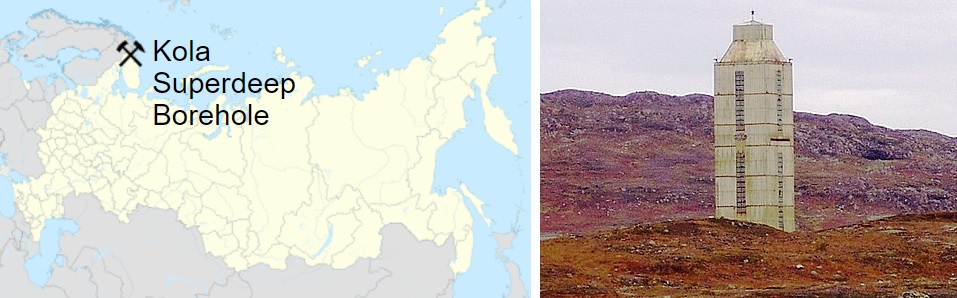
Kola Superdeep Borehole

In May of 1970, Soviet scientists began drilling into the Earth’s crust in the far north of the Kola Peninsula between Norway and Russia. Their goal was to dig the deepest hole ever, and uncover what is really happening in the Earth’s innards. Nine years later, they broke the world record for depth, reaching almost 10 kilometres underground. They hit the deepest point in 1989, reaching 12,262 metres. Beyond this, they could no longer continue, for the temperature was much higher than expected (over 180ºC) and the rock became far too porous.

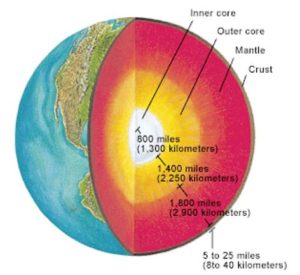
Along the way, the scientists found some bizarre things. One was small fossilized lifeforms more than 6 kilometres down, where lifeforms should not—and should never—have existed! Another shocking discovery was that the porous rock deep below was completely saturated with water. More recently, scientists from Northwestern University examined rocks from the mantle (which emerged from volcanoes) and found that they were composed of 1.5% water. After further research, they concluded that there is three times more water beneath the Earth’s crust than there are in all of the world’s oceans! The temperature down there is very high, but so is the pressure, keeping the water liquid and squeezing it out of the porous rocks. With this in mind, we can solve a number of great mysteries.
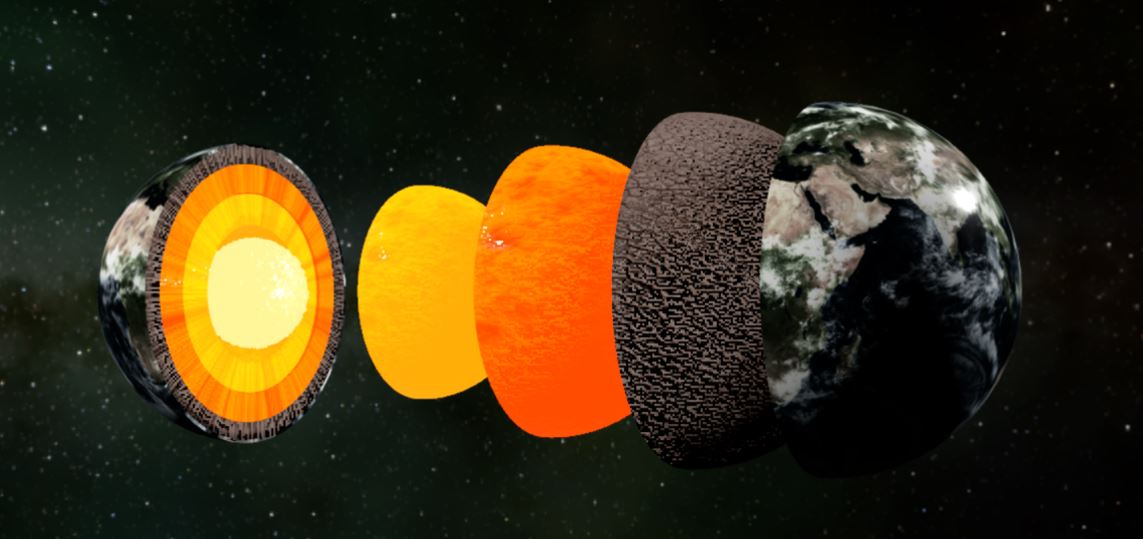
First, we now have a scientific source for where much of the water for the Flood came from. Rain clouds alone would not have been enough. Note how the Torah mentions the waters of the great deep first, before mentioning the rain, implying that the former was the more significant source of water. Second, we can better understand the Torah’s precise language, since it says the depths had to be “split apart” for the floodwaters to emerge. This splitting apart would certainly be required for all that water in the mantle beneath to emerge. Third, we can actually solve a scientific mystery for the baffled scientists at Kola who found fossilized ancient lifeforms deep below: Perhaps those lifeforms ended up there when the floodwaters returned underground and the surface closed back up, sealing lifeforms from above down beneath in a place where they otherwise could never have gotten.

There is one more wonderful confirmation of all this when we look at the way our Sages described the Flood: the Talmud (Sanhedrin 108b) states that the floodwaters that came from below, “between their legs”, was boiling hot! This was measure for measure justice from God, since the people “sinned with heat, so they were punished with heat”. Heat here is a euphemism for sexual sin, and since the pre-Flood generation abused their nether regions, “between their legs”, God made sure that those floodwaters that came from below were boiling hot. Recall that the scientists at Kola were surprised that the temperature below was much hotter than they expected (yet the water remained in liquid form). They had to stop drilling because the rock was too mushy and “like plastic”. It is worth adding that the same page of Talmud says the water from below was not only hot, but also thick.

“Setting the Earth Upon the Waters”

There is one more fascinating mystery that can be solved with the scientific discovery of the Earth’s inner waters. Each morning, in Birkot HaShachar, we thank God for “setting the earth upon the waters” (רוקַע הָאָרֶץ עַל הַמָּיִם). This blessing troubled me for years. What does it mean that the earth is set upon the waters? Earth’s crust is set upon the rocky mantle, lying above the molten core—and the waters are resting upon the crust! It all seemed backwards. Yet, now we can see, as is often the case, that the Sages phrased it correctly all along: the crust is resting upon a mantle that is full of water, three times more water than in all the oceans! With that, we can appreciate this berakhah much more deeply, and recite it with ever-more kavanah.