
Category Archives: Torah & Science

How Many Israelites Actually Left Egypt?

This week we start reading the fourth book of the Torah, Bamidbar, more commonly known as “Numbers” since it begins with a detailed census of the Israelites. The Torah concludes that there was a total of 603,550 men at this point in the Wilderness, implying a general population of about 3 million people. Or does it? While these are the numbers one generally hears when it comes to the question of how many Jews were present at the Exodus (about 600,000 men, and something like 3 million people when accounting for their families), there is an alternate way to read the Torah which might actually make far more sense.

(Please read the following with an open mind, and do not jump to any conclusions until you’ve read through to the end!)
Continue reading →

The Ten Plagues on the Ten Senses of the Human Body

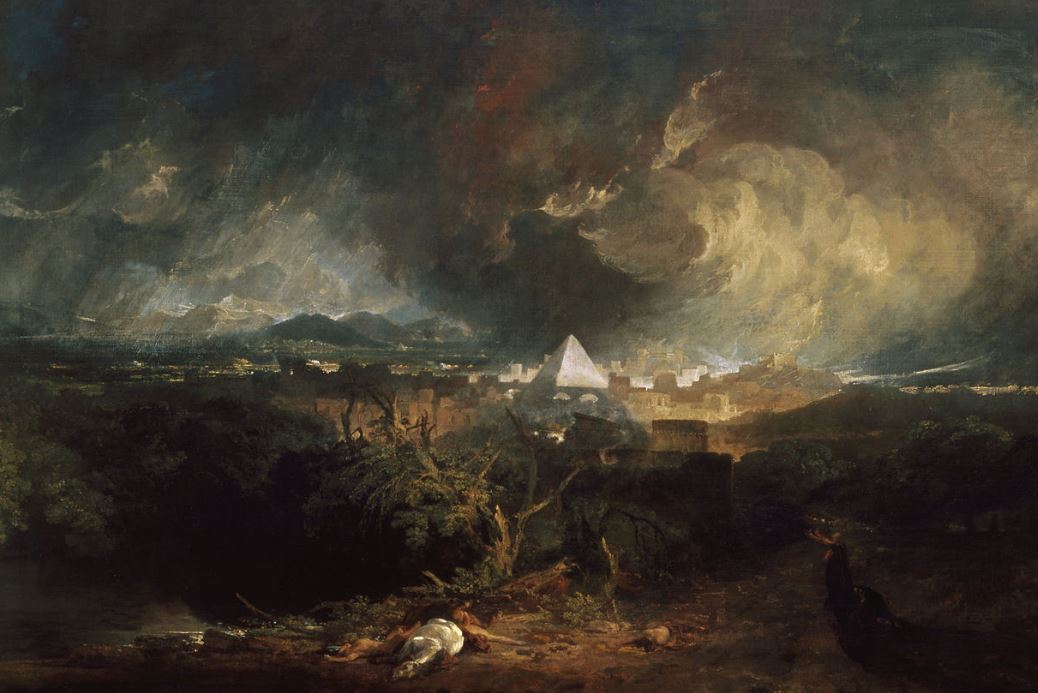
‘The Fifth Plague of Egypt’ by J.M.W. Turner (1800)

This week’s parasha, Bo, describes the final three plagues that God brought upon Egypt. There is an allusion to this in the very name of the parasha, since the gematria of “Bo” (בא) is 3. It is not a coincidence that the Torah divides the Ten Plagues between two parashas, seven in last week’s and three in Bo. In fact, all things that are “Ten” in the Torah (such as the Ten Utterances of Creation, the Ten Commandments, or the Ten Trials of Abraham) follow the same pattern of 7 and 3. The pattern is based on the Ten Sefirot, where there are three higher mochin, “mental” faculties, above the seven lower middot, “emotional” faculties or character traits. Since the Ten Sefirot permeate all aspects of Creation, this same pattern reveals itself in many places.

Continue reading →

The Sarah Paradox

This week’s parasha, Chayei Sarah, begins with the passing of Sarah: “And the life of Sarah was one hundred years, and twenty years, and seven years; the years of the life of Sarah.” (Genesis 23:1) The Sages wonder why the Torah phrased her lifespan in this strange way: a hundred years, and twenty years, and seven years. To paraphrase their answer (as cited by Rashi): at one hundred years old, Sarah was as beautiful and sinless as at twenty years old; and at twenty years old, she was as beautiful and sinless as at seven years old. This would explain one of the big puzzles of Sarah’s story: how was she always so desirable despite her advanced age?

Continue reading →