
The Caesar Who Saved Judaism

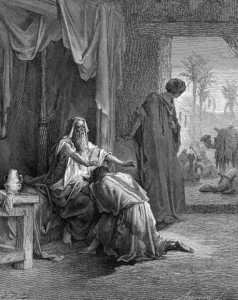
“Isaac Blessing Jacob”, by Gustav Doré

This week’s parasha, Toldot, begins with the births of the twins Jacob and Esau. Their mother, Rebecca, felt trouble brewing in her womb, and received prophecy that “two nations are in your womb, and two peoples will emerge from your innards” (Genesis 25:23). Jacob, of course, is the forefather of the Jewish people, while Esau would become the spiritual progenitor of the Roman Empire, and then the entire Christian world as a whole (see ‘How Esau Became Rome’).

The Ba’al haTurim (Rabbi Yaakov ben Asher, c. 1269-1343) comments on the above verse that the words shnei goyim b’vitnekh (שני גוים בבטנך), “two nations are in your womb”, has the same gematria as “this is Rabbi Yehuda and Antoninus” (זה רבי יהודה ואנטונינוס). Recall that Rabbi Yehuda haNasi was the president of Israel in the 2nd century CE, and is credited with composing the Mishnah, the first complete corpus of Jewish law, while Antoninus was a Roman official who was his close friend. The Ba’al haTurim is telling us that there is a profound connection between these two sets of people that are separated by nearly two millennia. What is the connection between the pair of Jacob and Esau, and the pair of Rabbi Yehuda haNasi and Antoninus? Continue reading

(Video) Blessings You Don’t Say but Really Should

What is the blessing on an elephant? How about an albino? Find out in this class where we explore the power and meaning of the ancient berachot instituted by our Sages. Also discussed is the mystical purpose of every Jew’s life, the divine Light of Creation, and an explanation of the 36 perfect tzadikim that exist in every generation.

Click here for a free, printable PDF companion guide with full text and transliteration of all the blessings.

Blessings You Don’t Say but Really Should

One of the core fundamentals of Judaism is the recitation of berakhot, “blessings”. On the simplest level, a blessing serves as a little bit of gratitude to God for what He bestows upon us. A Jew must be grateful at all times. In fact, it is the very root of the word Yehudi, which comes from lehodot, “to thank”, and from Leah thanking God for blessing her with a fourth child, Yehuda. As is well-known, a Jew is encouraged to make 100 blessings over the course of a single day. This ensures that a Jew remains grateful and positive always, and such a positive attitude is a valuable key to a successful and happy life.

Yet, ironically, the first people who make blessings in the Torah are not Jews at all! The first person to make a blessing with the formula of barukh followed by God’s Name is actually Noah (Genesis 9:26). This was when he blessed his son Shem. In turn, the next mention of barukh in the Torah is when Shem blessed Abraham (Genesis 14:19). However, both of these cases involve a person giving a blessing to another person, which is a little different than reciting a berakhah simply to thank God. And so, we find that the first person to truly recite a berakhah was Eliezer, in this week’s parasha, Chayei Sarah. This is when Eliezer thanked God for helping him succeed in his mission to find a suitable spouse for Isaac (Genesis 24:27).

Our Sages would later institute an actual berakhah with a specific text to recite upon achieving some great success, or hearing wonderful news (Berakhot 54a). The formula for this berakhah begins like every other (Barukh Atah Adonai Eloheinu Melekh haOlam…) and concludes with the words hatov v’hametiv, thanking God “Who is good and bestows goodness”. There is also an opposite blessing to recite upon hearing devastating news: Barukh… dayan ha’emet, affirming that God is the sole True Judge in this world and surely knows what’s best.

In the same pages of the Talmud, we are presented with many other interesting blessings that people today are generally unfamiliar with. While most are careful with blessings before and after eating food, as well as after going to the bathroom, hagomel after perilous situations, and reciting sh’echeyanu on happy occasions, new fruits, and significant new items, there are actually many more wonderful blessings that a Jew can recite throughout the day. With these in mind, it becomes much easier to hit those important 100 blessings a day. Continue reading