Mystery of the Shamir

This week’s parasha, Terumah, describes the construction of the mobile sanctuary, the Mishkan. While the Mishkan was designed to accompany the Israelites in their travels, the Haftarah for this week’s parasha describes how King Solomon finally built the permanent holy sanctuary in Jerusalem, the Beit haMikdash. The Haftarah tells us that the Temple “was built of stone finished at the quarry, and there was neither hammer nor axe nor any tool of iron heard in the house, while it was in building.” (I Kings 6:7) God did not permit the use of iron tools in constructing the Temple, for iron is an implement of war, and the Temple was a house of peace. So, how were the builders able to cut the stones without any iron tools?

The simplest explanation is that the stones were cut “at the quarry”, as the verse above states, and iron tools were only forbidden “in the house” itself. When God commanded not to use “hewn stones” for the altar (Exodus 20:23), it only meant not to cut the stones or bring iron tools directly onto the holy Temple Mount. The stones could, however, be cut elsewhere and brought to the Temple Mount. This suggestion is further supported by I Kings 5:31, where we read that “The king [Solomon] ordered huge blocks of choice stone to be quarried, so that the foundations of the house might be laid with hewn stones.”

Having said that, Jewish tradition holds that the stones for the Temple were cut entirely without the use of iron implements. Instead, our Sages teach that King Solomon had a unique tool called a Shamir, described as some kind of “worm” or “stone” that was able to penetrate even the toughest materials with laser-like precision. What, exactly, was the Shamir, and what might modern science reveal about this mysterious object?

Shamir in Tanakh and Talmud

The earliest source to mention the Shamir is the prophet Isaiah. In foretelling the destruction of Jerusalem, he said how the city “will be a desolation, it will not be pruned or hoed, and it shall be overgrown with shamir and thistles…” (Isaiah 5:6) This suggests that the Shamir is something organic and can grow. The notion is confirmed by the next source that discusses it, Jeremiah, who proclaimed that “The sin of Judah is inscribed with an iron stylus, engraved with tzipporen shamir…” (Jeremiah 17:1) Here we see the Shamir described as a tzipporen, loosely translated as a “fingernail” or “talon”. Again, it implies something organic, as opposed to the iron stylus it is juxtaposed with in the same verse.

We next see the Shamir in God’s message to the prophet Ezekiel, when He tells Ezekiel that He will make him like the Shamir, “harder than flint” (k’shamir chazak mitzor). Here we learn the Shamir is a substance of incredible strength. Rashi comments on this verse that the Shamir is a worm that splits rocks, or perhaps a type of hard flintstone, or even a particularly strong alloy of iron. The final direct mention of Shamir in the Tanakh is in Zechariah 7:12, where the nation is said to have hardened their hearts like the Shamir.*
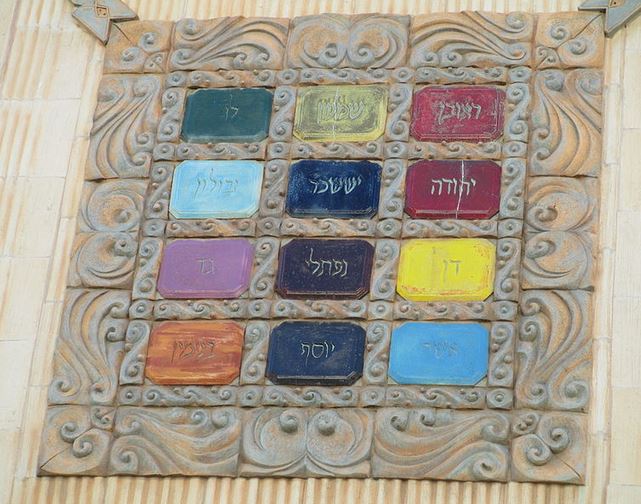
Modern Rendition of the Choshen, the High Priest’s Breastplate

Next, we learn in the Mishnah that God created ten special, mystical things on the eve of the first Sabbath, at the very end of Creation (Avot 5:6). In this list is included the miracle-working staff of Moses, the Two Tablets of Law, and the Shamir. Rabbi Ovadiah of Bartenura (c. 1445-1515) comments here that the builders would draw a line on a stone, and the Shamir worm would crawl along the line and split the stone. He also points out that it was with the Shamir that Moses created the choshen and ephod, the Priestly Breastplate, and engraved the names of the Tribes of Israel into the precious stones on that breastplate. The source for this is the Talmud:

In Gittin 68a, we learn that Solomon was unsure of how to build the Temple without iron tools, and consulted with the Sanhedrin at the time. They told him: “There is a Shamir that Moses used to cut the stones for the ephod.” Solomon then asked the Sages where to find the Shamir, and this leads to a lengthy story about how he acquired it. (In fact, this is the longest story in the whole Talmud!) The puzzling narrative requires an in-depth analysis of its own, and is beyond the scope of the present discussion. Suffice it to say that it involves the great warrior Benayahu ben Yehoyada, a confrontation with Ashmedai, the “prince of demons”, and the angelic “Prince of the Sea”.

The Midrash (Yalkut Shimoni II, 182) has a slightly different account: Solomon knew how to speak to animals (I Kings 5:13), and he asked them where the Shamir might be found, at which point an eagle flew to the Garden of Eden and brought it to him! He then asked the Sages how to use the Shamir, and they directed him to Ashmedai. The Midrash also notes that the Shamir was so powerful it had to be wrapped in wool and kept in a special lead box filled with barley. The same teaching is found in the Talmud (Sotah 48b), too, where we also learn that the Shamir was the size of a barley grain, and that it ceased to exist following the destruction of the First Temple.

The big mystery is how the tiny Shamir, whether a “worm” or a “stone”, was able to penetrate hard substances and cut them with laser-like precision. While one could simply relegate this to a miracle, we generally hold that even God works through derekh hateva, natural ways, in most cases. Could there be a scientific explanation for the Shamir? Thankfully, our Sages left us a major clue that might help solve the mystery.

Shamir in Science

Our Sages taught that the Shamir had to be kept specifically in a box of lead to avoid danger. We have all probably received an x-ray exam at some point in our lives, and the technician always makes sure to put a lead jacket on the parts of the body not being scanned. This is because lead is an excellent blocker of dangerous radiation. This little detail strongly suggests that the Shamir was likely radioactive. Perhaps it used some kind of high-energy radiation to cut through stone. In fact, today we have nuclear-pumped lasers which use radioactive uranium fragments to create ultra-powerful light rays. Though such lasers are not commercially available at the moment, they have been proposed for use in manufacturing for precision deep-cutting and welding!

(Interestingly, renowned Jewish physicist Edward Teller, often called the “father of the hydrogen bomb”, proposed using such nuclear-pumped lasers in a space defense system that would shoot down enemy nuclear missiles. His “Project Excalibur” was soon scrapped and never realized.)

And then there’s the lithoredo. In 2019, scientists in the Philippines discovered a new species of shipworm, named Lithoredo abatanica. Unlike other shipworms which eat and bore into wood, the lithoredo eats and bores into limestone! They have special tiny teeth to grind away rock. Here is a worm that is actually able to eat through stone, and quite precisely, too. Could the Shamir have been a special version of the lithoredo, or a related species that is now extinct?

There is another tiny organism on the planet that is bizarrely able to withstand incredible conditions, including deadly radiation, dehydration, and even the freezing vacuum of outer space. This organism is the tardigrade, also known as a “water bear”. The hardiest creature on the planet, it can suspend its metabolism and literally go decades without any food or water at all. Uniquely, the DNA of tardigrades is protected by a special protein that blocks radiation, allowing them to survive levels of radiation hundreds of times greater than what would be lethal for humans. Could the Shamir have been some kind of special hybrid organism with qualities of both the tardigrade, capable of living many decades and withstanding immense radiation; and of the lithoredo, able to eat, digest, and cut through stone? Did the Shamir contain radioactive material in its body, or generate something laser-like? It is certainly within the realm of the scientifically-possible.

A real microscopic image (colour-enhanced) of a tardigrade. (Credit: Eye of Science)

Ultimately, we may never know the true nature of the Shamir, for there are those who hold the future Third Temple will not require the Shamir in its construction. The Lubavitcher Rebbe, for instance, taught that since in the messianic era “swords will be beaten into plowshares” (Isaiah 2:4), iron will no longer be considered an implement of war and will therefore be allowed in the building of the Third Temple. Others hold that the Third Temple will not require building at all, and will descend fully-formed from the Heavens (see Rashi at the end of Sukkah 41a). Whatever the case might be, may we merit to see it speedily and in our days!
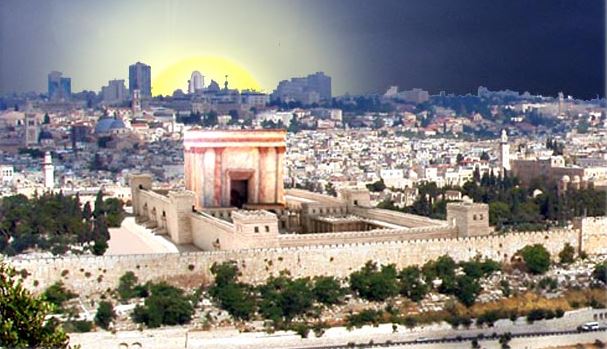
Courtesy: Temple Institute


*For Marvel comics fans: the word shamir was translated into Greek as adamas, and then to Latin as adamans, and to English as “adamant”, the origin of “adamantium”, that super-hard element injected into Wolverine’s skeleton, and that made up the body of Ultron. (For more on Judaism and comic books, see here.) The Shamir was also the inspiration for the adopted last name of Israeli prime minister Yitzhak Shamir.
Ten Sefirot: A Brief History

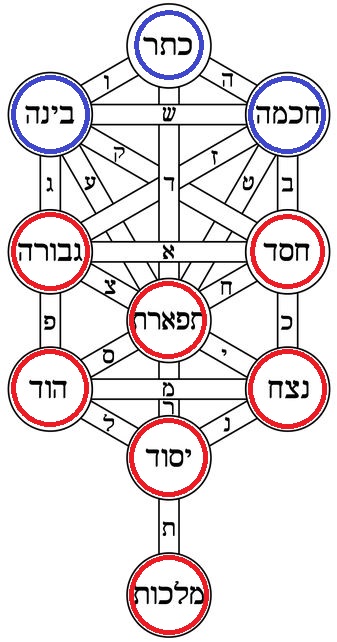
The Sefirot of mochin above (in blue) and the Sefirot of the middot below (in red) on the mystical “Tree of Life”.

This week, in parashat Yitro, we read the Ten Commandments. As with all other things that are ten in the Torah, the Ten Commandments correspond neatly to the Ten Sefirot. Just as the first three of the Sefirot are on a higher plane, referred as the mochin, the first three of the Commandments are also distinct and relate directly to God (to know there is a God, to have no other gods or idols, and not to take God’s Name in vain). We saw a similar division of ten into groups of three and seven in the Ten Plagues, where the first seven are read in parashat Va’era, and the final three in parashat Bo. Likewise, we find a division of ten into three and seven in the very first case of ten: the Ten Utterances of Creation.

As our Sages famously teach, God created the entire universe through Ten Utterances (Avot 5:1). When we look in the first chapter of Genesis at the account of Creation, we find the expression “And God said” exactly 10 times. It was through these Ten Utterances that God brought the entire cosmos into existence. It is important to note that the last instance of “And God said” (1:29) is really just a continuation of the ninth instance (1:28). The actual remaining Utterance is the first word of the Torah: Beresheet. This word itself was the First Utterance, and was the initial burst of energy that brought a dark universe into existence. The Second Utterance was “Let there be light”, and the Third was “Let there be a firmament”. While the first three clearly involve grand cosmic developments, the remaining seven Utterances all relate specifically to Earth.

Of course, all of the above tens correspond to the Ten Sefirot, the first emanations that emerged out of God’s Infinite Ein Sof. The Ten Sefirot permeate all of existence, which is why we find so many patterns of ten in the Torah and all around us in Creation. The notion of Ten Sefirot is a foundational and inseparable part of Judaism, yet few are aware of where all the information about the Sefirot came from! It is commonly thought that the Sefirot were first revealed by the Zohar, but this is highly inaccurate. Discussion of the Sefirot dates back centuries before the first publication of the Zohar. So, let’s take a brief trip back in time to explore the historical revelation of the Sefirot. Continue reading

The Faces of God’s “Chariot”

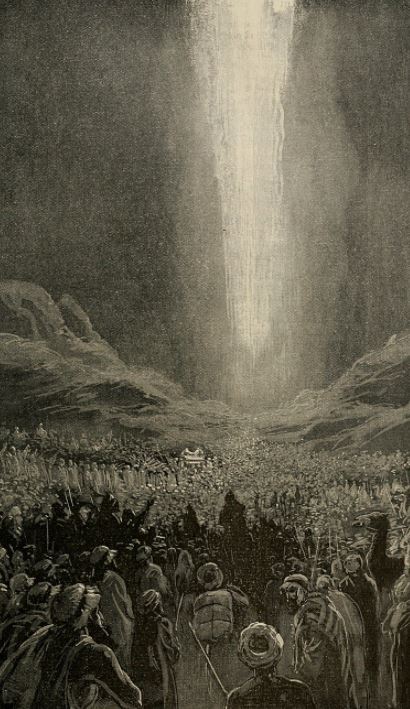
‘The Pillar of Fire’ by Paul Hardy (1896)

This week’s parasha is Beshalach, with its climactic moment being the Splitting of the Sea. Before this, we are told that “God went before them by day in a pillar of cloud to lead them the way; and by night in a pillar of fire to give them light, so that they could journey day and night.” (Exodus 13:21) The Zohar (II, 46b) comments on this that the Patriarchs travelled alongside Israel: the words “went before them by day” refers to Abraham; “in a pillar of cloud” is Isaac; “to lead them the way” is Jacob; “by night in a pillar of fire to give them light” is David. The Zohar then says that these four are the faces upon God’s Holy “Chariot”.

It is the prophet Ezekiel that describes the Chariot in greatest detail. The Book of Ezekiel begins with his famous vision:

And I looked, and, behold, a stormy wind came out of the north, a great cloud, with a fire flashing up, so that a brightness was round about it; and out of the midst thereof as the colour of electrum, out of the midst of the fire. And out of the midst thereof came the likeness of four living creatures. And this was their appearance: they had the likeness of a man. And every one had four faces, and every one of them had four wings… As for the likeness of their faces, they had the face of a man; and they four had the face of a lion on the right side; and they four had the face of an ox on the left side; they four had also the face of an eagle.

Each of the four corners of God’s Chariot has an angel “driving” it. As might be expected for a chariot, beneath each angel is a spinning wheel. The description appears to be speaking not of a simple wheel, but possibly a gyroscope, a “wheel within a wheel” as Ezekiel states (1:16). Each angel has four faces: the face of a man at front, a lion at right, an ox on the left, and an eagle on the back. Understanding the appearance of the animal faces is straight-forward, but whose human faces adorn the angels? The Zohar states these are the faces of God’s beloved Abraham, Isaac, Jacob, and David.

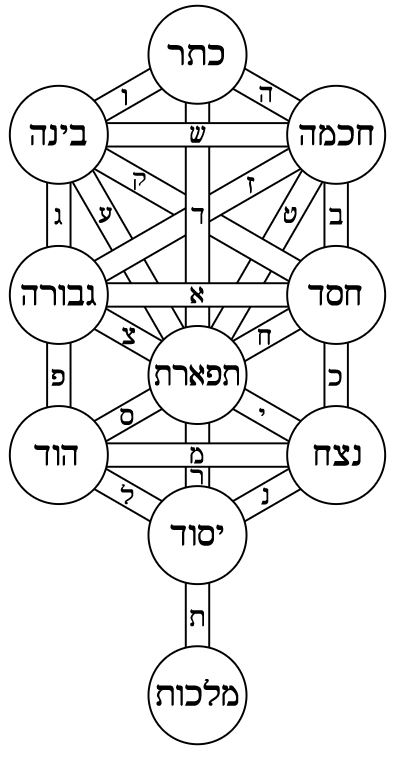
The “Tree of Life” depicting the Ten Sefirot, intertwined by the 22 Letters of the Hebrew Alphabet. Together, they make up the 32 Paths of Wisdom.

Recall that Abraham represents the Sefirah of Chessed, “kindness”; Isaac represents Gevurah, restraint and judgement; Jacob is Tiferet: beauty, balance, truth; and David is Malkhut, “kingdom”. These four Sefirot also correspond to four elements: Chessed is flowing, life-giving water; Gevurah is powerful, burning fire; Tiferet is the spirit of boundless air; Malkhut is the earthy kingdom below. Although there are, of course, Ten Sefirot, these four in particular serve as the major “axes” of the Tree of Life. They have also been said to correspond to the three major dimensions of space, and the fourth dimension of time. (It is worth mentioning that string theory has expanded the number of dimensions to ten—as we might have predicted all along based on the Sefirot!)

Each of the Chariot faces also parallels the major constellations of the Zodiac: first is dli, “Aquarius”, with the face of a human. Three months later comes shor, “Taurus”, the bull or ox. Three months after that is aryeh, “Leo”, the lion. Finally, after another three months is ‘akrav, “Scorpio”, which in ancient times was alternately referred to as the “Eagle” constellation, nesher. The Zohar (I, 24a) points out that the initials of these four constellations and their faces is shinan (שנא״ן), standing for shor, nesher, aryeh, and the nun sofit being representative of the complete human. This is the meaning of the cryptic statement in Psalms (68:18) that “God’s Chariots are myriads, alfei shinan; God is among them, as in Sinai.” Just as at the Splitting of the Sea and at the Divine Revelation at Mt. Sinai that followed, when God “descended” into this world amongst myriads of Chariots, He continues to “mount the Cherubs and fly, gliding on the wings of the winds…” (Psalm 18:11)

The Talmud (Avodah Zarah 3b) offers another mystical meaning of alfei shinan: that God “rides” through 18,000 worlds. This number is derived from the fact that the verse states the number of Chariots is ribotaim, meaning “twenty thousand”, but then says alfei shinan, which can mean “less two thousand”. So, twenty thousand less two thousand leaves 18,000! What are these 18,000 worlds through which God “rides”? The Zohar (ibid.) states that these are the worlds in which God’s Presence dwells. If His Presence dwells there, it implies that there is someone in those worlds to benefit from His Presence! Incredibly, one of the most ancient Jewish mystical texts, Seder HaRuchot, says that God visits these 18,000 worlds and “examines their populations” in an instant! Based on such sources, there have been authorities who’ve suggested there very well may be life on other planets—perhaps 18,000 of them out there in the vastness of the cosmos. Generally speaking, these 18,000 are thought to be strictly angelic worlds, inhabited by the supernal beings. (For a lot more on this, see here.)

Rotating Faces

While each forefather may have excelled in one particular aspect, he was also a complete man who possessed the other traits. Abraham was mainly Chessed, but clearly displayed Gevurah, too, as we see in harsh trials like the Akedah. The Torah says three times that Abraham arose early in disciplined service of God (Genesis 19:27, 21:14, 22:3). Meanwhile, Isaac was Gevurah first and foremost, but is also described with words of lovingkindness in at least three places (Genesis 24:67, 25:28, 27:9-14). Jacob is the perfect balance of the two, hence it is Jacob that embodies the balance and truth of Tiferet. And David is the very reflection of Jacob centuries later. One who reads the Tanakh carefully will see how the lives of Jacob and David mirror each other. (For more on this, see ‘The Mystical Connection Between Jacob and David’.)

This is one reason why each of the faces of the Patriarchs on the Chariot also had a lion, ox, and eagle face. When necessary, each of these great Jewish figures could “put on” their lion face, representing Gevurah, and fight noble battles. [In fact, the gematria of “lion” (אריה) is 216, equal to Gevurah (גבורה)!] At other times, they could be the “ox” peacefully tilling the soil and investing in the development of the Holy Land. As we read in the Tanakh, each of the four figures did tremendous work in the Holy Land, from digging wells to planting trees (and everything in between) in order to make the land flourish and prosper. They could also put on an “eagle” face and “hover over their hatchlings” (Deuteronomy 32:11). The eagle has to teach its chicks some perilous skills like flying and hunting. The figures of the Chariot similarly taught their families and disciples how to navigate the dangers of this material world and live the proper spiritual path. (The Arizal has a fascinating discussion on the eagle and its ability to spot and defeat the snake—symbolic of the evil inclination—in Sha’ar HaPesukim on Mishlei.) Their teachings continue to give us the tools to fly ever higher today.

There is a wonderful lesson here for us. Every good human being works hard like an ox, hovers over their family like an eagle, and defends them like a lion. Behind the face of each person—like the face of each Patriarch, and the face of each angel on God’s Chariot—is the face of a lion, an eagle, and an ox. The spinning wheels beneath these faces symbolize the need to put on a different one of these faces at different times, when the situation calls for it. We have to be able to display both kindness and strength, both beauty and modesty, humility and honour. We must balance all the elements—water, fire, air, earth—within us, and walk the spiritual trail blazed by Abraham, Isaac, Jacob, and David. This is the “pillar of fire” that guided and protected the Israelites in the Wilderness, and continues to guide us and protect us today.