Tag Archives: Aaron

Moses and Korach, Abel and Cain, Water and Ice

This week’s Torah reading is named after Moses’ cousin, Korach, and describes his rebellion against the leader of the Jewish people. Rashi’s commentary quotes a number of Midrashic texts to explain Korach’s motivation. Korach was a very wealthy and very wise man. Yet, despite being a distinguished member of the community, and Moses’ cousin, he was not appointed to any prominent roles. The high priesthood was bestowed upon Aaron, while the leadership of the Kohatithes (one of the major divisions of the Levites) was given to Elitzaphan, who was younger than Korach.

Upset by these developments, Korach gathered 250 others and protested: “…the entire congregation, all of them, are holy, and God is in their midst, so why do you raise yourselves above God’s assembly?” (Numbers 16:3) Korach essentially accused Moses of nepotism: putting his own favourites in holy positions to rule over the people, when in reality all the people should be on a high and exalted level, as they are all equally part of God’s assembly.

This was a very good argument, and many were swayed by Korach. After all, God had said to the people that “… you will be a kingdom of priests, and a holy nation” (Exodus 19:6). Amazingly, Rashi writes that Moses himself agreed with Korach! Moses said:

“Among the nations, there are many forms of worship and many priests, and they do not all gather in one temple. We, however, have only one God, one ark, one Torah, one altar, and one High Priest, but you two hundred and fifty men are all seeking the High Priesthood! I, too, would prefer that. Here, take for yourselves the service most dear [to God] of all: it is the incense, more cherished than any other sacrifice, but it contains deadly poison, by which Nadav and Avihu were burnt, so be warned…” (Rashi on 16:6)

The Incense Offering

The ketoret, or incense offering, was the greatest of Temple services, and could only be performed by the High Priest. It is said that anyone else who attempted it (including the High Priest if he was not in the highest state of purity) would die immediately. The Torah already relayed the story of Nadav and Avihu, the sons of Aaron who tried to bring their own incense, and perished.
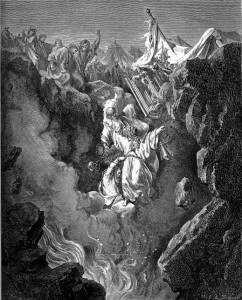
"Death of Korah, Dathan, and Abiram" by Gustave Doré

“Death of Korah, Dathan, and Abiram” by Gustave Doré

So, Moses told Korach and his supporters that he would have loved for everyone to be at the level of high priesthood. This is how God had originally intended it after all, and one day in the future it would be so. At the present moment, though, the people were simply not ready for it. If they indeed thought they were all capable of being the High Priest, Moses suggested for them to each bring their own incense. He warned them, though, not to forget what had happened to Nadav and Avihu.

The narrative continues with Korach and his supporters bringing their own incense offering, with the result being utter failure, and every one of them losing their life for it (16:35). Korach himself, together with his main supporters Datan and Aviram, was given a more severe punishment: they were swallowed up by the earth. Interestingly, this specific punishment was decreed by Moses. Why did Moses specifically want Korach to be swallowed up by the earth?

Cain and Abel

The Arizal explains that Moses and Korach were reincarnations of Abel and Cain (Sha’ar HaGilgulim, Ch. 29 and 32). Cain had risen up against Abel, argued with him, and then murdered him. The text states that the earth had “opened its mouth” to receive Abel’s blood (Genesis 4:11). This time around, Cain’s soul (within Korach) again rose up against Abel’s soul (within Moses) and quarreled with him. Now, to complete the spiritual rectification, measure for measure, it was Abel that buried Cain in the earth, with the text once again saying that the earth had “opened its mouth” (16:32).

Water and Ice

Practically speaking, Moses and Korach represent two types of people, indicated by their names. Moses, Moshe, was a name given by the Pharaoh’s daughter, who said ki min hamayim meshitihu, “For I drew him out of the water.” Korach, on the other hand, has the exact same Hebrew spelling as kerach, ice. Moses represents water; Korach represents ice. The latter is cold, hard, and unyielding, expanding ever larger as it freezes, symbolic of an inflating ego. The former is fluid, life-giving, and always flows to the lowest possible point, symbolic of humility. The lesson here is for each person to emulate the watery traits of Moses, and not the frozen qualities of Korach.

The Legend of Azazel: Scapegoat, or Fallen Angel?

The parashot of Acharei Mot and Kedoshim are typically read together. The major part of Acharei deals with various sacrificial services, most notably those concerning Yom Kippur, the Day of Atonement. Kedoshim begins by telling us that it is every person’s mission in life to become holy, just as God Himself is holy. This parasha is concerned with ethics, morality, and the path to righteousness, and includes the famous dictum to “Love your fellow as yourself” (Leviticus 19:18).

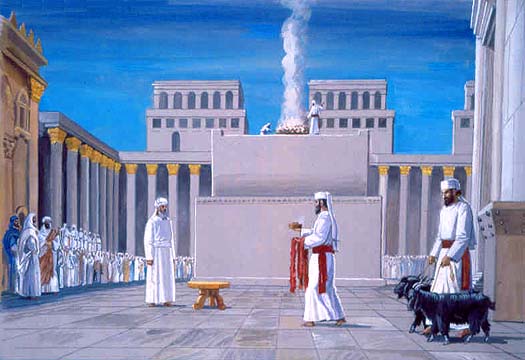
Perhaps the most peculiar item in this week’s portion is the mention of Azazel. As part of the atonement procedure on Yom Kippur, God commands Aaron to select (through a random lottery) two goats: one to be sacrificed, and another to be sent “to Azazel, in the wilderness” (Lev. 16:10). Aaron would place his hands on the goat to Azazel, and confess all of the people’s sins, as if transferring them to the animal (v. 21). The goat was then sent off into the wilderness.

The Rambam (Moreh Nevuchim, Part III, Ch. 46) writes that this act is completely symbolic. It does not mean that the High Priest literally transferred the people’s sins onto the goat, but that witnessing this act was meant to inspire a sense of repentance in the people, “as if to say, we have freed ourselves of our previous deeds, have cast them behind our backs, and removed them from us as far as possible.”

Temple Priests Bringing the Two Goats on Yom Kippur

Temple Priests Bringing the Two Goats on Yom Kippur

But what exactly is “Azazel”? What does the word mean? And why was the goat that symbolized sin sent towards it? The Talmud (Yoma 67b) maintains that the word Azazel can be broken down to mean “hardest of mountains”. This may be why some believe that the goat was sent off the edge of a mountainous cliff down to its death. The Talmud then presents the opinion of the school of Rabbi Ishmael: Azazel is a contraction of two names: Aza (or Uza) and Aza’el, and the goat atones for their sins. Other than this short allusion, this page of Talmud says nothing more.

Who were Aza and Aza’el?

The Fallen Angels

The origins of Aza and Aza’el are described in the Midrash (Yalkut Shimoni, Beresheet 44). When speaking of midrashic literature, it is important to remember the old adage that goes something like: one who believes that midrash is not true is a heretic, but one who believes that midrash is literally true is a fool. After all, the midrash corresponds to the third level of Torah study, referring to the metaphorical and allegorical level. (The other levels are peshat, the literal meaning; remez, the sub-textual meaning; and sod, esoteric/metaphysical secrets.)

Aza’el and Aza (also known as Shemhazai) were angels who saw the terrible sins of the people in the pre-Flood generation and scoffed at the pathetic humans. God told them that if they had been on Earth and given free will, they would succumb to their evil inclination far worse than people do. The angels wanted to prove God wrong, and asked Him to send them down to Earth into a physical body. God complied, and just as He had said, the angels quickly fell into all forms of evil.

Firstly, they could not hold back from the beautiful women, and this is what Genesis 6:2 means when it refers to divine beings mating with humans. The Midrash continues to say that it was these angels that taught women the art of makeup and provocative dress in order to entice men into further sin. These angels helped to bring the sword to the world, increasing bloodshed and warfare, as well as the consumption of animal meat, which was at this point forbidden, as God had only permitted Adam and Eve to consume fruits and vegetables.

Ultimately, the Midrash tells us that Shemhazai recognized his evil ways, and began a long process of repentance. No longer on Earth, but still not welcome back in the Heavenly realms, Shemhazai was suspended between the two worlds. Aza’el, on the other hand, refused to repent, and continued his evil ways. Thus, the Midrash concludes that the High Priest, in an act of repentance, would symbolically send the people’s sins towards Azazel, the one who taught mankind a new level of sinfulness, and refused to repent.

More details can be found in the Apocrypha. The Apocrypha refers to various ancient books which were not officially included in the Tanakh. Their origins are unclear, as is their authenticity. Nonetheless, they appear to have been well-known among the Jewish Sages, and are referenced in Talmud, Midrash, and Kabbalistic writings. One of the most famous of the apocryphal books is the Book of Enoch, which describes the journeys of Enoch (Hanoch, in Hebrew), who is briefly mentioned in Genesis 5:22. In the Book of Enoch, it is recorded that God sent the angel Raphael to apprehend Aza’el and stop his evil ways. Aza’el was chained to the “hardest of mountains” in the wilderness, as the Talmud quoted above explained. His painful imprisonment was a punishment, and the goats sent his way were a form of atonement for his sins. It is written there that at the End of Days, his time will come to an end, and Aza’el will finally be gone for good.


The above article is an excerpt from Garments of Light: 70 Illuminating Essays on the Weekly Torah Portion and Holidays. Click here to get the book! 

Eliyahu’s Immortality, Passover, and Shabbat HaGadol

This week’s Torah reading is Tzav, detailing many of the priestly laws that applied to the Kohanim. It begins with God telling Moses to instruct Aaron (the first Kohen) and his children in the proper sacrificial rites, starting with the olah, a type of offering that is wholly consumed by the flames (as opposed to being roasted and eaten). Rashi comments that the term “tzav” – command – has the connotation of commanding not just Aaron, but all of his future descendants, and all generations of kohanim.

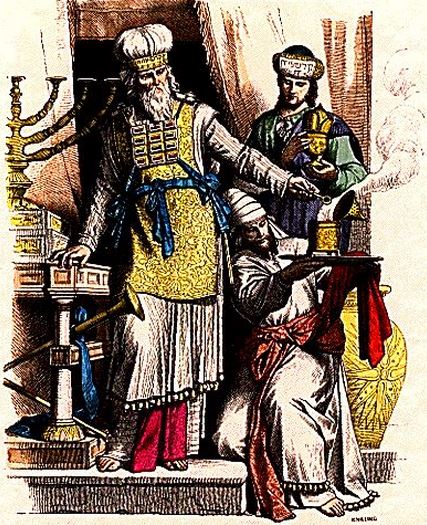
Kohen Gadol (High Priest) and Levites. (Braun & Schneider)

Kohen Gadol (High Priest) and Levites. (Braun & Schneider)

One of those descendants is Pinchas, the grandson of Aaron (through his son Elazar). For his heroic efforts, as described in Numbers 25, God blessed him with an eternal priesthood. Pinchas is mentioned as the Kohen Gadol (High Priest) in the book of Joshua (who was the first of the Biblical Judges). According to the Sages, he remained in this role until the times of Yiftach, one of the last Judges. This would mean he served as the High Priest for several hundred years! The Sages suggest that when God promised him an “eternal priesthood”, He literally meant it.

Due to the scandal that concluded the story of Yiftach (Judges 11-12), the commentaries state that Pinchas resigned as the High Priest. He then disappears from the narrative, only to reappear again a couple of centuries down the road. This time, he comes back as Eliyahu HaNavi, Elijah the prophet, as the Sages state: Pinchas ze Eliyahu, “Pinchas is Eliyahu”. The Arizal (Sha’ar HaGilgulim, 33, 2b) explains that Eliyahu was the reincarnation of Pinchas, while many others say it was literally one and the same person, since God’s blessing connoted everlasting life.

Eliyahu himself never passed away, further proving the point that Pinchas was meant to live forever. The Tanakh describes how Eliyahu was taken up to Heaven alive in a whirlwind of flames (II Kings 2:11). It is said that Eliyahu transformed into an angel, and thus lives on. This is why he appears (spiritually speaking) at certain times in the Jewish calendar and life cycle, including during a brit, and for the fifth cup during the Passover seder. Ultimately, it is prophesized that he will return in physical form once more at the End of Days to herald the coming of Mashiach, as it says: “Behold, I will send you Eliyahu the prophet before the coming of the Day of Hashem, the great and awesome” (Malachi 3:23).

The commentary of Abudraham (or Abu Dirham, Rabbi David ben Yosef of 14th century Spain) explains that this is why the Sabbath before Passover is called Shabbat HaGadol, “the Great Sabbath”. The verse in Malachi ends by saying “the great and awesome”, hagadol v’hanora. After all, this passage from Malachi is the Haftarah portion that we read at the synagogue on Shabbat HaGadol!

The basic purpose of Shabbat HaGadol is to get us into the “Pesach spirit” and prepare us for Passover. On this Sabbath, It is customary to review the Haggadah and the pertinent laws of the holiday. Similarly, the Haftarah portion is also designed to get us into the Passover mindset. The Haftarah ends by juxtaposing the first redemption under Moses with the coming redemption ushered in by Eliyahu:

“Remember the Law of Moses, My servant, whom I commanded at Horev [Mt. Sinai] for all Israel, statutes and ordinances. Behold, I will send you Eliyahu the prophet before the coming of the Day of Hashem…” (Malachi 3:23-24)

The Sages tell us that after the final redemption we will no longer need to recall the first redemption, which will pale in comparison. This is based on the verse in Jeremiah 23:7 which prophesizes that in the End of Days, people will no longer describe God as the One who took the children of Israel out of Egypt, but as the One who saved Israel from oppression all over the world, and restored them to their Promised Land.

This is one reason why during the Pesach seder, while commemorating the first redemption, we end by pouring a fifth cup for Eliyahu, who will come to usher in the final redemption. Is it then that Jews will no longer be misunderstood and oppressed, our exile will end, and we will all return to live in the Holy Land in peace, as we say at the conclusion of the seder: “Next year in Jerusalem”.