Tag Archives: Bava Batra

The Mystical Connection Between Jacob and David

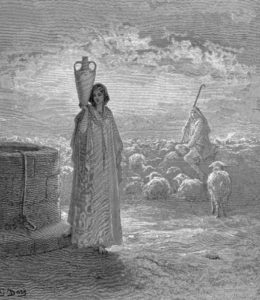
‘Jacob Keeping Laban’s Flocks’ by Gustave Doré

In this week’s parasha, Vayetze, we read how Jacob journeys to his relatives in Charan and the details of his twenty-year sojourn there. He falls in love with Rachel at first sight, then works tirelessly for seven years for the privilege of marrying her. When that fateful day comes, his father-in-law Lavan tricks him into marrying Rachel’s sister, Leah. Jacob is then forced to work another seven gruelling years. We read how Jacob didn’t care very much for Leah, as he only truly wanted to marry Rachel, and Leah felt entirely unloved. One question to ask is why Jacob didn’t simply divorce her? He had no intention of marrying Leah in the first place. One can argue that the marriage was null and void from the beginning, since a person must be aware of whom they are marrying. Why did Jacob stay with her? A number of explanations have been given for this:

The simplest is that Jacob pitied her. Lavan tricked Jacob into marrying Leah because she had no suitors. She would have grown old, all alone, and Jacob did not want to abandon her once they had been “married”. Another take on this is that Rachel was the one that deeply pitied her sister, and herself asked Jacob to stay married to Leah. One version of this story has it that Rachel even instructed Leah in how to play the part of Rachel so that Jacob wouldn’t be able to distinguish between them (see Bava Batra 123a).

From a spiritual perspective, this whole thing can be seen as one big middah k’neged middah—“measure for measure”—consequence: since Jacob had tricked his father into taking his brother’s blessing, he was now, in turn, tricked by his father-in-law. On a deeper level, we have written before how, when Jacob took his brother’s birthright and blessing, he essentially took on his brother’s mission in life. In the original conception of things, Jacob and Esau should have been twin holy warriors, with Jacob fighting the spiritual battles and Esau fighting the physical battles for God. When Esau failed, Jacob took over that mission. This is symbolized by the new name he was given: Israel, one who “fights with [or, alongside] God”. Jacob is unique in that the Torah continues to shift between his new and old name (whereas, for example, once Abram became “Abraham”, he is never again referred to as “Abram”). This is because Jacob and Israel are not old and new names, but rather dual names, for his dual personalities, representing his dual missions.

In the original plan, Jacob was meant to marry Rachel, and Esau was meant to marry Leah. (According to at least one opinion, Rachel and Leah were also fraternal twins, like Jacob and Esau; see Seder Olam Rabbah, ch. 2.) Once Jacob took over Esau’s mission and birthright, he also took on his wife. This is why he had to marry her! And he knew it all along. The Midrash states that Jacob initially feared marrying Leah because Esau would come after him for it! (Midrash Tanchuma, Vayetze 12 in Buber edition.) Meanwhile, another Midrash says that Jacob did love Leah, but turned away from her when she pointed out that her father tricked Jacob in the same way Jacob had tricked his own father, measure for measure (Lekach Tov on Genesis 27).

Whatever the case, their marriage was an unhappy one. Leah always felt unloved, and named all of her kids in relation to her hope that her husband would finally cherish her. He didn’t. Meanwhile, the wife he did love—Rachel—was barren for many years, and this strained their relationship tremendously (Genesis 30:1-2). It is little wonder that when Jacob meets Pharaoh decades later, he tells him that his whole life has been miserable (Genesis 47:9).

Jacob made many mistakes in his life, and such mistakes, of course, need rectification. This is where the Arizal (Rabbi Isaac Luria, 1534-1572) comes in, explaining how Jacob’s life was rectified in the life of King David.

David and Abigail

In Sha’ar HaGilgulim, “Gate of Reincarnations”, Rabbi Chaim Vital (1543-1620, the Arizal’s primary disciple) details Lavan’s various incarnations. Lavan’s soul was originally rooted in Abel, the son of Adam. The holy part of Abel (הבל), symbolized by the letter hei, was reincarnated in Moses (משה, whose other two letters come from Shem, שם, who was also incarnated in him), while his evil part, symbolized by bet-lamed, reincarnated in Lavan (לבן). Lavan was unable to rectify this part of Abel, and descended into sorcery and evil. Unrepaired, he had to reincarnate once more, as Bilaam (בלעם), the “non-Jewish version” of Moses. Thus, when Moses and Bilaam go head-to-head later in the Torah, they are actually two ancient halves of Abel!

As we know, Bilaam also descended into sorcery and evil, so he had to reincarnate again. This time around, he comes back as Naval (נבל). Recall that Naval was a very wealthy man, “with three thousand sheep and a thousand goats” (I Samuel 25:2). At the time, David and his loyal soldiers were encamped in Carmel, and protected Naval’s shepherds. This was before David had consolidated his monarchy, when King Saul had refused to give up the throne and sought to get rid of David.

David eventually reached out to Naval and asked for his help. He reminded Naval that his soldiers had watched over Naval’s flocks and shepherds, and ensured no harm came upon them. Instead of showing his gratitude, Naval rebuffed David’s messengers. This was wrong for a number of reasons, including the fact that David was already the rightfully-anointed king of Israel, and refusing a king in such a way carries a capital punishment. David armed four hundred of his men and headed towards Naval.

Naval’s wife Abigail got word of what was going on, and went out to greet David and pacify him. She took with her “two hundred loaves, and two bottles of wine, and five sheep ready dressed, and five measures of parched corn, and a hundred clusters of raisins, and two hundred cakes of figs” as a gift (25:18). While David was angrily racing towards Naval and thinking “he has returned me evil for good” and intending to exterminate his entire household (25:21-22), Abigail suddenly appeared. She placates him with a beautiful soliloquy (25:24-31), to which David responds:

Blessed be Hashem, the God of Israel, who sent you this day to meet me; and blessed be your discretion, and blessed you be, that you have kept me this day from bloodshed, and from finding redress for myself with my own hand.

David spares Naval, and sends Abigail back home in peace. Although David was merciful, God was not, and He struck Naval with what appears to be a heart attack: “his heart died within him, and he became as a stone” (25:37). In the aftermath of the narrative, David ends up marrying the widowed Abigail, and she becomes one of his most important and beloved wives.

Abigail meets David

Jacob Reincarnated

In the same way that Lavan reincarnated in Naval, Jacob returned in David. Upon closer examination, the parallels between them are striking. Jacob was the father of the Twelve Tribes, and David was the king that unified the Twelve Tribes into one cohesive kingdom (establishing the only divinely-approved dynasty). Jacob is the one that prayed in Jerusalem at Beit El, literally the “House of God”, placing twelve foundation stones there in his vision of the future Temple, and David was the one that actually acquired Jerusalem and paved the foundations for the Temple at that same Beit El site. Jacob is the only patriarch of whom it is said that he never “died”, just as it is common to sing David melekh Israel chai v’kayam, King David lives on. (The Ba’al HaTurim, on Genesis 32:12, points out many more connections between Jacob and David.)

Jacob’s first flaw was in slaving away for Lavan partly because of his physical desire for the beautiful Rachel (as we see in Genesis 29:21). This was rectified in David because he slaved away for Naval without any ulterior motive, and certainly with no desire for the beautiful Abigail (among the most beautiful women of all time, as per Megillah 15a). Just like Lavan tricked Jacob out of his rightful wages, Naval tricked David out of his rightful wage. Whereas Jacob fled from Lavan and was pursued by Lavan’s army, this time around it was David who had the military might on his side and pursued Naval.

Ultimately, David restrained himself from violence—not stooping to the level of Lavan/Naval—and God took care of the problem for him. He was rewarded with Abigail. And who was she? The Arizal reveals that she contained the spirit of Leah! (Incidentally, the gematria of אביגיל is 56, equal to כלאה, “like Leah”). The first time around, Jacob worked for Rachel and spurned Leah, making her feel “hated”. This time, David rectifies the mistake of his past life by essentially working for Leah, and marrying her willingly and lovingly.

To be clear, the Arizal does not state all of the above explicitly, though it may be extracted from his teachings, as recorded in Sha’ar HaGilgulim (particularly chapter 36). We must keep in mind that Rabbi Chaim Vital’s (together with his son Rabbi Shmuel Vital’s) transcription of his master’s teachings was not perfect, as he himself admits in many instances. He often introduces a statement, or an alternate teaching, with the words נראה לפי עניות דעתי, “it appears, from my limited knowledge…” Sometimes, he also adds פעם אחרת, that “another time” he apparently heard something different.

In the present discussion, the main teaching of the Arizal is actually of a different nature, taking the souls of Jacob and Lavan, Rachel, Leah, and David all the way back to Adam and the “Original Sin”.

Adam and the Snake

The Arizal taught that the Nachash (loosely translated as “snake” or “serpent”) caused Adam to waste two seminal drops. These two seminal drops carried the souls of Rachel and Leah. Lavan carried the essence of the Nachash who had imprisoned those souls. Jacob worked hard in order to free them from Lavan and marry them, because Jacob was a reincarnation of Adam and sought to reunite with those lost spiritual sparks of his. Jacob succeeded in fulfilling this tikkun.

Rachel and Leah were actually sparks of Adam, and parts of Jacob’s own soul. (In addition to the fact that, as Rabbi Vital reminds, a man infuses a part of his own soul into a woman when the two are intimate.) That spirit within Rachel then migrated into her son Benjamin, which is why the Torah tells us that Benjamin was born “when her soul left her” (Genesis 35:18), ie. left Rachel and entered him. The spirit within Leah, meanwhile, went into Abigail. This is why, in one place in Scripture (II Samuel 17:25), she is called Avigail bat Nachash, “Abigail, the daughter of Nachash” (or Avigal bat Nachash), as her spirit had come from those souls taken by the Serpent.

Alternatively, Avigail bat Nachash is not the wife of David, but actually the name of his sister, who was also called Abigail (or Abigal). Rabbi Vital points out (introducing it with those uncertain words פעם אחרת נראה לפי עניות דעתי) that the spirit within Leah split between Abigail the wife of David and Abigail the sister of David, for a completely different tikkun. This was a rectification for the fact that Jacob married two sisters—something explicitly forbidden by the Torah. (To be fair, Jacob lived before the official giving of the Torah.) To fix that error, Leah partially came back within David’s own sister whom, of course, he did not marry, and instead loved like a brother.

If all of this soul migration and rectification sounds complicated, that’s because it is! There are countless souls, each made up of thousands of sparks, all of which are dynamically moving through us, passing throughout history, jumping across space and time, and quietly weaving themselves into the tapestries of our intriguing lives.
How Esau Became Rome

In this week’s parasha, Toldot, we are introduced to the twin sons of Isaac: Jacob and Esau. The Torah tells us that the boys grew up and Esau became a “man of the field” while Jacob was “an innocent man sitting in tents” (Genesis 25:27). In rabbinic literature, Esau takes on a very negative aura. Although the Torah doesn’t really portray him as such a bad guy, extra-Biblical texts depict him as the worst kind of person.

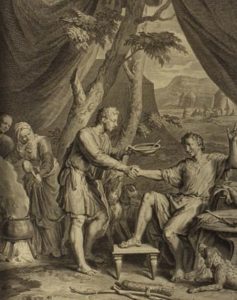
A 1728 Illustration of Esau selling his birthright.

Take, for instance, the first interaction between Jacob and Esau that the Torah relates. Esau comes back from the field extremely tired. At that moment, Jacob is cooking a stew. Esau asks his brother for some food, and Jacob demands in exchange that Esau give up his birthright (ie. his status as firstborn, and the privileges that come with that). Esau agrees because “behold, I am going to die” (Genesis 25:32). The plain text of the Torah makes it seem like Jacob took advantage of Esau’s near-fatal weariness and tricked him into selling his birthright. This is later confirmed when Esau says that Jacob had deceived him (Genesis 27:36), implying that Esau never really wished to rid of it.

Yet, the Torah commentaries appear to flip the story upside down. When Esau comes back from the field exhausted, it isn’t because he just returned from a difficult hunt, but rather because, as Rashi comments, he had just come back from committing murder! When Esau says “I am going to die”, it isn’t because he was on the verge of death at that moment, but because he didn’t care about the birthright at all, choosing to live by the old adage of “eat, drink, and be merry, for tomorrow we die”. This is a very different perspective on the same narrative.

Another example is when, many years later, Jacob returns to the Holy Land and Esau comes to meet him. Jacob assumes Esau wants to kill him, and prepares for battle. Instead, Esau genuinely seems to have missed his brother, and runs towards him, “embracing him, falling upon his neck, and kissing him” (Genesis 33:4). Again, some of the commentaries turn these words upside down, saying that Esau didn’t really lovingly kiss his brother, but actually bit him! Rashi’s commentary on this verse cites both versions. He concludes by citing Rabbi Shimon bar Yochai in stating that although Esau, as a rule, hates Jacob, at that moment he really did love his brother.

So, how bad was Esau really?

Seeing the Good in Esau

Occasionally, we read about Esau’s good qualities. The Midrash (Devarim Rabbah 1:15) famously states that no one honoured their parents better than Esau did. This is clear from a simple reading of the Torah, too, where Esau is always standing by to fulfil his parents’ wishes. For instance, as soon as he learns that his parents are unhappy with his choice of wives, he immediately goes off to marry someone they might approve of (Genesis 28:8-9).

We should be asking why his parents didn’t simply tell him from the start that his original wives were no good? Why did they allow him to marry them in the first place? If Esau really was the person who most honours his parents, he would have surely listened to them! We may learn from this that Esau’s parents didn’t put too much effort into him. It’s almost like Rebecca gave up on her son from the moment she heard the prophecy about the twins in her belly. The Torah says as much when it states, right after the birth of the twins, that “Isaac loved Esau because his game-meat was in his mouth, but Rebecca loved Jacob.” (Genesis 25:28) Rebecca showed affection to Jacob alone, while Isaac’s love for Esau was apparently conditional. Of course, children always feel their parents’ inner sentiments, and there is no doubt Esau felt his parents’ lack of concern for him. Is it any wonder he tried so hard to please them?

From this perspective, one starts to feel a great deal of pity for Esau. How can anyone read Esau’s heartfelt words after being tricked out of his blessing and not be filled with empathy?:

When Esau heard his father’s words, he cried out a great and bitter cry, and he said to his father, “Bless me, too, O my father! …Do you not have a blessing left for me?” (Genesis 27:34-36)

Esau was handed a bad deal right from the start. He was born different, not just in appearance, but with a serious life challenge. He was gifted (or cursed) with a particularly strong yetzer hara, from birth. His fate was already foretold, and his parents believed it. They invested little into him. And it seems all he ever wanted was to make them proud.

Incidentally, this is one of the major problems with fortune-telling, and why the Torah is so adamant about not consulting any kind of psychic. The psychic’s words, even if entirely wrong, will shape the person’s views. It is very much like the Talmud’s statement (Berakhot 55b) that a dream is fulfilled according to how it is interpreted. A person believes the interpreter, and inadvertently brings about that interpretation upon themselves. It’s a self-fulfilling prophecy.

Who knows what might have happened if Rebecca never bothered to consult a prophet about her pregnancy? After all, Jewish tradition is clear on the fact that negative prophecies do not have to come true. God relays such a prophecy in order to inspire people to change, and thus avert the negative decree. Such was precisely the case with Jonah and his prophecy regarding Nineveh. The people heard the warning, repented, and the prophecy was averted.

Perhaps this is what Isaac and Rebecca should have done. Instead of giving up on Esau, they should have worked extra hard to guide him in the right direction. (Isaac indirectly did the opposite, motivating his son’s hunting since he loved the “game-meat in his mouth”.) The Sages affirm that Esau was not a lost case, and state that had Jacob allowed his daughter Dinah to marry Esau, she would have reformed him (see, for example, Beresheet Rabbah 76:9).

At the end, Jacob returns to the Holy Land and, instead of the war with Esau that he was expecting, his brother welcomes him back with open arms. He weeps, and genuinely misses him. Esau has forgiven his brother, yet again, and buries the past. He hopes to live with his brother in peace henceforth, and invites him to live together in Seir. Esau offers to safely escort Jacob and his family. Jacob rejects the offer, and tells Esau to go along and he will join him later (Genesis 33:14). This never happens. Jacob has no intention to live with Esau, and as soon as his brother leaves, Jacob a completely different course. Esau is tricked one last time.

We only hear about Esau once more in the Torah. When Isaac dies, Esau is there to give his father a proper burial (Genesis 35:29). In fact, the Book of Jubilees, which doesn’t portray Esau too kindly either, nonetheless suggests that Esau had repented at the end of his life. There we read that it was his sons that turned evil, and even coerced him into wrongdoing (37:1-5). In Jubilees, Esau tells his parents that he has no interest in killing Jacob, and loves his brother wholeheartedly, more than anyone else (35:22). He admits that Jacob is the one that deserves the birthright, and a double portion as the assumed firstborn (36:12).

The Torah never tells us what ends up happening to Esau. The Midrash states that he was still there when Jacob’s sons came to bury their father in the Cave of the Patriarchs. Esau tried to stop them, at which point Jacob’s deaf grandson Hushim decapitated him. (A slightly different version is found in the Talmud as well, Sotah 13a.) Esau’s head rolled down into the Cave of the Patriarchs, while the rest of his body was buried elsewhere. Perhaps what this is meant to teach us is that while Esau’s body was indeed mired in sin, his head was completely sound, and he certainly had the potential to be a righteous man—maybe even one of the forefathers, hence his partial burial in the Cave of the Patriarchs.

At the end of the day, Esau is not so much a villain as he is a tragically failed hero.

Why Did Esau Become so Evil?

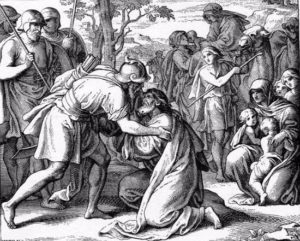
Esau meets Jacob, by Charles Foster (1897)

As we’ve seen, the Torah itself doesn’t portray Esau as such a bad person. Conversely, one of the 613 mitzvot is “not to despise an Edomite, for he is your brother.” (Deuteronomy 23:8) The Torah reminds us that the children of Israel and the children of Esau (known as Edomites) are siblings, and should treat each other as such.

Nearly a millennium later, the prophet Malachi—generally considered the last prophet and, according to one tradition, identified with Ezra the Scribe—says (Malachi 1:2-3):

“I have loved you,” says Hashem, “Yet you say: ‘How have You loved us?’ Was not Esau a brother to Jacob?” says Hashem, “yet I loved Jacob, but Esau I hated…”

The text goes on to differentiate between Israel and Edom, stating that while Israel will be restored, Edom will be permanently extinguished. We have seen this prophecy fulfilled in history; Israel is still here, of course, while Edom has long disappeared from the historical record. Jacob’s descendants continue to thrive, while Esau’s are long gone.

By the times of the Talmud, there were no real Edomites left, so the Sages began to associate Edom with a new entity: the Roman Empire. The Sages certainly didn’t believe that the Romans were the direct genetic descendants of Esau, but rather that they were their spiritual heirs. Why did the Sages make this connection?

I believe the answers lies with King Herod the Great.

Recall that approximately two thousand years ago Herod ruled as the Roman-approved puppet king of Judea. He was a tremendous tyrant, and is vilified in both Jewish and Christian tradition. The Talmud (Bava Batra 3b-4a) relates how Herod slaughtered all the rabbis in his day, leaving only Bava ben Buta, whom he had blinded. Later, Herod had an exchange with Bava and realized how wise the rabbis were:

Herod then said: “I am Herod. Had I known that the Rabbis were so circumspect, I should not have killed them. Now tell me what amends I can make.”

Bava ben Buta replied: “As you have extinguished the light of the world, [for so the Torah Sages are called] as it is written, ‘For the commandment is a light and the Torah a lamp’ (Proverbs 6:23), go now and attend to the light of the world [which is the Temple] as it is written, ‘And all the nations become enlightened by it.’” (Isaiah 2:2)

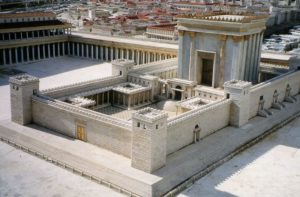
A model of Herod’s version of the Second Temple in Jerusalem

Herod did just that, and renovated the Temple to be the most beautiful building of all time, according to the Talmud. It wouldn’t last long, as that same Temple would be destroyed by his Roman overlords within about a century.

What many forget is that Herod was not a native Jew, but an Idumean. And “Idumea” was simply the Roman name for Edom. Herod was a real, red-blooded Edomite. (Though it should be noted that the Idumeans had loosely, or perhaps forcibly, converted to Judaism in the time of the Hasmoneans.) Herod took over the Jewish monarchy, and began the horrible persecutions that the Roman Empire—of which he was a part—was all too happy to continue. It seems quite likely, therefore, that the association between Edom and Rome began at that point. The people resented that Roman-Edomite tyrant Herod that persecuted them so harshly.

Henceforth, it was easy for the Sages to spill their wrath upon Edom, and their progenitor Esau. Esau became a symbol of the Roman oppressor. “Esau” and “Edom” were code words, used for speaking disparagingly about Rome to avoid alarming the authorities. Indeed, when the Sages speak about the evils of Esau, they are often really referring to the evils of the Roman Empire. It is therefore not surprising that Esau becomes possibly the most reviled figure in the Torah—as the Romans were unquestionably the most reviled entity in Talmudic times.


The above is an excerpt from Garments of Light, Volume Two. To continue reading, get the book here

Things You Didn’t Know About Abraham

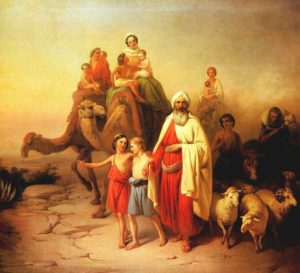
Abraham’s Journey to Canaan, by Jozsef Molnar (1850)

After two parashas that span the first two millennia of civilization, the Torah shifts its focus to the origins of Israel and the Jewish people starting with, of course, Abraham. Abraham is probably most famous for something that he actually isn’t: being the first monotheist. Noah was a monotheist long before Abraham, as was Noah’s son Shem, who was already a priest of the one Supreme God (El Elyon, as in Genesis 14:18). In Jewish tradition, it is said that Shem established the first yeshiva, and the patriarchs studied there. Was Abraham the first monotheist? No, but he is described as being the first person to actively preach monotheism to the world. He took it upon himself to crusade against idolatry—and the immoral behaviours that went with it.

Some of our Sages also state that Abraham invented the concept of a positive mitzvah. This means drawing closer to God not by abstinence and asceticism but through acts of kindness and the performance of physical actions. For this reason, the gematria of “Abraham” (אברהם) is 248, equal to the number of positive commandments in the Torah. Not surprisingly, Abraham is well-known for his legendary hospitality, his great compassion, and his ceaseless efforts on behalf of his fellow man.

Jewish tradition describes Abraham’s house as having a front door on each side so that guests wouldn’t have to look for the entrance. Meals were always on the house, as long as the guest was willing to thank God for it. Of his compassion, we read in the Torah how Abraham questioned God before the destruction of Sodom, seeking to exonerate the people despite their cruelty (Genesis 18). In this week’s parasha, Lech Lecha, we read of all the “souls that they had made” (Genesis 12:5), the countless people that Abraham and Sarah inspired and brought closer to God. In fact, the Meshekh Chokhmah (of Rabbi Meir Simcha of Dvinsk) on Genesis 33:18 states that Abraham later migrated to Egypt specifically because it was the capital of idolatry and impurity at the time, and Abraham wished to bring some light to that dark place.

What else do we know about Abraham? Extra-Biblical texts reveal some intriguing details in the life of Judaism’s first patriarch.

Discovering God

There are three major opinions as to when Abraham came to know God. The Talmud (Nedarim 32a) holds that he first recognized his Creator when he was three years old. This is deduced from Genesis 26:5, where God says Abraham had “listened to My voice”, ekev asher shama Avraham b’koli. The term “ekev” (עקב) has a numerical value of 172, and since we know Abraham lived 175 years, we learn that Abraham had listened to God’s voice for 172 of them, starting at age 3.

The Rambam (Rabbi Moshe ben Maimon, 1135-1204), meanwhile, writes in his Mishneh Torah that Abraham came to know God at age 40 (Hilkhot Avodat Kochavim 1:3). A more commonly-held view is that Abraham came to know God at age 52. This is based on the Talmudic statement that history is divided into three eras: the first 2000 years being the era of “chaos”, the next 2000 years being the era of Torah, and the final 2000 years being the era of Mashiach (Avodah Zarah 9a). Since we know that Abraham was born in the Hebrew year 1948, and the era of Torah started in the year 2000, Abraham must have been 52 when he came to know God.

One way to reconcile these three opinions is as follows: Abraham first realized there must be one God when he was three years old. By age 40, he was ready to begin his life’s work, and set forth in preaching his message. This got him into a lot of trouble, for which he was imprisoned, and ultimately sentenced to death. The Talmud (Bava Batra 91a) clarifies that he was imprisoned for 10 years. Then came the day of his execution. Abraham was thrown into the flames of Ur Kasdim when he was 52, and at this point God actually revealed Himself to Abraham for the first time, miraculously saving him from death. Therefore, there are those who say it wasn’t God who chose Abraham, but Abraham who chose God.

Abraham was already preaching long before he received any kind of prophecy or communication from Hashem. He logically deduced there must be one Creator to this world, and recognized the folly of idolatry on his own. He then took it upon himself to teach this truth, despite never having “heard” anything from God, or being summoned to do so. God chose him precisely because of this incredible initiative. We learn this explicitly from Genesis 18:19, where God says:

For I have known him, that he commands his children and his household after him, that they should keep the way of God, to do righteousness and justice; therefore God brings upon Abraham that which He has spoken of him.

God chose Abraham because he was already teaching others to be more Godly! At age 52, the God that Abraham had been preaching about for so long finally revealed Himself, in miraculous fashion. This sets off a new 2000-year era, that of Torah and prophecy, spanning from Abraham until the times of Rabbi Yehudah HaNasi, who compiled the Mishnah, thus putting the Oral Torah in writing for the first time.

Abraham the Kabbalist

The Talmud (Bava Batra 91a) states that Abraham was world-famous for being an unparalleled astrologer and healer. According to tradition, he was also a great mystic. It is believed that he authored, or in some other way originated, Sefer Yetzirah, the “Book of Formation”, one of the most ancient Kabbalistic text. The book explains how God fashioned the universe through the Hebrew letters. The Talmud (Sanhedrin 67a) suggests that mastery of this text would allow the mystic to create ex nihilo, out of nothing, and such was done by Rav Oshaya and Rav Chanina every Friday afternoon. These two rabbis would create a chunk of veal, and make a barbecue!

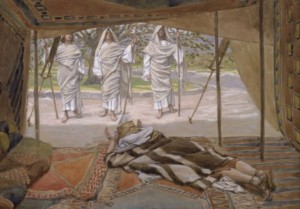
‘Abraham and the Three Angels’ by James Tissot

It appears the same was done by Abraham. We read in Genesis 18:7 that when the angels visited him, Abraham hastened to “make” a calf, v’imaher la’asot oto. The Malbim (Rabbi Meir Leibush Wisser, 1809-1879) comments on the Torah’s strange choice of verb by stating that Abraham literally created a calf through the wisdom of Sefer Yetzirah. This is why, he explains, the next verse has Abraham serving butter and milk. It is unthinkable that Abraham would serve veal with dairy—an explicit Torah prohibition—unless the veal was of his own creation, and was therefore not real meat that once had a soul. Abraham may have been the first person to serve vegan burgers.

Where did Abraham get this wisdom? According to one tradition, the angel Raziel (literally “God’s secret”) taught these mysteries to Adam. Adam passed it down to his son Seth, and onward it went down to Noah, then to his son Shem. Midrashic texts have Shem teaching Abraham, circumcising Abraham (Pirkei d’Rabbi Eliezer, ch. 29), and even ordaining Abraham as a priest (Midrash Aggadah, Genesis 14:19).

Alternatively, Abraham received mystical knowledge on his own. Kabbalah implies something “received”, and is often seen as being conferred directly by the Heavens to those who are worthy. In his commentary on Sefer Yetzirah, the Ravad (Rabbi Avraham ben David, c. 1125-1198) lists the names of the angels that taught our patriarchs this mystical wisdom:

The master of Shem was Yofiel. The master of Abraham was Tzadkiel. The master of Isaac was Raphael. The master of Yakov was Peliel. The master of Yosef was Gabriel. The master of Moshe Rabbeinu was Metatron. The master of Elijah was U’maltiel. Each of these angels passed down Kabbalah to his disciple, whether through a book or orally, in order to enlighten him, and to inform him of future events.

According to the Book of Jubilees (12:25), Abraham was also taught Hebrew directly from Heaven. It had been lost following the Great Dispersion of the Tower of Babel. Now, the Holy Tongue was restored. Of course, it wouldn’t have been possible for Abraham to learn Kabbalah and the mysticism of Sefer Yetzirah without knowledge of Hebrew, upon which it is all based. Interestingly, the Book of Jubilees (11:6) also paints Abraham as a great engineer. He first became famous for inventing a seed-scattering device attached directly to a plow, as well as a method for keeping birds from eating the seeds of farmers.

The Torah tells us that at the end of his life, Abraham gave over his entire inheritance to Isaac, his rightful heir, but left various matanot, “gifts”, for his other children (Genesis 25:6). He then sent those other children eastward, to live outside the borders of Israel, so that it would be clear that the Holy Land belongs solely to Isaac and his descendants. What were these gifts? The Sages state that these were kernels of mystical wisdom to take with them. Some say this was white magic, and others black magic. The Talmud (Sanhedrin 91a) associates it with impure wisdom of some sort. Many see in these gifts the mystical wisdom that would give rise to the ancient religions of the Far East. So perhaps there is a connection after all between the Hindu concept of Brahman—and the Hindu priestly caste of Brahmins—with the name Abraham.

While Abraham is generally seen as a forefather—whether biological or spiritual—of Jews, Christians, and Muslims, he is also a forefather of many other nations through his many other children that we often forget about (see Genesis 25). Our Sages say he is called “Avraham” because he is av hamon goyim, the father of a multitude of nations. He might very well be the father of all the world’s major religions, too.