Tag Archives: Jacob

Mashiach and the Mysterious 13th Zodiac Sign

When Jacob blesses his children before his passing, he begins by telling his sons that he wishes to reveal to them what will happen b’acharit hayamim, “in the End of Days”. Yet, the text we read does not appear to say anything about the End of Days! The Talmud (Pesachim 56a) states that the Shekhinah withdrew from Jacob at that moment so he was unable to reveal those secrets. If that’s the case, how was he able to properly bless his children?

The Talmud states that when the Shekhinah left him, Jacob worried one of his children was unworthy to hear those secrets. His sons then recited the Shema in unison and said, “just as there is only One in your heart, so is there in our heart only One.” Jacob was comforted to know they are all indeed righteous, and it seems the Shekhinah returned to him at this point, allowing him to bless his children in holiness. Nonetheless, Jacob reasoned that to reveal the secret of the End in explicit fashion would be unwise, so he encoded these mysteries within the blessings he recited. In fact, Jacob not only encrypted what will happen in the End, but summarized the breadth of Jewish history (see ‘How Jacob Prophesied All of Jewish History’ in Volume One of Garments of Light).

One place where Jacob appears to make an explicit reference to the End is in blessing Dan, when he says, “I hope for Your salvation, Hashem” (Genesis 49:18). Jacob says Dan will be the one to judge his people—alluding to the great Judgement Day—and wage the final battles like a “snake upon the road… who bites the horse’s heel so that its rider falls backwards”. Jacob is speaking of Mashiach. Although Mashiach is a descendent of David and from the tribe of Judah, the Midrash states that this is only through his father, while through his mother’s lineage Mashiach hails from the tribe of Dan.

Why does Jacob compare Mashiach to a snake?

Snakes of Divination

In cultures around the world, there is a peculiar connection between snakes and prophecy. In ancient Greece, for example, the Oracle went into a prophetic trance when supposedly breathing in the fumes (or spirit) of the dead python upon which the Temple in Delphi was built. According to myth, this great python (a word which has a Hebrew equivalent in the Tanakh, פתן) was slain by Apollo. The Temple was built upon its carcass. For this reason, the Greek prophetess was known as Pythia.

Similarly, the Romans had their sacred hill on the Vatican (later adopted as the centre of Christianity). The second-century Latin author Aulus Gellius explained that the root of the word Vatican is vates, Latin for “prophet”. Others explain that vatican refers more specifically to a “divining serpent”. Meanwhile, on the other side of the world the Aztecs had Quetzalcoatl and the Mayans had Kukulkan, the “feathered serpent” god of wisdom and learning. And such mystical dragons appear just about everywhere else, from Scandinavia to China.

Incredibly, the Torah makes the same connection, where Joseph is described as a diviner who uses a special goblet to nachesh inachesh (Genesis 44:5). This term for divination is identical to nachash, “snake”. In Modern Hebrew, too, the term for guessing or predicting is lenachesh. Why is the snake associated with otherworldly wisdom and prophecy?

Primordial Serpent

Back in the Garden of Eden, it was the Nachash, “Serpent”, who encouraged Eve to consume of the Forbidden Fruit. This was the fruit of the Tree of Knowledge. The Serpent is the one who unlocked the minds of Adam and Eve to higher wisdom so that they could “be like God”. Jewish tradition maintains that Adam and Eve were eventually supposed to eat of the Tree of Knowledge (for otherwise why would God put it there to begin with?) but they simply rushed to do so when they were not yet ready. They transgressed God’s command, and knew not what to do with all of this tremendous information, resulting in the shameful descent of man into sin. The one who instigated it all was the Nachash.

It appears that ever since then, the snake has been a symbol of forbidden wisdom. Such divination and mysticism can be quite dangerous, and most are unable to either grasp or properly use this knowledge. The Talmud cautions as much in its famous story of the four sages who entered “Pardes” (Chagigah 14b). Pardes is an acronym for the depths of Jewish wisdom, from the simple (pshat) and sub-textual (remez) to the metaphorical (drash) and esoteric (sod). The result of entering the mystical dimensions was that Ben Azzai died, Ben Zoma detached from this world, and Elisha ben Avuya became a heretic. Only Rabbi Akiva was able to “enter in peace and depart in peace.” It is important to remember that Rabbi Akiva was the teacher of Rabbi Shimon bar Yochai, the originator of the Zohar. (Still, the Zohar, like most mystical texts, does not speak explicitly of esoteric matters, but cloaks them in layers of garments and complex language which only the most astute can unravel.)

Long before, Joseph was a master of this wisdom, surprising even the Pharaoh and his best mystics, who proclaimed: “Can there be such a man in whom the spirit of God rests?” (Genesis 41:38). Joseph, of course, is a prototype of Mashiach. The sages state that Mashiach is a great prophet and sage in his own right, but can he really surpass the unparalleled prophecy of Moses or the wisdom of Solomon? The Alter Rebbe (Rabbi Schneur Zalman of Liadi, 1745-1812) solved the issue thus:

After the resurrection all will rise… the Patriarchs and Matriarchs, Moses and Aaron, all the righteous ones and the prophets, tens of thousands beyond number. Is it possible that Mashiach will teach them the same Torah that is revealed to us today? …Will all who knew the whole Torah be required to learn new laws from Mashiach? We must therefore say that Mashiach will instruct them in the “good of discernment and knowledge of the secrets of the esoteric teachings of Torah” that the “eyes will not have seen”—Moses and the Patriarchs not having been privileged to that knowledge, for only to Mashiach will it be revealed as it is written of him [Isaiah 52:13] “and he shall be very high.” (Likkutei Torah, Tzav)

Mashiach is the greatest of mystics, the holder of “forbidden” knowledge which will soon no longer be forbidden. The time will come when, as God originally intended, man will eat from the Tree of Knowledge and be “like God”. That first requires a return of mankind to the Garden of Eden, which is the very task of Mashiach. Beautifully, the gematria of Mashiach (משיח)—the one who brings us back into Eden—is 358, the same as Nachash (נחש)—the one who forced us out to begin with. And so, as Jacob foresaw, the snake symbolizes Mashiach himself.

While Mashiach is likened to a serpent, he must also defeat the Primordial Serpent which embodies all evil. Indeed, the Sages speak of two serpents (based on Isaiah 27:1): the “straight” serpent (nachash bariach) and the “twisted” serpent (nachash ‘akalaton). Mashiach is the straight serpent that devours the twisted one. This was all alluded to in Moses’ staff-turned-serpent consuming the Pharaoh’s staff-turned-serpent. In fact, another serpent staff, the nachash nechoshet, is later used by Moses to heal the nation. This healing staff found its way into Greek myth as well, where it was wielded by the healer god Asclepius, and eventually into the modern internationally-recognized medical symbol.

And that brings us back to the End of Days.

The 13th Zodiac

In recent years, there have been whispers of a necessity to change the current 12-sign horoscope to include a 13th zodiac sign. This was featured in the media on a number of occasions, with flashy headlines suggesting that some people’s astrological sign may now have changed. It is based on the fact that there is a “precession of the equinoxes”: Earth’s axis changes very slowly over time, meaning that the constellations which are visible in the night sky change, too.

The astrological signs are based on the 12 major constellations (out of 88 constellations total) that align with the sun and “rule” for about a month’s time every year (each making up 30º of the total 360º). The argument is that due to the precession of the equinoxes, a 13th sign has crept in which we can no longer ignore. The majority of astrologers have rejected this argument, mainly because astrology isn’t really based on the stars but fixed to the vernal equinox. While some in the East (namely Hindus) use “sidereal astrology”, which is based on shifting star positions, the system used in the West (“tropical astrology”) has 12 signs roughly corresponding to the 12 months.

The same is true in traditional Jewish thought, where each sign corresponds to a month on the Hebrew calendar, as well as to one of the twelve tribes of Israel. Having said that, including a 13th month for the Jewish system is not a problem at all. In fact, it is actually a solution, since the Jewish calendar has a 13th month in a leap year. The extra month has an astrological sign, too! Similarly, although we always speak of twelve tribes of Israel, there are really thirteen since, as we read in this week’s parasha, Jacob made Joseph count as two separate tribes: Ephraim and Menashe.

Whatever the case, whether the horoscope requires modification or not is irrelevant to Judaism, which denies any astrological effect on Israel (see ‘Should Jews Believe in Astrology’ in Volume One of Garments of Light). Besides, unlike astrologers, astronomers both ancient and modern have always been aware of this thirteenth constellation. To the ancient Babylonians it was the snake-like Nirah, while to the ancient Greeks it was known as Ophiuchus, the “serpent-bearer”. This constellation is in the shape of a man firmly grasping a twisted snake (the interlinked constellation Serpens). This is, of course, the very symbol of Mashiach, that serpentine saviour who defeats the primordial snake and all of its evil. After being an astrological footnote for a very long time, Ophiuchus has entered the spotlight, as if the cosmos itself is reminding us of Mashiach’s impending arrival.
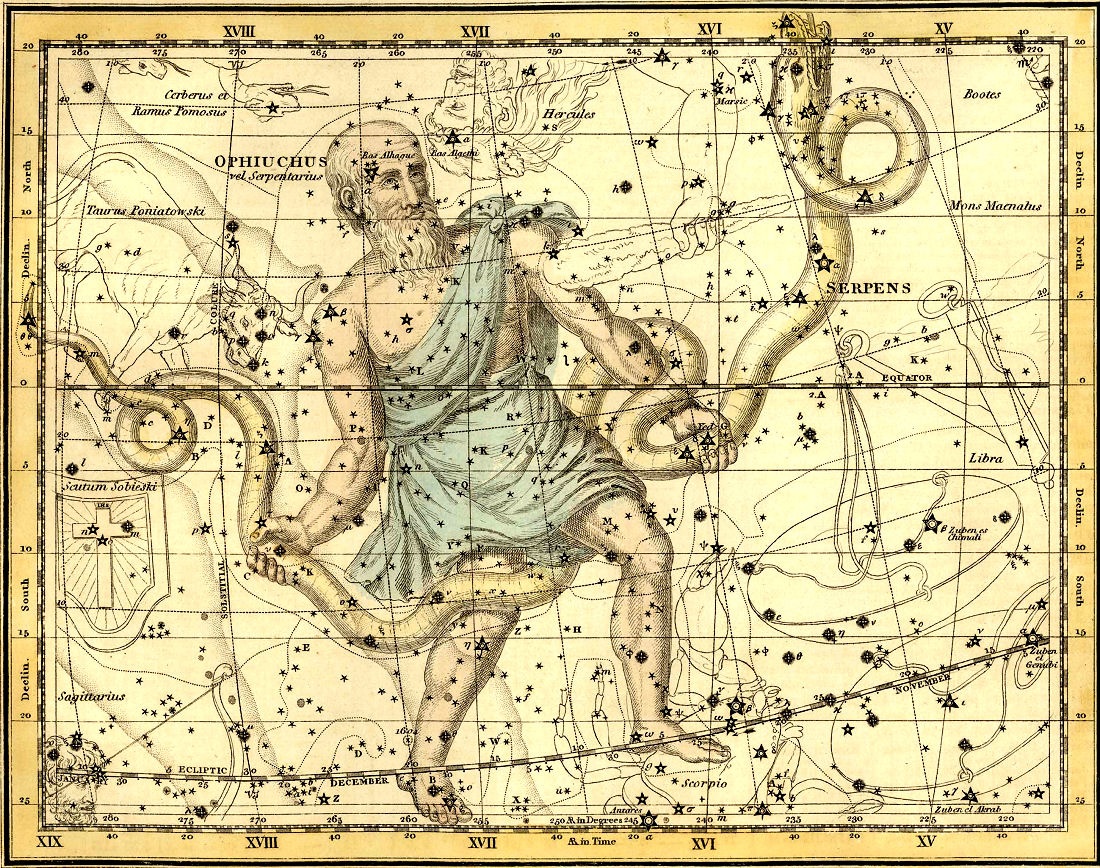
The constellation Ophiuchus (or Serpentarius) grasping the constellation Serpens, from Alexander Jamieson’s Celestial Atlas of 1822. It is interesting to note that Mashiach must be a direct descendant of King David, whose own father Yishai (Jesse) was also called Nachash! (See Talmud, Shabbat 55b.)


The above is an excerpt from Garments of Light, Volume Two. Get the book here

The Year 5778: Apex of the Messianic Era

The stars of this week’s parasha, Vayeshev, are Joseph and Judah. We are told how the sons of Jacob were envious (and suspicious) of Joseph, and ended up throwing him in a pit while deliberating what to do with him. Shimon wished to kill him, Judah to sell him, and Reuben to save him. Meanwhile, Midianite merchants found the helpless Joseph and abducted him, later selling him to Ishmaelites who brought Joseph down to Egypt. There, Joseph enters into servitude in the home of a well-to-do Egyptian family.

The Torah diverges from this narrative to describe what happens to Judah. Judah marries and has three sons. The elder Er marries Tamar and dies because of his sinful ways, as does the second son Onan after fulfilling the law of levirate marriage and marrying his former sister-in-law. After Judah fearfully avoids another levirate marriage for Shelah, his last son, Tamar seduces Judah and becomes pregnant. She gives birth to twins, Peretz and Zerach.

Peretz would go on to be a forefather of King David, and thus a forefather of Mashiach. As is known, there are actually two messianic figures (or two aspects to Mashiach): Mashiach ben David, and Mashiach ben Yosef—one from the line of Judah and one from the line of Joseph. In fact, it is in this week’s parasha where the spiritual origins of the two messiahs begin.

Samson and the Messiahs

Mashiach ben Yosef is the first messiah. He is the warrior that battles evil in the “End of Days”. Unfortunately, he is destined to die in these battles. The Talmud (Sukkah 52a) states how the entire nation will mourn his tragic death. However, it will not be too long before Mashiach ben David arises. As the direct descendant of the royal line, he re-establishes the rightful throne and restores the holy Kingdom of Israel. The Third Temple is built thereafter, and according to some Mashiach ben David reigns for forty years, as did his progenitor King David (Sanhedrin 99a, Midrash Tehillim 15).

We have already discussed why Mashiach ben Yosef must die in the past (see ‘Secrets of the Akedah’ in Garments of Light). How he will die is not exactly clear. What will bring him to his death? It appears that Mashiach ben Yosef will be sold out by his own people. This is what happened to one of the earliest prototypes of Mashiach ben Yosef: the Biblical judge Shimshon (Samson).

As is well known, when Jacob blessed his children, he concluded the blessing to Dan with the words “I hope for Your salvation, Hashem” (Genesis 49:18) which Rashi says refers to Samson, a descendent of Dan. Samson was the potential messiah of his generation. He was a warrior fighting the oppressive Philistines. Yet, the people of Judah did not appreciate the “trouble” he was causing, and apprehended him (Judges 15:11-12):

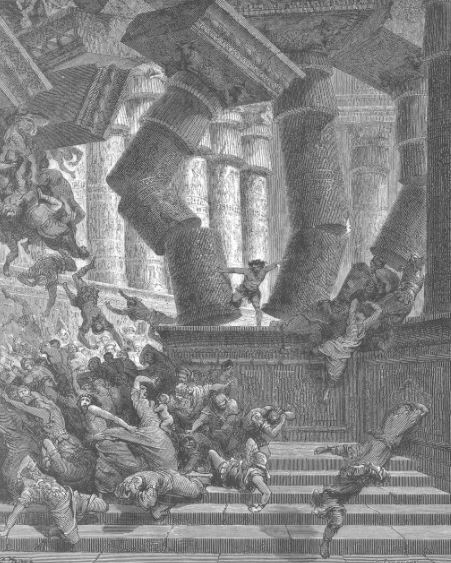
“Death of Samson”, by Gustav Doré

Then three thousand men of Judah went down to the cleft of the rock of Eitam, and said to Samson: “Do you not know that the Philistines are rulers over us? What then is this that you have done to us?” And he said to them: “As they did to me, so have I done to them.” And they said to him: “We have come to bind you, that we may deliver you into the hand of the Philistines.”

Samson turned himself in voluntarily, but with God’s help smote the Philistine oppressors and freed himself. He would be betrayed again by Delilah, but would manage to defeat the Philistines for good, though at the cost of his own life. Like Mashiach ben Yosef, Samson sacrifices himself.

The text above specifically states that three thousand men of Judah came for Samson. What is the significance of this numeric detail?

The Evil 3000

At the Exodus, the Torah states there was a “mixed multitude” (erev rav) of three thousand men among the Israelites. They, too, accepted the Torah at Mt. Sinai, only to instigate the Golden Calf incident forty days later. It is said that the same will happen at the End of Days, with an “erev rav” among the Jews who will instigate all sorts of problems for the nation from within (see, for example, Zohar I, 25 or Sha’ar HaGilgulim, ch. 39). Like Samson’s three thousand men of Judah, Mashiach ben Yosef is sold out by three thousand “Jewish” individuals.

And the fact that they are men of Judah is all the more significant. It was Judah in this week’s parasha who proposed selling Joseph. And to whom did he want to sell him?

And Judah said to his brothers: “What is the gain if we slay our brother and cover up his blood? Come, let us sell him to the Ishmaelites, but our hand shall not be upon him, for he is our brother, our flesh.” (Genesis 37:26-27)

Judah wanted to sell his brother to the Ishmaelites. In speaking of the battles of Mashiach ben Yosef and the End of Days, it is often the Ishmaelites (or the Ishmaelites banded together with Esau) that are implicated (see, for example, Pirkei d’Rabbi Eliezer, ch. 30). Today, of course, the modern “Philistines” are Ishmaelites, and among their biggest supporters are the descendants of Esau.

In The Era of Mashiach

This discussion is particularly timely in light of what’s currently happening in the Middle East. It seems the region is preparing for a massive war, one that would inevitably engulf the entire Ishmaelite sphere, if not the whole world. We’ve written before that we are undoubtedly in the “footsteps of the Messiah” and here is another intriguing point:

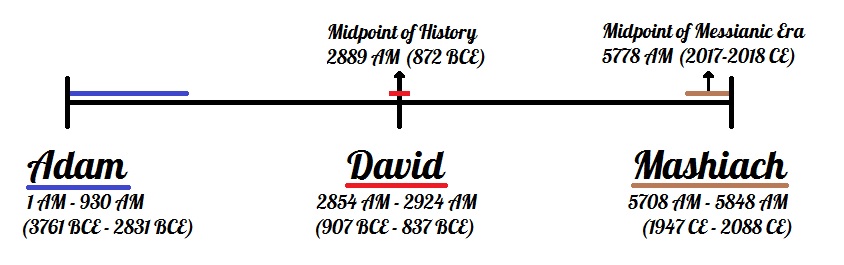
God originally intended for Adam to live 1000 years. Yet, we see in Genesis that Adam lived only 930 years. This is because, as is well known, Adam foresaw that David would be stillborn, and donated 70 years of his life to him. Indeed, David went on to live exactly 70 years. The Arizal saw in the name Adam (אדם) an acronym for three figures: Adam, David, Mashiach. These are the first, middle, and last major figures of human history. Based on this, Rabbi Yitzchak Ginsburgh teaches that David is supposed to be the literal midpoint of history. If that’s the case, then we only need to see when David lived to calculate the era of Mashiach.

The traditional lifetime for David is 2854-2924 AM (Anno Mundi, Hebrew calendar years, corresponding to about 907-837 BCE). To find the time period for the End of Days we must simply multiply David’s years by two. This gives 5708-5848, or 1947/1948-2087/2088 CE. That’s quite amazing, considering that Israel officially became a state in 5708 (the UN vote to create Israel took place in November 1947, and Israel declared independence in May 1948—both dates fall within the Jewish year 5708). And what would be the midpoint, or perhaps the apex, of the “End of Days” period? None other than 5778, the year which we are currently in.

Stay tuned.


The above essay is adapted from Garments of Light, Volume Three.
Get the book here! 


The Incredible History and Absurd Politics of Rachel’s Tomb

In this week’s parasha, Vayishlach, we read about Jacob’s return to the Holy Land after twenty years in Charan. After some time, Jacob and the family make a stop in Beit El, where Jacob first encountered God decades earlier. God appears to Jacob once more, and promises that “the land which I gave to Abraham and to Isaac, I will give to you and to your seed after you” (Genesis 35:12). God makes it clear that the Holy Land is designated solely for the descendants of Jacob—not the descendants of Esau, and not the descendants of Ishmael, or any other of Abraham’s concubine sons. It is the land of Israel, the new name that Jacob receives in this week’s parasha.

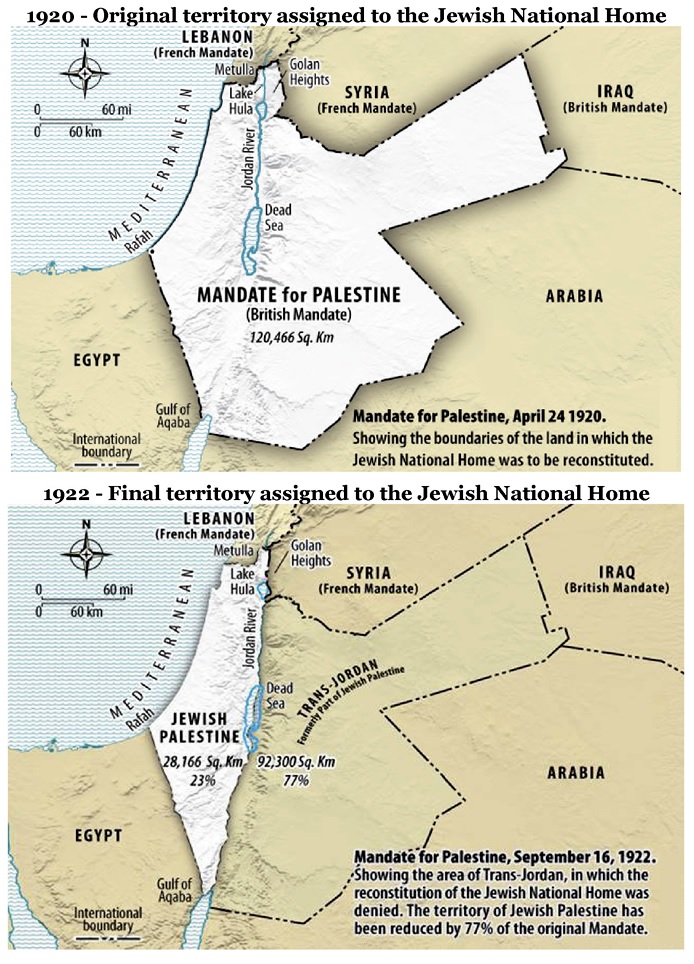
In fact, in this parasha we see mention of many Israelite sites, both ancient and modern, such as Hebron and Bethlehem. In our day, all of these are unfortunately within the political entity typically referred to as the “West Bank”. This title comes from the fact that the area is geographically on the west side of the Jordan River. Initially, the British Mandate for Palestine included both sides of the Jordan River, before the British gave the east to the Arabs to create the state of Jordan. This was the original “partition plan” for Palestine, with the eastern half meant to serve as the Arab state and the western half to become a Jewish one. Many have forgotten this important detail.

British Mandate for Palestine – Before and After (Credit: Eli E. Hertz)

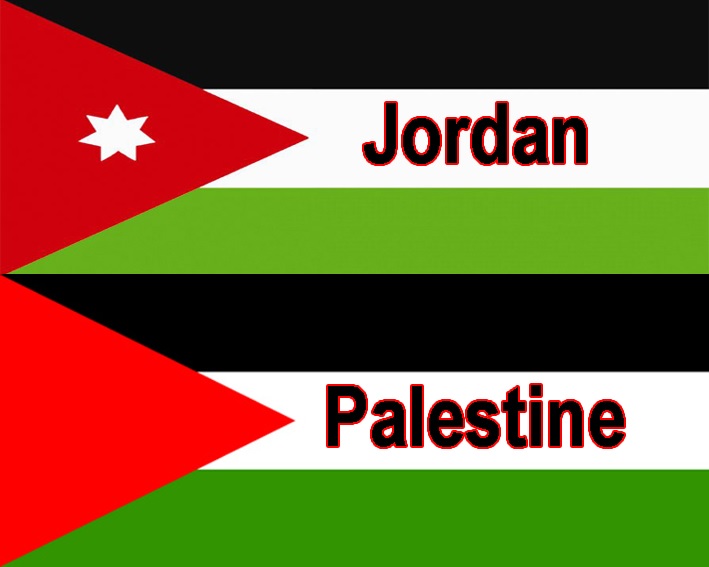
The current flags of the state of Jordan and the Palestinian movement. It is estimated that about half of Jordan’s current population of 9.5 million is Palestinian Arab.

Nonetheless, the unsuitable title of “West Bank” has stuck ever since. Some rightly avoid using the term in favour of the more appropriate “Judea and Samaria”. Truthfully, even this title is not entirely accurate, for the region is nothing less than the very heartland of Israel, the location of the vast majority of Biblical events, and the home of a plethora of Jewish holy sites. Among them is the tomb of Rachel, as we read in this week’s parasha (Genesis 35:16-20):

And they journeyed from Beit El, and there was still some distance to come to Ephrath, and Rachel gave birth, and her labor was difficult… So Rachel died, and she was buried on the road to Ephrath, which is Bethlehem. And Jacob erected a monument on her grave; that is the tombstone of Rachel until this day.

Throughout history, Rachel’s tomb was one of the most venerated sites in Judaism, and is often described as the Jewish people’s third-most holiest site (after the Temple Mount/Western Wall and Cave of the Patriarchs). As early as the 4th century CE the historian Eusebius already wrote of Rachel’s tomb being a holy site for Jews and Christians. Keep in mind that this is two centuries before anyone even whispered Islam. Not that it really matters, since Islam does not consider this a particularly special place. The Arab-Muslim historian and geographer of the 10th century, Al-Muqaddasi, doesn’t even mention Rachel’s tomb in his descriptions of Muslim-controlled Israel and its holy sites.

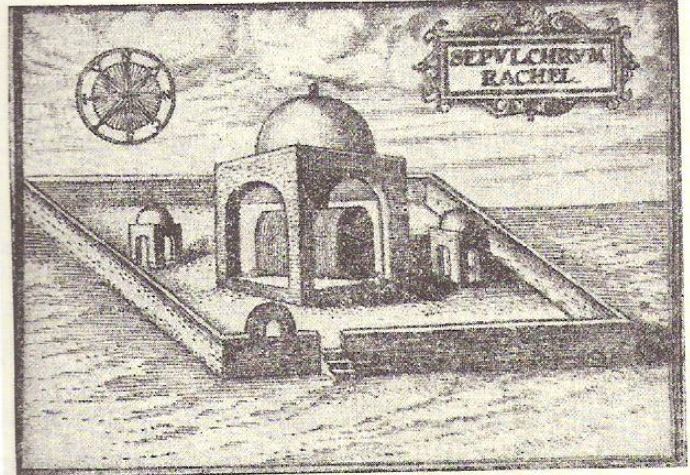
1585 Illustration of Rachel’s Tomb

Meanwhile, the Jewish traveler and historian Benjamin of Tudela (1130-1173) describes Rachel’s tomb in detail as being a domed structure resting upon four pillars, with Jewish pilgrims regularly visiting and inscribing their names on the surrounding eleven stones (representing the Tribes of Israel, less the tribe of Benjamin, as Rachel died giving birth to him). The earliest Muslim connection to the tomb is in 1421, when Zosimos mentions a small mosque at the site. (“Zosimos the Bearded” was a Russian Orthodox deacon famous for proposing the Moscow-Third Rome principle—which may be of great significance for calculating the time of Mashiach’s coming, as we’ve written in the past.)

The Ottomans originally transferred ownership of the site to the Jewish community (in 1615) but later reneged on the promise and even built walls to prevent Jews from going there, according to the British priest and anthropologist Richard Pococke (1704-1765). Pococke writes that the Ottomans used the area as a cemetery. Nonetheless, Jews could not be kept away from their millennia-old holy site, and continue to make pilgrimages. Christian writers G. Fleming and W.F. Geddes note in their 1824 report that “the inner wall of the building and the sides of the tomb are covered with Hebrew names, inscribed by Jews.”

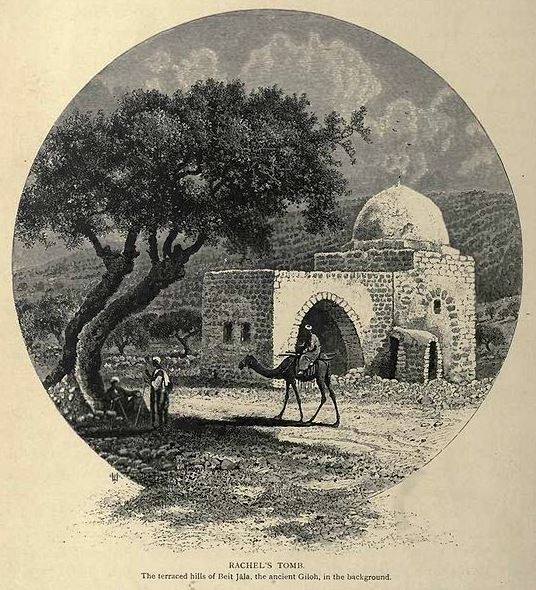
1880 Illustration of Rachel’s Tomb

Six years later, the Ottomans officially recognized Rachel’s tomb as a Jewish holy site again, and ten years later the site was purchased by famous Sephardic Jewish financier and philanthropist Moses Montefiore. Montefiore rebuilt the crumbling tomb, and even constructed a small adjacent mosque to appease the local Muslims. Around this time, British writer Elizabeth Anne Finn, who lived in Jerusalem while her husband was the consul there, wrote that Jerusalem’s Sephardic Jews never left the Old City unless to pray at Rachel’s tomb. Similarly, the Missionary Society of Saint Paul the Apostle wrote in 1868 that Rachel’s tomb

has always been held in respect by the Jews and Christians, and even now the former go there every Thursday, to pray and read the old, old history of this mother of their race. When leaving Bethlehem for the fourth and last time, after we had passed the tomb of Rachel, on our way to Jerusalem, Father Luigi and I met a hundred or more Jews on their weekly visit to the venerated spot.

Later, Jewish businessman Nathan Straus (of Macy’s fame) purchased even more land around the site that Montefiore had purchased. (Interestingly, Montefiore’s own tomb in England is a replica of Rachel’s tomb.)

Under the British Mandate, Jewish groups applied on multiple occasions for permission to repair the site, but were denied because of Muslim opposition. The Muslims themselves didn’t bother repairing it, of course. Conversely, many of them were (and still are) happy to attack the site whenever an opportunity presents itself:

Throughout the 1800s, the local e-Ta’amreh Arab clan had blackmailed the Jews to pay up 30 pounds a year or else they would destroy the tomb. In 1995, Arabs—led by a Palestinian Authority governor—attacked Rachel’s tomb and tried to burn it down. In 2000, they laid a 41-day siege on the site during the Second Intifada. In light of this, it made total sense when UNESCO declared in 2015 that Rachel’s tomb is a Muslim holy site that is “an integral part of Palestine”. The laughable resolution only confirms the senselessness and irrelevance of the United Nations.

Had they bothered to look at the historical record, they would have seen that Rachel’s tomb is, was, and always will be a Jewish holy site of immeasurable significance. Countless Jewish pilgrims have experienced miracles there, particularly for health and fertility. According to tradition, Rachel is the only matriarch to be buried outside of the Cave of the Patriarchs so that her spirit can weep and pray for her children in exile. Her prayers are successful, for we are in the midst of the exile’s final end, as prophesied by Jeremiah (31:14-16):

Thus said Hashem: “A voice is heard in Ramah, in lamentation and bitter weeping.” It is Rachel, weeping for her children. She refuses to be comforted for her children, because they are not. Thus said Hashem: “Refrain your voice from weeping, and your eyes from tears, for your work shall be rewarded,” said Hashem. “And they shall return from enemy lands. And there is hope for your future,” said Hashem. “And the children shall return to their borders…”


The above essay is adapted from Garments of Light, Volume Three.
Get the book here!