Tag Archives: Midianites

Joseph and the Rothschilds

This week’s parasha, Vayeshev, relays the infamous story of the Sale of Joseph. As explored in the past, a careful reading of the text shows that Joseph’s brothers didn’t necessarily sell him (see ‘Was Joseph Really Sold by His Brothers?’ in Garments of Light, Volume One). They threw him in a pit and abandoned him. They then discussed what to do next, and Yehudah only suggested selling him. While they were still deliberating, Reuben goes to get Joseph from the pit and discovers that he is no longer there. Midianites had found Joseph and enslaved him, then sold him to Ishmaelites that took him down to Egypt. Reuben runs to his brothers to relay that Joseph is gone! (Genesis 37:29-30)

The plain reading of the text suggests the brothers did not sell Joseph. However, because they abandoned him and seriously considered selling him, they took on the blame for it anyway. Most commentaries, including Rashi, insist that the brothers really were directly involved in the sale, but some commentators argue otherwise, including Rashi’s grandson Rashbam (Rabbi Shmuel ben Meir, c. 1085-1158), who wrote:

… עברו אנשים מדיינים אחרים דרך שם, וראוהו בבור ומשכוהו ומכרוהו המדיינים לישמעאלים. ויש לומר שהאחים לא ידעו, ואף על פי אשר כתב: אשר מכרתם אותי מצרימה (בראשית מ”ה:ד’), יש לומר: שהגרמת מעשיהם סייעה במכירתו. זה נראה לי לפי עומק דרך פשוטו של מקרא. כי ויעברו אנשים מדיינים – משמע על ידי מקרה, והם מכרוהו לישמעאלים.

… other, Midianite people passed by there and saw [Joseph] in the pit and pulled him out and sold him to the Ishmaelites. One could say that the brothers did not know of this, even though it is later written “that you sold me to Egypt” (Genesis 45:4) this is to mean that their actions indirectly caused his sale. This appears to me to be the more profound simple understanding of the verses, for “Midianite people passed by” coincidentally at that time, and they sold him to the Ishmaelites.

This interpretation would explain many other details, for instance, why were the brothers so shocked to see Joseph years later in Egypt? If they had sold him to a slave caravan going down to Egypt, why would they be surprised to find him there? They should have known he is in Egypt! In fact, we know the brothers all repented wholeheartedly, so why did they not, at some point, go down to Egypt and look for him or try to bring him back? The evidence is quite strong that the brothers genuinely did not know where he was.

A related follow-up question: Which brothers were there when Joseph was sold to begin with? The parasha begins by telling us that Joseph “tended the flocks with his brothers, and he was a youth with the sons of his father’s wives Bilhah and Zilpah.” (Genesis 37:2) It seems Joseph spent most of his time with the four sons from the concubine-wives, ie. Dan, Naftali, Gad, and Asher—the younger siblings. The sons of Leah, meanwhile, kept to themselves, perhaps because of seniority or maybe even an air of superiority. It seems to be that Joseph and the four sons of the concubine wives stayed close to home and shepherded their flocks near Jacob’s tent, while the sons of Leah were shepherding further away near Shechem and Dotan, which is why Jacob sends Joseph on a mission to find them and see what they are up to (Genesis 37:14). Note how the only brothers that are named in the account surrounding the sale are Reuben, Shimon, and Judah—three of the six sons of Leah. None of the other brothers are mentioned. One could make the case that maybe only the sons of Leah were involved.
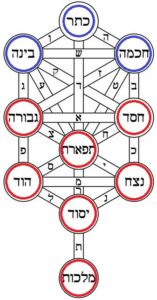
The Sefirot of Mochin above (in blue) and the Sefirot of the Middot below (in red) on the mystical “Tree of Life”.

Kabbalistically, the children of Leah make up a complete set corresponding to the lower Sefirot. Recall that the Ten Sefirot are divided up into the three lofty Mochin (“intellectual” faculties) and the seven lower Middot (“emotional” faculties). The firstborn Reuben, the kind one who tried to save Joseph, is Chessed, the first of the Middot. Chessed is associated with water, and Jacob later describes Reuben as pachaz k’mayim, “impetuous like water”. Second-born Shimon, the strongest, feistiest, and most judgemental of the brothers, neatly corresponds to second Gevurah, or Din, “severity” and “judgement”. The priestly Levi is Tiferet, the repentant Yehudah is Netzach, and Issachar and Zevulun are Hod and Yesod. Their sister Dinah, of course, corresponds to the feminine Malkhut.

It appears from the plain text of the parasha that the children of Leah mostly kept to their own “Sefirotic” group. That said, we find that Reuben was not with them when they discussed the sale of Joseph. The Zohar (I, 185b) explains that the sons of Jacob took turns tending to their father’s needs. That day was the day that Reuben was responsible for Jacob, so he was away with his father. This explains why Reuben only reappears later in the narrative. He only rushed back, the Zohar says, to save Joseph from the pit, and was completely unaware of the sale (וְאֲפִילּוּ רְאוּבֵן לָא יָדַע מֵהַהוּא זְבִינָא דְיוֹסֵף). He would not find out until many years later in Egypt. If we put all of this information together, it appears only five of the brothers were directly involved: Shimon, Levi, Yehudah, Issachar, and Zevulun. All ten are ultimately held culpable because brothers are all responsible for each other, and should always be aware of each other’s whereabouts and wellbeing. The fact that they let Joseph get sold into slavery was an absolute failure on the part of all ten, even those who were not technically involved. And that’s why we have so many traditions and teachings about the need for all ten brothers to be rectified, including through the Ten Martyrs later in history (see ‘The Ten Martyrs & the Message of Yom Kippur’ in Garments of Light, Volume Two).

But what of the five brothers that were mainly culpable? They would certainly need a special, additional tikkun. As we look through Jewish history, we find several more groups of “five brothers” that are of tremendous significance. Each of these groups of five propel Judaism forward and usher in a new era in Jewish history. Who are these groups of five and how do they relate to the five brothers of Joseph?

The Maccabees & the Tannaim

We find a set of five brothers with similar names to the first set in the story of Chanukah. Parashat Vayeshev is always read right around Chanukah time, and there are no coincidences in the Jewish calendar! Could it be that the righteous Yehudah, who takes the lead among the sons of Jacob and takes the lead in repentance, returns as Yehudah Maccabee, who takes the lead among the sons of Matityahu and takes the lead to save Judaism in the Second Temple era? Shimon, who was the most culpable of the sons and was not even blessed by Jacob on his deathbed (Genesis 49), returns as Simon Thassi, “Shimon the Righteous”, the last surviving son of the Maccabees and arguably the first rabbi. What a tikkun that would make! Levi, the family priest in Jacob’s time, returns as Elazar, described as the most “religious” of the Maccabees, the one tasked with learning and praying while the other brothers fought the Seleucids (see II Maccabees 8:22-23). Elazar eventually joins the battle himself, and tragically gets trampled by a war elephant. The little-known Issachar and Zevulun, who are not mentioned in the Genesis account, parallel Yonatan and Yochanan, of whom we also know the least about when it comes to the Maccabees.

In fact, as explored in the past, it is possible that these same five souls return once again in the students of Rabbi Akiva: Yehuda bar Ilai, Shimon bar Yochai, Elazar ben Shammua, Yose bar Halafta, and Meir. These five rabbis were involved in a great war, too—the Bar Kochva Revolt—and were among the few survivors. The Talmud credits them with reviving Judaism after the devastation of the war (Yevamot 62b). Again, this would serve as a worthy tikkun for the five sons of Jacob and the failure with Joseph. The fact that the five rabbis were students of Akiva (Aramaic for “Yakov”) bar Yosef might further hint to a connection to Joseph in the Torah.

With the first five brothers, Joseph told them that they intended something negative, but it was all in Hashem’s hands and He orchestrated it all to bring about something positive. It was all meant to happen, to bring Israel to its next phase of development in Egypt, and to set the stage for the Exodus. The same was true the second time around during Chanukah, with the five sons of Matityahu saving Judaism and bringing it to its next stage of development, the rabbinic era. And the third time was with the students of Rabbi Akiva, who were once again able to preserve Judaism amidst intense Roman persecution and exile, and adapt Judaism to a reality without a Temple, while laying the foundations of the Mishnah and Talmud.

The Rothschilds & the Chanukah Lights

One might go even further and find another set of five Jewish brothers who make a massive impact not only on the course of the Jewish people but on the world at large: the five original Rothschild sons. Their father Mayer Rothschild was initially set to become a rabbi. In his youth, he apprenticed with a banker and eventually became one himself. He was a deeply religious man, and ensured his five sons were the same. None of them intermarried or converted out. (Eldest son Amschel was particularly known to be very religious, and was nicknamed “the pious Rothschild”. Grandson Lionel was the first Jew in British parliament, and was sworn in over a Tanakh, wearing a kippah.)

The Rothschilds invested huge sums in support of shuls, yeshivas, orphanages, and Jewish institutions, and later played a big role in the Zionist movement and establishing some of the first Jewish towns in Israel. (A famous Hasidic story attributes Rothschild wealth and success to a blessing from Rabbi Hershelle Tschortkower.) Grandson Edmond de Rothschild gave the funds to establish Rishon Lezion, Metulla, Ekron, Rosh Pina, and Zichron Yaakov (named after his father Jacob Rothschild). He purchased an additional 125,000 acres of land in Israel, and gave the equivalent of what is today $700 million for the early infrastructure that made Israel possible. He was beloved by Jews and Arabs alike, and was called haNadiv haYadua, “the Famous Benefactor”.
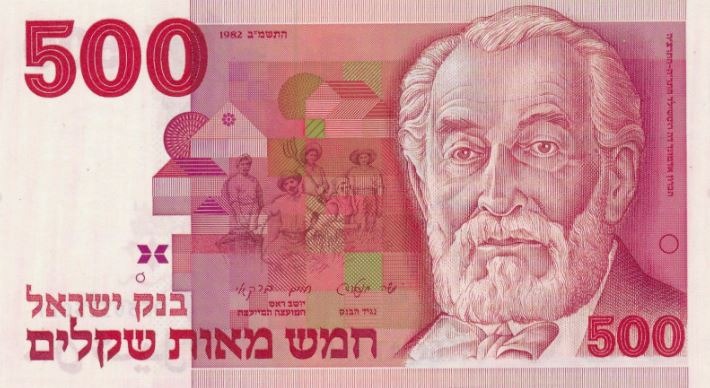
Edmond de Rothschild on an Israeli 500 Shekel Note (1982)
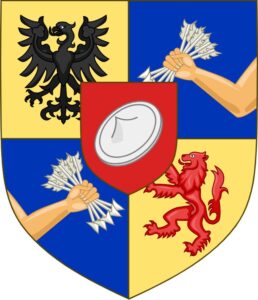
The name “Rothschild”, literally red shield, comes from the red banner the family had above their door in the Jewish quarter of Frankfurt. The family later designed a coat of arms that included a red shield, and an arm holding five arrows to represent the five brothers, based on Psalms 127:4, “Like arrows in the hand of a warrior are sons born to a man in his youth.” Some conspiracy theorists have argued that the red shield is symbolic of the family secretly being Edomites, connected to the wicked Esau. However, one could make the opposite case: the Rothschilds probably did more than any other family at the time to shield the Jewish people from the oppression of Edom! They also invested heavily in Edom, paying for some of the first European rail networks and modern factories, as well as hospitals, universities and research labs, museums, charities, and large public works.

We find a great deal of similarity between the five Maccabee sons and the five Rothschild sons. In both cases, the sons were deeply religious, their children less so, and the descendants that followed leaving the faith entirely. The Hasmonean dynasty of the Maccabees soon became entirely Hellenistic, taking on Greek names (like Alexander Yannai and Yochanan Hyrcanus) and Greek titles (like strategos and basileus), and eventually even persecuting rabbis, causing sages like Shimon ben Shatach and Yehoshua ben Perachia to flee to Egypt. Among the Rothschilds, too, within a few generations there was widespread assimilation, intermarriage, conversions, and support for all kinds of things antithetical to Judaism. Some Rothschilds even became vocal anti-Zionists and refused to ever visit Israel.
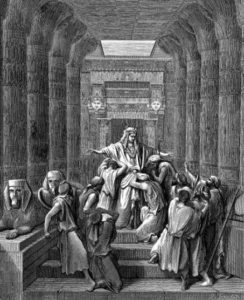
‘Joseph Makes Himself Known to His Brethren’ by Gustav Doré

And it all ties back to Joseph in Egypt. In fact, some see Joseph as a spiritual precursor to the Rothschilds: a “Court Jew” who became incredibly wealthy and powerful, drawing the ire and resentment of the Egyptians. The result is ultimately more antisemitism and persecution of Jews, but that leads to an Exodus to the Promised Land. This is, of course, reminiscent of what we witnessed in the 20th Century. It all reminds us of Joseph’s own words: “Now, do not be distressed or reproach yourselves because you sold me here; it was to save life that God sent me ahead of you… God has sent me ahead of you to ensure your survival on earth, and to save your lives in an extraordinary deliverance. So, it was not you who sent me here, but God…” (Genesis 45:4-8) We must remember that all is in Hashem’s hands. He orchestrates every detail of history. Moments that initially appear negative end up being revealed as positive in the long run. And this was Joseph’s superpower: having an ayin tova, a good eye, and seeing the positive within all things. That is why Jacob described him as being ben porat Yosef, ben porat alei ayin, good upon the eye (Genesis 49:22).

The Chanukah lights have the same message. They represent the ohr haganuz, the hidden light of Creation. We are not supposed to derive physical benefit from the Chanukah lights (hence the shamash) to remember to gaze beyond the physical light and into the spiritual. They remind us that things are not always as they appear to be. There is a hidden light beneath the revealed one. Sometimes we just need to look a little deeper to uncover it.

Happy Chanukah!

The Rabbi Who Made Judaism as We Know It

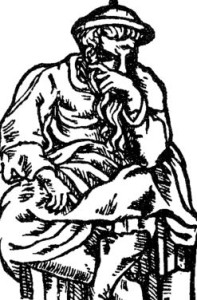
An illustration of Rabbi Akiva from the Mantua Haggadah of 1568

This week we continue to celebrate Passover and count the days of the Omer. The 49-day counting period is meant to prepare us spiritually for Shavuot, for the great day of the Giving of the Torah. As our Sages teach, the Torah wasn’t just given once three millennia ago, but is continually re-gifted each year, with new insights opening up that were heretofore never possible to uncover. At the same time, the Omer is also associated with mourning, for in this time period the 24,000 students of Rabbi Akiva perished, as the Talmud (Yevamot 62b) records:

Rabbi Akiva had twelve thousand pairs of disciples, from Gabbatha to Antipatris, and all of them died at the same time because they did not treat each other with respect. The world remained desolate until Rabbi Akiva came to our Masters in the South and taught the Torah to them. These were Rabbi Meir, Rabbi Yehudah, Rabbi Yose, Rabbi Shimon, and Rabbi Elazar ben Shammua—and it was they who revived the Torah at that time. A Tanna taught: All of them died between Pesach and Shavuot.

Rabbi Akiva is a monumental figure in Judaism. People generally don’t appreciate how much we owe to Rabbi Akiva, and how much he transformed our faith. In many ways, he established Judaism as we know it, during those difficult days following the destruction of the Second Temple, until the Bar Kochva Revolt, in the aftermath of which he was killed.

Rabbi Akiva is by far the most important figure in the development of the Talmud. From various sources, we learn that it was he who first organized the Oral Torah of Judaism into the Six Orders that we have today. The Mishnah, which is really the first complete book of Jewish law and serves as the foundation for the Talmud, was possibly first composed by Rabbi Akiva. The Talmud (Sanhedrin 86a) states that the main corpus of the Mishnah (including any anonymous teaching) comes from Rabbi Meir, while the Tosefta comes from Rabbi Nehemiah, the Sifra from Rabbi Yehuda, and the Sifre from Rabbi Shimon—and all are based on the work of Rabbi Akiva. Indeed, each of these rabbis was a direct student of Rabbi Akiva. (Although Rabbi Nehemiah is not listed among the five students of Rabbi Akiva in the Talmudic passage above, he is on the list in Sanhedrin 14a.)

In short, Rabbi Akiva began the process of formally laying down the Oral Tradition, which resulted in the production of the Mishnah a generation later, and culminated in the completion of the Talmud after several centuries.

It wasn’t just the Oral Torah that Rabbi Akiva had a huge impact on. We learn in the Talmud (Megillah 7a) that Rabbi Akiva was involved in a debate regarding which of the books of the Tanakh is holy and should be included in the official canon. Although it was the Anshei Knesset HaGedolah (“Men of the Great Assembly”) who are credited with first compiling the holy texts that make up the Tanakh, the process of canonization wasn’t quite complete until the time of Rabbi Akiva. Therefore, Rabbi Akiva both “completed” the Tanakh and “launched” the Talmud. This may just make him the most important rabbi ever.

That distinction is further reinforced when we consider the time period that Rabbi Akiva lived in. On the one hand, he had to contend with the destruction wrought by the Romans, who sought to exterminate Judaism for good. They made Torah study and Torah teaching illegal, and executed anyone who trained new rabbis. In fact, Rabbi Akiva was never able to ordain his five new students after his original 24,000 were killed. He taught them, but lost his life before the ordination could take place. The Talmud (Sanhedrin 14a) records:

The Evil Government [ie. Rome] decreed that whoever performed an ordination should be put to death, and whoever received ordination should be put to death, and the city in which the ordination took place should be demolished, and the boundaries wherein it had been performed, uprooted.

What did Rabbi Yehudah ben Bava do? He went and sat between two great mountains, between two large cities; between the Sabbath boundaries of the cities of Usha and Shefaram, and there ordained five sages: Rabbi Meir, Rabbi Yehudah, Rabbi Shimon, Rabbi Yose, and Rabbi Elazar ben Shammua. Rabbi Avia also adds Rabbi Nehemiah to the list.

As soon as their enemies discovered them, Rabbi Yehudah ben Bava urged them: “My children, flee!” They said to him: “What will become of you, Rabbi?” He replied: “I will lie down before them like a stone which none can overturn.” It was said that the enemy did not stir from the spot until they had driven three hundred iron spears into his body, making it like a sieve…

An illustration of Rabbis Akiva, Elazar ben Azaria, Tarfon, Eliezer, and Yehoshua, as they sit in Bnei Brak on Passover discussing the Exodus all night long, as described in the Passover Haggadah. Some say what they were actually discussing all night is whether to support the Bar Kochva Rebellion against Rome. In the morning, their students came to ask for their decision. They answered: “shfoch hamatcha el hagoyim asher lo yeda’ucha…” as we say when we pour the fifth cup at the Seder.

In the wake of the catastrophic destruction of the Bar Kochva Revolt, and the unbearable decrees of the Romans, traditional Judaism and its holy wisdom nearly vanished. The “world was desolate”, as the Talmud describes, “until Rabbi Akiva came” and relayed that holy wisdom to the five students who would ensure the survival of the Torah. In fact, the vast majority of the Mishnah’s teachings are said in the name of either Rabbi Akiva or these five students. Rabbi Yehudah bar Ilai alone is mentioned over 600 times in the Mishnah—way more than anyone else—followed by Rabbi Meir, Rabbi Shimon, and Rabbi Yose. Without Rabbi Akiva’s genius and bravery, Judaism may have been extinguished.

Meanwhile, Judaism at the time also had to contend with the rise of Christianity. Rabbi Akiva had to show Jews the truth of the Torah, and protect them from the sway of Christian missionaries. It is generally agreed that Onkelos (or Aquila of Sinope) was also a student of Rabbi Akiva. Recall that Onkelos was a Roman who converted to Judaism, and went on to make an official translation of the Torah for the average Jew. That translation, Targum Onkelos, is still regularly read today. What is less known is that Onkelos produced both a Greek and Aramaic translation of the Torah to make the holy text more accessible to Jews (as Greek and Aramaic were the main vernacular languages of Jews at the time). Every Jew could see for himself what the Torah really says, and would have the tools necessary to respond to missionaries who often mistranslated verses and interpreted them to fit their false beliefs.

Interestingly, some scholars have pointed out that Rabbi Akiva may have instituted Mishnah and began its recording into written form as a way to help counter Christianity. Because Christians adopted the Torah and appropriated the Bible as their own, it was no longer something just for Jews. As such, it was no longer enough for Jews to focus solely on Tanakh, for Christians were studying it, too, and the study of Tanakh was no longer a defining feature of a Jew either. The Jewish people therefore needed another body of text to distinguish them from Christians, and the Mishnah (and later, Talmud) filled that important role. This may be a further way in which Rabbi Akiva preserved Judaism in the face of great adversity.

Finally, Rabbi Akiva also preserved and relayed the secrets of the Torah. He was the master Kabbalist, the only one who was able to enter Pardes and “exit in peace” (Chagigah 14b). One of his five students was Rabbi Shimon, yes that Rabbi Shimon: Shimon bar Yochai, the hero of the Zohar. Thus, the entire Jewish mystical tradition was housed in Rabbi Akiva. Without him, there would be no Zohar, no Ramak or Arizal, nor any Chassidut for that matter.

All in all, Rabbi Akiva is among the most formidable figures in Jewish history. In some ways, he rivals only Moses.

How Moses Returned in Rabbi Akiva

We see a number of remarkable parallels in the lives of Moses and Rabbi Akiva. According to tradition, Rabbi Akiva also lived to the age of 120, like Moses. We also know that Rabbi Akiva was an unlearned shepherd for the first third of his life. At age 40, he went to study Torah for twenty-four years straight and became a renowned sage. According to the Arizal, Rabbi Akiva carried a part of Moses’ soul, which is why their lives parallel so closely (Sha’ar HaGilgulim, ch. 36):

Moses spent the first forty years of his life in the palace of Pharaoh, ignorant of Torah, just as Rabbi Akiva spent his first forty without Torah. The next forty years Moses spent in Cush and Midian, until returning to Egypt as the Redeemer of Israel at age 80, and leading the people for the last forty years of his life. Rabbi Akiva, too, became the leading sage of Israel at age 80, and spent his last forty years as Israel’s shepherd. As we’ve seen above, it isn’t a stretch to say that Rabbi Akiva “redeemed” Israel in his own way.

More specific details of their lives are similar as well. Moses’ critical flaw was in striking the rock to draw out water from it. With Rabbi Akiva, the moment that made him realize he could begin learning Torah despite his advanced age was when he saw a rock with a hole in it formed by the constant drip of water. He reasoned that if soft water can make a permanent impression on hard stone, than certainly the Torah could make a mark on his heart (Avot d’Rabbi Natan 6:2). Perhaps this life-changing encounter of Rabbi Akiva with the rock and water was a tikkun of some sort for Moses’ error with the rock and water.

Similarly, we read in the Torah how 24,000 men of the tribe of Shimon were killed in a plague under Moses’ watch (Numbers 25:9). This was a punishment for their sin with the Midianite women. Moses stood paralyzed when this happened, unsure of how to deal with the situation. The plague (and the sin) ended when Pinchas took matters into his own hands, and was blessed with a “covenant of peace”. The death of the 24,000 in the time of Moses resembles the 24,000 students of Rabbi Akiva that perished, with Rabbi Akiva, like Moses, unable to prevent their deaths. In fact, Kabbalistic sources say that the 24,000 students of Rabbi Akiva were reincarnations of the 24,000 men of Shimon (see Sefer Gilgulei Neshamot, Letter Kaf).

There is at least one more intriguing parallel between Moses and Rabbi Akiva. We know that the adult generation in the time of Moses was condemned to die in the Wilderness because of the Sin of the Spies. Yet, we see that some people did survive and enter the Promised Land. The Torah tells us explicitly that Joshua and Caleb, the good spies, were spared the decree. In addition, Pinchas was blessed with a long life (for his actions with the plague of the 24,000) and survived to settle in Israel. (According to tradition, Pinchas became Eliyahu, who never died but was taken up to Heaven in a flaming chariot.) We also read in the Book of Joshua that Elazar, the son and successor of Aaron, continued to serve as High Priest into the settlement of Israel, and passed away around the same time as Joshua (Joshua 24:33). Finally, the Sages teach that the prophet Ahiyah HaShiloni was born in Egypt and “saw Amram” (the father of Moses) and lived until the times of Eliyahu, having been blessed with an incredibly long life (Bava Batra 121b). In his introduction to the Mishneh Torah, the Rambam (Rabbi Moses ben Maimon, 1135-1204) lists Ahiyah as a disciple of Moses, later a member of David’s court, and the one who passed on the tradition through to the time of Eliyahu.

Altogether, there are five people who were born in the Exodus generation but were spared the decree of dying in the Wilderness. (Note: the Sages do speak of some other ancient people who experienced the Exodus and settled in Israel, including Serach bat Asher and Yair ben Menashe, but these people were born long before the Exodus, in the time of Jacob and his sons.) These five people were also known to be students of Moses. The conclusion we may come to is that five of Moses’ students survived to bring the people and the Torah into Israel, just as five of Rabbi Akiva’s students survived to keep alive the Torah and Israel.

If we look a little closer, we’ll find some notable links between these groups of students. We know that Elazar ben Shammua, the student of Rabbi Akiva, was also a kohen, like Elazar the Priest. Caleb and Joshua are descendants of Yehudah and Yosef, reminiscent of Rabbi Yehudah and Rabbi Yose (whose name is short for “Yosef”), the students of Rabbi Akiva. Rabbi Meir, often identified with the miracle-worker Meir Baal HaNess, has much in common with Pinchas/Eliyahu, while Rabbi Shimon bar Yochai explicitly compared himself to Ahiyah haShiloni in the Midrash (Beresheet Rabbah 35:2). As such, there may be a deeper connection lurking between the five surviving students of Moses and the five surviving students of Rabbi Akiva.

Lastly, we shouldn’t forget the Talmudic passage that describes how Moses visited the future classroom of Rabbi Akiva, and was amazed at the breadth of wisdom of the future sage. Moses asked God why He didn’t just choose Akiva to give the Torah to Israel? It was such a great question that God didn’t reply to Moses!

The Greatest Torah Principles

Of all the vast oceans of wisdom that Rabbi Akiva taught and relayed, what were the most important teachings he wished everyone to take to heart? First and foremost, Rabbi Akiva taught that the “greatest Torah principle” (klal gadol baTorah) is to love your fellow as yourself (see Sifra on Kedoshim). Aside from this, he left several gems in Pirkei Avot (3:13-16), which is customary to read now between the holidays of Pesach and Shavuot:

Rabbi Akiva would say: excessive joking and light-headedness accustom a person to promiscuity. Tradition is a safety fence for Torah, tithing is a safety fence for wealth, vows a safety fence for abstinence; a safety fence for wisdom is silence.

He would also say: Beloved is man, for he was created in the image [of God]; it is a sign of even greater love that it has been made known to him that he was created in that image, as it  says, “For in the image of God, He made man” [Genesis 9:6]. Beloved are Israel, for they are called children of God; it is a sign of even greater love that it has been made known to them that they are called children of God, as it is stated: “You are children of the Lord, your God” [Deuteronomy 14:1]. Beloved are Israel, for they were given a precious item [the Torah]; it is a sign of even greater love that it has been made known to them that they were given a precious item, as it is stated: “I have given you a good portion—My Torah, do not forsake it” [Proverbs 4:2].

All is foreseen, yet freedom of choice is granted. The world is judged with goodness, and all is in accordance with the majority of one’s deeds.

He would also say: Everything is given as collateral, and a net is spread over all the living. The store is open, the storekeeper extends credit, the account-book lies open, the hand writes, and all who wish to borrow may come and borrow. The collection-officers make their rounds every day and exact payment from man, with his knowledge and without his knowledge. Their case is well-founded, the judgement is a judgement of truth, and ultimately, all is prepared for the feast.

These words carry tremendous meanings, both on a simple level and on a mystical one, and require a great deal of contemplation. If we can summarize them in two lines: We should be exceedingly careful with our words and actions, strive to treat everyone with utmost care and respect, and remember that a time will come when we will have to account for—and pay for—all of our deeds. We should be grateful every single moment of every single day for what we have and who we are, and should remember always that God is good and just, and that all things happen for a reason.


The above essay is adapted from Garments of Light, Volume Three.
Get the book here! 

Did Moses Have a Black Wife?

Towards the end of this week’s Torah portion, Beha’alotcha, we read that “Miriam and Aaron spoke against Moses because of the Cushite woman whom he had married, for he had married a Cushite woman.” (Numbers 12:1) This verse brings up many big questions, and the Sages grapple with its meaning. Who is this Cushite woman? When did Moses marry her? Why did Miriam and Aaron speak “against” Moses because of her? Why the superfluous phrasing of mentioning twice that he married the Cushite woman? What does “Cushite” even mean?

Traditionally, there are two main ways of looking at this passage: either Moses actually took on a second wife in addition to his wife Tzipporah, or the term “Cushite” simply refers to Tzipporah herself. The second interpretation is problematic, since we know Tzipporah was a Midianite, not a Cushite. The term “Cushite” generally refers to the people of Cush, or Ethiopia, and more broadly refers to all black people or Africans. Scripture does connect the Cushites with the Midianites in one verse (Habakkuk 3:7), which some use as proof that the Midianites were sometimes referred to as Cushites, or had particularly dark skin.

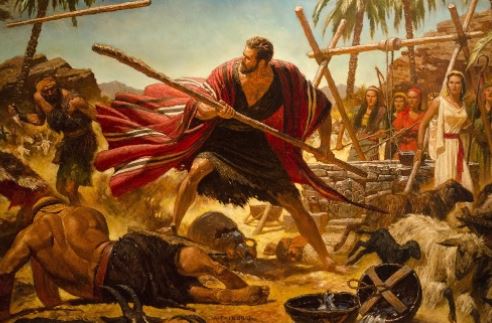
‘The Fight at Jethro’s Well’ – where Moses first meets Tzipporah – scene from ‘The Ten Commandments’ (1953) painted by Arnold Friberg.

Rashi (Rabbi Shlomo Itzchaki, 1040-1105) prefers the second interpretation. He says that Tzipporah was called a “Cushite” because she was very beautiful. He cites Midrash Tanchuma in stating that just as everyone can immediately identify a black person (Cushite), everyone immediately recognized the incomparable beauty of Tzipporah. The same Midrash offers another possibility: apparently if a person had a very beautiful child in those days, they would call them “Cushite” to ward off the evil eye. This suggests that a Cushite was not considered beautiful at all, yet Rashi provides a numerical proof that Cushite does indeed mean “beautiful”, since the gematria of Cushite (כושית) is 736, equal to “beautiful in appearance” (יפת מראה), the term frequently used in the Torah to describe beauty.

If the Cushite is Tzipporah, then why did Miriam and Aaron suddenly have a problem with her? Rashi cites one classic answer: because Moses had become so holy—recall how after coming down Sinai, his skin glowed with such a blinding light that he had to wear a mask over his face—he had essentially removed himself from this material world. This means he was no longer intimate with his wife Tzipporah. Miriam had learned of this, and thought Moses was in error for doing so.

Unlike certain other religions, Judaism does not preach celibacy, and does not require complete abstinence to remain holy and pure. Conversely, Judaism holds that sexual intimacy is an important aspect of spiritual growth. The famous Iggeret HaKodesh (the “Holy Letter”, often attributed to the Ramban, Rabbi Moshe ben Nachman, 1194-1270, but more likely written by Rabbi Joseph Gikatilla, 1248-1305) writes that it is specifically during sexual union (if done correctly and in holiness) that a man and woman can bring down and experience the Shekhinah, God’s divine presence.

As such, Miriam and Aaron came to their little brother and admonished him for separating from his wife. This is why the Torah goes on to state that “They said, ‘Has God spoken only to Moses? Hasn’t He spoken to us too?’” (Numbers 12:2) Miriam and Aaron argued that they, too, were prophets, and they clearly had no need to separate from their own spouses! Moses was so humble and modest that he did not respond at all: “…Moses was exceedingly humble, more so than any person on the face of the earth.” (Numbers 12:3)

God immediately interjected and summoned Miriam and Aaron to the Ohel Mo’ed, the “Tent of Meeting”, where He regularly conversed with Moses. God told them:

If there be prophets among you, I will make Myself known to him in a vision; I will speak to him in a dream. Not so My servant Moses; he is faithful throughout My house. With him I speak mouth to mouth; in [plain] sight and not in riddles, and he beholds the image of the Lord…

God makes it clear to Miriam and Aaron that although they are also prophets, they are nowhere near the level of Moses. In all of history, Moses alone was able to speak to God “face to face”, while in a conscious, awake state. All other prophets only communed with God through dreams or visions, while asleep or entranced.

By juxtaposing the fact that Moses was the humblest man of all time, and also the greatest prophet of all time, the Torah may be teaching us that the key to real spiritual greatness is humility. Moses had completely subdued his ego, and so he merited to be filled with Godliness. Fittingly, the Talmud (Sotah 5a) states that where there is an ego, there cannot be a Godly presence, because a person with a big ego essentially sees themselves as a god—and there cannot be two gods! “Every man in whom there is haughtiness of spirit, the Holy One, blessed be He, declares: ‘I and he cannot both dwell in the world.’”

Moses Had a Black Wife

The explanation above is certainly a wonderful one, yet it is hard to ignore the plain meaning of the text: that Moses actually married a Cushite woman. The repetitive phrasing of the verse seems like it really wants us to believe he had taken another wife. And many of the Sages agree. However, Moses hadn’t married her at this point in time, but many years earlier. The Midrash describes in great detail what Moses was up to between the time that he fled Egypt and arrived in Midian. After all, he had fled as a young man, and returned to Egypt in his 80th year. What did he do during all those intervening decades?

The Midrash (Yalkut Shimoni, Shemot 168) says that Moses initially fled to Cush. At the time, the Cushites had lost their capital in a war and were unsuccessful in recapturing it. Their king, named Koknus (קוקנוס, elsewhere called Kikanos or Kikianus), fought a nine-year war that he was unable to win, and then died. The Cushites sought a strong ruler to help them finally end the conflict. They chose Moses, presumably because he had fought alongside the Cushites and had a reputation as a great warrior. Moses did not disappoint, and devised a plan to win the war and recapture the Cushite capital. (His enemy was none other than Bilaam!) The grateful Cushites gave Moses the royal widow of Koknus for a wife, and placed him upon the throne.

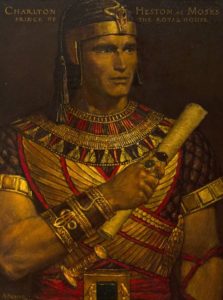
Charlton Heston as Egyptian General Moses, also by Arnold Friberg

This Midrash is very ancient, and was already attested to by the Jewish-Roman historian Josephus (37-100 CE). Josephus writes (Antiquities, II, 10:239 et seq.) a slightly different version of the story, with Moses leading an Egyptian army against the Cushites. The Cushite princess, named Tharbis, watches the battle and falls in love with the valiant Moses. She goes on to help him win the battle, and he fulfils his promise in return to marry her. In some versions, Moses eventually produces a special ring that causes one to forget certain events, and puts it upon Tharbis so that she can forget him. He then returns to Egypt.

So, Moses married a Cushite queen. Yet, he remembered “what Abraham had cautioned his servant Eliezer” about intermarriage, and abstained from touching her. (If you are wondering how Moses later married Tzipporah, who was not an Israelite, remember that the Midianites are also descendants of Abraham through his wife Keturah, see Genesis 25:2. Thus, Moses still married within the extended family of Abrahamites.) Although Moses married the Cushite queen, he never consummated the marriage. The Midrash says he reigned over a prosperous Cush for forty years until his Cushite wife couldn’t take the celibacy anymore and complained to the wise men of Cush. Moses abdicated his throne and finally left Ethiopia. He was 67 years old at the time.

All of this was kept secret until it came out publicly in this week’s parasha. This is a terrific version of the story, but it doesn’t answer why Miriam and Aaron complained to Moses. For this we must look to the mysticism of the Arizal.

Soulmates of Moses

The Arizal cites the above Midrash in a number of places (see Sefer Likutei Torah and Sha’ar HaPesukim on this week’s parasha, as well as Sha’ar HaMitzvot on parashat Shoftim). He explains that both Tzipporah and the Cushite were Moses’ soulmates. This is because Moses was a reincarnation of Abel, who had two wives according to one tradition. This was the reason for the dispute between Cain and Abel, resulting in the latter’s death. Cain was born with a twin sister, and Abel was born with two twin sisters (otherwise, with whom would they reproduce?) Cain reasoned that he should have two wives since he was the older brother, and the elder always deserves a double portion. Abel reasoned that he should have the second wife since, after all, she was his twin! Cain ultimately killed Abel over that second wife.

Therefore, the Arizal explains that Cain reincarnated in Jethro, and Abel in Moses. This is why Jethro gave his daughter Tzipporah to Moses, thus rectifying his past sin by “returning” the wife that he had stolen.* Moses’ other spiritual twin was the Cushite woman. The Arizal suggests that Miriam and Aaron were aware of this, and were frustrated that Moses did not consummate his marriage to the Cushite, for she was his true soulmate! Apparently, after the Exodus Moses summoned the Cushite woman and she happily joined the Israelites and converted to Judaism. The Arizal explains that this was a necessary tikkun, a spiritual rectification for her lofty soul. However, he could not consummate the marriage because her soul originated from a place of intense dinim gemurim, strict judgement and severity. It appears that when Miriam heard about his abstention from his wife, she complained to Moses, failing to grasp that a soul as pure as Moses’ had different requirements.

Whatever the case may be, the root of the matter is Moses’ separation from his wife (or wives). Having said all that, there is a third possibility. This comes from a simple reading of the Torah text, and the lesson that we learn from it is particularly relevant today.

Black or White

When we read the first two verses of Numbers 12 in isolation, we might be led to believe that Miriam and Aaron had a problem with Moses marrying a black woman. Was there a hint of racism in their complaint, or did they just genuinely wonder whether an Israelite was allowed to marry a black person? Either way, we see how perfectly the punishment fits the crime: “… Behold, Miriam was afflicted with tzara’aat, [as white] as snow.” (Numbers 12:10)

If the issue was about Moses separating from his wife, it isn’t clear why Miriam would be punished with tzara’at (loosely translated as “leprosy”). Rashi, for one, does not seem to offer a clear explanation why this in particular was her punishment. Of course, we know that God doesn’t really “punish”, and simply metes out justice, middah k’neged middah, “measure for measure”. It is therefore totally fitting that in complaining about Moses taking a black woman as a wife, Miriam’s own skin is turned white “like snow”. Perhaps God wanted to remind her that she is not so white herself.

We can learn from this that there really is no place for racism in Judaism. In fact, God explicitly compares the Israelites to the Cushites (Amos 9:7), and maintains that He is not the God of the Jews alone, but the God of all peoples: “‘Are you not as the children of the Cushites unto Me, O children of Israel?’ Said Hashem. ‘Have I not brought up Israel out of the land of Egypt, [just as I brought] the Philistines from Caphtor, and Aram from Kir?’” Among a list of nine holy people that merited to enter Heaven alive, without ever dying, the Sages include a Cushite man named Eved-Melekh (Derekh Eretz Zuta 1:43, see Jeremiah 39:16).

At the end of the day, there is no reason to hold prejudice against anyone, or discriminate against any individual at all, as the Midrash (Yalkut Shimoni, Shoftim 42) clearly states:

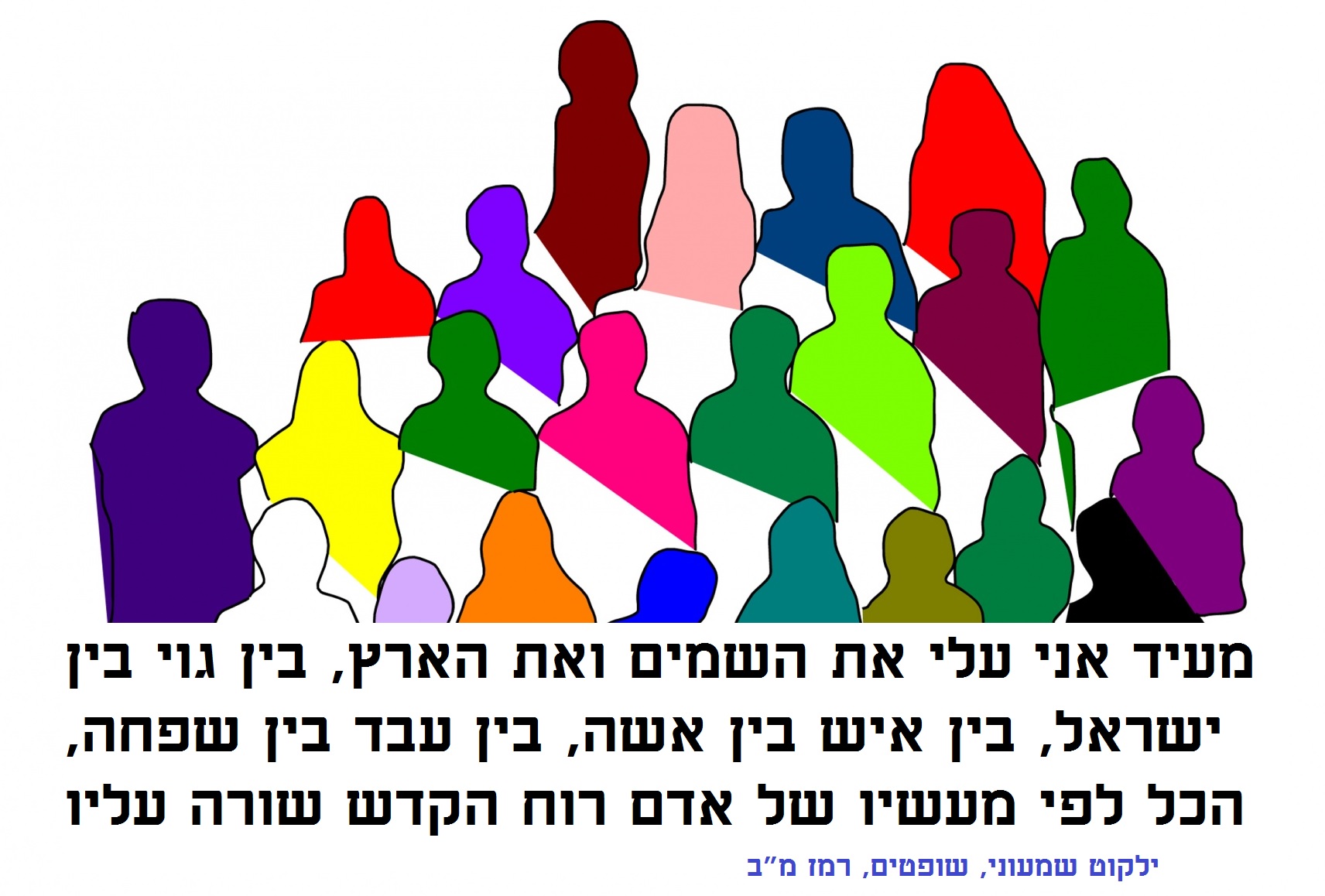
I bring Heaven and Earth to witness that the Divine Spirit may rest upon a non-Jew as well as a Jew, upon a woman as well as a man, upon a maidservant as well as a manservant. All depends on the deeds of the particular individual.

*The Arizal actually writes how Cain reincarnated in three people: Korach, Jethro, and the Egyptian taskmaster that Moses killed before fleeing Egypt. The rectification for the improper dispute between Cain and Abel was rectified in the dispute between Korach and Moses, with Moses’ victory. The rectification for the stolen wife was fulfilled by Jethro. And the rectification for Cain murdering Abel was that Moses, in return, killed the Egyptian taskmaster. Thus, all the rectifications were complete. We can see a hint in the name Cain (קין) to his three future incarnations: the ק for Korach (קרח), the י for Jethro (יתרו), and the ן for the Egyptian, whose name we don’t know but perhaps it started with a nun!


The above essay is adapted from Garments of Light, Volume Three.
Get the book here!