Tag Archives: Passover

The Spiritual Significance of Sefirat haOmer

The Torah commands that each day between the holidays of Pesach and Shavuot be verbally counted (Leviticus 23:15). Along with this counting, a bundle of barley was brought as an offering in the Holy Temple. The barley was measured in units of omer, with one omer being equal to approximately 3 litres. Today, we no longer have a Temple or barley offerings, but the mitzvah of counting the days between Pesach and Shavuot remains, and is referred to as Sefirat HaOmer, “the Counting of the Omer”. Since there are exactly seven weeks between the two holidays, there are 49 days which need to be counted. What is the deeper meaning behind this seemingly mundane practice?

The Fifty Levels

There are a number of spiritual explanations for Sefirat haOmer. Perhaps the most popular is the idea that in Egypt, the Jews were so deeply mired in the immoral and idolatrous Egyptian society that they had descended all the way down to the 49th level of impurity.

It is said that there are 50 levels of impurity, rooted in (or at least suggested by) the numerical value of the Hebrew word for “impure” (tam’e, טמא) which has a gematria of 50. The Jews had stooped down to the 49th level, and had they reached the 50th, there would have been no hope of salvation for them. Thus, God cut short the 400 year period of slavery that was decreed upon them, and immediately took the Jews out of Egypt before they could fall any further.

Corresponding to these, the Jewish mystics teach that there are 50 levels of constriction in the world. Egypt represented these 50 constrictions. Again, this can be illustrated through Hebrew and gematria: Egypt is Mitzrayim (מצרים), the root of which is tzar (צר, meaning “constrict” or “narrow”) and the suffix of which is ים, numerically equalling 50. Egypt is the land of 50 constrictions.

Following the Exodus, the task of the Jews was to cleanse themselves of the 49 levels of impurity which they had acquired, and to break free from all those constrictions that were imposed upon them. This is why they needed a 49-day period – one for each impurity and constriction – before they were ready for the Divine Revelation and reception of the Torah at Mt. Sinai on Shavuot.

The Tree of Life

The Passover Haggadah reminds us that each Jew must envision themselves as personally coming out of Egypt. Though we are thankfully no longer literally slaves, the truth is that each of us is still mired in some kind of constriction, be it a constriction to time or work, money or health, stress, fears, and all those others things that “narrow” our lives and confine us into various forms of spiritual slavery. The Torah commands each of us to break free, to remove all of those impurities and boundaries, and to elevate ourselves over this special period of 49 days. Each day is associated with a unique energy to help us in this path.

The 49 energies stem from the Kabbalistic “Tree of Life”. This Tree is composed of ten Sefirot (a term not coincidentally related to Sefirat HaOmer). These Ten Sefirot are regarded as the spiritual building blocks with which God created the universe (together with the twenty-two letters of the Hebrew alphabet). It is said that all things in existence are permeated with these ten energies, and all things that are “ten” in the Torah correspond to the ten sefirot: the Ten Divine Utterances of Creation, the Ten Trials of Abraham, the Ten Plagues, the Ten Commandments, etc.

The top three sefirot are called the Mochin – the mental or intellectual faculties. The bottom seven are referred to as the Middot – the emotional and practical elements. During the time of the Omer, we are meant to focus on the purification of the bottom seven sefirot. Meanwhile, on Shavuot – having received the Torah – we are then able to rise further to the upper three mental sefirot and focus on intellectual development.
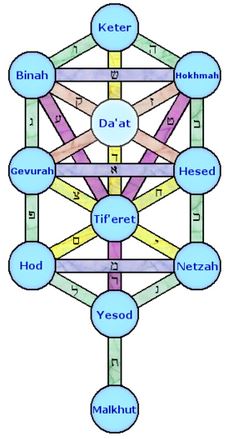
Etz Chaim, “Tree of Life”, Showing the 10 Sefirot and the 22 Lines that Unite Them (Corresponding to the Hebrew Alphabet), as Depicted by the Arizal

Therefore, each of the seven weeks between Pesach and Shavuot is associated with one of the seven Middot. The first week of the Omer corresponds to the sefirah of Chessed – kindness. The second to the sefirah of Gevurah – restraint and self-control. The third to Tiferet – balance (also called Emet – truth). The fourth is Netzach – “victory”, or persistence (often associated with faith). The fifth, Hod – gratitude, and the sixth, Yesod – literally “foundation”, referring to sexual purity. Lastly there’s Malkhut, “kingdom”, which is associated with the faculty of speech.

Each of the seven days of the week is further associated with one of these seven sefirot. So, the first day of each week corresponds to Chessed, and the second day of each week to Gevurah, and so on. This gives each of the 49 days a totally unique quality which one should be meditating on, and more importantly, attempting to rectify.

For example, tonight we will count the third day, with the corresponding sefirah of Tiferet sh’b’Chessed, “Balance (or Truth) in Kindness”. This suggests developing a harmonious approach to kindness: being a more giving person; charitable, helpful, sympathetic, but also making sure not to be taken advantage of or tricked into false kindness. Unfortunately, misplaced kindness has become a staple of Western society. (How often do we see well-meaning liberals supporting the “poor and disadvantaged” terrorists?) Tonight’s sefirah might be summarized well by the old Midrashic teaching that “those who are kind to the cruel will ultimately be cruel to the kind.”

Similarly, each of the remaining 49 days has a powerful message to teach us, hence the tremendous importance of Sefirat HaOmer – counting and meditating upon each and every one of these very special days.


The article above is adapted from Garments of Light – 70 Illuminating Essays on the Weekly Torah Portion and Holidays. Click here to get the book!
Should Jews Believe in Astrology?

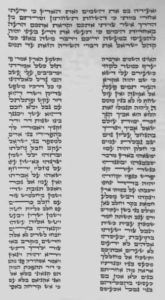
This week’s parasha, the second last of the Torah, is Ha’azinu. This parasha is unique in that it consists almost entirely of one lengthy song – clearly visible when looking at a Torah scroll, where the text of Ha’azinu is split into two narrow columns. Moses sang this prophetic song to the nation right before his passing.

Two columns of parashat Ha'azinu

Two columns of parashat Ha’azinu

In the verses that introduce it (Deut. 31:19), we see God commanding Moses to write the song and “teach it to the Children of Israel. Place it in their mouths so that this song will be for Me a witness for the Children of Israel.” God wanted Moses to diligently teach this song to the entire nation. In fact, the actual wording of the verse has God commanding everyone – each member of the nation – to write the song for themselves. It is based on this verse that the Sages drew the mitzvah of writing a Torah scroll (or participating in writing one), even though the plain text of the verse states only to write this particular song, Ha’azinu.

Perhaps because of this, the Ramban taught that Ha’azinu contains the entire Torah within it. Moreover, he believed that every detail of every person’s life is somehow encoded within this song! In one famous story, when a student of the Ramban, a man named Avner, heard this teaching, he was so baffled by it that he left Judaism entirely, converted to another religion, and became a prominent anti-Semite. When Avner later confronted the Ramban, the Rabbi showed him how one verse in the song did indeed accurately point to this man’s life. Avner was so ashamed that he disappeared, never to be heard from again.

Heavenly Princes

And so, each and every one of the song’s 43 verses has a great deal to teach us. The eighth verse begins by telling us that God gave each nation their lot, and the ninth verse says that “Hashem’s portion is His people, the lot of His inheritance.” The Zohar comments on these words that while God established Heavenly “princes” to watch over every nation in the world, Israel is watched over by God Himself. The Ramban (in his Discourse on Rosh Hashanah) elaborates:

He gave each and every nation… some known star or constellation, as is known by means of the science of astrology… Higher above [the constellations] are the angels of the Supreme One, whom He appointed as “princes” over them… It is further written, “So shall you be My people, and I will be your God, and you will not be subject to other powers at all.” (Jeremiah 11:4)

When we often say that Hashem is our God (as we do in the daily Shema), or when the Tanakh writes that we are God’s people, this does not mean that gentiles cannot have a relationship with God, or that there are other gods out there for the non-Jewish world. Rather, it means that while God oversees absolutely everything in His universe, and has created all people, He has also appointed various Heavenly (or astrological) forces above each nation – except Israel. These forces are not independent in their own right, as they are subject to the angels above them, and these angels ultimately serve God. As such, the nations of the world have various Heavenly intermediaries between themselves and Hashem. Israel, however, has a direct connection to Him. In fact, this is the hidden meaning within the name “Israel” (ישראל), which can be read as yashar El. (ישר-אל), “straight to God”.

Ain Mazal L’Israel

Long before the Ramban, the Sages of the Talmud debated whether the constellations had an effect on people (Shabbat 156a). The consensus of the Rabbis was that constellations do impact people, but Jews are free from this influence. They learn this from the prophet Jeremiah, who prophesied: “Thus said Hashem: Learn not the way of the nations, and be not dismayed at the signs of heaven, for the nations are dismayed at them.” (10:2) God tells Israel not to draw meaning from heavenly signs as the other nations do. The Talmud goes on to tell us a story about Abraham, who cried out to God: “Master of the Universe! I have looked at the constellations and find that I am not fated to have children.” To this, God replied: “Stop your star-gazing! Israel has no constellations.”

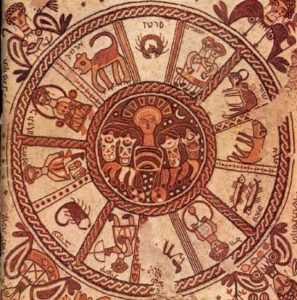
Hebrew Zodiac from a 6th Century Synagogue

Hebrew Zodiac from a 6th-Century Synagogue

Elsewhere, the Talmud tells us that Abraham was once a powerful astrologer, and great men from around the world came to consult with him about their fortunes (Bava Batra 16b). When Abraham looked into his own fate, he saw that he would not have children. God commanded him to desist from astrology, for the Jewish people have the power to transcend the stars. Of course, Abraham went on to have many children.

Later on, Moses would record in the Torah the prohibition for Jews to consult various fortune-tellers and astrologers. The Rambam codifies the law in this way:

It is forbidden to tell fortunes. [This applies] even though one does not perform a deed, but merely relates the falsehoods which the fools consider to be words of truth and wisdom. Anyone who performs a deed because of an astrological calculation or arranges his work or his journeys to fit a time that was suggested by the astrologers is [liable for] lashes, as [Leviticus 19:26] states: “Do not tell fortunes.”
(Sefer HaMadda, Hilchot Avodah Zarah, Chapter 11, Halacha 9)

Transcending Nature

We see from the above that various Heavenly forces, angels, and constellations do exist, and certainly do influence the world. Astrological signs can be potent forces. Ironically, earlier in his discourse, the Ramban points out how astrology is intricately tied into the Jewish calendar: it is no coincidence that Pesach is celebrated in the month of Nisan, the sign of which is Aries (the ram, or sheep), since the main mitzvah of Pesach was to sacrifice a lamb; and it is no coincidence that Rosh Hashanah – judgement day, when each person is put on trial – is in the month of Tishrei, the sign of which is Libra, the scales of justice. The Midrash (Yalkut Shimoni, Shemot 418) even tells us how each of the 12 Tribes of Israel corresponds to one of the 12 astrological signs of the zodiac!

And yet, all the sources are clear: Jews are not to dabble in astrology, for we have no need for intermediaries, and we have all the power to break free from the influence of the constellations. It is precisely when we believe in astrology that it becomes real, just as Abraham had no children as long as he believed in the heavenly signs that he saw. Every Jew must realize that we are Israel, yashar El, and that Hashem alone is our astrological sign. There is no need to believe in what the Rambam calls “emptiness and vanity”. The Rambam ends his laws on this subject by telling us to live up to the Torah’s call (Deut. 18:13) to be of “perfect faith with Hashem, your God.” When one has perfect faith in the Master of the Universe, anything is possible, and this is how God finished his rebuke to Abraham:

“Stop your star-gazing! Ain mazal l’Israel. What is your calculation? Is it because Jupiter stands in the West? Then I will turn it back and place it in the East!”


The article above is an excerpt from Garments of Light: 70 Illuminating Essays on the Weekly Torah Portion and Holidays. Click here to get the book! 
How Long Were the Israelites Actually In Egypt?

Bo chronicles the final events in the exodus from Egypt. We read about the final three plagues (locust, darkness, and the smiting of the firstborn), the first Passover night, and at last, the liberation of the Israelites. Here, we are told that the Israelites left Egypt after having dwelled there for 430 years (Exodus 12:40). However, Jewish tradition (based on counting up all the years mentioned in the Torah) holds that the Israelites were only in Egypt for 210 years! To further complicate things, God had prophesized to Abraham that his descendants would be slaves in a foreign land for 400 years (Genesis 15:13). So, which is it? Were the Israelites in Egypt for 430 years, 210 years, or 400 years? There appears to be a simple answer to this question, and is the one most commonly cited. However, upon closer examination, this explanation breaks down entirely, and the real answer becomes much harder to find.

The Simple Answer

Let’s begin with the simple answer. Rashi’s commentary on the verse in question is that the Israelites were indeed in Egypt for only 210 years, since this is the sum one comes to when counting the lifespans of Jacob, Levi, Kohath, Amram, and Moses. According to this chronology, the Israelites lived prosperously in Egypt for 116 years. By this point, Jacob and his sons (the original immigrants) had all passed away, and a new pharaoh ascended to power in Egypt. Envious of Israelite prosperity and success, and suspicious of their populous numbers, the new pharaoh began instituting various anti-Semitic laws. Tradition holds that this period of segregation and persecution lasted thirty years, after which the Israelites were formally enslaved. Thus, the Israelites were slaves for 86 years. The year of their enslavement corresponds to the year of Miriam’s birth, hence her name, which (according to one explanation) literally means “very bitter”.* Moses was born six years later, and liberated the Israelites when he was eighty.

Rashi states that since 400 or 430 years in Egypt is impossible, one must assume that by “dwelling” and “sojourning”, the Torah refers to all the dwellings and sojourning since the time of Abraham. Rashi points out that if one counts back 400 years from the Exodus, one comes to the year that Isaac was born. Another thirty years before that was when Abraham beheld the “Covenant of the Parts”, and received the prophecy that his descendants will be slaves and foreigners for 400 years. Therefore, when the Torah states that the Israelites were in Egypt for 430 years, it is going all the way back to Abraham’s Covenant, which happened exactly 430 years earlier. And when God told Abraham his descendants would be slaves for 400 years, He literally meant all of Abraham’s descendants, starting with his first son, Isaac, born thirty years later. This explanation seems to work, at least when reinterpreting the definition of what it means to be “enslaved” and what it means to be “in Egypt”.

However, even Rashi is unhappy with this answer. He says that one has no choice but to accept this explanation al karchacha, literally “against one’s will”. He finishes by saying that this was one of the things that the Sages edited when translating the Torah into Greek for King Ptolemy. (Recall that over two millennia ago, Ptolemy gathered seventy rabbis, put them in separate guarded rooms, and forced them to translate the Torah into Greek. Despite their separation, all seventy rabbis produced the exact same translation, making the exact same amendments where necessary, to make the text more palatable to the Greeks. This text became known as the Septuagint, because of the seventy rabbis. According to Yalkut Shimoni, there were seventy-two rabbis, and they made fifteen changes to the text, one of which is the duration of the Israelites’ dwelling in Egypt.)

The Problem with the Simple Answer

Aside from the fact that the Israelites were slaves for 86 years, not 400, and that the Torah states that they dwelled specifically in Egypt for 430 years, and not elsewhere, there is a much more pronounced problem with the simple answer. If we say that the 430 figure comes from the moment when Abraham first received the prophecy, that means that Abraham got it thirty years before Isaac was born, which means Abraham was seventy years old at the time (since Isaac was born when Abraham was 100). However, the Torah tells us that Abraham only came to the land of Israel for the first time when he was 75 (Genesis 12:4). Sometime after this, he descended to Egypt because of a famine, then returned to Israel. Years later, he participated in the war against the Mesopotamian kings (Genesis 14). It is only following this war that the Torah states, “After these things the word of Hashem came to Abram in a vision…” (Genesis 15:1). And it was in this vision that Abraham received the prophecy of 400 years. It is therefore impossible that he was seventy years old at that time! In fact, the very next chapter speaks of the birth of Ishmael, Abraham’s first son through Hagar, who was born when Abraham was 86. Based on this, some commentaries suggest the Covenant of the Parts happened when Abraham was 85 or 86 years old.

So, we may accept the figure of 400 years starting with Isaac, but where did 430 come from? In lieu of a historical answer, we may have to delve into more mystical literature.


The above is an excerpt from Garments of Light, Volume Two. To continue reading, get the book here