Tag Archives: Torah and Science

Mishkan & the Kabbalah of Organ Systems

This week’s parasha, Terumah, begins outlining the construction of the Mishkan, the mobile Tabernacle. As is well-known, the Mishkan was a microcosm of the universe, and also paralleled the human body and its components. Commenting on the construction materials listed at the start of the parasha, Midrash HaGadol states:

“Gold” is the soul; “silver”, the body; “copper”, the voice; “blue” [tekhelet], the veins; “purple”, the flesh; “red”, the blood; “flax”, the intestines; “goat hair”, the hair; “ram skins dyed red”, the skin of the face; “tachash skins”, the scalp; “shittim wood”, the bones; “oil for lighting”, the eyes; “spices for the anointing oil and for the sweet incense”, the nose, mouth and palate; “shoham stones and gemstones for setting”, the kidneys and the heart.
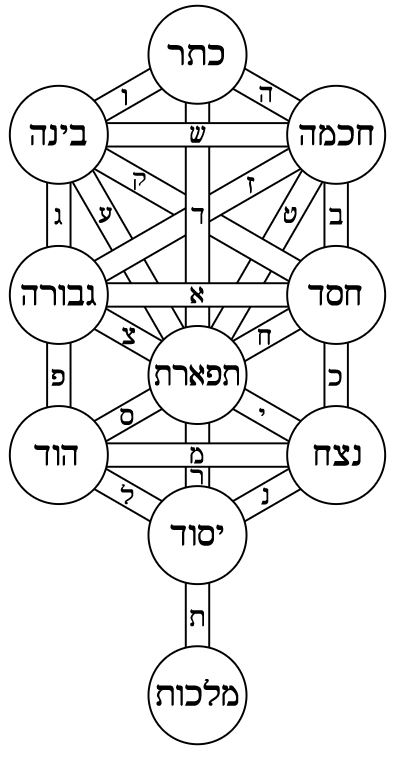
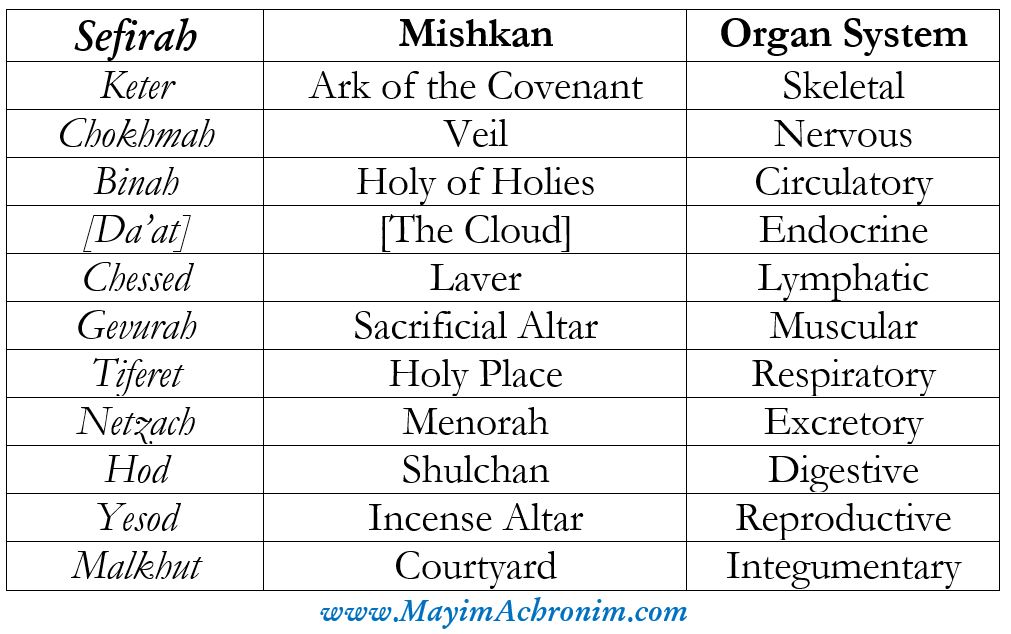
At the same time, we find that there were (not surprisingly) ten major components in the structure of the Mishkan: (1) the courtyard, (2) the laver for washing, (3) the sacrificial altar, (4) the inner “Holy” place, and its three components (5) the Table of Showbread, (6) Menorah, and (7) Incense Altar, followed by (8) the Veil, behind which was (9) the “Holy of Holies”, containing (10) the Ark of the Covenant. As with all tens in the Torah, they correspond to the Ten Sefirot. One way to parallel them to the Sefirot is as follows:

In mystical texts, the trifecta of Binah-Tiferet-Malkhut always represent divine space and Divine Presence. These neatly correspond to the three spaces within the Mishkan: the large and mostly empty courtyard is Malkhut, often described as an “empty” vessel, but also identified most closely with the Shekhinah, the Divine Presence of God as manifest in this lowest of worlds. As soon as a person entered the Mishkan, they would sense the Shekhinah in the courtyard. When one passed the next partition, they entered the Holy space, corresponding to Tiferet. Finally, the innermost sanctum of the Mishkan was the Kodesh Kodashim, the Holy of Holies, the space of which parallels lofty Binah.
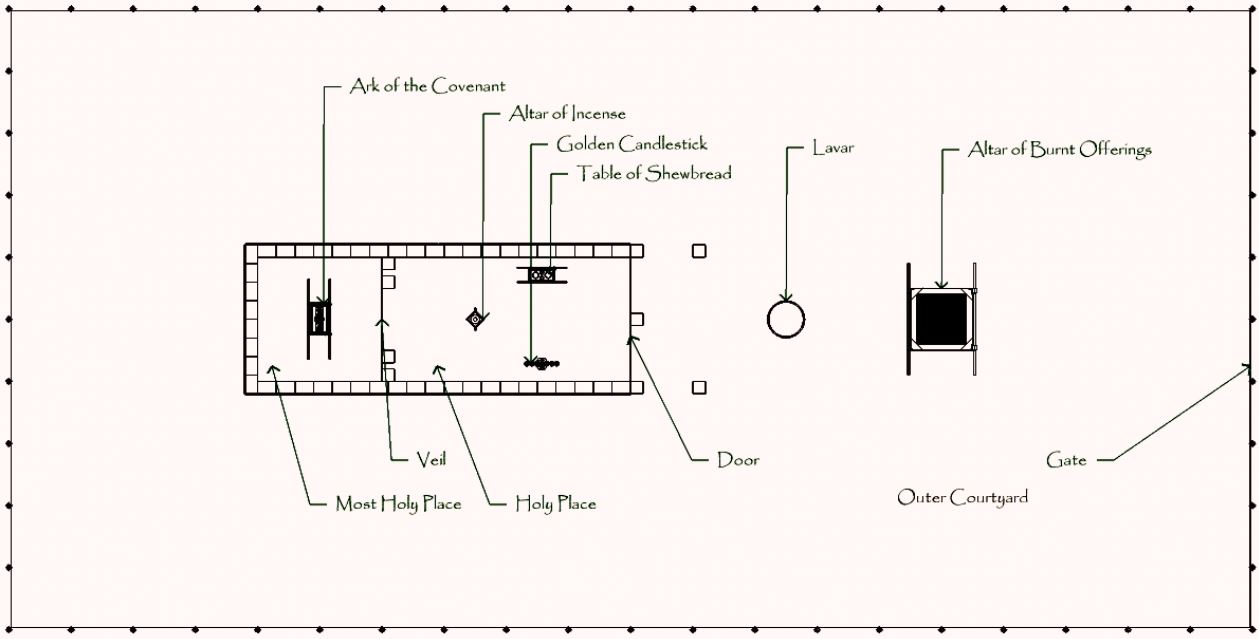
Before performing their services, the kohanim first needed to wash in the copper laver. The purifying waters of the laver, of course, represent Chessed, always associated with pure water, kindness and positive energy. Following this, the kohanim could bring offerings on the sacrificial altar to atone for sins, representing the realm of Gevurah and Din, harsh severity and judgement, always associated with fire. Fittingly, this is the place of slaughtering and burning in the Mishkan.

Inside the Holy place, there were three structures. First and foremost was the Menorah, its eternal, ever-burning flames representative of eternal Netzach. The Menorah became a symbol of all of Israel, the oldest symbol of Judaism. It is indicative of our flame that shall never be extinguished, and that no matter how much we are oppressed, we emerge victorious. Opposite the Menorah stood the Shulchan, a table with twelve loaves of bread that remained miraculously fresh. This is symbolic of splendorous Hod. The root of Hod literally means to “acknowledge” and to “thank”, and the Torah commands that it is specifically after eating a bread-meal that we must recite birkat hamazon to thank God and acknowledge all the good that He bestows upon us. (Almost all other berakhot requirements are of rabbinic origin.) Last of the three structures in the Holy is the incense altar, facilitating atonement of the gravest sins, especially those in the sexual realm, associated with Yesod.

Then came the Holy of Holies, corresponding to the highest three Sefirot of the Mochin. The kohen gadol entered past the special Veil, paralleling Chokhmah, and stood before the Ark of the Covenant, representing the very Will of God, Keter. The Ark contained the Ten Commandments, inscribed with a total of 620 letters, the gematria of “Keter” (כתר)! From between the Cherubs above the Ark came the voice of God, revealing His Divine Will. Better yet, mystical texts speak of two higher energies emanating from Keter, called Ta’anug (“Pleasure”) and Emunah (“Faith”). This tie in neatly with the two other items in the Holy of Holies: the jar of manna, representing delicacy and Ta’anug; and the almond-rod of Aaron, representing true Emunah in God and His laws. The hidden Sefirah of Da’at was represented by the “Cloud” of God that descended upon the Tabernacle.

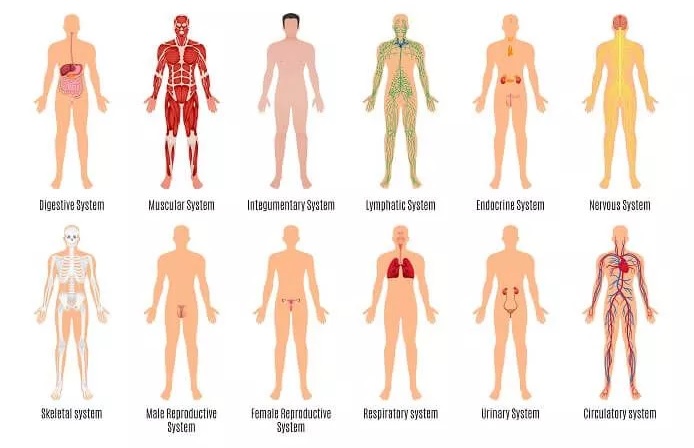
Tying this back to the beginning—the Mishkan as a model of the human body—we find that there are also ten organ systems in the human body that work together to keep us alive and functioning. These organ systems correspond to the Sefirot, too. Keter, the origin from which all the divine energy emerges, is often called the “skull”. It corresponds to the skeletal system that gives structure to the entire body, and without which the body would collapse and have no form or function. Chokhmah is the brain and the nervous system (self-explanatory).
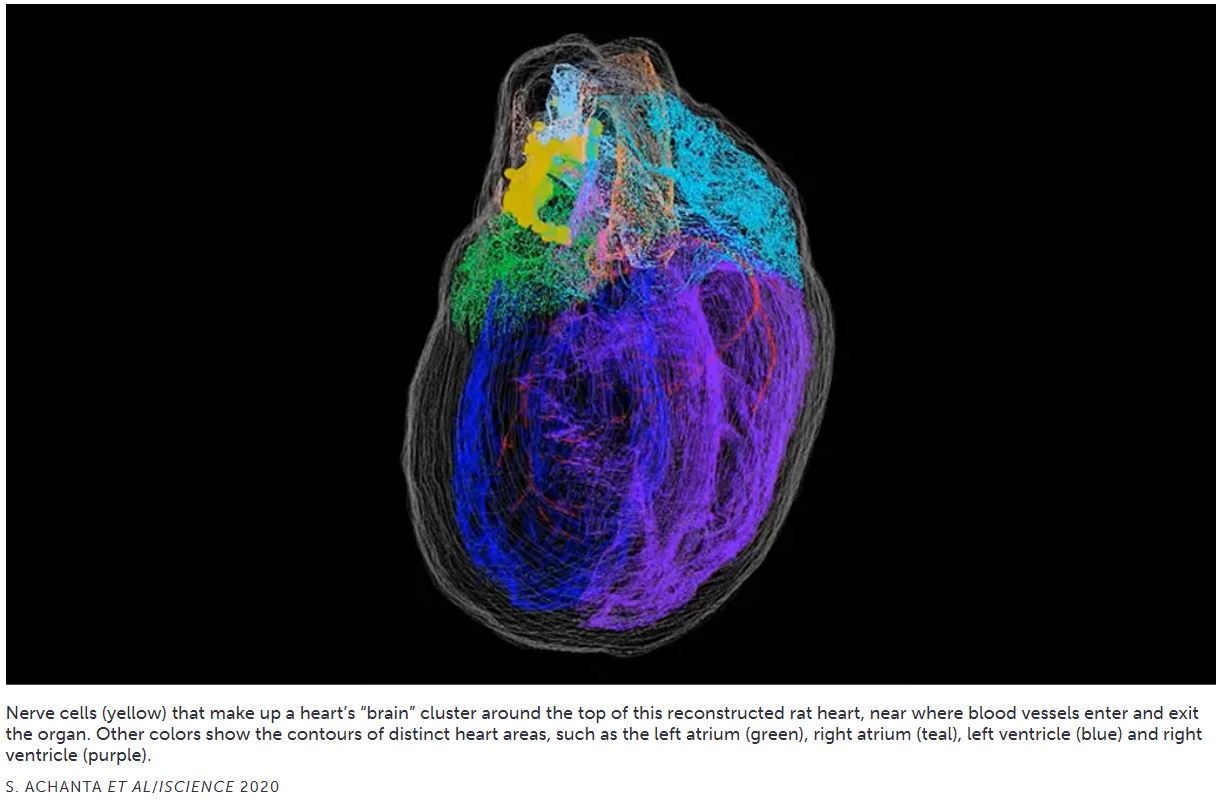
Although Binah is a mental faculty, it is also associated with the heart. Today, scientists know that the heart has a neural network of its own, and may indeed play some role in our emotions and unconscious. The heart has even been called “the little brain” by some researchers. Thus, Binah is a fitting place for the circulatory system. Binah is described as the “mother” that gives birth to the Sefirot below and keeps them nourished. Similarly, the circulatory system delivers vital oxygen and nutrients to every cell of the body.
It is intriguing to note here that Binah is considered a “feminine” Sefirah (being Ima, the “mother”) and we find that women have less issues with heart disease and cardiovascular disorders than men do. Meanwhile, Chokhmah is called the “father” and is a masculine quality, and studies show that women are three times more likely than men to have mental health issues! This gives us further evidence for seeing how the Sefirot manifest themselves in the organ systems of men and women.

The main interface between the nervous system and the circulatory system is the endocrine system, controlling the production and release of hormones. The endocrine system doesn’t actually have any major organs of its own, just a set of glands distributed around the body and overlapping with other systems (like the kidneys of the excretory system and the pancreas of the digestive system). The main control centre of the endocrine system is the brain’s hypothalamus, regulating which hormones get released into the bloodstream. Thus, the endocrine system bridges together the circulatory and the nervous systems—without having any specific organs of its own—nicely paralleling the hidden Da’at which bridges Chokhmah and Binah.

Next in the Sefirot is Chessed, associated with water and with excess and overflow (it is also known as Gedulah, “largesse”). This is the little-known lymphatic system of the body, which transports and regulates excess fluids around the body. The lymphatic system is also important in the development and transport of immune cells (lymphocytes) that protect the body from foreign invaders, another link to the protective energy of Chessed. Moreover, Chessed is typically associated with whiteness, like the milky lymph fluid and the immune system’s white blood cells. In the Mishkan, the laver of Chessed served to wash away germs and impurities (both spiritual and physical), another link to the germ-fighting power of the immune system and lymph nodes.

On the other side of Chessed is strict and fiery red Gevurah, “severity” and “strength”. This parallels the red musculature, the heaviest system in the body, and the one that burns the vast majority of the body’s energy. Like Gevurah, it is the muscles that give us strength. Fittingly, the meat of the sacrificial animal that was consumed in the Mishkan was, of course, muscle. Then comes Tiferet, associated with the element of air, and paralleling the respiratory system. Just as Tiferet plays a central role being in the middle of the Sefirot, and balances them all, the respiratory system is in the middle of the body, bringing in vital oxygen for every cell to stay alive. Tiferet is described as “God’s Throne”, where the Divine Light of Creation is concealed, and to which we all aspire. (The people and Land of Israel are rooted in Tiferet, as explored here.) It is the respiratory system that allows us to elevate our souls Heavenward, to have an “out-of-body experience”, whether through meditative breathwork or through (risky) shortcuts like inhaling various substances.

The dual Sefirot of Netzach and Hod are usually associated with the kidneys, and other filtering organs of the body. They neatly parallel the excretory (urinary) system and the digestive system, respectively. Netzach lies below watery Chessed (of the lymphatic system), and the kidneys filter the fluids in our bloodstream and work in tandem with the lymphatic system. In our prayers, we often speak of God “examining” or “testing” our kidneys (bochen klayot), and some might see in this a metaphor that whenever God gives us tests or tribulations, it is only to “purify” us, just as the kidneys do for the blood. This parallels what was said above about the Menorah as a victorious symbol of our ever-burning flame, despite the difficulties of our history.

Similarly, the digestive system of Hod nicely corresponds to the Shulchan and its loaves of bread in the Mishkan. Recall that Hod is the place of berakhot, through which we “acknowledge” and “thank” God—as mentioned above—and the most frequent way to do this is by reciting blessings on food for the digestive system! Hod lies beneath muscular Gevurah, and there is an important connection here: The digestive system depends on a network of involuntary smooth muscles to move food matter through the system (plus an extra layer of muscle around the stomach to “churn”). Without smooth muscles, digestion would be impossible.

In Kabbalistic texts, fiery Gevurah sometimes represents the entire left pillar of Binah-Gevurah-Hod, all of which is associated with redness and severity; while watery Chessed stands for the entire right pillar of Chokhmah-Chessed-Netzach, associated with whiteness and fluidity. With this in mind, it is especially appropriate that in the array of organ systems, the entire left side relies on red muscles (cardiac muscles of the heart for Binah, skeletal muscles for Gevurah, digestive smooth muscles for Hod); while the entire right side relies on fluids (cerebrospinal fluid for the nervous system of Chokhmah, lymph fluids for Chessed, blood plasma for the kidneys of Netzach).

Lastly, we have the reproductive system for Yesod (obviously), followed by the largest and most superficial integumentary system (of skin, hair, and nails) for lowliest and earthliest Malkhut. Just as skin envelops our bodies, curtains of animal skins enveloped the courtyard of the Mishkan, corresponding to Malkhut. In these ways, we can see how the ten organ systems of the human body neatly parallel the Ten Sefirot, and the ten components of the Mishkan—both a macrocosm of the human body and a microcosm of the universe. To summarize:
The Mystical Significance of Bones

In this week’s parashah, Beshalach, the Israelites finally leave Egypt. We read how Moses made sure to take with him ‘atzamot Yosef, the “bones of Joseph” (Exodus 13:19). It is interesting that a bone is called an ‘etzem (עצם), which literally means an “essence”. As an adjective, ‘atzum (עצום) means “strong”, as well as “shut” or “closed up”. This is fitting since bones are the strongest components of the body, and “closed up” within muscles and other tissues. (For those who like numbers, the gematria of עצום is 206, which is the total number of bones in the human body!) There is something especially significant about bones. God made Eve from Adam’s bone, and Adam later declared that Eve is “bone of my bone” (‘etzem mi’atzamai), implying that her essence is like his essence, and now he would finally be happy and no longer feel alone. What is so special about bones that they hold the very essence of a person?

One of the amazing wonders of biology is that each and every cell of our bodies contains our entire genome (except, of course, the reproductive cells). So, the DNA inside the nucleus of eye cells contains the genes that also program toenails, and the toes have the DNA of the retinal proteins in our eyes! It remains one of the great mysteries of biology how cells are able to control exactly which genes are turned “on” or “off” in every cell, and how they make sure that eyes don’t have nails, and nails don’t grow eyes. In our adult bodies, most cells have already been differentiated into something specific (like eyes or toes), but there is one place where cells remain undifferentiated, and could become anything. These are called stem cells, and they exist mainly within our bones. Here in the bone marrow, we do indeed find our ‘etzem, the core essence of who we are, still undifferentiated and full of potential to become anything.

This explains why God made Eve from Adam’s bone specifically, as if He took some of Adam’s undifferentiated stem cells to create Eve! This is precisely how a modern-day scientist experimenting with genetic engineering or organ printing would do it. Better yet, when scientists and surgeons need to extract bone marrow for stem cell transplants today, the rib bone is actually a great place to get them, since they are near the surface and easily accessible, with little meat around them. (I know that some people will quote a different opinion from our Sages, as in Berakhot 61a, that Eve was “split” from a two-faced Adam, or that she was made from his “tail”, but the rib opinion makes a great deal of sense from a scientific perspective.) In any case, when we remember that our bones contain our undifferentiated cells and our untampered DNA, we appreciate the beauty of divine Hebrew in calling a bone an “essence”.

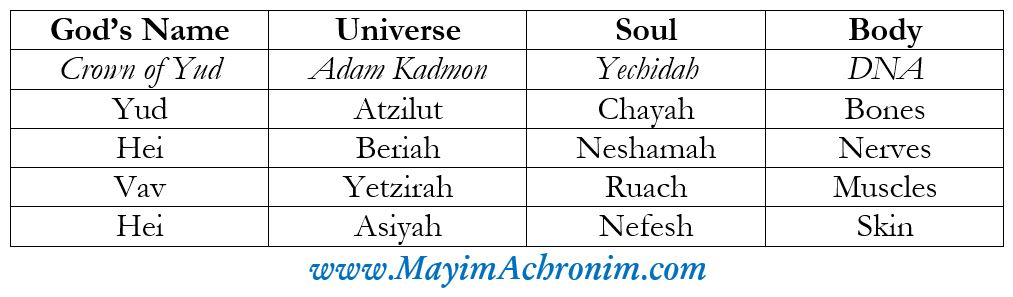
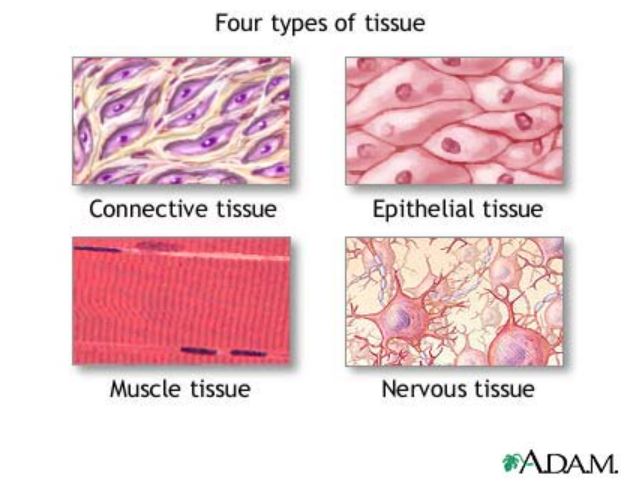
Scientifically speaking, the human body has four main types of tissues: bones are a type of connective tissue, and then there is muscle tissue, nervous tissue, and epithelial tissue. The Torah, too, speaks of four types of tissues: bones, plus bassar (meat), gidim (nerves), and ‘or (skin), neatly paralleling the four biological categories. We know that all fours in the Torah—such as the four mystical universes, the four Pardes aspects of Torah study, and the four letters of God’s Ineffable Name—match up and correspond to each other. We can link these up yet again with the four tissue types, to see once more the divine anatomy with which we were created:

Skin represents the surface level of Torah study, pshat (פשט), corresponding to the lowest realm, the physical and superficial Asiyah (as well as the lowest level of soul, the nefesh). Interestingly, the word in Hebrew to undress, ie. to remove one’s surface garments and reveal the skin, is lehitpashet (להתפשט)!

Beneath the skin is muscle, the bulkiest and heaviest part of the body, representing the sub-surface level of Torah study, remez, and the angelic realm of Yetzirah, as well as the next level of soul, ruach. The ruach is typically associated with the heart, also a muscle. With this we can understand why bassar (בשר), “flesh” or “meat”, shares a root with revealing news, levasser (לבשר)—for what is levasser but to reveal something currently hidden and as yet unknown? Levasser is to give more information beyond the obvious surface pshat that is already known! Moreover, we can now better understand why the Torah specifically uses the term yetzirah to describe the creation of Adam’s body (Genesis 2:7), and the command later for him to specifically become one bassar with his wife (2:24).

Going onwards, the muscles are innervated and controlled by nerves, paralleling drash, the metaphorical and allegorical level of Torah study, and the higher realm of Beriah, along with the neshamah level of soul. The neshamah is seated in the brain, the largest bundle of nerves in our body.

Finally, the inner-most part of the body is the bone, representing sod, the deepest part of Torah and its very essence. This is the level of soul called chayah, fitting because our Sages taught that Eve (made from Adam’s bone) was originally called Chayah, and only after the consumption of the Fruit did she become Chavah (see Kli Yakar on Genesis 3:20). The bone-sod level corresponds to the highest realm of God’s pure emanation, Atzilut. (The pure white colour of bone symbolically adds to this, along with the alliteration between Atzilut and ‘atzamot!) Atzilut is the place of pure, unadulterated light. Light is אור, with a value of 206, again like the total number of bones in the human body. We see a beautiful phonetic relationship between the surface level of skin, ‘or, spelled עור, and the deepest-most level of bone, corresponding to secret light, or, אור. (A word for an even more profound secret is raz, רז, with a value of 207, going one step further.) Without bones, the body would fall apart into a shapeless mass, just as would Torah without sod. (The Chida, Rabbi Chaim Yosef David Azulai [1724-1806] pointed out that if you take the sod out of Pardes [פרדס], you are left with pered [פרד], a mule!)

And what of the hidden-most “fifth” part—the “crown” atop the Yud of God’s Name and the yechidah soul, paralleling the most mysterious and mystical Adam Kadmon? Perhaps it’s the DNA itself, the very code that gives rise to all four tissue types of our bodies.

To summarize:

A final thought: Damage to the skin often heals back to the way it was before. Muscle and nerve damage is much harder to reverse, and sometimes irreparable. Bones, however, tend to heal back even stronger than they were. There is a wonderful lesson here for each of us, both individually and collectively as a nation: If something hurts us deeply and damages our very essence, we should bounce right back and recover, growing even stronger than we were before, so that our inner essence shines brighter than ever.

Shavua Tov and Happy Tu b’Shevat!


For more on ‘The Divine Anatomy of the Human Body’, see here.

Understanding Resurrection of the Dead

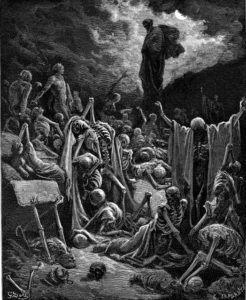
‘The Vision of the Valley of the Dry Bones’ by Gustav Doré

One of the fundamental principles of Jewish belief is in Techiyat haMetim, a future Resurrection of the Dead. The Rambam (Rabbi Moshe ben Maimon, 1138-1204) enumerated it among the 13 Principles of Faith that every Jew must believe in. He based it mainly on the famous Mishnah that opens the tenth chapter of the tractate Sanhedrin. It begins by stating that every member of the nation of Israel has a share in the World to Come, and then goes on to give several exceptions to the rule—those who forfeit their share. The first is anyone who holds “there is no Resurrection of the Dead from the Torah”. In other words, a person who argues that the Resurrection of the Dead is not a legitimate Torah principle. Such a person is a heretic and forfeits their share in the World to Come. The big question is: do we actually see anywhere in the Torah that there is a reference to the Resurrection of the Dead? The Talmud (starting on Sanhedrin 90b) gives numerous possibilities, most of them indirect derivations, before giving us one place in the Torah that does directly allude to the Resurrection of the Dead. This special verse is in this week’s parasha, Ha’azinu.

In the song of Ha’azinu, Moses quotes God as declaring: “See now that I, I am the One; There is no god beside Me. I deal death and give life; I wounded and I will heal: None can deliver from My hand.” (Deuteronomy 32:39) The order of words is significant: God did not say that He gives life and then puts to death, but rather that He puts to death and then He gives life! Thus, those that have died will be resurrected back to life. Some in the past disputed this interpretation, including the ancient Sadducees who did not believe in any afterlife. Recall that the Sadducees held strictly to the Law of Moses, to the Written Torah, and rejected the Oral Torah. They pointed to places in Tanakh that speak of She’ol, a repository for the lifeless dead, and quoted verses like “the dead do not praise God!” (Psalm 116:17) in support of their position. Interestingly, the Samaritans also believe only in the Torah, and reject even the Prophets and Ketuvim, yet they do believe in a Resurrection of the Dead based on our verse in Ha’azinu!

Once we look into the Prophets, we see numerous references of the future Resurrection. The first that is typically cited is Ezekiel’s Vision of the Dry Bones (Ezekiel 37). In this episode, God took Ezekiel to a valley and raised up skeletons, asking the prophet if they could come back to life. Ezekiel replied that only God knows such things, and God proceeded to bring the bones back to life. In Rabbinic tradition, it is believed that these revived skeletons were a segment of the Tribe of Ephraim. Back in Egypt, the Israelites desperately awaited their salvation, and many believed the time of Redemption had come and gone. They miscalculated by 30 years, and a group of Ephraimites decided to take matters into their own hands and flee. Unfortunately, they didn’t make it and ended up dying (or being killed) in the Wilderness. It was these Ephraimites that God resurrected before Ezekiel’s eyes. This description is found in multiple places in Midrash (such as Yalkut Shimoni I, 226), and in the Talmud (Sanhedrin 92b). The same page of Talmud does offer an opinion that the Vision of the Dry Bones might only be metaphorical, or that it doesn’t necessarily imply a literal future resurrection of all the dead. It could just be highlighting God’s power to revive the dead in general, or even just an allegory for the restoration of Israel after destruction and exile. The contradiction is resolved by saying both are true: the Vision had metaphorical meaning, but it was also literally true!

Another place in Tanakh that is a clear source for Resurrection is Daniel’s statement that “Many of those that sleep in the dust of the earth will awake, some to eternal life, others to reproaches, to everlasting abhorrence.” (Daniel 12:2) Similarly, Isaiah stated “Oh, let Your dead revive! Let corpses arise! Awake and shout for joy, you who dwell in the dust. For Your dew is like the dew on fresh growth; You make the land of the spirits come to life.” (Isaiah 26:19) Here, Isaiah refers to a “dew” of resurrection, and mystical texts have much to say about this dew. One of the early Kabbalistic works, Sefer haPeliyah, says that it is the same dew that was used to revive the Israelites when they briefly “died” from the overwhelming Sinai Revelation. The Talmud (Chagigah 12b) says God keeps this special dew locked up in the highest of the Seven Heavens, the realm of ‘Aravot, alongside His Throne and chief angels like Seraphim and Ofanim. Elsewhere, the Talmud (Ketubot 111b) reads the verse above not as “dew on fresh growth” but as “dew of light”, since the exact words are tal orot. What is this light? It is the light of Torah, and therefore “Anyone who engages with the light of Torah, the light of Torah will revive him; and anyone who does not engage with the light of Torah, the light of Torah will not revive him.”

The Talmud here continues to say that all the righteous dead will resurrect specifically from Jerusalem, since it says in Psalms 72:16 that they shall “blossom out of the city like the grass of the earth”—and the city is none other than Jerusalem. The Zohar (II, 28b) adds that the future resurrection will begin from the indestructible luz bone. This bone will absorb the dew and become like dough, from which God will reform the body. Is there such a non-decomposing bone in the human body? As explored in depth before, scientifically speaking there is no such bone, and “luz” may actually refer to other things. It may even refer to Jerusalem itself, based on Jacob’s Vision in Genesis 28 which says the original name of the place was Luz. So, resurrecting from “Luz” may just mean that everyone will resurrect in Jerusalem!

Intriguingly, Rabbi Aryeh Kaplan suggested that luz may be referring to DNA, and the Zohar might be saying that resurrection will be possible by taking a small remaining DNA sample and reviving from it the entire body. Today, scientists have indeed made major advances in DNA biotechnology, organ printing, and cloning that may make it possible. In fact, in another place the Zohar (I, 135a, Midrash haNe’elam) actually suggests this might be the case: “In the future time, the Holy One, blessed be He, will rejoice with the righteous, and will rest His Presence upon them, and all will rejoice with great joy… Said Rabbi Yehuda: the righteous are destined in that time to create worlds and resurrect the dead.” So, it will be the Tzadikim in the Messianic Age who will have the power to revive the dead! It remains to be seen whether this will be an entirely spiritual power, or whether it might involve the use of DNA technology.

Relatedly, advances in modern medicine and health are allowing us to dramatically increase lifespans. Isaiah prophesies that a time will come when a centenarian will be considered a “youth” (Isaiah 65:20). The ancient Book of Jubilees (Ch. 23) speaks of a time when man’s lifespan will return to that of Adam and the first generations, who lived nearly a millennium. In the future, each person will enjoy a thousand-year lifespan. This is probably related to the Talmudic and Midrashic statement that the Messianic Age will conclude by the year 6000, after which there will be a cosmic thousand-year Sabbath (see, for instance, Sanhedrin 97a). Based on Psalm 147:2-3, the Zohar (I, 139a, Midrash haNe’elam) gives a more detailed timeline: first Jerusalem will be rebuilt (arguably this has already happened), and then the Temple will be rebuilt, followed by the Ingathering of the Exiles, and only forty years after this will the Resurrection of the Dead begin.

Initially, all will be resurrected, including the wicked, except the pre-Flood generation (Yalkut Shimoni II, 429). Once everyone is resurrected, they will be judged and receive their due reward or punishment. This is also affirmed in the Talmud, in the famous discussion between Rabbi Yehuda haNasi and the Roman emperor Antoninus (Sanhedrin 91a-b). The latter questioned how God could judge a soul—which is pure and righteous—for the sins of the body, and how God could judge a body—which is just a hunk of matter and otherwise lifeless—for actions driven by the soul. Using a clever parable, Rabbi Yehuda explained how God will bring souls back into bodies and judge both together. (See also the Ramban in his Discourse on Rosh Hashanah, where he explains how Judgement Day will follow the Resurrection.)

The righteous will go on to enjoy their reward, as supported by another passage in Kiddushin 39b, which states the true reward for all mitzvot will be bestowed in the Era of Resurrection. This is the real definition of Olam HaBa, the “World to Come”, that our Sages speak of. While the term Olam HaBa is often used more ambiguously or in reference to other realms, it is really the era of reward here on Earth, when body and soul reunite. This is further supported by the Talmud in Ketubot 111b which says that in Olam HaBa, the yields of fruits and vegetables will multiple dramatically, and making wine will be effortless, with a single grape or cluster of grapes able to “produce no less than thirty jugs of wine”. This teaching is based on a verse in this week’s Ha’azinu, too.

Modern harvesting and winemaking technologies have already automated much of the process and simplified winemaking significantly, in fulfilment of Talmudic prophecy.

Another verse in this week’s parasha states that God’s Holy Land “atones for its people” (Deuteronomy 32:43). And so, there is a belief that those buried in the Holy Land have all their sins automatically wiped out. Rabbi Elazar takes it one step further and says only those buried in Israel will merit to be resurrected! The other Sages counter that this cannot be the case, and that anyone who at least “walked four cubits in the Land of Israel is assured a place in the World to Come”. However, we know that Resurrection can only take place in the Holy Land, so what will happen to all the bodies buried outside of Israel? God will miraculously make the corpses from all over the world “roll” through underground tunnels to Jerusalem! (Ketubot 111a)

The Talmud further tells us (both in Ketubot 111b and in Sanhedrin 90b) that people will be resurrected fully clothed. Rabbi Meir used a parable to explain this to Queen Cleopatra, saying that just as a “naked” kernel of wheat is buried in the ground and sprouts new wheat grains with several layers of chaff, so too will the righteous be resurrected covered up. Reish Lakish, meanwhile, uses two Scriptural verses to prove that people will initially be resurrected in the same state in which they died (blind, lame, etc.) but will then be miraculously healed. Since Adam and Eve were created as twenty-year-olds in the Garden of Eden (Beresheet Rabbah 14:7), it seems people will similarly take on the youthful bodies of a twenty-year-old.

The Zohar’s Midrash HaNe’elam cited above suggests that the process of Resurrection may last something like 200 years until all the righteous return. First will be revived the generation of the Exodus (Zohar III, 168b), along with the great Patriarchs and Prophets of old. Then all those who “drew water” from the wellsprings of Torah. Everyone else will follow, and all will eventually enjoy a millennium of peace and prosperity, with the ability to explore the farthest reaches of the universe and the highest heavens, and to truly marvel at all of God’s creations in the vast cosmos. It isn’t clear what will happen after that. Some envision a totally spiritual existence entirely devoid of the physical, perhaps for eternity (which is really hard to fathom). Others believe God will simply hit “reset” and a new Sabbatical cycle will begin, with civilization starting from the beginning all over again. Whatever the case, we must first usher in Mashiach and the Messianic Age, followed by the Era of Resurrection, and a millennium of Shabbat peace and reward. May we merit to see it soon.

Gmar chatima tova!