
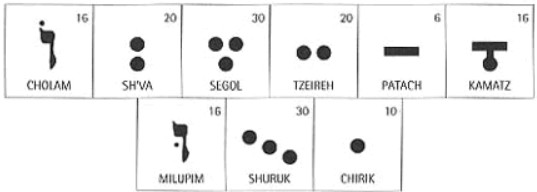
 This article is a follow-up to the previous one about the correct pronunciation of God’s name (יהוה), YHWH. Recall that our Sages teach that the nekudot vowels on God’s name are shva, cholam, and kamatz, meaning that the right way to pronounce the name would be “Yehowah”. A number of people reached out arguing that the letter vav is pronounced with a “v” sound, and therefore the name is “Yehovah”. Some referred to the work of Dr. Nehemiah Gordon, who makes the case for the vav being “v” partly based on words in Ezekiel (more on that below), and partly based on a poem by Elazar haKalir (c. 6th century CE) where he rhymes levi (לוי) with navi (נביא). The implication is that Jews as far back as the 6th century were pronouncing the vav as a “v” sound. Gordon himself notes that great rabbis like the Ibn Ezra were puzzled by this rhyme, because it was common knowledge then that the vav is really a “w” sound. Indeed, we find that the vav was a waw for most of Israelite and Jewish history. Below are ten big reasons for why the vav is a waw.
First of all, the Hebrew alphabet is divine and precise. There is no need for two letters to have the exact same sound. We already have a “v” sound in the soft beit or veit, when without a dagesh. The ancient mystical Sefer Yetzirah tells us that there are seven letters in Hebrew that are kefulot, “doubled”, and have two sounds depending on whether they have a dagesh or not. Since we already have a “v” sound in the veit, there is no need for a vav with the exact same sound. Some argue that there are other letters that sound the same, like kaf and chet, or tav and tet, but this is not true at all. Each of these is distinct, despite people confusing them and mispronouncing them today. (For lots more on this, see ‘Shabbat or Shabbos: What’s the Correct Pronunciation?’ in Garments of Light, Volume Two.)
Second, everyone agrees that the vav has an “oo” or “u” sound. We all pronounce it that way, for instance when the vav is at the start of a word (such as in the expression shana tova u’metukah). The “oo” and “w” sounds are highly connected. In fact, you cannot make a “w” sound without first making an “oo” with your lips (try it!) This is not the case with a “v”. Note how making a “v” sound requires a different mouth and lip shape than making a “w” sound (and the “v” also requires teeth). The “w” is like the “oo”, and the “v” is nothing like the “oo”. This is yet another piece of evidence that the vav is really a waw. (Interestingly, in English a W is called a “double-u”, implying the same “oo” connection.)
Another major proof comes from Hebrew contractions. For example, “he” is hu (הוא) and “mouth” is pe (פה), so “his mouth” is combined to make pihu (פיהו), such as in Exodus 4:15 or Psalms 10:7. Often, such words are simplified and shortened by dropping the letter hei, leaving behind פיו, as in Numbers 27:21 or Psalms 33:6. Although this contraction is typically pronounced as piv today, with a “v”, it makes a lot more sense to pronounce it piw, which is essentially the same as pihu. Try saying pihu (פיהו) and piw (פיו)—it’s the same! This is strong evidence that the vav must be a waw, as that’s the only way to retain the proper pronunciation of these common contractions. There are hundreds of such cases, including other words like avihu (אביהו) and aviv (אביו), which clearly should be aviw, since that’s what sounds identical to avihu. This leads directly to point number four:
Theophoric Jewish names like Eliyahu (אליהו), Yirmiyahu (ירמיהו), and Yeshayahu (ישעיהו) all contain God’s name and end with “yahoo”. They do not end with “yahoov” or “yahov”, because the vav here is not a “v”, but an “oo”. This is even clearer when the theophoric part is at the start of the name and not the end, such as in Yehoshua (יהושע) or Yehoshafat (יהושפט). No one says Yehovshua; all agree that it’s pronounced Yehowshua. The sound of the vav here is clearly a waw, too.
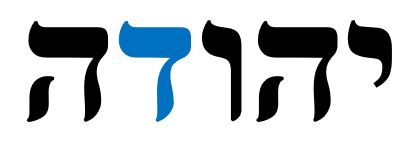 More amazingly, God put His name within each and every Jew: the name Yehudah (יהודה) is just God’s name with a dalet inside. As God’s people, meant to spread the name of God around the world, and “call in His name” wherever we go (explained at-length in the previous essay), we fittingly have God’s name embedded within ours. No one says Yehuvdah, it’s obviously Yehudah, and when you remove the dalet, you should be left with God’s name, ie. Yehudah becomes Yehu’ah, like Yehowah. In no way does it become Yehovah, which would require adding a whole new consonant sound that was not there. (It also does not become Yahweh or Yah’weh, which is what some argue is the name of God.)
Sister Languages
Next, we turn to evidence from other ancient languages in the region. The sister language of Hebrew is Aramaic. Hebrew and Aramaic have the same alphabet, and many of the same root words. There are even Aramaic words in the Torah (most famously, yagar sahadutha in Genesis 31:47) and even more Aramaic words across Tanakh, including major chunks of the Book of Daniel. The vernacular of the Jewish people for centuries after the Babylonian Exile was Aramaic. The Talmud was written in Aramaic, as was the Zohar. And in Aramaic, the vav is indisputably a waw. It would not make much sense if Hebrew had a different pronunciation of the same letter. Some argue that maybe Hebrew and Aramaic were influenced by Arabic, where the vav is a waw. In reality, it’s a lot more likely that the older Hebrew and Aramaic influenced Arabic, not the other way around. Besides, historians agree that it was waw in other related ancient languages, too, like Phoenician and Ugaritic. And even if there was some Arabic influence, it does not make it wrong that the vav is a waw, which leads to point number seven:
Remember that Moses first encountered God on Sinai, near or in the region of Midian, roughly in today’s Saudi Arabia (see ‘Red Sea or Reed Sea: Where is Mount Sinai?’ also in Volume Two of Garments of Light). The Ten Commandments were later revealed on the same mountain, as relayed in parashat Yitro, named after the Midianite chief leader. The Torah concludes by saying that YHWH came to Israel from Sinai (Deuteronomy 33:2). Historians point out that the ancient Qurayya people in Midian worshipped a supreme God they called Hawayah, which is most likely the same as YHWH. After all, we know that Yitro (“Jethro”) returned to his people after visiting Moses at Sinai and worshipping YHWH there with him (Exodus 18:27). Rashi comments here that Yitro went back to spread the faith in the region. This would certainly explain the Midianite Hawayah and its strong resemblance to Yehowah.
On the point of related languages, it is worth mentioning the Septuagint. Recall that King Ptolemy gathered 72 of the great Jewish rabbis of the time to translate the Torah into Greek (see Megillah 9a-b and Yalkut Shimoni I, 3). Our Sages say that, despite being put into separate rooms to ensure accuracy, the rabbis miraculously made the same handful of changes so that the Greeks would not misunderstand or misuse the Torah. How did those great rabbis transliterate the letters into Greek? Greek did not have a “v” sound in their language at all, nor did they have a letter like W or waw. Because of that, the rabbis transliterated all soft beits (ie. veits) into hard beits. Avraham became “Abraham”, and Yakov became “Yakob”. And what did they do with the waw? If it was pronounced back then as a vav like veit, we would expect them to similarly transliterate the vav into the Greek equivalent hard “b”. We would expect to see Yavan (יון) become “Yaban” (Ιαβαν), or David (דוד) become “Dabid” (Δαβίδ, which is how it is sometimes spelled in Modern Greek, or more commonly Ντέιβιντ). But it’s not! The Sages transliterated Yavan as Ya-ouan (Ιωυαν), approximating the “w” sound in lieu of a proper W letter. Later, when the rest of Tanakh was translated as well, David became Da-uid (Δαυίδ). This is further strong proof that in ancient times, and in Second Temple times when the Septuagint was produced, the vav was undoubtedly a waw.
More support comes from Sa’adia Gaon (c. 892-942). Sa’adia Gaon was an expert in Hebrew language and a pioneer of Hebrew systemization and grammar, as he laid out in important works like HaAgron and his commentary on Sefer Yetzirah. He points out that the Hebrew letters are distinct and pure, meaning there are no “fused” sounds like “j” or “ts”. So, for instance, Sa’adia Gaon explains that the letter gimel cannot be a jimel like the Arabs say, because the “j” sound is not pure, ie. it is a fusion of two sounds, “d” and “zh”. (The only sounds that are seemingly not distinct, according to Sa’adia Gaon, are the sin and samekh. However, I did suggest a solution to that problem in the same Garments 2 essay cited above.) Sa’adia Gaon held that the vav is definitely a waw—as it is in Arabic, Aramaic, and other Semitic languages. In his time, the vav was a waw, as it was in the times of the Ibn Ezra in the 12th century, and as is retained by several Mizrachi-Sephardic communities to this day (including Yemenite, Libyan, Tunisian, and Baghdadi). So, when did the waw transition to a vav?
It may have started in the late Roman Empire era. We know that Latin originally had a “w” sound but it was eventually dropped and replaced with a hard “v”. In fact, the letter V was pronounced as a “w” in Classical Latin. For example, the famous expression of Julius Caesar veni, vidi, vici (“I came, I saw, I conquered”) was pronounced wenee, weedee, weekee. In Classical Latin, the V was a “w” and “oo” sound (just like the original vav!) Over time, perhaps due to Germanic influence, it hardened into a “v” sound. This may have affected the many Jewish communities exiled across the Roman Empire and its successors in the Middle Ages. (It would explain why it didn’t affect the Yemenite waw, since the Yemenites were not under Roman rule.)
More impactful was Ashkenazi influence in recent centuries. Eastern European languages like Russian and German do not have a “w” sound. They pronounce the W like a “v”. (The German name “Wolf” is pronounced “Volf”, and the German car Volkswagen is “folks-vagen”, which is also what Russians call it.) Yiddish developed in these lands, which is why Yiddish does not have a “w” sound either. Not surprisingly, Yiddish-speaking communities dropped the original Hebrew waw entirely. By the late 1800s, Ashkenazim had become the dominant Jewish group in the world. They migrated to America en masse, and they made up the majority of the early aliyot to Israel (particularly from Eastern European Jewish communities). The result was that Modern Hebrew, devised primarily by Ashkenazim, codified the waw as a vav. This made it all the more common and widespread today, even among Sephardim.
Back, Body & Breath
Another argument Dr. Gordon makes for the “v” sound is that Ezekiel seems to write the word for “back”, gav, both as גב and גו. This would imply that the veit and the vav are interchangeable and have the same sound. However, a careful reading of Tanakh suggests that the word גו is an altogether different word, related to the better-known גויה, which means “body”. In Ezekiel, it only appears in 23:25, where the term is אַחֲרֵי גַוֵּךְ, and strangely, the nikkud on the vav is a shuruk, which typically has an “oo” sound. Metzudat Zion (by Rabbi David Altschuler, 1687-1769, explaining difficult words in Tanakh) comments here that the word is like gufekh (גוּפך), “your body”, not “your back”. He says it’s the same word as in I Samuel 31:12, geviyat Shaul (גְּוִיַּת שָׁאוּל), the “body of Saul”. So, גב and גו are not the same, and not interchangeable.
Going back to Elazar haKalir and his levi-navi rhyme, a single verse in a single poem from the post-Second Temple era is no proof that the waw should be a vav. It says nothing about how the letter was originally pronounced in Biblical times, or in Temple times. Besides, even levi and navi are not perfect rhymes, and poetry is full of imperfect rhymes, so it could well have been lewi and navi. Indeed, we see that haKalir does make many other imperfect rhymes throughout his poetry, including rhyming hei with chet, or reish with dalet. Other poets of the time rhymed imperfectly, too, and that was normal. It is worth reading Ibn Ezra’s critique of the poets’ imperfections and mispronunciations, in his commentary on Ecclesiastes 5:1, which he concludes in an exasperated tone, saying: “I cannot clarify even a bit of the thousands of the poets’ mistakes” (ולא אוכל לבאר אחד מני אלף מטעות הפייטנים).
Finally, we know that the name of God is supposed to be made up of four vowels, and no consonants. This is attested to both in rabbinic tradition and in extra-rabbinic sources like Josephus (c. 37-100 CE), who clearly says the Tetragrammaton is composed of four vowels (see Wars of the Jews, Book V, 5:7, where he describes the name of God engraved on the headplate of the kohen gadol). The “w” or “u” sound is a vowel (sometimes classified as a semi-vowel), but a “v” is not. V is a consonant, and requires using one’s teeth to pronounce. And this is important from a spiritual perspective as well:
Unlike “Yehovah”, when pronouncing “Yehowah” the mouth remains open and there are no blockages in the flow of the name. The vav, however, requires making a “block” of sorts with one’s teeth. (A “v” sound is considered labiodental, requiring the use of one’s lips and teeth, whereas the “w” is only labial and not dental.) A person with no teeth would have a hard time pronouncing “Yehovah”, but no problem saying “Yehowah”. A baby could say it, and a centenarian could say it, too. Which is partly the point: it’s a universal name, a name with which any person could call out to the one true God. (As the prophet Joel says in 3:5 that “All who call in My name shall be saved…”) And it’s as simple as a breath.
Many have pointed out that the name “Yehowah” sounds like a smooth breath. Fittingly, the name is introduced in the Torah not in the first chapter, as one might expect, but rather in the second chapter, amidst the creation of Adam. Here, Yehowah “blows” a soul into Adam. The word for “soul” itself, neshamah, is nearly identical to “breath”, neshimah. And we are meant to meditate upon God with each and every breath, just as King David finishes his Book of Psalms with the phrase: “every neshamah praise Yah, Hallelu-Yah!” And as Ezekiel (37:6) quotes God in his End of Days prophecy about the Resurrection of the Dead: “I will put breath into you, and you shall live again. And you shall know that I am Yehowah!”
To summarize the ten points for the waw (and pronunciation of “Yehowah”):
- Redundant to have both a veit and a vav (every letter is distinct)
- The “oo” sound (which works with waw but not vav)
- Contractions like pihu and avihu (same as piw and aviw, not piv and aviv)
- Theophoric names like Yehoshua and Eliyahu
- The name Yehudah, without a dalet
- Comparing to Aramaic and other sister languages
- The Midianite Qurayya people’s Hawaya
- The Septuagint and our 72 Sages’ transliteration
- Sa’adia Gaon & Ibn Ezra
- A name of four vowels
For those who are interested in going further on this topic, see this in-depth video which, though not from a Jewish source, makes a number of other excellent points, and brings additional examples.
Pingback: How to Pronounce God’s Name | Mayim Achronim