
Tag Archives: Adam and Eve

Everything You Wanted to Know About Reincarnation in Judaism

This week’s Torah portion is Mishpatim, which is concerned with the first major set of laws that the Israelites received following the Ten Commandments. While the term mishpatim literally means “ordinances” or “judgements”, the Zohar (II, 94a) suggests a very different interpretation:

“And these are the judgements which you shall set before them…” These are the rules concerning reincarnation, the judgement of souls that are sentenced according to their acts.
The Zohar goes on to interpret the laws in the Torah with regards to the mechanisms of reincarnation. For example, whereas the Torah begins by describing a Hebrew servant who is indentured for six years of labour and must then be freed in the seventh year, the Zohar interprets that this is really speaking of souls which must reincarnate in order to repair the six middot before they could be freed. (The middot are the primary character traits: chessed, kindness; gevurah, restraint; tiferet, balance and truth; netzach, persistence and faith; hod, gratitude and humility; and yesod, sexual purity.)

While the Zohar speaks at length about reincarnation, it is the Arizal who systematically laid down the rules of reincarnation and explained the Zohar in depth. His primary disciple, Rabbi Chaim Vital, recorded these teachings in a famous treatise known as Sha’ar HaGilgulim, “Gate of Reincarnation”. The following is a brief condensation of the basic rules of reincarnation that are defined in this tremendous text, answering many of the common questions people have about spiritual transmigration.

Why Do People Reincarnate?

At the start of the eighth chapter, Rabbi Vital writes:

למה מתגלגלים. דע, כי הנשמות יתגלגלו לכמה סבות, הראשונה הוא, לפי שעבר על איזו עבירה מעבירות שבתורה, ובא לתקן. הב’ הוא, לתקן איזו מצוה שחסר ממנו. השלישית היא, שבא לצורך אחרים, להדריכם ולתקנם… לפעמים יתגלגל, ליקח את בת זוגו, כי לא זכה בראשונה לקחתה

Why do people reincarnate? Know that souls reincarnate for several reasons: The first is that one transgressed one of the prohibitions in the Torah, and returns to repair it. The second is to fulfil a mitzvah that one lacks. The third is in order to assist others, to guide them, and rectify them… Sometimes one reincarnates to marry their soulmate, which they did not merit to do in a previous life.

The Ari explains that people mainly reincarnate in order to atone for sins of past lives, or to fulfil mitzvahs that they didn’t do previously. Later, in Chapter 16, we read that people who return do not have to fulfil all the mitzvahs in one lifetime, but only have to accomplish those that their souls are still lacking. Some reincarnate not for their own rectification, but to assist others. We are told elsewhere that these are usually very righteous individuals who agree to return to this world in order to help others.
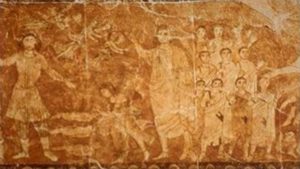
Fresco of the Resurrection of the Dead from the ancient Dura-Europos Synagogue

Some also reincarnate because they either did not marry, or married the wrong person. They must return to reunite with their true soulmate. The Arizal teaches that, unfortunately, some people are so deeply mired in kelipot, negative spiritual “husks”, that they are unable to find their soulmate in this world. These people will reunite with their other half only in Olam HaBa, the “next world” at the time of the Resurrection. With regards to finding soulmates, this is directed particularly at male souls, for it is primarily a man’s responsibility to find his soulmate.

On that note, the following chapter tells us that female souls actually reincarnate very rarely. To begin with, female souls are more refined than male ones, and are unlikely to require more rectifications. What does happen more commonly is that male souls are reincarnated into female bodies! This opens up a number of fascinating scenarios which Rabbi Chaim Vital describes.

What Do People Reincarnate Into?

In Chapter 22, we read that people can reincarnate not only into human bodies, but also animals, vegetation, and even inanimate matter. For example, a person who feeds others non-kosher food reincarnates as a tree; one who sheds blood reincarnates into water; those who transgress various sexual prohibitions reincarnate into bats, rabbits, and other animals; while proud people and those who talk too much reincarnate into bees. (We are told that this is what happened to the judge Deborah who, despite her greatness and wisdom, had a bit of pride and was required to reincarnate into a bee, hence her name devorah, which literally means “bee”!)

It is important to mention, though, that an entire human soul does not fully reincarnate into another organism. Rather, souls are complex entities made up of many different interacting sparks. It is only those sparks that require rectification that return to this world (Chapter 14). Interestingly, the Arizal teaches that when two people really dislike each other, and are constantly in conflict with one another, this is often because the two are sharing sparks from one soul!

How Many Times May One Reincarnate?

Sha’ar HaGilgulim records that a person can reincarnate thousands of times—but only on the condition that they improve at least a little bit in each incarnation. If they fail to improve, they can only reincarnate a maximum of three times. After three strikes, that particular spark is sent to Gehinnom (loosely translated as “hell”) where it will be purified. However, the souls of those who regularly learn Torah are never sent to Gehinnom, and always merit reincarnation. This is one of the incredible protective powers of regular Torah study.

In multiple places, the Arizal teaches about the reincarnations of Abel, the son of Adam. Abel (הבל) had a good side and a bad one. The good side was represented by the letter Hei (ה) of his name, and the bad by the Beit and Lamed (בל). In order to be rectified, the bad part reincarnated in Laban (לבן), the wicked father-in-law of Jacob. Laban didn’t do much better, so he was reincarnated in the gentile prophet Bilaam (בלעם). He, too, was an ungodly person, so the Beit-Lamed soul was reincarnated for the third time in Naval (נבל), the ungrateful man who rejected David. Naval was strike three, and that Beit-Lamed soul no longer returned in the same way in a human reincarnation. It did suffer a punishment at some point in the form of a stone, which is why we read in the Tanakh (I Samuel 25:37) that when Naval died, “he became a stone” secretly alluding to a reincarnation in stone!

We see from the above how a person’s name may offer tremendous hints as to their soul sparks, previous lives, tests, challenges, and character traits. When we read about the above individuals in the Tanakh, we see how similar they were. All three were very wealthy, famous, and participated in divination and sorcery. All were cunning, greedy, and deceitful individuals. The Arizal explains in detail what rectifications each was supposed to do, and how one life affected the next, weaving together these three seemingly unrelated Biblical narratives that span nearly a thousand years into one beautiful tapestry.

Which Body Will A Person Have at the End?

Perhaps the most famous question: if a soul has so many different bodies over so many different lifetimes, which body will that soul inhabit in the afterlife, or in the world of Resurrection? Rabbi Vital writes:

וכן הענין בכל נשמה ונשמה, וכאשר יהיה זמן התחיה, כל גוף וגוף יקח חלקו של נשמתו, כפי חלק הזמן שלו באיזו מדרגה היתה

And with each and every soul, when the time of the Resurrection comes, each and every body will take its corresponding soul, according to the part that it had at that particular time.

Thus, each part of the soul will have its own body, and all reincarnations will exist simultaneously as distinct individuals in Olam HaBa!

Breaking Free from Materialism

In Chapter 23, Rabbi Vital suggests that the most important thing to take from all of this is to live a meaningful, spiritual life. When a person is mired in materialism, and cares only for their physical aspects, they become so attached to their bodies that they cannot exist without one. And so, when that person’s body dies their soul is in complete disarray; frightened, pained, and unable to ascend onwards. Angels must come and quickly place the soul in a new body. As such, this person can never free themselves from endless reincarnations into this imperfect, difficult world.

However, those who in their lifetimes tap into their souls, and are comfortable with their spiritual side, are able to simply take off their dead bodies like an old garment, and move on. For such people, their wonderful portion in Olam HaBa is not too far away.


The above is an excerpt from Garments of Light: 70 Illuminating Essays on the Weekly Torah Portion and Holidays. Click here to get the book! 
Should Jews Celebrate New Year’s?

On December 31st, much of the world’s population stays up past midnight to commemorate the start of the new calendar year. This event is considered to be the most widely-celebrated public holiday in the world. Yet every year, many Jews wonder if they should be participating in these celebrations. Some answer with a quick no, since January 1st is associated with the circumcision of Jesus (as it is the 8th day following Christmas, December 25th). Others may say yes, since, among other reasons, we all use the Gregorian calendar, and January 1st is simply a secular holiday, having lost any past religious affiliations. As is often the case, the truth lies somewhere in the middle.

Back to the Roman Calendar

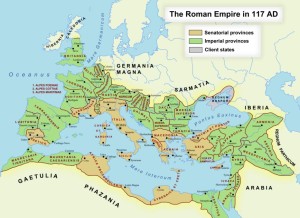
Roman Empire (Credit: Ancient History Encyclopedia)

Roman Empire (Credit: Ancient History Encyclopedia)

Today’s Gregorian calendar is based on the older Julian calendar, introduced by Julius Caesar. Historical records show that by the time of Julius Caesar, the Romans celebrated their new year on January 1st. In fact, “January” is named after the Roman god Janus, the deity of beginnings and ends, doors and gateways. Janus is always depicted as a double-headed god, with one head looking back into the past, and the other gazing into the future.

January 1st was also the start of the consular year in Rome, when the two highest-ranking elected officials, the consuls, took up their office for a single year term. From this information, we see that January 1st was already celebrated as a new year long before the time of Jesus.

Was Jesus Circumcised on the 1st of January?

Today, some Christian denominations still commemorate January 1st as the “Feast of the Circumcision”. The math is simple: if Christmas is the holiday of Jesus’ birth, then like all Jews he would have been circumcised on the eight day following his birth – January 1st. The question is: was Jesus actually born on the 25th of December?

Of course, many are aware of the fact that Jesus was certainly not born on the 25th of December. The New Testament does not mention the date of his birth at all, and suggests it was sometime in the summer, since it mentions people going to take a census (always done in the summer months), and that the shepherds were out watching their flocks (which they probably wouldn’t do in the cold winter nights of December). Early Christian leaders gave various dates to the birth of Jesus, ranging from March 28th to November 18th. Today, scholars believe it was likely the end of September.

Ironically, early Christian leaders actually mocked those who celebrated birthdays of any kind, especially that of Jesus, and considered it a pagan ritual. Alas, this is where Christmas actually comes from. Originally, December 25th was around the time of the pagan Roman holiday of Saturnalia. Later, it was also instituted as a holiday in honour of the birth of Sol Invictus, the solar deity. This comes from an ancient tradition to celebrate the “birth of the sun”, since the days start getting longer around this time of the year, hence the “solar rebirth”. To make Christianity more palatable to pagans, Christian leaders eventually switched “birth of the sun” to “birth of the Son”, ie. Jesus. And so, Jesus was not born on the 25th of December, and certainly wasn’t circumcised on the 1st of January.

(That is, of course, if Jesus had existed at all. More and more scholars are agreeing that Jesus probably never existed to begin with. Click here to read more about this.)

Celebrating the New Year on the 1st of January

Most European countries actually adopted January 1st as the start of a new year quite recently. The British Empire celebrated the New Year on March 25th until 1752! Similarly, many calendars continue to celebrate a new year sometime in the spring, including the Iranian, Assyrian, and several Indian calendars. Others have New Year’s days at other times, most famously the Chinese New Year in late January/early February. Nonetheless, most of these places, including China, also commemorate January 1st as the start of an international new year. Today, January 1st is definitely devoid of any real religious significance, and is perhaps the one truly global celebration. Having said that, it may still be tied to a historical bitterness for the Jewish people.

Sylvester’s Day

In several European countries, New Year’s Eve is called “Sylvester” or “St. Sylvester’s Day”. In Israel, too, December 31st is called “Sylvester”. This is the day of the passing of Pope Sylvester I, later canonized as a saint. Essentially nothing is known of this pope, though various legends arose over the centuries. Historical records suggest that it was during his reign that the Roman Emperor Constantine proclaimed the Edict of Milan which, among other things, stripped Jews of various rights and forbade them from living in Jerusalem.

Yet, Sylvester has nothing to do with New Year’s Eve itself; it is simply a coincidence of dates. Besides, many churches mark Sylvester’s Day on January 2nd, not December 31st. Either way, few people commemorate Sylvester’s Day at all, and most people have never even heard of it. (If Sylvester really was so bad for the Jews, maybe we should celebrate the day of his death!)

New Year’s in the Talmud

Amazingly, the Talmud (Avodah Zarah 8a) actually discusses New Year’s, calling it by its Roman name, Kalenda, or Kalends. The Mishnah here begins by listing it among the holidays of idol worshippers. However, it then goes on to explain that Kalenda originates in the Torah!

The Rabbis explain that following the consumption of the Forbidden Fruit, Adam soon noticed that the days were gradually getting shorter. (Since he was created on Rosh Hashanah – in the autumn – and consumed the Fruit that very same day.) Adam mistakenly thought that the days must be getting shorter because of his sin, and the world was descending into eternal darkness. He started to fast in repentance, and after eight days of fasting, the winter solstice came, and Adam noticed that the days were once again getting longer. In celebration, Adam established an eight-day feast (to balance out his eight-day fast). The following year, Adam commemorated both the winter solstice (around December 25th) and the day that marked the end of his eight-day feast (January 1st). The Talmudic sages conclude: “However, [Adam] established them for the sake of Heaven, but the [heathens] appropriated them for the sake of idolatry.”

So perhaps, if we have the sake of Heaven in mind, we may just be able to celebrate New Year’s in some way after all.

How Did Adam Live 930 Years?

This week’s parasha is Vayelech, which begins with Moses’ statement that “Today I am one hundred and twenty years old” (Deut. 31:2). It was the 7th of Adar, Moses’ birthday, and also his day of passing. Moses goes on to conclude his final speech to the people, then sings a deeply prophetic farewell song in next week’s portion Ha’azinu, followed by his blessings to the people in the last parasha of the Torah, V’Zot HaBracha.

Moses was the greatest of all prophets, the humblest man to walk the earth, and the central founding figure of Judaism. He was blessed with living a full and healthy life spanning exactly 120 years. It has become common today for people to wish each other 120 years of life. Why is this the specific figure? Can humans not live longer? Don’t we see in Genesis that Adam lived 930 years, Noah lived 950 years, and Methuselah (Metushelach) lived a record 969 years? What happened?

The Flood Generation

Ten generations from Adam, the world had descended into endless sin and immorality. God decreed that man’s days “will be numbered at one hundred and twenty” (Genesis 6:3). Many believe this to mean that God decreed humans will no longer be able to live past 120 years. Indeed, when looking at modern records of longevity, the vast majority of the world’s oldest people die close to 120 years. There has only been one official case of anyone exceeding 120, a Frenchwoman named Jeanne Calment who lived 122 years.

However, the traditional Jewish interpretation is that the Genesis verse above does not mean man is unable to live past 120. After all, our forefathers Abraham, Isaac, and Jacob lived long after this decree, and they lived 175, 180, and 147 years, respectively. Rather, the Jewish Sages state that God decreed the arrival of the Great Flood 120 years hence. God gave mankind 120 years to repent, and possibly avert the Flood. Noah was commissioned to go around and inspire people to mend their ways, and he had 120 years to do it.

Unfortunately, Noah failed in this endeavour, unable to bring even a single person to righteousness (as the Ark only carried his own family at the end). This is one reason for why the Flood is known in Hebrew as mabul Noach, literally “Noah’s Flood” (or mei Noach, “Noah’s waters”), as if he was partially responsible for not doing enough to inspire people to change. Because of this, many (including Rashi) have commented on the verse “Noah was a righteous and pure man in his generation” (Genesis 6:9) to mean that Noah was only righteous in his faulty generation. Had he lived in another generation, such as that of Abraham, he would not have been deemed so righteous!

We see from the Biblical chronology that after the Flood, people’s life spans steadily shorten. Moses’ older siblings Aaron and Miriam lived 123 and 126 years. Moses died at 120, and this appears to have become the new limit. After Moses, there are only a few people noted to have lived longer, one of which is Yehoyada the High Priest, who lived 130 years (II Chronicles 24:16).

What accounts for this steady degeneration in longevity?

Yeridat HaDorot

The Talmud (Shabbat 112b) states: “If the earlier [scholars] were sons of angels, we are sons of men; and if the earlier [scholars] were sons of men, we are like asses…” This is one of many passages that attests to the well-known concept of yeridat hadorot, “the descent of the generations”. It is said that each passing generation falls lower and lower in its wisdom and spiritual greatness. This concept can solve the puzzle of longevity.

The body is a finite lump of matter. It is only animated and vitalized by the infinite soul within it. Thus, the greater the soul, the longer the body can live. As the spiritual potential in each generation falls, so too does the lifespan.

Moreover, it is taught that Adam contained essentially all of the souls of humanity within him (Sha’ar HaGilgulim, ch. 11). As more and more people were born over the centuries, this single universal soul broke down further and further into smaller and smaller fragments. With the exception of a number of “new souls”, the vast majority of the world’s 7 billion people are all parts of the soul of Adam. It is therefore not surprising that today’s spiritual capabilities (and with that, the lifespans) are severely limited.

At the Speed of Light

Science may offer another intriguing possibility. According to modern physics, time as we know it doesn’t really exist. The universe is one interwoven fabric of both time and space. The faster one moves through space, the slower the effects of time for that person. There is actually a formula to measure the impact of this time dilation, known as the Lorentz transformation. It is given by the equation ΔT = t√1-v2/c2 [or: t = t÷ √(1-v2/c2)], where v is one’s speed and c is the speed of light.

Theoretically, the speed of light is the absolute maximum in our universe. At light speed (just under 3.00 x 10⁸ m/s, or 300,000 km/s), time will totally stop for the traveller (if plugging it into the formula, one gets a value of zero). This seems impossible. However, if we plug in a value very close to light speed, such as 2.99 x 10⁸ m/s, we get a very interesting result.* A person who has perceived living 80 years will have actually lived 980 earthly years! That makes Adam’s 930 years a more palatable 76, and Methuselah’s record 969 as 79. This fits in well with the verse in Psalms that a normal lifespan is 70 to 80 years (Psalms 90:10). But how could Adam and Methuselah have lived at near-light speed?

Beautifully, the Sages teach us that Adam was not a human like us. In many texts (such as Bereshit Rabbah 20:12), Adam is described not simply as a being of flesh, but rather as a being of light. Though most will interpret this metaphorically, there are those sages, such as the Arizal (for example, in Sefer HaLikutim, Bereshit, ch. 3) that interpret this quite literally. It remains to be seen what this means exactly, and if it has anything at all to do with physics, but perhaps there is much more to the idea of Adam being a man of light than we can imagine.


The article above is an excerpt from Garments of Light: 70 Illuminating Essays on the Weekly Torah Portion and Holidays. Click here to get the book! 
——–

*To be fair, choosing a value such as 2.99 x 10⁸ m/s may be deemed quite arbitrary. One can also plug in finer values even closer to the speed of light, such as 2.997 or 2.9972, and so on, each of which would give a more refined result. The point of this exercise is simply to illustrate the relativity of time, and what might explain the difference in perceived years between our generations and those of the first people, through a scientific perspective.