
Tag Archives: Angels

The Amazing Story of Og, the Giant King of Bashan

Devarim, or Deuteronomy in English, is the fifth and final book of the Torah. Deuteronomy comes from the Greek deuteronomion, meaning “second law”, which itself comes from the alternate Hebrew name of the book, Mishneh Torah, meaning “repetition of the law”. The name stems from the fact that Deuteronomy is essentially a summary of the four previous books of the Torah. The key difference is that it is given in the point of view of Moses, and records his final sermon to the people before his death.

One of the enigmatic figures mentioned in this week’s parasha is Og, the king of the land of Bashan. This character is explicitly mentioned a total of 10 times in the Torah, of which 8 are in this portion alone. He is first mentioned in the introductory verses of the parasha (1:4), which state how Moses began his discourse after smiting Sihon, the king of the Amorites, and Og, the king of Bashan.
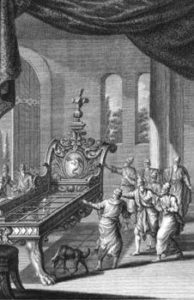
Og’s Bed, by Johann Balthasar Probst (1770)

We are later told how Og had come out to confront the children of Israel, and the Israelites defeated his army in battle. Og is said to be the last survivor of the Rephaim (3:11), which were apparently a nation of giants. His bed is described as being made of iron, and being nine cubits long, or roughly 18 feet!

Rashi provides a little more information. He tells us that Og was the last survivor of the Rephaim in the time of Abraham. It was then that the king Amraphel, together with his allies, dominated the Fertile Crescent region, and decimated many nations that inhabited it. One of these groups of victims were the Rephaim, and Og was the sole survivor among them. He was the “refugee” mentioned in Genesis 14:13 that came to Abraham to inform him of what had happened.

So, who was Og? Where did he come from? Why did he initially help Abraham, but then come out to battle Moses centuries later? And was he really a giant?

Half Man, Half Angel

The Talmud (Niddah 61a) tells us that Og was the grandson of Shemhazai. As we have written previously, Shemhazai was one of the two rebellious angels that had descended to Earth. These two angels argued before God that He should not have created man, who was so faulty and pathetic. God told the angels that had they been on Earth, and given the same challenges that man faced, they would be even worse.

The angels wanted to be tested anyway, and were thus brought down into Earthly bodies. Of course, just as God had said, they quickly fell into sin. This is what is meant by Genesis 6:2, which describes divine beings mating with human women. Their offspring, initially called Nephilim, were large and powerful, and were seen as “giants” by common people. However, during the Great Flood of Noah, all of these semi-angelic beings perished. Except for one.

The Sole Survivor

Midrashic texts famously record that Og was the only survivor of the Great Flood, aside from Noah and his family. When the torrential rains began, Og jumped onto the Ark and held on tightly (Zevachim 113b). He swore to Noah that he would be his family’s eternal servant if Noah would allow him into the Ark (Yalkut Shimoni, Noach 55). The Talmud (ibid.) states that the rain waters of the Flood were actually boiling hot. Yet, the rain that fell upon Og while he held unto the Ark was miraculously cool, allowing him to survive. Perhaps Noah saw that Og had some sort of merit (after all, his grandfather was the one angel that repented). Noah therefore had mercy on Og, and made a special niche for Og in the Ark. This is how the giant survived the Flood.

A variant account suggests that Og survived by fleeing to Israel, since the Holy Land was the only place on Earth which was not flooded.

Abraham’s Servant

As promised, Og became the servant of Noah and his descendants. The Zohar (III, 184a) says that he served Abraham as well, and as part of his household, was also circumcised. As Rashi says (on Genesis 14:13), Og informed Abraham that his nephew Lot was kidnapped, and that the armies of Amraphel and his allies were terrorizing the region. Rashi quotes the Midrash in telling us that Og hoped Abraham would go into battle and perish, so that Og would be able to marry the beautiful Sarah. For informing Abraham, Og was blessed with wealth and longevity, but for his impure intentions, he was destined to die at the hands of Abraham’s descendents (Beresheet Rabbah 42:12).

Whatever the case, the giant soon fell into immorality. The Zohar continues that although he had initially taken the Covenant upon himself (by way of the circumcision), he had later broken that very same Covenant by his licentious behaviour. He used his physical abilities to become king over 60 large, fortified cities (Deuteronomy 3:4). When the nation of Israel passed by his territory, he gathered his armies to attack them.

It is said that Moses feared Og for a number of reasons: Og had lived for centuries, and was also circumcised, so Moses figured the giant had a great deal of merit. God told Moses not to worry, and gave Moses the strength to slay Og himself. As the famous story goes, Moses used a large ten-cubit (roughly 20 foot) weapon to jump ten cubits high in the air—and was only able to strike Og’s ankle! Still, it caused Og to trip over and be impaled by a mountain peak. (On that note, there is a little-known Midrash which states Og survived the Flood simply because he was so large, and the floodwaters only reached up to his ankles! See Midrash Petirat Moshe, 1:128)

It is important to remember once more the old adage that one who believes that the Midrash is false is a heretic, yet one who believes that the Midrash is literally true is a fool. It is highly unlikely that Og was actually so immense (especially considering that this would make him bigger than the dimensions of Noah’s Ark). The Torah tells us his bed was nine cubits long, which the most conservative opinions estimate to be closer to 13 feet, a far more reasonable number.

There are many more colourful stories about Og, including one where a Talmudic sage found his thigh bone and ran through it (Niddah 24b). Another suggests that Og is actually Eliezer, Abraham’s trusty servant (Yalkut Shimoni, Chayei Sarah 109). This is an intriguing possibility, and might help explain how Abraham and Eliezer alone were able to defeat the conglomeration of four massive armies (See Genesis 14, with Rashi).

Archaeologists have even found mention of Og in ancient Phoenician and Ugaritic texts. One clay tablet from the 13th century BCE (Ugarit KTU 1.108) is believed to be referring to him as Rapiu, or the last of the Rephaim—as the Torah states. It suggests that Og’s grandeur got the better of him, and he began to consider himself a god among puny men:

May Rapiu, King of Eternity, drink [w]ine, yea, may he drink, the powerful and noble [god], the god enthroned in Ashtarat, the god who rules in Edrei, whom men hymn and honour with music on the lyre and the flute, on drum and cymbals, with castanets of ivory, among the goodly companions of Kothar…

Perhaps this hubris was Og’s fatal flaw, and brought about his ultimate downfall.
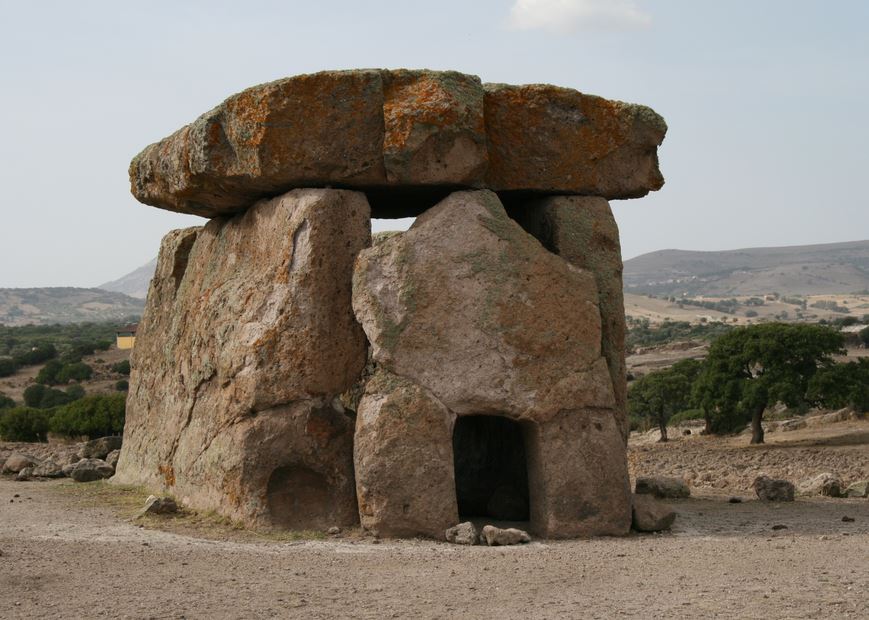
Dolmen (courtesy of www.museodeidolmen.it)

Dolmen (courtesy of www.museodeidolmen.it)

Interestingly, there are also a number of dolmen found in the modern-day area that would have been Bashan. These dolmen are massive stone structures that were erected millennia ago, with some rocks weighing many tons and perplexing scholars as to how they were put together. It is thought that dolmen served as burial tombs, and perhaps have a connection to the tradition of giants living in the Bashan area.

This is an excerpt from Garments of Light: 70 Illuminating Essays on the Weekly Torah Portion and Holidays. Click here to get the book. 

The Legend of Azazel: Scapegoat, or Fallen Angel?

The parashot of Acharei Mot and Kedoshim are typically read together. The major part of Acharei deals with various sacrificial services, most notably those concerning Yom Kippur, the Day of Atonement. Kedoshim begins by telling us that it is every person’s mission in life to become holy, just as God Himself is holy. This parasha is concerned with ethics, morality, and the path to righteousness, and includes the famous dictum to “Love your fellow as yourself” (Leviticus 19:18).

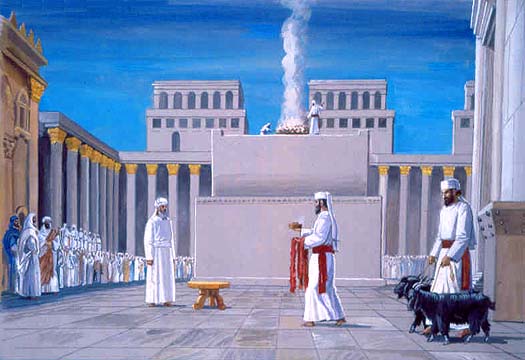
Perhaps the most peculiar item in this week’s portion is the mention of Azazel. As part of the atonement procedure on Yom Kippur, God commands Aaron to select (through a random lottery) two goats: one to be sacrificed, and another to be sent “to Azazel, in the wilderness” (Lev. 16:10). Aaron would place his hands on the goat to Azazel, and confess all of the people’s sins, as if transferring them to the animal (v. 21). The goat was then sent off into the wilderness.

The Rambam (Moreh Nevuchim, Part III, Ch. 46) writes that this act is completely symbolic. It does not mean that the High Priest literally transferred the people’s sins onto the goat, but that witnessing this act was meant to inspire a sense of repentance in the people, “as if to say, we have freed ourselves of our previous deeds, have cast them behind our backs, and removed them from us as far as possible.”

Temple Priests Bringing the Two Goats on Yom Kippur

Temple Priests Bringing the Two Goats on Yom Kippur

But what exactly is “Azazel”? What does the word mean? And why was the goat that symbolized sin sent towards it? The Talmud (Yoma 67b) maintains that the word Azazel can be broken down to mean “hardest of mountains”. This may be why some believe that the goat was sent off the edge of a mountainous cliff down to its death. The Talmud then presents the opinion of the school of Rabbi Ishmael: Azazel is a contraction of two names: Aza (or Uza) and Aza’el, and the goat atones for their sins. Other than this short allusion, this page of Talmud says nothing more.

Who were Aza and Aza’el?

The Fallen Angels

The origins of Aza and Aza’el are described in the Midrash (Yalkut Shimoni, Beresheet 44). When speaking of midrashic literature, it is important to remember the old adage that goes something like: one who believes that midrash is not true is a heretic, but one who believes that midrash is literally true is a fool. After all, the midrash corresponds to the third level of Torah study, referring to the metaphorical and allegorical level. (The other levels are peshat, the literal meaning; remez, the sub-textual meaning; and sod, esoteric/metaphysical secrets.)

Aza’el and Aza (also known as Shemhazai) were angels who saw the terrible sins of the people in the pre-Flood generation and scoffed at the pathetic humans. God told them that if they had been on Earth and given free will, they would succumb to their evil inclination far worse than people do. The angels wanted to prove God wrong, and asked Him to send them down to Earth into a physical body. God complied, and just as He had said, the angels quickly fell into all forms of evil.

Firstly, they could not hold back from the beautiful women, and this is what Genesis 6:2 means when it refers to divine beings mating with humans. The Midrash continues to say that it was these angels that taught women the art of makeup and provocative dress in order to entice men into further sin. These angels helped to bring the sword to the world, increasing bloodshed and warfare, as well as the consumption of animal meat, which was at this point forbidden, as God had only permitted Adam and Eve to consume fruits and vegetables.

Ultimately, the Midrash tells us that Shemhazai recognized his evil ways, and began a long process of repentance. No longer on Earth, but still not welcome back in the Heavenly realms, Shemhazai was suspended between the two worlds. Aza’el, on the other hand, refused to repent, and continued his evil ways. Thus, the Midrash concludes that the High Priest, in an act of repentance, would symbolically send the people’s sins towards Azazel, the one who taught mankind a new level of sinfulness, and refused to repent.

More details can be found in the Apocrypha. The Apocrypha refers to various ancient books which were not officially included in the Tanakh. Their origins are unclear, as is their authenticity. Nonetheless, they appear to have been well-known among the Jewish Sages, and are referenced in Talmud, Midrash, and Kabbalistic writings. One of the most famous of the apocryphal books is the Book of Enoch, which describes the journeys of Enoch (Hanoch, in Hebrew), who is briefly mentioned in Genesis 5:22. In the Book of Enoch, it is recorded that God sent the angel Raphael to apprehend Aza’el and stop his evil ways. Aza’el was chained to the “hardest of mountains” in the wilderness, as the Talmud quoted above explained. His painful imprisonment was a punishment, and the goats sent his way were a form of atonement for his sins. It is written there that at the End of Days, his time will come to an end, and Aza’el will finally be gone for good.


The above article is an excerpt from Garments of Light: 70 Illuminating Essays on the Weekly Torah Portion and Holidays. Click here to get the book! 

The Eighth Day of Pesach: Isaac, the Afikoman, and Mashiach ben Yosef

Of the three patriarchs, the holiday of Passover is most intimately tied to Isaac. According to tradition, Isaac was born on Passover. Commenting on Genesis 18:10, Rashi explains that the angels’ visit to Abraham and Sarah occurred on Passover, and the angels promised a son to be born – Isaac – exactly one year from that time. This important detail helps to solve a key chronological problem. Earlier, God had told Abraham that his offspring would be subjugated for 400 years. However, when one makes an accounting of the timeline, they will find that the Jews were only in Egypt for a total of 210 years! How could this be?

Commenting on that verse (Genesis 15:13), Rashi calculates how the Exodus occurred exactly 400 years from the birth of Isaac. Thus, God’s word was perfectly fulfilled, since Isaac was the very first of Abraham and Sarah’s offspring. Although Isaac was not subjugated in the sense that the Jews in Egypt were, nonetheless he was certainly troubled by the Canaanites and Philistines, as the Torah records, and was considered a “foreigner” in the Holy Land throughout his life, since God had not yet officially granted the land to the Jews, nor did Isaac settle it permanently.

Digging further, if Isaac was born on the first day of Passover, then his brit milah (circumcision) would have been on the eighth day of Passover. Though the eighth day is not celebrated in Israel, it is celebrated in the diaspora. According to Chassidic custom, as initiated by the Baal Shem Tov (the founder of Chassidism) the eighth day of Passover is associated with Mashiach. In fact, it is customary to hold a Seudat Mashiach, a “Mashiach Feast” on the final afternoon of the holiday, complete with matzahs and four cups of wine. Just as Passover celebrates the First Redemption (led by Moses), the last day of Passover is meant to represent the Final Redemption (led by Mashiach). And it is only commemorated in the diaspora since, after all, it is diaspora Jewry that needs the Final Redemption and the Ingathering of the Exiles more than anyone.

Finally, during the Pesach seder we have three matzahs to go along with the Pesach platter. It is taught that these three matzahs represent the three patriarchs: Abraham, Isaac, and Jacob. One of the fifteen steps in the seder is yachatz, where the middle of the three matzahs is broken in half. The larger half is covered and hidden as the afikoman, while the smaller half remains at the seder table. Thus, the matzah which we break is specifically the one associated with Isaac.

So then, what is the deeper connection between Mashiach and the Redemption, Passover and the Afikoman, and the forefather Isaac?

Who is Mashiach?

The Jewish mystics teach that there are actually two messiahs: Mashiach ben Yosef, and Mashiach ben David. This is derived from a number of texts and principles. One of these is the fact that the Tanakh has a clear pattern when it comes to major national events: first comes a descendant of the matriarch Rachel to usher it in, and then comes a descendant of the matriarch Leah to complete the mission. For example, Yosef (a son of Rachel) came to Egypt first to set the stage, and then came Yehuda (a son of Leah) to prepare the land for the actual arrival of the rest of the family (see Genesis 46:28). First, Joshua (of the tribe of Ephraim, and a descendant of Rachel) brought the Jews into the land of Israel following the Exodus, then Othniel (from the tribe of Yehuda) finished the job of conquering and settling the land. The first king of Israel was Saul (from the tribe of Benjamin, and a descendant of Rachel) and only then came King David (again of Yehuda). Thus, in every major event, we see clearly that first comes a descendant of Rachel to prepare the way and fight the battles, and only afterwards comes a descendant of Leah to finish the job.

In the same way, the Sages teach that first comes Mashiach ben Yosef (a descendant of Rachel), whose mission is to fight all the battles on behalf of Israel, and only after this comes Mashiach ben David (a descendant of Leah), who completes the messianic role. And who is Mashiach ben Yosef? Amazingly, the Sages say that this is none other than Isaac, reincarnated!

Of all the patriarchs and major Torah figures, Isaac is spoken of the least in Scripture. Hardly anything is said of him. It is explained that this is because Isaac has not completed his mission, and his story is not over. He has yet to fight many battles. The Sages permute his name – Itzchak (יצחק) – into the words Ketz Chai (קץ חי), literally that he “will live [again] at the End”. This is one reason why Itzchak (which means “will laugh”) is in the future tense. Isaac is Mashiach ben Yosef, who will come at the End to fight the final battles. Beautifully, the gematria of Itzchak (יצחק) is 208, equivalent to Ben Yosef (בן יוסף), also 208.

This brings us back to Passover and the afikoman. The middle matzah is broken in half. One half – the one associated with the patriarch Isaac – remains on the seder plate, together with the other matzahs that symbolize the other patriarchs. The other half – the larger one – is hidden away, only to be revealed at the very end. This is symbolic of Isaac’s final role as that of Mashiach, whose arrival is also concealed until the very ‘End of Days’. And on the eighth and final day of the Passover holiday – the day on which Isaac was circumcised and entered into the Covenant – we hold a ‘Mashiach Feast’ to celebrate the coming Final Redemption, may it arrive speedily and in our days.

Chag sameach!