This week’s Torah portion is Mishpatim, which is concerned with the first major set of laws that the Israelites received following the Ten Commandments. While the term mishpatim literally means “ordinances” or “judgements”, the Zohar (II, 94a) suggests a very different interpretation:
“And these are the judgements which you shall set before them…” These are the rules concerning reincarnation, the judgement of souls that are sentenced according to their acts.
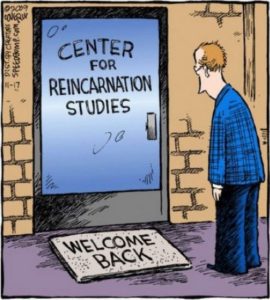 The Zohar goes on to interpret the laws in the Torah with regards to the mechanisms of reincarnation. For example, whereas the Torah begins by describing a Hebrew servant who is indentured for six years of labour and must then be freed in the seventh year, the Zohar interprets that this is really speaking of souls which must reincarnate in order to repair the six middot before they could be freed. (The middot are the primary character traits: chessed, kindness; gevurah, restraint; tiferet, balance and truth; netzach, persistence and faith; hod, gratitude and humility; and yesod, sexual purity.)
While the Zohar speaks at length about reincarnation, it is the Arizal who systematically laid down the rules of reincarnation and explained the Zohar in depth. His primary disciple, Rabbi Chaim Vital, recorded these teachings in a famous treatise known as Sha’ar HaGilgulim, “Gate of Reincarnation”. The following is a brief condensation of the basic rules of reincarnation that are defined in this tremendous text, answering many of the common questions people have about spiritual transmigration.
Why Do People Reincarnate?
At the start of the eighth chapter, Rabbi Vital writes:
למה מתגלגלים. דע, כי הנשמות יתגלגלו לכמה סבות, הראשונה הוא, לפי שעבר על איזו עבירה מעבירות שבתורה, ובא לתקן. הב’ הוא, לתקן איזו מצוה שחסר ממנו. השלישית היא, שבא לצורך אחרים, להדריכם ולתקנם… לפעמים יתגלגל, ליקח את בת זוגו, כי לא זכה בראשונה לקחתה
Why do people reincarnate? Know that souls reincarnate for several reasons: The first is that one transgressed one of the prohibitions in the Torah, and returns to repair it. The second is to fulfil a mitzvah that one lacks. The third is in order to assist others, to guide them, and rectify them… Sometimes one reincarnates to marry their soulmate, which they did not merit to do in a previous life.
The Ari explains that people mainly reincarnate in order to atone for sins of past lives, or to fulfil mitzvahs that they didn’t do previously. Later, in Chapter 16, we read that people who return do not have to fulfil all the mitzvahs in one lifetime, but only have to accomplish those that their souls are still lacking. Some reincarnate not for their own rectification, but to assist others. We are told elsewhere that these are usually very righteous individuals who agree to return to this world in order to help others.
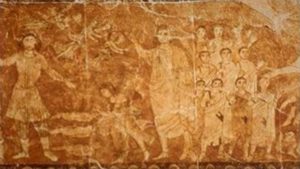
Fresco of the Resurrection of the Dead from the ancient Dura-Europos Synagogue
Some also reincarnate because they either did not marry, or married the wrong person. They must return to reunite with their true soulmate. The Arizal teaches that, unfortunately, some people are so deeply mired in kelipot, negative spiritual “husks”, that they are unable to find their soulmate in this world. These people will reunite with their other half only in Olam HaBa, the “next world” at the time of the Resurrection. With regards to finding soulmates, this is directed particularly at male souls, for it is primarily a man’s responsibility to find his soulmate.
On that note, the following chapter tells us that female souls actually reincarnate very rarely. To begin with, female souls are more refined than male ones, and are unlikely to require more rectifications. What does happen more commonly is that male souls are reincarnated into female bodies! This opens up a number of fascinating scenarios which Rabbi Chaim Vital describes.
What Do People Reincarnate Into?
In Chapter 22, we read that people can reincarnate not only into human bodies, but also animals, vegetation, and even inanimate matter. For example, a person who feeds others non-kosher food reincarnates as a tree; one who sheds blood reincarnates into water; those who transgress various sexual prohibitions reincarnate into bats, rabbits, and other animals; while proud people and those who talk too much reincarnate into bees. (We are told that this is what happened to the judge Deborah who, despite her greatness and wisdom, had a bit of pride and was required to reincarnate into a bee, hence her name devorah, which literally means “bee”!)
It is important to mention, though, that an entire human soul does not fully reincarnate into another organism. Rather, souls are complex entities made up of many different interacting sparks. It is only those sparks that require rectification that return to this world (Chapter 14). Interestingly, the Arizal teaches that when two people really dislike each other, and are constantly in conflict with one another, this is often because the two are sharing sparks from one soul!
How Many Times May One Reincarnate?
Sha’ar HaGilgulim records that a person can reincarnate thousands of times—but only on the condition that they improve at least a little bit in each incarnation. If they fail to improve, they can only reincarnate a maximum of three times. After three strikes, that particular spark is sent to Gehinnom (loosely translated as “hell”) where it will be purified. However, the souls of those who regularly learn Torah are never sent to Gehinnom, and always merit reincarnation. This is one of the incredible protective powers of regular Torah study.
In multiple places, the Arizal teaches about the reincarnations of Abel, the son of Adam. Abel (הבל) had a good side and a bad one. The good side was represented by the letter Hei (ה) of his name, and the bad by the Beit and Lamed (בל). In order to be rectified, the bad part reincarnated in Laban (לבן), the wicked father-in-law of Jacob. Laban didn’t do much better, so he was reincarnated in the gentile prophet Bilaam (בלעם). He, too, was an ungodly person, so the Beit-Lamed soul was reincarnated for the third time in Naval (נבל), the ungrateful man who rejected David. Naval was strike three, and that Beit-Lamed soul no longer returned in the same way in a human reincarnation. It did suffer a punishment at some point in the form of a stone, which is why we read in the Tanakh (I Samuel 25:37) that when Naval died, “he became a stone” secretly alluding to a reincarnation in stone!
We see from the above how a person’s name may offer tremendous hints as to their soul sparks, previous lives, tests, challenges, and character traits. When we read about the above individuals in the Tanakh, we see how similar they were. All three were very wealthy, famous, and participated in divination and sorcery. All were cunning, greedy, and deceitful individuals. The Arizal explains in detail what rectifications each was supposed to do, and how one life affected the next, weaving together these three seemingly unrelated Biblical narratives that span nearly a thousand years into one beautiful tapestry.
Which Body Will A Person Have at the End?
Perhaps the most famous question: if a soul has so many different bodies over so many different lifetimes, which body will that soul inhabit in the afterlife, or in the world of Resurrection? Rabbi Vital writes:
וכן הענין בכל נשמה ונשמה, וכאשר יהיה זמן התחיה, כל גוף וגוף יקח חלקו של נשמתו, כפי חלק הזמן שלו באיזו מדרגה היתה
And with each and every soul, when the time of the Resurrection comes, each and every body will take its corresponding soul, according to the part that it had at that particular time.
Thus, each part of the soul will have its own body, and all reincarnations will exist simultaneously as distinct individuals in Olam HaBa!
Breaking Free from Materialism
In Chapter 23, Rabbi Vital suggests that the most important thing to take from all of this is to live a meaningful, spiritual life. When a person is mired in materialism, and cares only for their physical aspects, they become so attached to their bodies that they cannot exist without one. And so, when that person’s body dies their soul is in complete disarray; frightened, pained, and unable to ascend onwards. Angels must come and quickly place the soul in a new body. As such, this person can never free themselves from endless reincarnations into this imperfect, difficult world.
However, those who in their lifetimes tap into their souls, and are comfortable with their spiritual side, are able to simply take off their dead bodies like an old garment, and move on. For such people, their wonderful portion in Olam HaBa is not too far away.
The above is an excerpt from Garments of Light: 70 Illuminating Essays on the Weekly Torah Portion and Holidays. Click here to get the book!