Tag Archives: Cushite

Eye-Opening Facts About Conversion

At the end of this week’s parasha, Vayishlach, the Torah mysteriously mentions that one of the Edomite chiefs, Lotan, had a sister named Timnah. The Sages famously ask why this detail is important to mention? Why does it matter that an Edomite chief had a sister named Timnah? The name “Timnah” appears two more times in the chapter (Genesis 36), once as the name of a clan descended from Esau, and once by telling us that Timnah was a concubine of Esau’s son Eliphaz, and gave birth to Amalek. The Talmud (Sanhedrin 99b) puts it all together for us and explains:

Timnah was a righteous woman who really wanted to convert and join the Abrahamic faith. She first approached Abraham about conversion, but he rejected her. She then approached Isaac and he, too, rejected her. Finally, she went to Jacob and got rejected a third time. At this point, she went to the “next best thing”, Eliphaz, and reasoned that this is the closest she can get to the family of Abraham. Tragically, the result was her son Amalek, eternal tormentor of Israel. The Sages conclude that our Patriarchs should not have rejected Timnah! Because they were too harsh with a potential convert, the evil Amalek came into the world, and has been torturing the people of Israel ever since. The message of our Sages is clear: converts should be welcomed, and we should not make it too difficult for a person to become a member of Israel. In fact, our Sages state that “Israel was exiled only to draw converts”! (Pesachim 87b)

Amazingly, the Talmud Yerushalmi (Kiddushin 4:1 or 65b) records Rav stating that all potential converts should be accepted, even those who converted with ulterior motives. Although their initial intentions were not pure, if we welcome them properly and inspire them, they will become genuine converts. After all, “The Torah of Hashem is pure, restoring the soul; the decrees of Hashem are enduring and make the simple wise; the precepts of Hashem are just, gladdening the heart; the mitzvah of Hashem is clear, illuminating the eyes.” (Psalms 19:8-9) If the prospective convert is taught properly, they will undoubtedly come to a true love of Hashem and His Torah. That was the approach of the great Hillel, who famously converted three people who initially had false intentions.

The Talmud (Shabbat 31a) records that the first Gentile came before Shammai and asked to be converted on condition that he only accept the Written Torah, and not the Oral Torah. Shammai rejected him, but Hillel accepted him, and soon educated him on why the Oral Torah is essential. The second Gentile came before Shammai and asked to be converted “on one foot”, quickly and without any Torah learning. Shammai rejected him, but Hillel accepted him and converted him on one foot! He simply told the convert: “That which is hateful to you, don’t do to others—this is the whole Torah. The rest is commentary. Go learn!” Finally, the third Gentile came before Shammai asking to be converted on condition that he become a kohen gadol, so Shammai naturally rejected him. Hillel converted him anyway, and then taught him why he cannot be a kohen. The passage ends by telling us that the three converts eventually met each other and declared: “Shammai’s strictness sought to drive us from the world; Hillel’s meekness brought us under the wings of the Divine Presence!”

Today, we no longer see such rapid conversions in the Orthodox world. On the contrary, the process has become long (typically around two years), and often expensive. A prospective convert is expected to study Jewish law in depth and pass a written test before conversion. The reality is that this is actually a fairly recent development, and was not the case for the vast majority of Jewish history. It is worth going through the halakhic sources to find out the facts about conversion. Continue reading

Gentiles Becoming Jews

The Haftarah for this week’s parasha, Beha’alotkha, is a passage from the prophet Zechariah in which we read that in the End of Days, “many nations will attach themselves to Hashem and become [part of] My people, and I shall dwell among you…” (2:15) This is reminiscent of a more famous verse later in Zechariah: “In those days, ten people from nations of every tongue will take hold—they will take hold of every Jew by a corner of their cloak and say, ‘Let us go with you, for we have heard that God is with you.’” (8:23) What we find in these verses is that in the lead-up to the Messianic Age, many nations will start to realize the truth of Hashem and His Torah and wish to learn with the Jewish people and even become Jews themselves. Today, we are living the fulfilment of this prophecy and witnessing mass-conversions and similar “Judafying” trends all over the world.

Semei Kakungulu

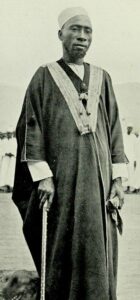
One of the first such notable cases was that of Semei Kakungulu of the Baganda tribe in Africa about a century ago. Kakungulu had converted to Christianity in his youth, before becoming a powerful British-backed chief and warlord. Later in life, Kakungulu took a deep dive into the Bible and started to find inconsistencies and errors in the New Testament. According to legend, he isolated himself in a room and emerged some time later having thrown out the New Testament and declaring only the “Old” to be true. He then circumcised himself and his son and started to live according to Torah law. In 1925, a group of Orthodox Jews passed by Kakungulu’s village, and ended up staying to teach the locals proper Jewish laws and practices, including shechitah and prayer services. By the end of his life, Kakungulu had inspired 8,000 Africans to join him and built a network of 36 synagogues. Despite challenges and persecutions over the subsequent decades, today there are still some 2,000 of them in Uganda (called Abayudaya), and the community is recovering and growing.

A more recent case is that of Segundo Villaneuva of Peru. Like Kakungulu, he found many inconsistencies in the New Testament, and ultimately ended up immersing in Torah. He started his own community, called Bnei Moshe, which soon grew to over 500 people. In 1989, Villaneuva and 160 others completed Orthodox conversions, and the following year made aliyah. Two more waves of conversions and aliyahs followed. Villaneuva’s story inspired many more Latin American communities to embrace Judaism, and it is estimated that there are now 60 such communities across 14 countries in the region.

Parallel to this are many Christian communities that are not abandoning their core beliefs, but still choosing to transition towards traditional Torah observance. This isn’t new, and groups like Seventh-Day Adventists (currently numbered at 21 million around the world) long ago switched to a kosher-style diet and Sabbath observance on Saturday. The Evangelical “Living Church of God”—with 400 congregations around the world and over 10,000 members—commemorate Rosh Hashanah and Yom Kippur, along with the three regalim, and have embraced other Jewish practices. Similar to them are the 8,000 or so Brazilians that are Pentecostal Christians but keep a host of Orthodox Jewish laws, down to circumcision, going to the mikveh, covering their hair, and eating kosher. While these communities still retain their wayward Christian beliefs, they are nonetheless starting to wake up to the truth and shifting in the right direction. Even the Pope said (in a 2018 interview) that more people should keep Shabbat like Jews do! I believe all of this, too, is a fulfilment of Zechariah’s vision.

Of course, mention must be made of the rapidly growing Noahide movement. The Bnei Noach are righteous people who choose to abide by the Torah’s Noahide Laws, without converting to Judaism. It is estimated that there are between 20,000 and 50,000 Noahides around the world today, and the unofficial number could be much higher. The Lubavitcher Rebbe played a key role in launching the Noahide movement, and was particularly adamant about educating non-Jews about the Noahide Laws. He hoped to make the Noahide Laws the backbone of all societies and legal systems, and famously corresponded with President Reagan on this matter.

Rethinking Conversion

Today there are converts to Judaism from all over the globe, from hundreds of different ethnicities and cultures. This includes Palestinians from Gaza, even a former Hamas terrorist, and the famous case of Abraham Sinai, a one-time Shia Hezbollah terrorist who ended up becoming a rabbi! Many African-Americans are converting to Judaism, including the well-known cases of NBA superstar Amar’e Stoudemire (now Yehoshafat) and musician Nissim Black.

This ties right back to our parasha, in which the Torah tells us that Moses married a Cushite woman. While there are certainly numerous differing interpretations of what exactly happened there, the simple pshat seems to be that Moses married a black woman and Miriam apparently had a problem with this. In turn, measure-for-measure, God punished Miriam by making her skin “snow-white” (Numbers 12:10). Perhaps God was sending Miriam a message: you’re not so white yourself! We should remember the words of the prophet Amos (9:7) in which God declares: “Are you children of Israel not like the children of Cush to Me?” (הֲלוֹא כִבְנֵי כֻשִׁיִּים אַתֶּם לִי בְּנֵי יִשְׂרָאֵל נְאֻם־יְהֹוָה) We must not forget that all human beings were made in the image of God, and every person is precious in Hashem’s eyes. Indeed, the Midrash states in several places:

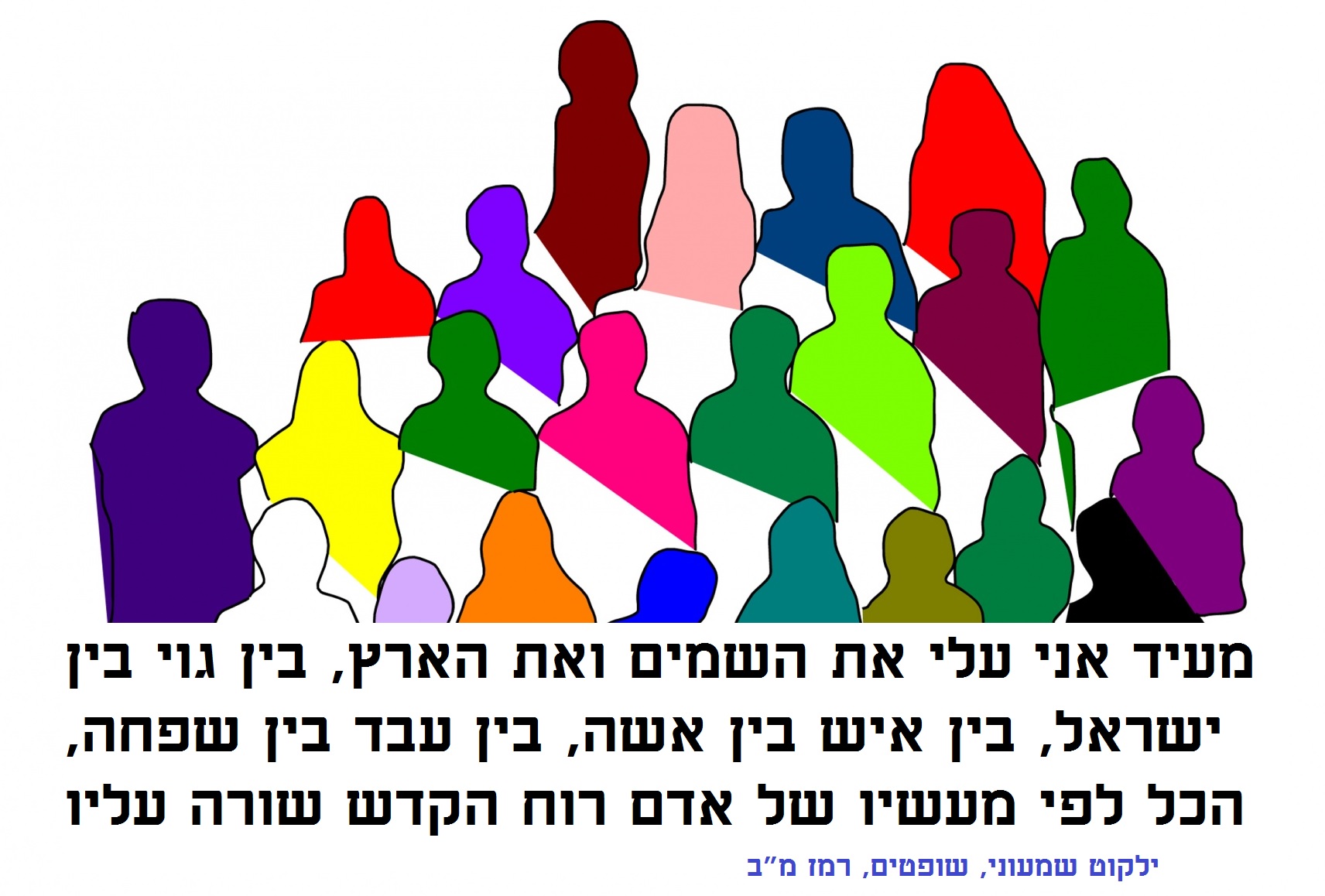
I bring Heaven and Earth to witness that the Divine Spirit may rest upon a non-Jew as well as a Jew, upon a woman as well as a man, upon a maidservant as well as a manservant—all depends on the deeds of the particular individual. (Yalkut Shimoni II, 42; Eliyahu Rabbah 9)

מעיד אני עלי את השמים ואת הארץ, בין גוי בין ישראל, בין איש בין אשה, בין עבד בין שפחה,
הכל לפי מעשיו של אדם רוח הקדש שורה עליו

Just about everyone agrees that we are in the Ikvot haMashiach, on the doorstep of the Messianic Age, and our dear prophets told us long ago to expect in these days that many people will wish to join Israel. We are living this time now, and we must do everything possible to welcome more people into the Jewish fold. The Orthodox world urgently needs to rethink how conversions are carried out: to simplify and soften the process, to remove the unnecessary roadblocks and red tape, and to make it easier (and more pleasant) for people to become Jewish—in fulfilment of prophecy. Let’s not forget what our Sages said in the Talmud that “Israel was exiled among the nations only to draw converts” (Pesachim 87b). Indeed, the actual laws of conversion according to the Talmud, Mishneh Torah, and other ancient halakhic sources is very simple and straight-forward, and could even be done in a single day! If Hillel could famously convert a man “while standing on one foot” (Shabbat 31a), there’s no reason why we can’t.

Some worry about the consequences of such an approach, namely that it will result in inauthentic or “fake” Jews. The truth is, as our Sages state in multiple places, all you need to be considered a bona fide “Jew” is to reject idolatry! In Megillah 13a it says “anyone who spurns idolatry is called a Yehudi” (שֶׁכׇּל הַכּוֹפֵר בַּעֲבוֹדָה זָרָה נִקְרָא ״יְהוּדִי״) while Nedarim 25a says “so grave is idolatry that anyone who rejects it is considered to have acknowledged the entire Torah” (חֲמוּרָה עֲבוֹדָה זָרָה, שֶׁכׇּל הַכּוֹפֵר בָּהּ — כְּאִילּוּ מוֹדֶה בַּתּוֹרָה כּוּלָּהּ). Others pose a similar argument that loosening conversion standards will “dilute” Judaism and result in more secularism and less Torah observance. The reality is that some 90% of the Jewish world is already secular anyway, so what difference does it really make? On the contrary, in absolute terms you will have more potential for Torah observance and Torah learning, plus a larger number of people overall keeping mitzvot and doing good, going to shuls, giving tzedakah, supporting Israel, and so on.

In short, the positives far outweigh the potential negatives. And at the very least, it will lessen the scourge of antisemitism, and will serve to strengthen our nation through sheer numbers. At the moment, Jewish people are easy to pick on because there are very few of us. For instance, we are outnumbered about 100 to 1 by Muslims, and this is one reason why Muslims have little fear in abusing Jews around the world, and why many Jews fear their far-more-numerous Muslim neighbours. In recent months, Jews have sadly been taking down their mezuzot and hiding their Star of David necklaces. This wouldn’t be the case if we weren’t so terribly outnumbered. If every other house in the world had a mezuzah, there would be no fear in displaying one. If half the university was made up of Jewish students, there would be no fear of going to class (nor would there be such flagrant, raging anti-Israel protestors shutting down the campus).

Judaism has never really been a missionary religion, but perhaps it’s time to change that. After all, Moshe Rabbeinu told us that when the nations of the world hear Torah, they will be inspired and say “Surely, this great nation must be a wise and discerning people!” (Deuteronomy 4:6) And Isaiah predicted that in the End of Days, we will no longer be a small people serving God, but shall become a “light unto the nations, so that My salvation should reach the ends of the Earth.” (Isaiah 49:6) The verses are clear and unambiguous: it’s time to spread Torah openly and outwardly, to all the nations, to every corner of the planet. The world is thirsty for it, and needs it now more than ever.

Rav Yitzchak Ginsburgh, too, argues that now is the time for the “Fourth Revolution in Torah Learning”: The first revolution was putting the Oral Law into written form—which had previously been forbidden. Nearly two thousand years ago, the Sages decided it was time to break that taboo and record the Oral Torah. The result, of course, was entirely positive, and resulted in an explosion of Torah learning. The second revolution was allowing Torah to become “one’s trade”, and have full-time Torah scholars and rabbis. This was originally unheard of, and Torah scholars in previous generations all had jobs and businesses of their own. However, changes in society necessitated having dedicated people who are full-time facilitators of Torah and mitzvot for the community. We wouldn’t be able to have the beautiful Jewish communities we have today without full-time rabbis. The third revolution came in the late 1800s, when advanced Torah study was finally opened up for women. Now, Rav Ginsburgh says, we are on the cusp of the fourth revolution, to teach Torah to the non-Jewish world, and this is the key for bringing about the Final Redemption.

Coming back to this week’s parasha, we read that “when a stranger who resides with you offers a Passover sacrifice to God, it must be offered in accordance with the rules and rites of the Passover offering. There shall be one law for you, for the stranger, and the citizen of the land.” (Numbers 9:14) The Torah says that even foreigners and those non-Jews dwelling among us could participate in Passover. Meanwhile, Zechariah describes that following the final war of Gog u’Magog, which will see a coalition of nations from around the world seek to destroy Israel, those same nations will be required to “pilgrimage to Jerusalem from year to year to bow to the King, God of Hosts, and celebrate the holiday of Sukkot.” (14:16) The Torah is inviting the nations of the world to join the Jews. Let’s extend that invitation, welcome with open arms all those who seek Hashem, and bring the whole world one step closer to Geulah.

Did Moses Have a Black Wife?

Towards the end of this week’s Torah portion, Beha’alotcha, we read that “Miriam and Aaron spoke against Moses because of the Cushite woman whom he had married, for he had married a Cushite woman.” (Numbers 12:1) This verse brings up many big questions, and the Sages grapple with its meaning. Who is this Cushite woman? When did Moses marry her? Why did Miriam and Aaron speak “against” Moses because of her? Why the superfluous phrasing of mentioning twice that he married the Cushite woman? What does “Cushite” even mean?

Traditionally, there are two main ways of looking at this passage: either Moses actually took on a second wife in addition to his wife Tzipporah, or the term “Cushite” simply refers to Tzipporah herself. The second interpretation is problematic, since we know Tzipporah was a Midianite, not a Cushite. The term “Cushite” generally refers to the people of Cush, or Ethiopia, and more broadly refers to all black people or Africans. Scripture does connect the Cushites with the Midianites in one verse (Habakkuk 3:7), which some use as proof that the Midianites were sometimes referred to as Cushites, or had particularly dark skin.
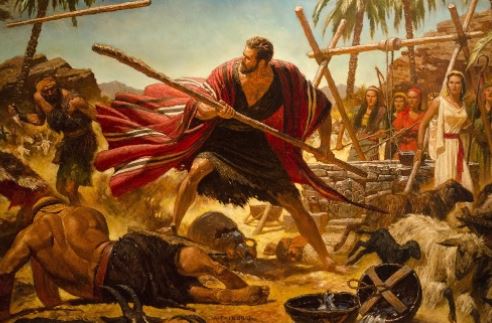
‘The Fight at Jethro’s Well’ – where Moses first meets Tzipporah – scene from ‘The Ten Commandments’ (1953) painted by Arnold Friberg.

Rashi (Rabbi Shlomo Itzchaki, 1040-1105) prefers the second interpretation. He says that Tzipporah was called a “Cushite” because she was very beautiful. He cites Midrash Tanchuma in stating that just as everyone can immediately identify a black person (Cushite), everyone immediately recognized the incomparable beauty of Tzipporah. The same Midrash offers another possibility: apparently if a person had a very beautiful child in those days, they would call them “Cushite” to ward off the evil eye. This suggests that a Cushite was not considered beautiful at all, yet Rashi provides a numerical proof that Cushite does indeed mean “beautiful”, since the gematria of Cushite (כושית) is 736, equal to “beautiful in appearance” (יפת מראה), the term frequently used in the Torah to describe beauty.

If the Cushite is Tzipporah, then why did Miriam and Aaron suddenly have a problem with her? Rashi cites one classic answer: because Moses had become so holy—recall how after coming down Sinai, his skin glowed with such a blinding light that he had to wear a mask over his face—he had essentially removed himself from this material world. This means he was no longer intimate with his wife Tzipporah. Miriam had learned of this, and thought Moses was in error for doing so.

Unlike certain other religions, Judaism does not preach celibacy, and does not require complete abstinence to remain holy and pure. Conversely, Judaism holds that sexual intimacy is an important aspect of spiritual growth. The famous Iggeret HaKodesh (the “Holy Letter”, often attributed to the Ramban, Rabbi Moshe ben Nachman, 1194-1270, but more likely written by Rabbi Joseph Gikatilla, 1248-1305) writes that it is specifically during sexual union (if done correctly and in holiness) that a man and woman can bring down and experience the Shekhinah, God’s divine presence.

As such, Miriam and Aaron came to their little brother and admonished him for separating from his wife. This is why the Torah goes on to state that “They said, ‘Has God spoken only to Moses? Hasn’t He spoken to us too?’” (Numbers 12:2) Miriam and Aaron argued that they, too, were prophets, and they clearly had no need to separate from their own spouses! Moses was so humble and modest that he did not respond at all: “…Moses was exceedingly humble, more so than any person on the face of the earth.” (Numbers 12:3)

God immediately interjected and summoned Miriam and Aaron to the Ohel Mo’ed, the “Tent of Meeting”, where He regularly conversed with Moses. God told them:

If there be prophets among you, I will make Myself known to him in a vision; I will speak to him in a dream. Not so My servant Moses; he is faithful throughout My house. With him I speak mouth to mouth; in [plain] sight and not in riddles, and he beholds the image of the Lord…

God makes it clear to Miriam and Aaron that although they are also prophets, they are nowhere near the level of Moses. In all of history, Moses alone was able to speak to God “face to face”, while in a conscious, awake state. All other prophets only communed with God through dreams or visions, while asleep or entranced.

By juxtaposing the fact that Moses was the humblest man of all time, and also the greatest prophet of all time, the Torah may be teaching us that the key to real spiritual greatness is humility. Moses had completely subdued his ego, and so he merited to be filled with Godliness. Fittingly, the Talmud (Sotah 5a) states that where there is an ego, there cannot be a Godly presence, because a person with a big ego essentially sees themselves as a god—and there cannot be two gods! “Every man in whom there is haughtiness of spirit, the Holy One, blessed be He, declares: ‘I and he cannot both dwell in the world.’”

Moses Had a Black Wife

The explanation above is certainly a wonderful one, yet it is hard to ignore the plain meaning of the text: that Moses actually married a Cushite woman. The repetitive phrasing of the verse seems like it really wants us to believe he had taken another wife. And many of the Sages agree. However, Moses hadn’t married her at this point in time, but many years earlier. The Midrash describes in great detail what Moses was up to between the time that he fled Egypt and arrived in Midian. After all, he had fled as a young man, and returned to Egypt in his 80th year. What did he do during all those intervening decades?

The Midrash (Yalkut Shimoni, Shemot 168) says that Moses initially fled to Cush. At the time, the Cushites had lost their capital in a war and were unsuccessful in recapturing it. Their king, named Koknus (קוקנוס, elsewhere called Kikanos or Kikianus), fought a nine-year war that he was unable to win, and then died. The Cushites sought a strong ruler to help them finally end the conflict. They chose Moses, presumably because he had fought alongside the Cushites and had a reputation as a great warrior. Moses did not disappoint, and devised a plan to win the war and recapture the Cushite capital. (His enemy was none other than Bilaam!) The grateful Cushites gave Moses the royal widow of Koknus for a wife, and placed him upon the throne.
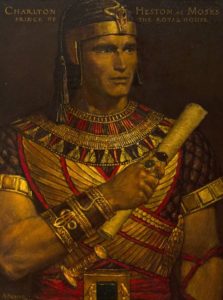
Charlton Heston as Egyptian General Moses, also by Arnold Friberg

This Midrash is very ancient, and was already attested to by the Jewish-Roman historian Josephus (37-100 CE). Josephus writes (Antiquities, II, 10:239 et seq.) a slightly different version of the story, with Moses leading an Egyptian army against the Cushites. The Cushite princess, named Tharbis, watches the battle and falls in love with the valiant Moses. She goes on to help him win the battle, and he fulfils his promise in return to marry her. In some versions, Moses eventually produces a special ring that causes one to forget certain events, and puts it upon Tharbis so that she can forget him. He then returns to Egypt.

So, Moses married a Cushite queen. Yet, he remembered “what Abraham had cautioned his servant Eliezer” about intermarriage, and abstained from touching her. (If you are wondering how Moses later married Tzipporah, who was not an Israelite, remember that the Midianites are also descendants of Abraham through his wife Keturah, see Genesis 25:2. Thus, Moses still married within the extended family of Abrahamites.) Although Moses married the Cushite queen, he never consummated the marriage. The Midrash says he reigned over a prosperous Cush for forty years until his Cushite wife couldn’t take the celibacy anymore and complained to the wise men of Cush. Moses abdicated his throne and finally left Ethiopia. He was 67 years old at the time.

All of this was kept secret until it came out publicly in this week’s parasha. This is a terrific version of the story, but it doesn’t answer why Miriam and Aaron complained to Moses. For this we must look to the mysticism of the Arizal.

Soulmates of Moses

The Arizal cites the above Midrash in a number of places (see Sefer Likutei Torah and Sha’ar HaPesukim on this week’s parasha, as well as Sha’ar HaMitzvot on parashat Shoftim). He explains that both Tzipporah and the Cushite were Moses’ soulmates. This is because Moses was a reincarnation of Abel, who had two wives according to one tradition. This was the reason for the dispute between Cain and Abel, resulting in the latter’s death. Cain was born with a twin sister, and Abel was born with two twin sisters (otherwise, with whom would they reproduce?) Cain reasoned that he should have two wives since he was the older brother, and the elder always deserves a double portion. Abel reasoned that he should have the second wife since, after all, she was his twin! Cain ultimately killed Abel over that second wife.

Therefore, the Arizal explains that Cain reincarnated in Jethro, and Abel in Moses. This is why Jethro gave his daughter Tzipporah to Moses, thus rectifying his past sin by “returning” the wife that he had stolen.* Moses’ other spiritual twin was the Cushite woman. The Arizal suggests that Miriam and Aaron were aware of this, and were frustrated that Moses did not consummate his marriage to the Cushite, for she was his true soulmate! Apparently, after the Exodus Moses summoned the Cushite woman and she happily joined the Israelites and converted to Judaism. The Arizal explains that this was a necessary tikkun, a spiritual rectification for her lofty soul. However, he could not consummate the marriage because her soul originated from a place of intense dinim gemurim, strict judgement and severity. It appears that when Miriam heard about his abstention from his wife, she complained to Moses, failing to grasp that a soul as pure as Moses’ had different requirements.

Whatever the case may be, the root of the matter is Moses’ separation from his wife (or wives). Having said all that, there is a third possibility. This comes from a simple reading of the Torah text, and the lesson that we learn from it is particularly relevant today.

Black or White

When we read the first two verses of Numbers 12 in isolation, we might be led to believe that Miriam and Aaron had a problem with Moses marrying a black woman. Was there a hint of racism in their complaint, or did they just genuinely wonder whether an Israelite was allowed to marry a black person? Either way, we see how perfectly the punishment fits the crime: “… Behold, Miriam was afflicted with tzara’aat, [as white] as snow.” (Numbers 12:10)

If the issue was about Moses separating from his wife, it isn’t clear why Miriam would be punished with tzara’at (loosely translated as “leprosy”). Rashi, for one, does not seem to offer a clear explanation why this in particular was her punishment. Of course, we know that God doesn’t really “punish”, and simply metes out justice, middah k’neged middah, “measure for measure”. It is therefore totally fitting that in complaining about Moses taking a black woman as a wife, Miriam’s own skin is turned white “like snow”. Perhaps God wanted to remind her that she is not so white herself.

We can learn from this that there really is no place for racism in Judaism. In fact, God explicitly compares the Israelites to the Cushites (Amos 9:7), and maintains that He is not the God of the Jews alone, but the God of all peoples: “‘Are you not as the children of the Cushites unto Me, O children of Israel?’ Said Hashem. ‘Have I not brought up Israel out of the land of Egypt, [just as I brought] the Philistines from Caphtor, and Aram from Kir?’” Among a list of nine holy people that merited to enter Heaven alive, without ever dying, the Sages include a Cushite man named Eved-Melekh (Derekh Eretz Zuta 1:43, see Jeremiah 39:16).

At the end of the day, there is no reason to hold prejudice against anyone, or discriminate against any individual at all, as the Midrash (Yalkut Shimoni, Shoftim 42) clearly states:

I bring Heaven and Earth to witness that the Divine Spirit may rest upon a non-Jew as well as a Jew, upon a woman as well as a man, upon a maidservant as well as a manservant. All depends on the deeds of the particular individual.
*The Arizal actually writes how Cain reincarnated in three people: Korach, Jethro, and the Egyptian taskmaster that Moses killed before fleeing Egypt. The rectification for the improper dispute between Cain and Abel was rectified in the dispute between Korach and Moses, with Moses’ victory. The rectification for the stolen wife was fulfilled by Jethro. And the rectification for Cain murdering Abel was that Moses, in return, killed the Egyptian taskmaster. Thus, all the rectifications were complete. We can see a hint in the name Cain (קין) to his three future incarnations: the ק for Korach (קרח), the י for Jethro (יתרו), and the ן for the Egyptian, whose name we don’t know but perhaps it started with a nun!

The above essay is adapted from Garments of Light, Volume Three.
Get the book here!