Tag Archives: Jerusalem

Tisha B’Av: Why Are We Still Mourning?

This week’s Torah portion is Devarim, which begins the fifth and final book of the Torah. This book (Deuteronomy), is written from the perspective of Moses, and summarizes much of what the Torah discussed earlier. At the same time, it also introduces many new mitzvot, and reveals deeper insights into the Torah’s previous narratives. For example, while the book of Numbers told us that Moses was forbidden to enter the Holy Land because he disobeyed God in striking the rock, here we are told that Moses was forbidden to enter the Land because of the incident of the Spies! (1:22-38) How do we reconcile these differences? The answer can actually be found in next week’s parasha, Va’etchanan.

Va’etchanan (literally “and I beseeched”) describes how Moses begged God to allow him to enter the Holy Land. The Talmud (Berachot 32b) states that Moses prayed so much that God actually relented and forgave him for striking the rock. However, it would have been wrong for Moses to enter the Holy Land at that time, considering that the rest of the men were condemned to perish in the Wilderness because of the sin of the spies. After all, Moses was their leader. Could a shepherd abandon his flock? Would a captain abandon his sinking ship? So, Moses didn’t enter the land not because of the rock, but because of the spies.
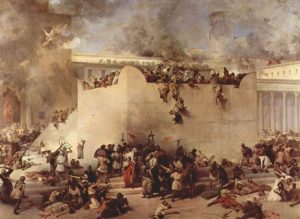
'Destruction of the Temple of Jerusalem' by Francesco Hayez (1867)

‘Destruction of the Temple of Jerusalem’ by Francesco Hayez (1867)

This is all the more pertinent now with Tisha B’Av right around the corner. Tisha B’Av commemorates the destruction of both Holy Temples in Jerusalem, along with a handful of other tragedies said to have happened on, or around, that date – the ninth of the month of Av. According to tradition, the origins of Tisha B’Av lie in the incident of the spies. It was on that day that the spies returned from the land of Israel, and reported negatively about the people’s chances of conquering the land. The faithless nation feared and cried needlessly on that day so, it is said, God subsequently gave the nation many good reasons to truly fear and cry on that day throughout history.

The Problem with the 9th of Av

There are many problems with this classic narrative. First of all, why would God punish generations far in the future for the sins of that one generation long ago? Deuteronomy 24:16 itself states clearly that “Parents shall not be put to death because of their children, nor children because of their parents. Each person shall be put to death for their own crime.” While the Torah does also mention a number of times that God “carries over the iniquity of the fathers onto the children to the third and fourth generations”, the phrase concludes by saying this is only true to those that “hate Him”. In any case, it is only to the third and fourth generations, not millennia into the future! Even so, the Talmud (Makkot 24a) says the prophet Ezekiel came and repealed this divine decree anyway:

Said Rabbi Yose bar Chanina, “Moses pronounced four decrees upon Israel, which four prophets came and cancelled.”
…Moses said, “carries over the iniquity of the fathers onto the children…” (Exodus 34:7) Ezekiel came and cancelled it: “The one who sins will die.” (Ezekiel 18:14)
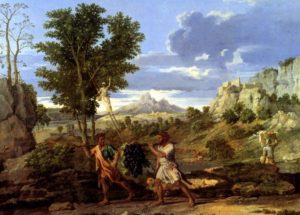
'The Spies With The Grapes Of The Promised Land' by Nicolas Poussin (1664)

‘The Spies With The Grapes Of The Promised Land’ by Nicolas Poussin (1664)

Second of all, did the spies really return on the 9th of Av? The Talmud (Ta’anit 29a) calculates that the spies went forth on the 29th of Sivan and returned forty days later on the 9th of Av. However, the Torah tells us that the spies went to Israel at the start of the grape harvest (Numbers 13:20) and the same tractate of Talmud (Ta’anit 30b) states that the grape harvest season lasted from the 15th of Av until Yom Kippur! How could the spies have returned on the 9th of Av when the grape harvest only began on the 15th? (A simple Google search reveals that the ideal time for grape harvest is September-October, which is right between the 15th of Av and Yom Kippur.)

On the same note, when exactly were the Temples destroyed? The Tanakh tells us that “in the fifth month, on the seventh day of the month, which was the nineteenth year of King Nebuchadnezzar, king of Babylon, came Nebuzaradan, the captain of the guard, a servant of the king of Babylon, to Jerusalem. And he burned the house of Hashem, and the king’s house…” (II Kings 25:8-9) This verse suggests the First Temple was destroyed on the 7th of Av.

Another verse in the Tanakh tells us that “in the fifth month, in the tenth day of the month, which was the nineteenth year of King Nebuchadnezzar, king of Babylon, came Nebuzaradan, the captain of the guard, who stood before the king of Babylon, to Jerusalem; and he burned the house of Hashem, and the king’s house…” (Jeremiah 52:12-13) The verse is nearly identical, except that this one says Nebuzaradan came on the 10th and destroyed the Temple.

We have the 7th of Av and the 10th of Av, but no 9th! The Talmud (Ta’anit 29a) notes this contradiction and tries to reconcile it this way: “On the seventh the heathens entered the Temple and ate therein and desecrated it throughout the seventh and eighth, and towards dusk of the ninth they set fire to it and it continued to burn the whole of that day [the tenth].” Rabbi Yochanan goes on to say that if it were up to him, the mourning day would be the 10th of Av, not the 9th, since this is when the Temple was mostly destroyed.

And what about the Second Temple? Josephus lived through its destruction, and later wrote about it in detail. He says that it was destroyed on the 10th of Av, and writes that the Jews mourn its destruction on the same day that they mourn the destruction of the First Temple. However, he seems to admit that he is uncertain about the exact dates that the Temples fell.

What does the Talmud say? It, too, is uncertain, but concludes that since “good things tend to happen on good days, and bad things on bad days,” it is assumed that the Second Temple was destroyed on the same day as the First Temple!

Postponing, Abolishing, or Redefining?

This year, Tisha B’Av falls on Shabbat, so the fast is postponed, appropriately, to the 10th. While Rabbi Yochanan felt that the 10th is the correct day to fast anyway, Rabbi Yehudah HaNasi – the great redactor of the Mishnah – wanted to have the fast of Tisha B’Av abolished completely! Some say this was only when Tisha B’Av falls on Shabbat and needs to be postponed, while others say he wanted it gone entirely (Megillah 5b).

This idea has been echoed in modern times. The primary reason for mourning on Tisha B’Av is because of Jerusalem’s destruction and the Jewish people’s exile. Today, the Jewish people have returned to the Holy Land and have rebuilt Jerusalem. While there’s no Temple just yet, we are free to travel to, and settle in, the Holy City whenever we wish. Why are we still mourning?

Perhaps Rabbi Yehudah felt the same way. In his day, Jews had also returned to Jerusalem and enjoyed relatively good terms with the Romans. Rabbi Yehudah himself was friends with the Caesar known in the Talmud as ‘Antoninus’ (possibly the Emperor Marcus Aurelius, or maybe a local Roman governor).

Meanwhile, far worse tragedies have befallen the Jewish people since then: crusades, inquisitions, pogroms, the Holocaust, and the list goes on. Why focus on the temples and Jerusalem when there are more recent, greater tragedies? Indeed, former Israeli Prime Minister Menachem Begin intended to combine all the days of commemoration, and move Holocaust Remembrance Day and Israel’s Memorial Day to Tisha B’Av.

Perhaps this is what Tisha B’Av should be: one day to remember all of the suffering that has troubled the Jewish people, and all the suffering that continues to plague the world. A day to remind us that Mashiach has not come yet, the Temple is not yet rebuilt, and the world is not yet whole. A day to ask ourselves: what exactly are we doing to hasten the arrival of that magnificent, forthcoming time? What are we doing that will finally put an end to all the mourning? Tisha B’Av should be a day not about drowning in the sad tears of the past, but about actively working towards the happy tears of the future.

And this is precisely what Rabbi Akiva told his colleagues when they saw the ruins of the Temple. While Rabban Gamliel, Rabbi Elazar ben Azariah, and Rabbi Yehoshua ben Chananiah immediately fell into a bout of weeping, Rabbi Akiva was laughing. Surprised, they asked him to explain himself. He told them that while they were dwelling on the destruction of the first and second temples, he was dwelling on the vision of the coming Third Temple. The rabbis responded – and with this the tractate ends – “Akiva, you have consoled us! Akiva, you have consoled us!”
Did Bilaam Prophesize 9/11?

Parashat Balak describes how the Moabite king Balak hired the (non-Jewish) prophet Bilaam to curse the Israelites. Balak saw what the Israelites had done to neighbouring kingdoms, and feared that he would lose his own as well. He therefore sought to reverse their fortunes through a curse. The Sages state that Bilaam could sense the precise moment when – just once a day, for precisely 1/58,888th of an hour (or about 61 milliseconds) – God was in his “strictest” mode, and Bilaam could take advantage of this moment to kindle God’s wrath against His chosen people (Berakhot 7a).

The plan ultimately failed, of course, and instead of cursing the Israelites, Bilaam’s mouth uttered blessings and praises. Perhaps most interesting, Bilaam also spoke a series of prophecies about the End of Days. They begin like this:

I see it, but not now; I behold it, but it is not soon. A star has gone forth from Jacob, and a scepter will arise from Israel which will smite the Moabite princes and uproot the sons of Seth. Edom shall be inherited, and Seir will become the inheritance of its enemies, and Israel shall do valiantly. And out of Jacob shall one have dominion, and will destroy the remnant of the city… (Numbers 24:17-19)

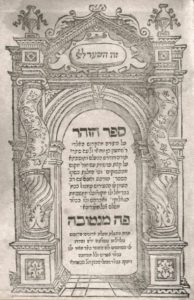
1558 Mantua Publication of the Zohar

1558 Mantua Publication of the Zohar

Bilaam describes a time in the very distant future, and the Sages agree that the “star of Jacob” refers to Mashiach. The Zohar (III, 212b) further elaborates on Bilaam’s prophecies, and describes what precisely is supposed to happen, and when that star of Jacob will be seen. Within this lengthy passage are a few verses that describe a scene quite familiar to the modern reader, and have therefore been used to suggest that the Zohar predicted the events of September 11, 2001:

… And [the star] will be seen on the sixth day, on the 25th day of the sixth month. It will be gathered on the seventh day, at the end of seventy days. On the first day it will be seen in a city of Rome. On that same day, three high structures of that city of Rome will fall and a great edifice will fall…

In traditional Jewish texts, Rome is typically referred to as Edom, and represents the entire Western (or European/Christian) world. The “city of Rome” represents whatever place is the centre of the Western world at a particular period of time. After the city of Rome itself had fallen in 476 CE, the “new Rome” was Constantinople. When this new Rome collapsed as well (and became present-day Istanbul), a “Third Rome” was said to arise. In the past, we have written about the identity of the Third Rome. Most scholars – at least in Jewish circles – agree on two possibilities: the Third Rome is either Moscow (as we have written about before), or New York.*

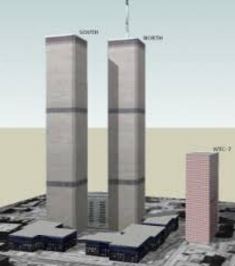
World Trade Centers: North, South, and 7

World Trade Centers North, South, and 7

If it is indeed New York, then the Zoharic passage above makes a lot of sense. A great edifice of three high structures will fall? Yes, on September 11, three of the iconic World Trade Center buildings collapsed (WTC1, WTC2, and WTC7). And the dates match quite closely, too. The Zohar says the 25th of the sixth month, ie. the 25th of the month of Elul. September 11, 2001 happened to be the 23rd of Elul!

Shortly after the 9/11 attacks, a number of articles circulated online (for example, here) suggesting that the Zohar predicted this tragedy, and added an additional detail of great interest: These articles claimed that Rabbi Eliyahu Kramer, better known as the Vilna Gaon – who lived in the 18th century – corrected the Zohar and wrote that the event will, in fact, take place on the 23rd of Elul. These articles claim that the Vilna Gaon’s correction is recorded in a mystical text called Sifra DiTzniuta.

Are these claims true, and did the Zohar really predict the September 11 attacks?

What Do The Prophecies Actually Say?

First of all, Sifra DiTzniuta was written and published long before the Vilna Gaon’s time, so suggesting that his correction of the Zohar was recorded there is already unlikely. The Vilna Gaon did write a commentary to the Sifra DiTzniuta. Having searched through both Sifra DiTzniuta and the Vilna Gaon’s commentary on it, I was unable to find any reference to the 23rd of Elul, or any correction of the Zohar’s prophecy. This doesn’t necessarily mean the claim is false, but it definitely looks like the source is incorrect.

Either way, we have to go back to the Zohar and read the entire passage, not only those few verses describing the fall of the buildings. It reads like this:

It is taught that in the future, the Holy One, blessed be He, will rebuild Jerusalem and reveal one firm star, glowing with seventy pillars of fire, and with seventy sparks flashing from it in the middle of the Firmament, and they will be reigned over by seventy other stars, and they will glow and burn for seventy days.

And [the star] will be seen on the sixth day, on the 25th day of the sixth month. It will be gathered on the seventh day, at the end of seventy days. On the first day it will be seen in a city of Rome. On that same day, three high structures of that city of Rome will fall and a great edifice will fall. The ruler of that city will die. Then the star will spread out to be seen in the rest of the world. In that time, great wars will stir all around the four corners of the world and no faith will be found among [its people].

In the middle of the world, when that star will shine in the middle of the Firmament, a great king will arise and rule the world, and his spirit will gain pride over all the kings, and he will awaken a war between both sides, and he will become strong against them.

On the day that the star will be hidden, the Holy Land will tremble forty-five miles around the place of the Holy Temple, revealing an underground cave. From this cave will come out a blazing fire to burn the world. And from this cave a great branch will grow out, and it will rule over the whole world, and to it will be given the kingdom. The Holy Beings will gather to it. Then Mashiach will be revealed to the entire world…

Clearly, there is a lot more going on! While Jerusalem has been rebuilt, we have yet to see the emergence of a star glowing with seventy pillars of fire, with seventy other stars glowing for seventy days. (These may be metaphors, of course, and may not be literally referring to celestial objects.) The Zohar says the edifice would fall at the end of seventy days (or at the beginning, depending on how one reads the passage). There was nothing particularly salient about the period of seventy days before or after 9/11. Moreover, “the ruler of that city” did not die on that day. The events of 9/11 did instigate “great wars” and it is true that we live in an increasingly faithless world. Ultimately, a “great king” to rule the entire world has not arisen (as far as we can tell), nor did the Holy Land tremble to reveal a cave from which Mashiach sprang forth.

Therefore, to suggest that this Zohar is speaking of the 9/11 attacks is perhaps a bit premature. While there are several parallels, the entire sequence of events has not occurred in the years since September 11, 2001. It appears that we have yet to witness the true fulfilment of Bilaam’s and the Zohar’s prophecies.

*While New York is the largest city in the United States, and by far its most important and famous, another candidate for the “Third Rome” is Washington, D.C. Washington has the plus of being a capitol city, the seat of “the ruler” as the Zohar says. It, too, was attacked on 9/11, and its major edifice – the Pentagon (the world’s largest office building) – damaged. Interestingly, long before Washington became America’s capital city, it was settled by a man who named it Rome!


The article above is adapted from Garments of Light – 70 Illuminating Essays on the Weekly Torah Portion and Holidays. Click here to get the book!

Chanukah: Did the Jews Really Defeat the Greeks?

“No two cities have counted more with mankind than Athens and Jerusalem. Their messages in religion, philosophy and art have been the main guiding light in modern faith and culture. Personally, I have always been on the side of both…”

– Winston Churchill

Chanukah is perhaps the most famous of Jewish holidays. The nine-branched candelabrum, the chanukiah, is instantly recognized by people around the world. One reason for this is because of the halakhah of pirsumei nissah, literally “publicising the miracle”. Although just about every Jewish holiday revolves around some kind of miracle, it is particularly with regards to Chanukah that there is a special mitzvah to publicize its wonder. And so, one can find a glowing, public chanukiah on display in pretty much every major city on the planet.

Chanukah Around the World

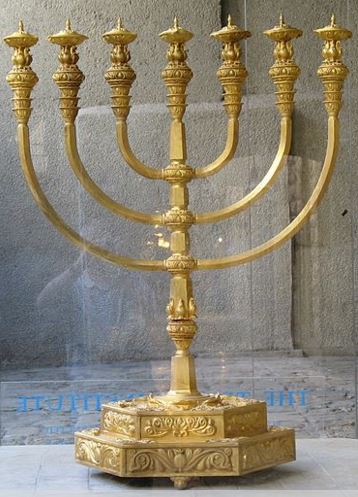
The purpose of the chanukiah is well-known: after defeating the Greeks and recapturing Jerusalem, and its Holy Temple, the Jewish warriors led by the Maccabees discovered only one cruse of oil for the Temple menorah (this one with seven branches, as the Torah commands). Although the oil was meant to last only for one day, it miraculously burned for eight, the amount of time necessary to produce a fresh batch of olive oil.

Temple Menorah Replica by Jerusalem's Temple Institute

Temple Menorah Replica by Jerusalem’s Temple Institute

This is the story as recounted in the Talmud. However, the more ancient Book of Maccabees (which is part of the apocrypha, scriptural texts that did not make it into the official Biblical canon) provides a different reason for the eight-day festival. Here, we are told that since the Temple was still in the hands of the Greeks two months earlier, the Jewish nation was unable to celebrate the Torah festival of Sukkot. Of all the Torah-mandated holidays, Sukkot is most associated with the Temple, and was celebrated with many offerings on the altar, along with water libations, and eight days of revelry. Since the people were unable to commemorate Sukkot properly in the month of Tishrei, they decided to commemorate it in the month of Kislev instead, now that the Temple was back in Jewish hands. So, they kept an eight-day festival, with offerings, libations, and revelry, both in honour of the belated Sukkot, and to celebrate their victory over the Greeks.

A David and Goliath Story

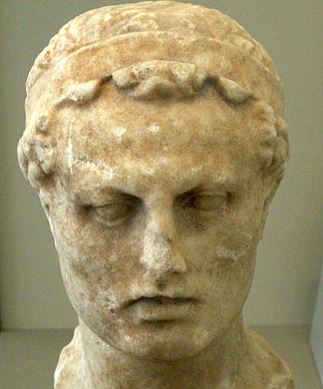
Chanukah is a beautiful underdog narrative. The mighty Syrian-Greeks (better known as the Seleucids, to differentiate them from the mainland Greeks in Europe) are imposing their Hellenism upon the conquered and impoverished Jewish people, still struggling to rebuild after the decimation of the First Temple period. The Greek king, Antiochus, demands the sacrifice of a pig upon a Jewish altar, and the Jews refuse. Well, at least some of them do.

Bust of Antiochus IV Epiphanes, of Chanukah fame, at the Altes Museum in Berlin (Credit-Jniemenmaa)

Bust of Antiochus IV Epiphanes, of Chanukah fame, at the Altes Museum in Berlin (Credit: Jniemenmaa)

At the time, there were many Hellenized, assimilated Jews among the masses that were very much okay with a pig on the altar. (It seems that history repeats itself: the first graduation ceremony in 1883 of Hebrew Union College, a Reform seminary, consisted of frog legs, crabs, and shrimp, among other non-kosher foods, earning it the nickname, “the treif banquet”.) Matityahu the High Priest wouldn’t have any of it, and together with his five sons—soon to be known as the “Maccabees”—started a revolution.

More than anything else, this was a civil war between traditional Jews and the Hellenized ones. Of course, the Hellenized Jews had support from the Greek government, which soon brought in some 60,000 troops, together with war elephants, according to the Book of I Maccabees (4:28-29). The Maccabee forces managed to scramble 10,000 mostly-untrained, guerrilla warriors. Ultimately, the 10,000 overpower the professional Greek army. The Seleucid Empire would never be the same again, and less than a century later, would totally come to an end.

Spiritual vs. Physical

Today, the Chanukah story often carries the same message: the Greeks were materialistic, promiscuous, Godless people, while the Jews were moral, spiritual, and God-fearing. Chanukah, then, celebrates the triumph of righteousness over licentiousness, religion over secularism, spirituality over physicality.

While the above description of the Seleucid-Syrian-Greeks may be true, it presents a false image of the Greeks as a whole, and one that isn’t at all consistent with traditional Jewish holy texts, especially the Talmud. In truth, the great Jewish sages of the Talmud valued and respected the Greeks. They stated (Megillah 8b) that it is forbidden to translate the Torah into any language, except Greek, which the rabbis considered a rich and beautiful tongue. The rabbis also adopted the Greek style of democratic government, with elected officials sitting on the Sanhedrin, from the Greek root synedrion, meaning “sitting together”.

One of the earliest known synedrions was established by Alexander the Great, made up of representatives from across his vast empire to assist him in government. The Talmudic sages spoke highly of Alexander the Great. According to legend, Alexander saw a vision of the Jewish High Priest before coming to conquer Jerusalem. There are several versions of this story, but all agree that Alexander was grateful to the High Priest, and spared Israel from his destructive conquests (as well as from paying tribute, according to some sources). In turn, the rabbis adopted “Alexander” as an honorary Jewish name. Indeed, one of the sages of the Talmud is Rabbi Alexandri, and many other rabbis have Greek names, such as Hyrcanus, Teradion, Antigonus, Dosa, Papa, Symmachus, and Tarfon.

These rabbis gathered in various learning academies across Israel and Persia (producing the Jerusalem and Babylonian Talmuds, respectively). Their academies were very similar to the Greek academy. In fact, the successors of a Greek academy spoke very much like the rabbis of the Talmud, quoting teachings from previous generations and debating them, while citing an uninterrupted chain of tradition all the way back to Plato, much the same way that rabbis cite an uninterrupted tradition back to Moses. Many of their modes of reasoning and dialectics were the same, too, even lesser-used forms such as gematria, another Greek word adopted by Judaism. The Greeks had also used their alphabet for numerology (an art that they called isopsephy).

Greek traditions appear to have even found their way into Jewish holidays. In ancient Greece, families would get together for symposia, parties in which they would recount the history of Greece and its great victories. According to the Greek philosophers, it was best to drink three cups of wine at a symposium, while drinking five cups was considered excessive and inappropriate. Thus, most people drank four cups. They would lie on couches, specifically on their left side. Recounting history while drinking four cups of wine and lying on one’s left—sound familiar? Let’s not forget that afikoman is itself a Greek word (epikomon, literally “that which comes after” or “that which comes last”, referring to either dessert or the concluding festive songs).

While the ancient Greeks certainly held onto a number of abhorrent beliefs and practices, to suggest that all the Greeks were atheistic, unjust, or not spiritual is certainly untrue. Socrates was killed for criticizing Athenian injustice, Plato preached how illusory this physical world is, and Aristotle described metaphysics and theology as the “first philosophy” and most important of subjects. One of the earliest known preachers of reincarnation was Pythagoras, who also wrote of three souls, much like the Jewish conception of nefesh, ruach, and neshamah. Nor is it a secret that some of the angels mentioned in the Talmud bear Greek titles, among them Sandalfon and Metatron.

So, did the Jews really defeat the Greeks? We certainly defeated the immoral and oppressive Seleucid Greeks in battle, but definitely not the Greek spirit as a whole. In fact, some might argue that Judaism is the best preservation of ancient Greek culture in the modern world! Whereas the rest of society has moved on to other methods of education, we still have a yeshiva system like the ancient Academy. While others celebrate their holidays with gifts and formal dinners, we gather in symposia, reliving the words of our Sages, who openly bore their Greek names. And of course, while most of society is primarily concerned with what’s happening on television, we’re still trying to be philosophers, debating the finest points of reality.

The Greeks had a profound impact on all of civilization, and Judaism was not immune from it. Perhaps this is why, over time, the holiday became less about defeating Greeks and more about the miracle of light. Chanukah is a holiday celebrating Jewish resilience, and symbolizing the power of light over darkness, and hope over despair. It is a lesson in resisting assimilation and being true to ourselves; in standing up for what’s right and upholding our customs; and most importantly, in the longest, blackest nights of winter, Chanukah teaches us that although the world may be full of evil, one tiny flame can break through all the darkness.

[This is part one of a three-part series. See here for part two.]


The article above is adapted from Garments of Light: 70 Illuminating Essays on the Weekly Torah Portion and Holidays. Click here to get the book!