Tag Archives: Levi

Mysteries of Shemini Atzeret & Simchat Torah

Tonight we usher in Shemini Atzeret, the final “eighth” day following Sukkot, which is technically a distinct holiday of its own. In the diaspora—where we keep two days of yom tov—the second day of Shemini Atzeret is Simchat Torah, when we start a new Torah reading cycle with a big celebration. In Israel—where one yom tov is observed—Simchat Torah and Shemini Atzeret are on the same day. The Torah does not actually say what the purpose of Shemini Atzeret is, and why it is distinct from Sukkot. Simchat Torah is not mentioned in the Torah at all! What is the real meaning behind these mysterious festivals?
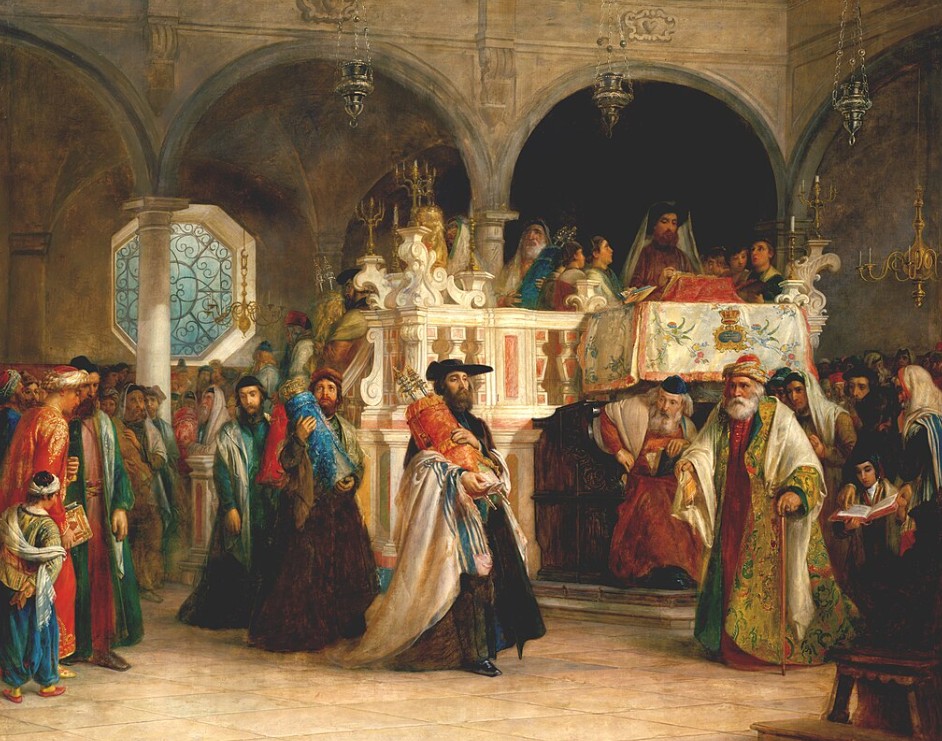
‘The Feast of the Rejoicing of the Law at the Synagogue in Livorno’ by Solomon Hart (1850)

The Torah itself only tells us that we should have one extra holiday after Sukkot, a yom tov in which we should not do any work and in which we should bring offerings to Hashem (Leviticus 23:36, 39). Commenting on this, Rashi famously cites our Sages and quotes God saying “‘I keep you back with Me [atzarti] one more day’—like a king who invited his children to a banquet for a certain number of days. When the time arrived for them to leave, he said, ‘Children, I beg you, please stay one more day with me; it is so hard for me to part from you!’” The Zohar adds to this a beautiful explanation:

As discussed in the recent class here, Sukkot is a holiday envisioning the future, not commemorating the past. The prophet Zechariah tells us (in chapter 14) that in the forthcoming Messianic age, all the nations of the world will come to Jerusalem to celebrate Sukkot with us. Sukkot will become an international festival! And so, the Zohar says, once all the nations of the world leave following seven days of Sukkot in Jerusalem, only the Jewish people will remain for one more day of celebration just for us—Shemini Atzeret. That’s why the Torah says atzeret tihyeh lakhem, “it shall be an atzeret for you” (Numbers 29:35), meaning specifically for the people of Israel and not the other nations of the world who will come to celebrate Sukkot! (See Zohar I, 64a)

But why is this particular date special? What happened in history on Shemini Atzeret to make it a holiday to begin with?

Secrets from Jubilees

The ancient (apocryphal) Book of Jubilees provides an incredible origin to Shemini Atzeret. Recall that Jubilees was excluded from the Tanakh by most Jewish communities (although it was included in the Ethiopian Tanakh and in the ancient Essene Tanakh, and many copies have been found among the Dead Sea Scrolls). Nonetheless, it was always studied and referenced throughout history, and many parallel passages are found in our Midrashim (for more on this, see here).

The setup for Shemini Atzeret begins in Chapter 31 of Jubilees, where we read how Jacob destroyed all the idols in his household (paralleling Genesis 35:2). Jubilees says that it was here that Rachel told her husband about the teraphim she took from Lavan, and handed them over to Jacob to be destroyed. Jacob then finally goes to visit his parents after decades away from them. Instead of taking his entire big family on the journey, he decides to bring only his sons Levi and Judah. Isaac and Rebecca give these two grandsons special blessings, and Isaac gives Levi a blessing to be priestly and Judah to be royal. This is Jubilees’ explanation for why later in history the tribe of Levi would become priests and the tribe of Judah would give rise to the line of kings. It also explains why these are the two tribes that survived throughout history, to this day, while the other tribal lineages have been lost.

In Chapter 32, Jacob fulfils his promise to tithe everything he has to Hashem—and that includes his children! So he lines them all up and counts from the youngest up, the tenth being Levi. Thus, Levi is chosen to be the “tithe”, and to dedicate his life to Hashem. Levi has a dream where God confirms that he will be the family priest. He then builds an altar and begins his work of sacrificial offerings. The family has a seven-day celebration, going out into the fields and dwelling in booths. According to Jubilees, this is the original Sukkot!

On the eighth day, after the seven-day Sukkot is over, Hashem appears to Jacob again. This is where He affirms that “You shall be called Jacob no more, but Israel shall be your name” (Genesis 35:10). The following verses in the Torah tell us that God blesses Jacob to be fruitful, and promises to Jacob the Holy Land, and tells him that nations and kings will emerge from him. This special day is Shemini Atzeret! Fittingly, Jubilees adds that God then reveals to Jacob all the things that will happen in the End of Days, engraved upon seven tablets. Again, we see the link between Sukkot-Shemini Atzeret and the End of Days, the holiday being more about envisioning the future then commemorating the past.

In this way, Jubilees shows how Jacob celebrated Sukkot and Shemini Atzeret long before Sinai, confirming our Sages statement that the Patriarchs observed the whole Torah and marked all the holidays—even though their lives pre-dated Sinai and they did not have a physical Torah in their hands.

What about Simchat Torah? There is no explicit mention of it in Tanakh, and not in Mishnah or Talmud (and not in Jubilees either). This is a much more recent holiday. Where did it come from, and why?

Celebrating the Torah

In olden times, the Torah was typically read over the course of not one year, but three years. (Earlier still, in Biblical times, it was read publicly over the course of seven years—more on that below.) It was in the Persian Empire that the Babylonian sages sped up the cycle to read the whole Torah once a year (see Megillah 29b). Even as late as the Rambam (Rabbi Moshe ben Maimon, 1138-1204), he writes in the Mishneh Torah that there were still some minority communities who followed a three-year cycle, although it had become nearly universal to follow a one-year cycle (Hilkhot Tefillah 13:1). The Rambam codifies that the Torah begins anew with parashat Beresheet on the Shabbat following Sukkot. He then states that it was Ezra the Scribe who instituted the yearly cycle. There is no contradiction here, because Ezra came to Israel from Babylon.

Why start with Beresheet in the fall? Why not in Nisan, which is the first month of the Jewish calendar? This goes back to the debate between Rabbi Eliezer and Rabbi Yehoshua on when Creation took place (Rosh Hashanah 10b-11a). The former said that Creation took place in Tishrei, while the latter argued it took place in Nisan. Rabbi Eliezer brings multiple proofs for his position, including the fact that the Torah states there had not yet been precipitation and then God “raised a mist” and made it rain before creating Adam (Genesis 2:5-6). So, the creation of Adam is clearly tied to the start of the rainy season, meaning Creation must have been in Tishrei!

Another proof is that the Torah says God created every species in its mature, adult form, including trees already containing fruits on their branches. When do find that trees are full of fruit and ready for harvest? In Tishrei! (Sukkot marks the final fruit harvest of the year.) Thus, it is fitting to read Beresheet in the fall, since the Torah begins with a description of a divine spirit “hovering over the waters”, the separation of upper and lower waters and establishment of the water cycle, the first rains, and trees full of fruit. And by the Rambam’s time, the yearly Torah-reading cycle had become essentially universal. However, the Rambam does not mention Simchat Torah.

Some four hundred years later, the Shulchan Arukh (in Orach Chaim 669) does mention Simchat Torah, but very briefly. The way Rav Yosef Karo (c. 1488-1575) phrases it makes it seem like it’s only outside of Israel—where people have to keep two yom tovs—that the second yom tov is called Simchat Torah. The Ashkenazi gloss of the Rama (Rabbi Moshe Isserles, 1530-1572) adds the details that we are familiar with: to remove all the Torah scrolls from the ark and have a big celebration, with hakafot, song and dance, and aliyot for all. The Rama’s language suggests this was the practice specifically in European lands. He cites the Arba’ah Turim of Rabbi Yakov ben Asher (“Ba’al haTurim”, c. 1269-1343) who explicitly says it was “the custom in Ashkenaz” to hold a big celebration and feast in honour of the completion of the Torah reading cycle and the start of a new one. The Ba’al haTurim was born in Ashkenaz but moved with his family to Spain around the year 1300, and became a rabbi among Sephardim. It could well be that his family of Ashkenazi rabbis introduced Simchat Torah to the Sephardic world. By the time of the great Abarbanel (1437-1508)—who was advisor to the Spanish crown and was given an exemption from the Spanish Expulsion, but famously chose to leave with his people—we see that Simchat Torah was observed in Spain, too, and Abarbanel explains (in his commentary on Deuteronomy 31:9):

It is written that each and every year, the high priest or the prophet or judge or gadol hador would read on Sukkot a portion of Torah, and would conclude reading the books of Genesis, Exodus, Leviticus, and Numbers over the course of six years, and then in the seventh year (the Sabbatical), the king would read on Sukkot the book of Deuteronomy, and would complete the Torah. Thus, the custom has remained until our days, that on the eighth day festival, Shemini Atzeret, on the last day we have Simchat Torah, on which we complete the Torah…

Rav Yosef Karo himself was born in Spain, and ultimately settled in Tzfat where he was the chief rabbi. His contemporary was the great Arizal (Rabbi Isaac Luria, 1534-1572), who lived out his final years in Tzfat and revolutionized Judaism with his mystical teachings. The Arizal had an Ashkenazi father and a Mizrachi mother, and was raised in Egypt by his uncle, studying under great rabbis like the Radbaz (Rabbi David ben Solomon ibn Zimra, 1479-1573, also born in Spain). The Arizal played a big role in fusing together Sephardic, Mizrachi, and Ashkenazi practices. He revealed various mystical meditations on Simchat Torah, and particularly on the hakafot. And so, from Tzfat, Simchat Torah spread to the Mizrachi world as well, and it soon become universal to hold a big Simchat Torah celebration—with the additional details and practices mentioned by the Ba’al haTurim and Rama that first originated in Ashkenaz.

Celebrating the Tree of Life

We can now clearly piece together the evolution of Simchat Torah. It officially began in Central Europe. The first explicit mention of the term “Simchat Torah” appears to be in the 11th century Machzor Vitry, written by Rav Simcha of Vitry, France, a student of Rashi. Simchat Torah might trace back to an earlier custom among the Geonim to have a big celebration upon completion of the Torah-reading cycle. The Rambam, who came from a long line of Sephardic rabbis, does not mention Simchat Torah in the 12th century, but the Sephardi gadol Abarbanel does speak of it in the 15th century, meaning it was adopted among Sephardim at some point in those intervening three centuries. It may have been due to the Ba’al haTurim’s family who immigrated from Ashkenaz to Sepharad around the end of the 13th century.

At the same time, in 1290 CE, came the first publication of the Zohar, in Spain. The Zohar (III, 97a) does mention Simchat Torah, calling it by its Aramaic name Hedvata d’Oraita (which is likely what it would have originally been called among the Babylonian Geonim). The Zohar gives a beautiful explanation as to why we celebrate with the Torah specifically on Shemini Atzeret. As noted above, Shemini Atzeret is the festival that is only for Israel, once all the nations of the world leave after Sukkot, and once the seventy bulls offered on behalf of the seventy nations was complete. Now, only Israel remains, delighting with Hashem once last time before going off to start a new year. And what makes our relationship with Hashem special? What makes us unique compared to the other nations? The Torah! It is our covenant with Hashem, with Torah as contract, and our devotion to its laws and its study. So, Shemini Atzeret is the ideal time to celebrate the Torah, to dance with the Torah, renew our commitment to Torah, and start a new Torah-reading cycle.

We see how, between the Zohar and the Arba’ah Turim, Simchat Torah spread throughout Sepharad; and after the Spanish Expulsion, to North Africa and the Middle East and Mizrachi communities as well. Today it has become a beautiful, universal practice in all Jewish communities, a public display of faith and commitment to Hashem and His Torah. And this ties right back into what the Zohar says about Simchat Torah:

Intriguingly, the Zohar gives it another name, calling it Hedvata d’Ilana, a celebration of the Tree of Life. The simple meaning is that King Solomon called the Torah a “Tree of Life for those who grasp it” (Proverbs 3:18). On Simchat Torah we grasp the Torah quite literally! On a deeper level, connecting Simchat Torah to the Tree of Life is yet another allusion to Creation, and to Adam and Eve in the Garden of Eden. At the start of the year, we have a new opportunity to “choose life” (Deuteronomy 30:19), to live a godly life of divine service, a life of blessing, righteousness, kindness, and goodness. It is the opportune time to set resolutions for the new year, so that it should be a fruitful, productive, happy, and blessed year for all.

Chag sameach!
The Difference between “Jew” and “Hebrew”

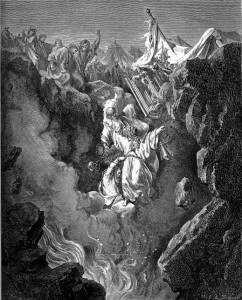
“Death of Korah, Dathan, and Abiram” by Gustave Doré

This week’s parasha is named after Korach, the rebellious cousin of Moses. Korach felt he had been unfairly slighted. Moses had apparently made himself like a king over the people, then appointed his brother Aaron as high priest. The final straw was appointing another cousin, the younger Elitzaphan, as chief of the Kohatites, a clan of Levites of which Korach was an elder. Where was Korach’s honour?

Korach’s co-conspirators were Datan and Aviram, leaders of the tribe of Reuben. They, too, felt like they’d been dealt a bad hand. After all, Reuben was the eldest son of Jacob, and as the firstborn among the tribes, should have been awarded the priesthood.

The Sages explain that Reuben indeed should have held the priesthood. Not only that, but as the firstborn, he should have also been the king. Reuben, however, had failed in preventing the sale of Joseph, and had also committed the unforgivable sin of “mounting his father’s bed”. For this latter crime especially, and for being “unstable like water”, Jacob declared that Reuben would “not excel” or live up to being “my first fruit, excelling in dignity, excelling in power” (Genesis 49:3-4).

Instead, the status of “firstborn” was awarded to Joseph, who had taken on the mantle of leadership and saved his entire family in a time of terrible drought. Jacob made Joseph the firstborn, and thus gave Joseph a double portion among the Tribes and in the land of Israel. He put Joseph’s sons Ephraim and Menashe in place of his own firsts Reuben and Shimon (Genesis 48:5). Meanwhile, the excellence of “dignity”—the priesthood—went to the third-born son, Levi, and the excellence of power—royalty—went to the fourth son, Judah. (The second-born Shimon was skipped over because he, too, had greatly disappointed his father in slaughtering the people of Shechem, as well as spearheading the attempt to get rid of Joseph.)

Levi merited to hold the priesthood because the Levites were the only ones not to participate in the Golden Calf incident (Exodus 32:26). The Book of Jubilees (ch. 32) adds a further reason: Jacob had promised to God that he would tithe everything God gave him (Genesis 28:22), and everything included his children. Jacob thus lined up his sons, and counted them from the youngest up. The tenth son, the tithe, was Levi (who was the third-oldest, or “tenth-youngest”, of the twelve). And so, Levi was designated for the priesthood, to the service of God.

Judah merited the royal line for his honesty and repentance—particularly for the sale of Joseph, and for the incident with Tamar. He further established his leadership in taking the reins to safely secure the return of Benjamin. The name Yehudah comes from the root which means “to acknowledge” and “to be thankful”. Judah acknowledged his sins and purified himself of them. Ultimately, all Jews would be Yehudim, the people who are dedicated to repentance and the acknowledgement and recognition of Godliness in the world. Much of a Jew’s life is centered on prayers and blessings, thanking God every moment of the day, with berakhot recited before just about every action. The title Yehudi is therefore highly appropriate to describe this people. Yet, it is not the only title.

Long before Yehudi, this people was known as Ivri, “Hebrew”, and then Israel. What is the meaning of these parallel names?

Hebrew: Ethnicity or Social Class?

The first time we see the term “Hebrew” is in Genesis 14:13, where Abraham (then still called Abram) is called HaIvri. The meaning is unclear. The Sages offer a number of interpretations. The plain meaning of the word seems to mean “who passes” or “who is from the other side”. It may refer to the fact that Abraham migrated from Ur to Charan, and then from Charan to the Holy Land. Or, it may be a metaphorical title, for Abraham “stood apart” from everyone else. While the world was worshipping idols and living immorally, Abraham was “on the other side”, preaching monotheism and righteousness.

An alternate approach is genealogical: Ever was the name of a great-grandson of Noah. Noah’s son Shem had a son named Arpachshad, who had a son named Shelach, who had a son named Ever (see Genesis 11). In turn, Ever was an ancestor of Abraham (Ever-Peleg-Reu-Serug-Nachor-Terach-Abraham). Thus, Abraham was called an Ivri because he was from the greater clan of Ever’s descendants. This must have been a powerful group of people recognized across the region, as attested to by Genesis 10:21, which makes sure to point out that Shem was the ancestor of “all the children of Ever”. Amazingly, archaeological evidence supports this very notion.

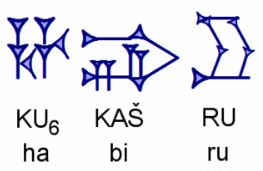
“Habiru” in ancient cuneiform

From the 18th century BCE, all the way until the 12th century BCE, historical texts across the Middle East speak of people known as “Habiru” or “Apiru”.  The Sumerians described them as saggasu, “destroyers”, while other Mesopotamian and Egyptian texts describe them as mercenary warriors, slaves, rebels, nomads, or outlaws. Today, historians agree that “Habiru” refers to a social class of people that were somehow rejected or outcast from greater society. These were unwanted people that did not “fit in”. That would explain why Genesis 43:32 tells us that Joseph ate apart from the Egyptians, because “the Egyptians did not eat bread with the Hebrews; for that was an abomination to the Egyptians.”

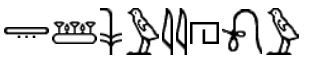
One of the “Habiru” described in Egyptian texts are the “Shasu YHW” (Egyptian hieroglyphs above), literally “nomads of Hashem”. Scholars believe this is the earliest historical reference to the Tetragrammaton, God’s Ineffable Name, YHWH.

Defining “Hebrew” as an unwanted, migrating social class also solves a number of other issues. For example, Exodus 21:2 introduces the laws of an eved Ivri, “a Hebrew slave”. When many people read this passage, they are naturally disturbed, for it is unthinkable that God would permit a Jew to purchase another Jew as a slave. Yet, the Torah doesn’t say that this is a Jew at all, but an Ivri which, as we have seen, may refer to other outcasts from an inferior social class. The Habiru are often described as slaves or servants in the historical records of neighbouring peoples, so it appears that the Torah is actually speaking of these non-Jewish “Hebrews” that existed at the time. Regardless, the Torah shows a great deal of compassion for these wanderers, and sets limits for the length of their servitude (six years), while ensuring that they live in humane conditions.

Rebels and Mystics

Though he was certainly no slave or brigand, Abraham was undoubtedly a “rebel” in the eyes of the majority. To them, he was a “criminal”, too, as we read in the Midrash describing his arrest and trial by Nimrod the Babylonian king. Abraham spent much of his life wandering from one place to another, so the description of “nomad” works. So does “warrior”, for we read of Abraham’s triumphant military victory over an unstoppable confederation of four kings that devastated the entire region (Genesis 14). There is no doubt, then, that Abraham would have been classified as a “Habiru” in his day.

His descendants carried on the title. By the turn of the 1st millennium BCE, it seems that all the other Ivrim across the region had mostly disappeared, and only the descendants of Abraham, now known as the Israelites, remained. The term “Hebrew”, therefore, became synonymous with “Israelite” and later with Yehudi, “Judahite” or “Jew”. (This is probably why later commentators simply assumed that the Torah was speaking about Jewish slaves in the Exodus 21 passage discussed above.) To this day, in many cultures and languages the term for a “Jew” is still “Hebrew”. In Russian it is yivrei, in Italian it is ebreo, and in Greek evraios. In other cultures, meanwhile, “Hebrew” is used to denote the language of the Jews. It is Hebrew in English, hebräisch in German, hébreu in French.

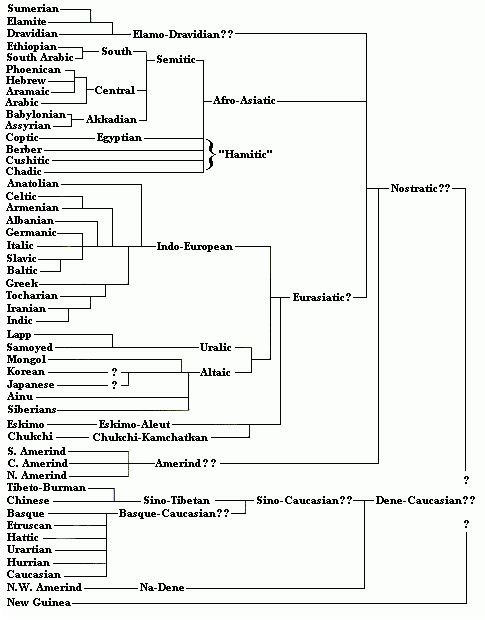
In fact, another rabbinic theory for the origins of the term Ivri is that it refers specifically to the language. In Jewish tradition, Hebrew is lashon hakodesh, “the Holy Tongue” through which God created the universe when He spoke it into existence. The language contains those mystical powers, and because the wicked people of the Tower of Babel generation abused it, their tongues were confounded in the Great Dispersion. At that point, God divided the peoples into seventy new ethnicities, each with its own language, giving rise to the multitude of languages and dialects we have today.

A possible language tree to unify all of the world’s major tongues, based on the work of Stanford University Professor Joseph Greenberg. (Credit: angmohdan.com)

Hebrew did not disappear, though. It was retained by the two most righteous people of the time: Shem and Ever. According to tradition, they had built the first yeshiva, an academy of higher learning. Abraham had visited them there, and Jacob spent some fourteen years studying at their school. The Holy Tongue was preserved, and Jacob (who was renamed Israel) taught it to his children, and onwards it continued until it became the language of the Israelites.

Alternatively (or concurrently), Abraham learned the Hebrew language from his righteous grandfather Nachor, the great-grandson of Ever. We read of the elder Nachor (not to be confused with Nachor the brother of Abraham) that he had an uncharacteristically short lifespan for that time period (Genesis 11:24-25). This is likely because God took him away so that he wouldn’t have to live through the Great Dispersion. (Nachor would have died around the Hebrew year 1996, which is when the Dispersion occurred. The Sages similarly state that God took the righteous Methuselah, the longest-living person in the Torah, right before the Flood to spare him from the catastrophe.)

Interestingly, we don’t see much of an association between the Hebrew language and the Hebrew people in the Tanakh. Instead, the language of the Jews is called, appropriately, Yehudit, as we read in II Kings 18:26-28, Isaiah 36:11-13, Nechemiah 13:24, and II Chronicles 32:18. The term Yehudit may be referring specifically to the dialect of Hebrew spoken by the southern people of Judah, which was naturally different than the dialect used in the northern Kingdom of Israel.

Israel and Jeshurun

The evidence leads us to believe that “Hebrew” was a wider social class in ancient times, and our ancestors identified themselves (or were identified by others) as “Hebrew”. This was the case until Jacob’s time. He was renamed Israel, and his children began to be referred to as Israelites, bnei Israel, literally the “children of Israel”. The twelve sons gave rise to an entire nation of people called Israel.

The Torah tells us that Jacob was named “Israel” because “he struggled with God, and with men, and prevailed” (Genesis 32:29). Jewish history really is little more than a long struggle of Israel with other nations, and with our God. We stray from His ways so He incites the nations against us to remind us who we are. Thankfully, throughout these difficult centuries, we have prevailed.

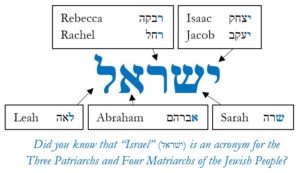
Within each Jew is a deep yearning to connect to Hashem, hinted to in the name Israel (ישראל), a conjunction of Yashar-El (ישר-אל), “straight to God”. This is similar to yet another name for the people of Israel that is used in the Tanakh: Yeshurun. In one place, Moses is described as “king of Yeshurun” (Deuteronomy 33:5), and in another God declares: “Fear not, Jacob my servant; Yeshurun, whom I have chosen.” (Isaiah 44:2) Yeshurun literally means “upright one”. This is what Israel is supposed to be, and why God chose us to begin with. “Israel” and “Yeshurun” have the same three-letter root, and many believe these terms were once interchangeable. The Talmud (Yoma 73b) states that upon the choshen mishpat—the special breastplate of the High Priest that contained a unique stone for each of the Twelve Tribes—was engraved not Shivtei Israel, “tribes of Israel”, but Shivtei Yeshurun, “tribes of Yeshurun”.

What is a Jew?

By the middle of the 1st millenium BCE, only the kingdom of the tribe of Judah remained. Countless refugees from the other eleven tribes migrated to Judah and intermingled with the people there. Then, Judah itself was destroyed, and everyone was exiled to Babylon. By the time they returned to the Holy Land—now the Persian province of Judah—the people were simply known as Yehudim, “Judahites”, or Jews. Whatever tribal origins they had were soon forgotten. Only the Levites (and Kohanim) held on to their tribal affiliation since it was necessary for priestly service.

As already touched on previously, it was no accident that it was particularly the name of Yehuda that survived. After all, the purpose of the Jewish people is to spread knowledge of God, and within the name Yehuda, יהודה, is the Ineffable Name of God itself. This name, like the people that carry it, is meant to be a vehicle for Godliness.

Perhaps this is why the term Yehudi, or Jew is today associated most with the religion of the people (Judaism). Hebrew, meanwhile, is associated with the language, or sometimes the culture. Not surprisingly, early Zionists wanted to detach themselves from the title of “Jew”, and only use the term “Hebrew”. Reform Jews, too, wanted to be called “Hebrews”. In fact, the main body of Reform in America was always called the Union of American Hebrew Congregations. It was only renamed the “Union for Reform Judaism” in 2003!

All of this begs the question: what is a Jew? What is Judaism? Is it a religion? An ethnicity or culture? A people bound by some common history or language? By the land of Israel, or by the State of Israel?

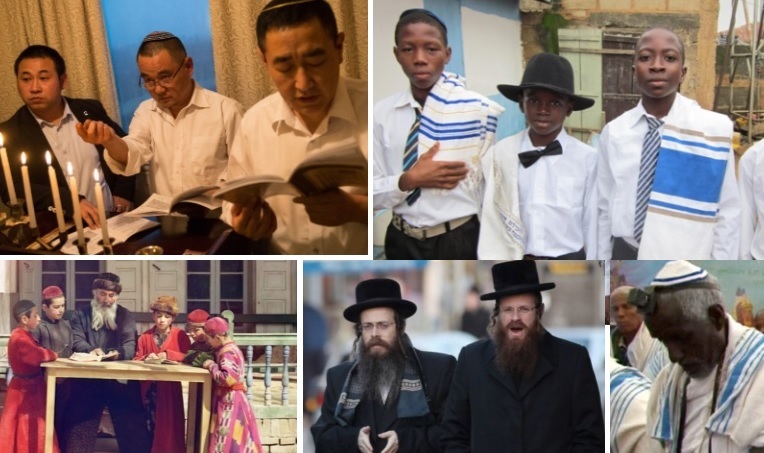
It cannot be a religion, for many Jews want absolutely nothing to do with religion. There are plenty who proudly identify as atheists and as Jews at the same time. We are certainly not a culture or ethnicity, either, for Ashkenazi Jews, Sephardi Jews, Mizrachi Jews, Ethiopian Jews, all have very different customs, traditions, and skin colours. Over the centuries, these groups have experienced very different histories, too, and have even developed dozens of other non-Hebrew Judaic languages (Yiddish, Ladino, Bukharian, and Krymchak are but a few examples).

So, what is a Jew? Rabbi Moshe Zeldman offers one terrific answer. He says that, despite the thousands of years that have passed, we are all still bnei Israel, the children of Israel, and that makes us a family. Every member of a family has his or her own unique identity and appearance, and some members of a family may be more religious than others. Family members can live in distant places, far apart from each other, and go through very different experiences. New members can marry into a family, or be adopted, and every family, of course, has its issues and conflicts. But at the end of the day, a family is strongly bound by much more than just blood, and comes together when it really matters.

And this is precisely what Moses told Korach and his supporters in this week’s parasha. Rashi (on Numbers 16:6) quotes Moses’ response:

Among each of the other nations, there are multiple sects and multiple priests, and they do not gather in one house. But we have none other than one God, one Ark, one Torah, one altar, and one High Priest…

There is something particularly singular about the Jewish people. We are one house. We are a family. Let’s act like one.

Continue reading

Embracing Converts, and the Seeds of Amalek

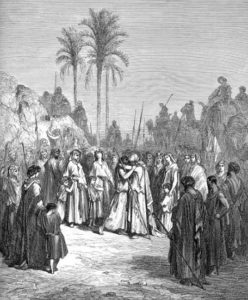
'The Meeting of Jacob and Esau' by Gustav Doré

‘The Meeting of Jacob and Esau’ by Gustav Doré

This week’s parasha is Vayishlach, which recounts Jacob’s return and settlement in the Holy Land after twenty years of living in Charan. At the end of the parasha is a long list of the genealogies of Jacob’s brother, Esau. The list seems unnecessary, and many Sages have wondered why the Torah bothers to spend so much time recounting Esau’s descendants. There have even been debates on whether the entire text of the Torah is equally holy, or if passages like the Ten Commandments are holier than passages such as this list of Esau’s genealogies. Meanwhile, the Arizal states that many of the deepest secrets of Creation are embedded particularly in this seemingly boring and superfluous passage. He draws particular significance from the list of the kings of Edom. The Arizal says these kings are codenames for the Sefirot, and a careful reading of the text reveals the cosmological rectifications (tikkunim) required to repair all of Creation and restore the world to perfection.

About half way through the list we are told that “… the sister of Lotan was Timna” (Genesis 36:22). Again, the Sages are baffled at this extra addition. We already care little enough that there was once an Edomite chief named Lotan – who cares that he had a sister named Timna? The Talmud (Sanhedrin 99b) notes how there were those who scoffed at such verses, saying: “Did Moses have nothing better to write?” And then, the same page of Talmud comes in to explain its tremendous significance:

Timna was a royal princess… Desiring to become a proselyte, she went to Abraham, Isaac and Jacob, but they did not accept her. So she went and became a concubine to Eliphaz the son of Esau, saying, “I’d rather be a servant to this people than a mistress of another nation.” From her, Amalek was descended, who afflicted Israel. Why so? Because they should not have repulsed her!

The Talmud combines the verse in question – which states that Timna was the royal sister of the chief, or prince, Lotan – with an earlier verse (36:12) that says she married Esau’s son Eliphaz and bore Amalek. She wished to convert to Judaism and approached the Patriarchs. All three rebuffed her. So, she ended up with Eliphaz – the closest she could get to being part of the nation. This union gave rise to the evil Amalek, that antagonizing force which has been oppressing Israel for millennia. The Sages state that the Patriarchs should have embraced this potential convert, instead of pushing her away. Their failure to open their arms led to centuries of Jewish suffering. The Talmud sends a pretty clear message: gentiles and converts should not be turned away, and doing so only breeds more resentment against Jews, bringing out all of the world’s “Amaleks”.

Soulmates of Jacob and Moses

The Arizal comments on the Timna passage and points out something even more amazing. He taught (Sha’ar HaMitzvot, Shoftim) that Timna was actually the soulmate of Jacob! Timna contained a great deal of holiness, and Jacob was meant to convert her and marry her, thereby elevating her spiritual sparks. That would have been a massive tikkun of its own, and would have hastened the coming of Mashiach. Instead, Jacob rejected her, and she went on to produce Amalek, bringing evermore evil into the world, and further delaying the coming of Mashiach.

The Arizal highlights that Moses made a similar mistake in not consummating his marriage to the Cushite (Ethiopian) woman. Both Tzipporah and the Cushite woman were Moses’ soulmates, and while Moses did the right thing in converting the Cushite, he never properly married her. Her sparks of holiness were not fully elevated, and the tikkun was left incomplete. This is why Aaron and Miriam were upset with their brother, as we read later in Numbers 12:1, “And Miriam and Aaron spoke against Moses because of the Cushite woman whom he had married…”

Rabbi Akiva’s 24,000 Students in Shechem

In this week’s parasha, too, we read how the people of Shechem genuinely wished to unite with Jacob’s family, agreed to circumcise themselves, and converted en masse. However, Jacob’s sons Shimon and Levi rejected them and resorted to violence in avenging what was done to their sister Dinah. Jacob was horrified at the actions of his sons, and later did not bless the two on his deathbed. It appears their sin was never forgiven, as hundreds of years later the tribes of Shimon and Levi were not given set borders within the Holy Land, but only a handful of cities interspersed among the other tribes. Kabbalistic texts reveal that Shimon and Levi killed 24,000 people in Shechem, and these 24,000 converted souls later reincarnated as the 24,000 students of Rabbi Akiva!

Did You Know These Famous People Converted to Judaism?

All of these narratives point to the same lesson: converts should be welcomed and accepted wholeheartedly. They have the potential for great holiness. The Talmud (Bava Kamma 38a) states that a gentile who occupies himself with Torah is equal to a kohen gadol, a High Priest! The Arizal describes five types of Jewish souls, and the souls of converts are among the purest. (The other types are “Old Souls”, “New Souls”, “True New Souls”, and the “Souls of Cain and Abel”. Of these, the most impure are Old Souls.) It goes without saying that there is no place for racism of any kind within Judaism – Moses himself married a black woman, and was reprimanded for not being diligent in consummating that union.

Historically, Jews were never the proselytizing kind. There are no Jewish missionaries that go out knocking on the doors of gentiles to seek converts. At the same time, Judaism was rarely a popular religion to convert in to. But this will change very soon, and we have to be ready for that day, for the prophet Zechariah (8:23) predicted:

It shall come to pass that ten men shall take hold – from all the languages of the nations – shall take hold of the corners of a Jew’s clothes, saying: “We will go with you, for we have heard that God is with you…”


The above essay is an excerpt from Garments of Light, Volume One. Get the book here!