
Tag Archives: Midrash

The Mysterious Urim and Thummim, and the Dome of the Rock

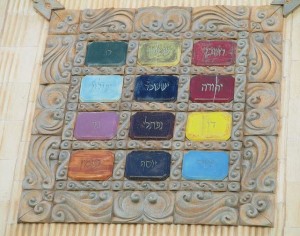
Modern Rendition of the Choshen, the High Priest’s Breastplate

This week’s Torah portion is Tetzave, which focuses on the holy vestments worn by the Kohen Gadol, the High Priest. Perhaps the most enigmatic of these vestments is the choshen hamishpat, the “breastplate of judgement”. This breastplate was embedded with twelve different precious stones, each symbolizing one of the Twelve Tribes. Housed within the breastplate were the Urim v’Tumim, mysterious objects whose nature has been speculated upon for centuries.

The Torah itself does not elaborate on what the Urim and Tumim are. The Talmud (Yoma 21b) states that they were one of the five things that were in the First Temple but missing in the Second Temple. Many believe that these were a couple of stones used to communicate with God. Unseen and unused for some two and a half millennia, it isn’t surprising that the Urim and Tumim are clouded in mystery.

Guilty or Innocent?

Some scholars see urim rooted in the root arur, “cursed”, and tumim from tam, “innocent”. Thus, these stones were used to figure out if a person was guilty or innocent, or if a certain decision was right or wrong. We read in I Samuel 14:36-44 how King Saul debated whether to pursue the Philistines in battle or not, so the High Priest addressed the question to God. God does not respond, so Saul concludes there must be a guilty person among them causing God to turn away. He then separates the people into groups to see which group contains the guilty party. It turns out that it is Saul’s son Jonathan who erred. This passage highlights the use of Urim and Tumim in divine communication, both in finding whether an action is right or wrong, and in determining guilt and innocence.

How did the stones communicate this? The word urim can mean “lights”, so it is thought that the stones glowed: one stone for yes/innocent, and the other for no/guilty. Others hold that the Urim and Tumim gave power to the Breastplate itself, causing the letters engraved upon it to glow. Each of the twelve stones on the Breastplate was engraved with the name of the corresponding tribe. However, the twelve names do not include all twenty-two letters of the Hebrew alphabet! The missing letters—Chet, Tet, Tzadi, Kuf—are in the names of the patriarchs, which were also engraved onto the plate, together with the phrase shivtei yeshurun, “Tribes of Jeshurun”. (Jeshurun was an ancient name for Israel.)

Interestingly, Rabbi Chaim Vital writes that this is how the Arizal could “read” people’s faces, by seeing a sort of Breastplate on their forehead. In Sha’ar Ruach HaKodesh, he explains that each person’s forehead has the twenty-two letters mystically engraved upon it, and the letters glow allowing the adept to penetrate into one’s soul and fortune. Each letter symbolizes different things. If no letters at all are shining, the person is nearing their death!

The Foundation Stone

Meanwhile, Targum Yonatan comments (on Exodus 28:30) that the Urim and Tumim were themselves inscribed with the alphabet, through a mystical name of God—“the name through which He created all three hundred and ten worlds”. Again, the letters would glow in sequence to provide the answer to one’s question. Targum Yonatan appears to suggest that the Urim and Tumim were special stones formed from the great Even HaShetiya, the Foundation Stone. According to tradition, this is the Stone from which Creation began, some seeing it is the very centre of the universe. Targum Yonatan says the Foundation Stone was placed by God to “seal up the mouth of the great deep at the beginning”.

This refers to the account of Creation, where it is stated at the beginning that everything was “chaos and void, with darkness upon the deep” (Genesis 1:2) before God said, “Let there be light.” Looking at these verses carefully, we see that the Torah uses the word tehom for the great deep, before the introduction of light, or. It isn’t difficult to see a connection between or v’tehom and urim v’tumim. The Urim and Tumim are meant to be conduits for communicating with the Divine, while the Foundation Stone has traditionally been seen as the very link between the Heavens and Earth.

Where is this Foundation Stone? The Talmud (Yoma 53b) tells us that the Even Shetiya is precisely the site of the Holy of Holies, the inner sanctum of the Temple, where the High Priest entered just once a year on Yom Kippur. The Stone served as the foundation for the Ark of the Covenant. The Ark, too, was a means of Divine Communication, with a Heavenly Voice emanating from between the Cherubs on the Ark’s Cover. We therefore see a link between the Ark and the Urim v’Tumim. The Talmud tells us that both the Ark and the Urim were missing in the Second Temple, together with the Shekhina and the spirit of prophecy. In short, the Second Temple era was devoid of any real divine communication.

The Dome of the Rock
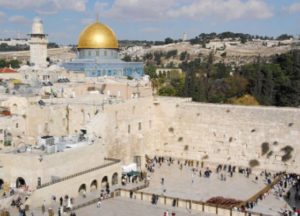
The Dome of the Rock and the Western Wall. Some believe the Temple was located right in front of the Wall, in the forested area pictured above.

So, what stood instead of the Ark in the Holy of Holies of the Second Temple? The Foundation Stone! It protruded “three fingers above the ground” and it is on this Stone that the High Priest would place the burning coals and incense on Yom Kippur (Yoma 53b). It is atop this Stone that the Muslims built the famous gold-topped Dome of the Rock (hence the name).

The Rabbis debate whether the Rock inside the Dome really is the Foundation Stone or not. The Arizal is among those who believed it is not, suggesting instead that the Temple was built right in front of where the Western Wall is today. Meanwhile, the Radbaz and Rav Ovadia of Bartenura maintained that it is indeed the Stone. They are supported by an ancient Midrash which prophesies that the Ishmaelites will do fifteen things in Israel, one of which is building a shrine atop the Holy of Holies (Pirkei d’Rabbi Eliezer, ch. 30). The midrashic passage concludes by presciently saying the Ishmaelites will instigate three great wars at the end: one in Arab lands, one in the Sea, and one in the West. It is in the midst of these wars that Mashiach will come.

A picture from beneath the Rock, the area known as the “Well of Souls”

When that time comes, the Ark of the Covenant—which many believe is currently hidden under the Foundation Stone—will be restored, together with the Priestly Vestments. In light of the fact that we are now quite clearly living out the final verses of that midrashic passage, it seems we shall soon be able to finally unravel the mystery of the Urim v’Tumim.


The above article is adapted from Garments of Light: 70 Illuminating Essays on the Weekly Torah Portion and Holidays. Click here to get the book! 
Should Jews Believe in Astrology?

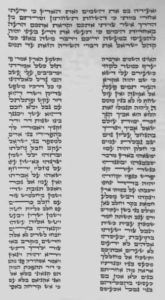
This week’s parasha, the second last of the Torah, is Ha’azinu. This parasha is unique in that it consists almost entirely of one lengthy song – clearly visible when looking at a Torah scroll, where the text of Ha’azinu is split into two narrow columns. Moses sang this prophetic song to the nation right before his passing.

Two columns of parashat Ha'azinu

Two columns of parashat Ha’azinu

In the verses that introduce it (Deut. 31:19), we see God commanding Moses to write the song and “teach it to the Children of Israel. Place it in their mouths so that this song will be for Me a witness for the Children of Israel.” God wanted Moses to diligently teach this song to the entire nation. In fact, the actual wording of the verse has God commanding everyone – each member of the nation – to write the song for themselves. It is based on this verse that the Sages drew the mitzvah of writing a Torah scroll (or participating in writing one), even though the plain text of the verse states only to write this particular song, Ha’azinu.

Perhaps because of this, the Ramban taught that Ha’azinu contains the entire Torah within it. Moreover, he believed that every detail of every person’s life is somehow encoded within this song! In one famous story, when a student of the Ramban, a man named Avner, heard this teaching, he was so baffled by it that he left Judaism entirely, converted to another religion, and became a prominent anti-Semite. When Avner later confronted the Ramban, the Rabbi showed him how one verse in the song did indeed accurately point to this man’s life. Avner was so ashamed that he disappeared, never to be heard from again.

Heavenly Princes

And so, each and every one of the song’s 43 verses has a great deal to teach us. The eighth verse begins by telling us that God gave each nation their lot, and the ninth verse says that “Hashem’s portion is His people, the lot of His inheritance.” The Zohar comments on these words that while God established Heavenly “princes” to watch over every nation in the world, Israel is watched over by God Himself. The Ramban (in his Discourse on Rosh Hashanah) elaborates:

He gave each and every nation… some known star or constellation, as is known by means of the science of astrology… Higher above [the constellations] are the angels of the Supreme One, whom He appointed as “princes” over them… It is further written, “So shall you be My people, and I will be your God, and you will not be subject to other powers at all.” (Jeremiah 11:4)

When we often say that Hashem is our God (as we do in the daily Shema), or when the Tanakh writes that we are God’s people, this does not mean that gentiles cannot have a relationship with God, or that there are other gods out there for the non-Jewish world. Rather, it means that while God oversees absolutely everything in His universe, and has created all people, He has also appointed various Heavenly (or astrological) forces above each nation – except Israel. These forces are not independent in their own right, as they are subject to the angels above them, and these angels ultimately serve God. As such, the nations of the world have various Heavenly intermediaries between themselves and Hashem. Israel, however, has a direct connection to Him. In fact, this is the hidden meaning within the name “Israel” (ישראל), which can be read as yashar El. (ישר-אל), “straight to God”.

Ain Mazal L’Israel

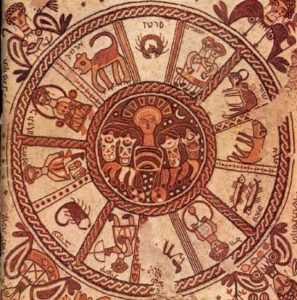
Long before the Ramban, the Sages of the Talmud debated whether the constellations had an effect on people (Shabbat 156a). The consensus of the Rabbis was that constellations do impact people, but Jews are free from this influence. They learn this from the prophet Jeremiah, who prophesied: “Thus said Hashem: Learn not the way of the nations, and be not dismayed at the signs of heaven, for the nations are dismayed at them.” (10:2) God tells Israel not to draw meaning from heavenly signs as the other nations do. The Talmud goes on to tell us a story about Abraham, who cried out to God: “Master of the Universe! I have looked at the constellations and find that I am not fated to have children.” To this, God replied: “Stop your star-gazing! Israel has no constellations.”

Hebrew Zodiac from a 6th Century Synagogue

Hebrew Zodiac from a 6th-Century Synagogue

Elsewhere, the Talmud tells us that Abraham was once a powerful astrologer, and great men from around the world came to consult with him about their fortunes (Bava Batra 16b). When Abraham looked into his own fate, he saw that he would not have children. God commanded him to desist from astrology, for the Jewish people have the power to transcend the stars. Of course, Abraham went on to have many children.

Later on, Moses would record in the Torah the prohibition for Jews to consult various fortune-tellers and astrologers. The Rambam codifies the law in this way:

It is forbidden to tell fortunes. [This applies] even though one does not perform a deed, but merely relates the falsehoods which the fools consider to be words of truth and wisdom. Anyone who performs a deed because of an astrological calculation or arranges his work or his journeys to fit a time that was suggested by the astrologers is [liable for] lashes, as [Leviticus 19:26] states: “Do not tell fortunes.”
(Sefer HaMadda, Hilchot Avodah Zarah, Chapter 11, Halacha 9)

Transcending Nature

We see from the above that various Heavenly forces, angels, and constellations do exist, and certainly do influence the world. Astrological signs can be potent forces. Ironically, earlier in his discourse, the Ramban points out how astrology is intricately tied into the Jewish calendar: it is no coincidence that Pesach is celebrated in the month of Nisan, the sign of which is Aries (the ram, or sheep), since the main mitzvah of Pesach was to sacrifice a lamb; and it is no coincidence that Rosh Hashanah – judgement day, when each person is put on trial – is in the month of Tishrei, the sign of which is Libra, the scales of justice. The Midrash (Yalkut Shimoni, Shemot 418) even tells us how each of the 12 Tribes of Israel corresponds to one of the 12 astrological signs of the zodiac!

And yet, all the sources are clear: Jews are not to dabble in astrology, for we have no need for intermediaries, and we have all the power to break free from the influence of the constellations. It is precisely when we believe in astrology that it becomes real, just as Abraham had no children as long as he believed in the heavenly signs that he saw. Every Jew must realize that we are Israel, yashar El, and that Hashem alone is our astrological sign. There is no need to believe in what the Rambam calls “emptiness and vanity”. The Rambam ends his laws on this subject by telling us to live up to the Torah’s call (Deut. 18:13) to be of “perfect faith with Hashem, your God.” When one has perfect faith in the Master of the Universe, anything is possible, and this is how God finished his rebuke to Abraham:

“Stop your star-gazing! Ain mazal l’Israel. What is your calculation? Is it because Jupiter stands in the West? Then I will turn it back and place it in the East!”


The article above is an excerpt from Garments of Light: 70 Illuminating Essays on the Weekly Torah Portion and Holidays. Click here to get the book! 
How Did Adam Live 930 Years?

This week’s parasha is Vayelech, which begins with Moses’ statement that “Today I am one hundred and twenty years old” (Deut. 31:2). It was the 7th of Adar, Moses’ birthday, and also his day of passing. Moses goes on to conclude his final speech to the people, then sings a deeply prophetic farewell song in next week’s portion Ha’azinu, followed by his blessings to the people in the last parasha of the Torah, V’Zot HaBracha.

Moses was the greatest of all prophets, the humblest man to walk the earth, and the central founding figure of Judaism. He was blessed with living a full and healthy life spanning exactly 120 years. It has become common today for people to wish each other 120 years of life. Why is this the specific figure? Can humans not live longer? Don’t we see in Genesis that Adam lived 930 years, Noah lived 950 years, and Methuselah (Metushelach) lived a record 969 years? What happened?

The Flood Generation

Ten generations from Adam, the world had descended into endless sin and immorality. God decreed that man’s days “will be numbered at one hundred and twenty” (Genesis 6:3). Many believe this to mean that God decreed humans will no longer be able to live past 120 years. Indeed, when looking at modern records of longevity, the vast majority of the world’s oldest people die close to 120 years. There has only been one official case of anyone exceeding 120, a Frenchwoman named Jeanne Calment who lived 122 years.

However, the traditional Jewish interpretation is that the Genesis verse above does not mean man is unable to live past 120. After all, our forefathers Abraham, Isaac, and Jacob lived long after this decree, and they lived 175, 180, and 147 years, respectively. Rather, the Jewish Sages state that God decreed the arrival of the Great Flood 120 years hence. God gave mankind 120 years to repent, and possibly avert the Flood. Noah was commissioned to go around and inspire people to mend their ways, and he had 120 years to do it.

Unfortunately, Noah failed in this endeavour, unable to bring even a single person to righteousness (as the Ark only carried his own family at the end). This is one reason for why the Flood is known in Hebrew as mabul Noach, literally “Noah’s Flood” (or mei Noach, “Noah’s waters”), as if he was partially responsible for not doing enough to inspire people to change. Because of this, many (including Rashi) have commented on the verse “Noah was a righteous and pure man in his generation” (Genesis 6:9) to mean that Noah was only righteous in his faulty generation. Had he lived in another generation, such as that of Abraham, he would not have been deemed so righteous!

We see from the Biblical chronology that after the Flood, people’s life spans steadily shorten. Moses’ older siblings Aaron and Miriam lived 123 and 126 years. Moses died at 120, and this appears to have become the new limit. After Moses, there are only a few people noted to have lived longer, one of which is Yehoyada the High Priest, who lived 130 years (II Chronicles 24:16).

What accounts for this steady degeneration in longevity?

Yeridat HaDorot

The Talmud (Shabbat 112b) states: “If the earlier [scholars] were sons of angels, we are sons of men; and if the earlier [scholars] were sons of men, we are like asses…” This is one of many passages that attests to the well-known concept of yeridat hadorot, “the descent of the generations”. It is said that each passing generation falls lower and lower in its wisdom and spiritual greatness. This concept can solve the puzzle of longevity.

The body is a finite lump of matter. It is only animated and vitalized by the infinite soul within it. Thus, the greater the soul, the longer the body can live. As the spiritual potential in each generation falls, so too does the lifespan.

Moreover, it is taught that Adam contained essentially all of the souls of humanity within him (Sha’ar HaGilgulim, ch. 11). As more and more people were born over the centuries, this single universal soul broke down further and further into smaller and smaller fragments. With the exception of a number of “new souls”, the vast majority of the world’s 7 billion people are all parts of the soul of Adam. It is therefore not surprising that today’s spiritual capabilities (and with that, the lifespans) are severely limited.

At the Speed of Light

Science may offer another intriguing possibility. According to modern physics, time as we know it doesn’t really exist. The universe is one interwoven fabric of both time and space. The faster one moves through space, the slower the effects of time for that person. There is actually a formula to measure the impact of this time dilation, known as the Lorentz transformation. It is given by the equation ΔT = t√1-v2/c2 [or: t = t÷ √(1-v2/c2)], where v is one’s speed and c is the speed of light.

Theoretically, the speed of light is the absolute maximum in our universe. At light speed (just under 3.00 x 10⁸ m/s, or 300,000 km/s), time will totally stop for the traveller (if plugging it into the formula, one gets a value of zero). This seems impossible. However, if we plug in a value very close to light speed, such as 2.99 x 10⁸ m/s, we get a very interesting result.* A person who has perceived living 80 years will have actually lived 980 earthly years! That makes Adam’s 930 years a more palatable 76, and Methuselah’s record 969 as 79. This fits in well with the verse in Psalms that a normal lifespan is 70 to 80 years (Psalms 90:10). But how could Adam and Methuselah have lived at near-light speed?

Beautifully, the Sages teach us that Adam was not a human like us. In many texts (such as Bereshit Rabbah 20:12), Adam is described not simply as a being of flesh, but rather as a being of light. Though most will interpret this metaphorically, there are those sages, such as the Arizal (for example, in Sefer HaLikutim, Bereshit, ch. 3) that interpret this quite literally. It remains to be seen what this means exactly, and if it has anything at all to do with physics, but perhaps there is much more to the idea of Adam being a man of light than we can imagine.


The article above is an excerpt from Garments of Light: 70 Illuminating Essays on the Weekly Torah Portion and Holidays. Click here to get the book! 
——–

*To be fair, choosing a value such as 2.99 x 10⁸ m/s may be deemed quite arbitrary. One can also plug in finer values even closer to the speed of light, such as 2.997 or 2.9972, and so on, each of which would give a more refined result. The point of this exercise is simply to illustrate the relativity of time, and what might explain the difference in perceived years between our generations and those of the first people, through a scientific perspective.