Tag Archives: Mishneh Torah

Witches and Wizards in the Torah

In this week’s parasha, Mishpatim, the Torah prescribes capital punishment for a witch, stating that “A sorceress shall not live” (Exodus 22:17). Rashi explains here, citing the Talmud in Sanhedrin 67a, that although the phrasing is in the feminine, the law applies to a sorceress or a sorcerer. Both female witchcraft and male wizardry are forbidden. The reason that the Torah phrases it in the feminine is simply because sorcery is more common among women. The Zohar (I, 126b) explains why it is that women are more drawn to witchcraft than men:

It all goes back to the Garden of Eden, where the Serpent approached Eve and “injected into her a zuhama”, a spiritual impurity. Although this zuhama went on to “infect” all mankind that descend from Eve, women are more prone to its effects, and more drawn to the “Other Side”, the Sitra Achra. However, the Zohar also states elsewhere (such as in III, 230a, Ra’aya Mehemna) that women are more attracted to all faith in general, and it is easy to see how women today and throughout history were a lot more dedicated to their faith than men. Women are naturally more drawn to matters of faith, belief, and mysticism—whether good or bad.

Now, what actually constitutes witchcraft or sorcery? The Sages derive that there are 10 types of sorcery, based on Deuteronomy 18:10-11, which states “Let no one be found among you who consigns a son or daughter to the fire; or an enchanter who enchants, a soothsayer, a diviner, a sorcerer; one who casts spells, or one who consults ghosts or familiar spirits, or one who inquires of the dead.” The first in the list of ten is an “enchanter” (קסם), and then the term “who enchants” (קסמים) implies two more distinct types of enchantments. (In Modern Hebrew, this root term is used for a magician or illusionist.) Then we are given seven more practices.

A me’onen (מעונן) is one who predicts ominous times and seasons, from the root onah meaning a “season” or period of time. The same root here implies wasting seed, like Onan son of Judah in the Torah (Genesis 38). Thus, the Sages suggest that a me’onen is a person who performs sorcery using semen, or involving some other sexual perversion (see Sanhedrin 65b). Next comes a menachesh (מנחש) who “divines” and, literally, “guesses” the future through various means. For instance, in the Torah we read how Joseph would be menachesh using his special silver goblet (Genesis 44). The Talmud (ibid.) adds that a menachesh uses omens and derives meaning from all kinds of random events, or even from the activity of birds, fish, and other animals.

Then comes the mechashef (מכשף), this time phrased in the masculine, for a generic sorcerer. A chover (חבר) is translated as one who “casts spells” but that definition seems more fitting for the sorcerer. A literal reading of chover implies someone who connects and brings things together, lechaber, perhaps one who brews potions, reminiscent of a witch’s cauldron. The Talmud (Sanhedrin 65a) adds here that a chover is one who burns different concoctions of incense to idols or demons. The purpose may be to summon or gather those demons. Another possibility is that what a chover brings together is animals, for example snakes, scorpions, or insects. A chover, therefore, might include a malicious snake charmer.

The final three in the list of ten all seem to be about contacting ghosts and spirits. First is a person who inquires of ov (אוב). Based on the root, it may be a person who channels their dead ancestors (avot). Another is one who inquires of yidoni (ידעוני), translated as a “familiar spirit”, perhaps the ghost of someone famous and well-known like a great historical figure. The last is a medium who contacts the souls of the dead directly. The Talmud (Sanhedrin 65b) suggests that a person who practices ov may get possessed by a ghost and speak in their name. Often, this is done by the use of a skull. A yidoni, meanwhile, uses the bone of a certain animal called yadua to contact the dead. Finally, the generic “necromancer” is a person who fasts and then goes to sleep in a cemetery to collect information from dead spirits.

Biblical Warlocks

The Zohar (I, 166b) states that history’s greatest sorcerer was Laban, father-in-law of Jacob. In fact, when Jacob complains that Laban flipped his wages ten times, aseret monim (Genesis 31:7), the true meaning here is that Laban used all ten types of wizardry (outlined above) against Jacob! So, when Jacob later told Esau that he lived with Laban, im Lavan garti—that he lived with the infamous sorcerer and escaped his clutches—he meant to tell Esau that just as he escaped all forms of Laban’s sorcery, he would similarly withstand Esau.

The Zohar here says that the next great warlock of the Torah, Bila’am, learned his sorcery directly from Laban, who was actually his grandfather! The Talmud, meanwhile, has an opinion that Bila’am was one and the same person as Laban (Sanhedrin 105a). The Arizal reconciles the two by teaching that Bila’am was the reincarnation of Laban. Thus, he was both Laban’s descendant on the one hand, and at the same time literally Laban because he was his reincarnation (see Sha’ar HaPesukim on Balak).

The Tanakh (Joshua 13:22) actually calls Bila’am a kosem, the first type of sorcery on the Torah’s list. The verse here says that the Israelites killed Bila’am and his disciples el halaleyehem (אל חלליהם). The standard translation is something like “with their corpses”, but this reading doesn’t make much sense. The Zohar explains that halaleyehem really refers to their flying crafts, because Bila’ams team of sorcerers knew how to fly using magic! (In Modern Hebrew, a halalit is a spacecraft.) Today, flying on a broomstick is associated with witches. Where did this notion come from?

Talmudic Witches

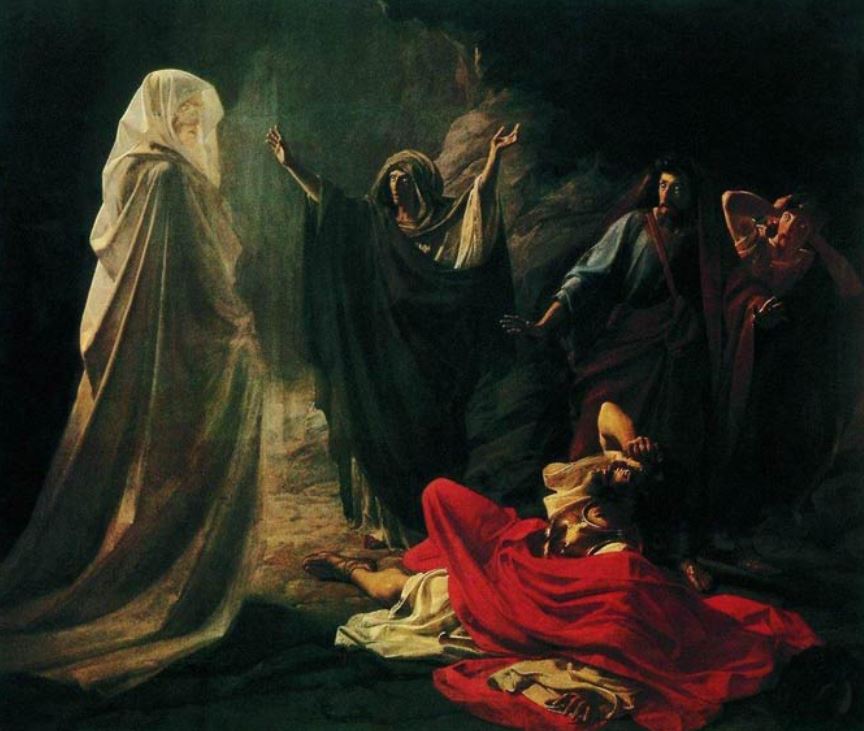
The only woman directly called a “witch” in Tanakh is Jezebel, the wife of the wicked Israelite king Ahab (II Kings 9:22). Jezebel is the one that relentlessly persecuted the prophet Eliyahu, but was ultimately defeated. The Talmud suggests that Ahab was such a wicked king only because he was bewitched by Jezebel (Yerushalmi Sanhedrin 10:2). Another Biblical figure thought of as a sorceress is the “Witch of Endor”, although she is not addressed this way in Tanakh (I Samuel 28). It was this necromancing woman that Saul went to in order to summon the soul of the prophet Samuel. The Tanakh makes sure to note there that Saul had previously banned all forms of necromancy, but when he himself needed the council of his now-deceased prophet Samuel, he hypocritically resorted to a ba’alat ov, a woman who practiced the ov form of necromancy.

Nikolai Ge’s “Witch of Endor” (1857)

The Talmud says much more about witches, and recounts multiple stories featuring them. In the most famous such incident, Shimon ben Shatach (early 1st century BCE), president of the Sanhedrin in his day (and brother of Queen Salome Alexandra), managed to execute eighty witches in Ashkelon at once. In fact, when he ran for president, Shimon ben Shatach’s campaign promise was that he would eliminate witchcraft from Israel. The Talmud says he initially failed to keep his promise, but when things got out of hand, he gathered a group of eighty men and headed to the cave in Ashkelon where the witches were headquartered. Through a clever ruse, he managed to capture all eighty of them, and had them all hanged.

The Talmud Yerushalmi mentions this in its exploration of the Mishnah (Sanhedrin 6:6) which teaches that it is forbidden to try two capital cases in one day. Yet, Shimon ben Shatach tried and hanged eighty. Presumably it was necessary in that situation, since the witches were highly dangerous and had to be eliminated immediately. The Talmud also mentions this story because the Mishnah presents an opinion that women were never hanged at all, only men were subject to hanging, yet here we have proof that Shimon hanged eighty women. Again, it was probably an exceptional case. (The Talmud Bavli also speaks about this incident briefly in Sanhedrin 45b).

In the Shimon ben Shatach story, the witches are able to conjure items at will, seemingly speaking them into existence. One conjured bread, another conjured a food, and a third produced wine. Some of the Sages were also described as being able to conjure, however not through black magic, but rather white magic, as taught in Sefer Yetzirah and other ancient mystical texts. Rav Oshaya and Rav Chanina had made a calf, while the sage Rava had bara gavra, produced a human-like golem (Sanhedrin 65b). Some say the magical incantation of “abracadabra” comes from Rava bara gavra, while others derive it directly from the Hebrew-Aramaic evra k’dibra, “I will create as I speak”. I have not heard a theory regarding the origins of the final word of the magical formula, “alakazam”, but my own conjecture is that it comes from al hakesem or al hakosem, through the powers of the kosem, the first of the Torah’s ten types of sorcery, the same term used to describe Bila’am.

As a general requirement, the Talmud teaches that a sage who sat on the Sanhedrin actually had to be knowledgeable in witchcraft and wizardry (Sanhedrin 17a). This is so that, like Shimon ben Shatach, the Sanhedrin would be able to properly apprehend and try witches and wizards. Relatedly, in Shabbat 81b we read how Rav Chisda and Rabbah bar Rav Huna were once on a ship and a witch wanted to sit with them but they refused, so she uttered a spell and the whole ship stopped in the middle of the sea! The rabbis uttered something of a counter-spell of their own, and the ship started moving again. The witch soon gave up, noting that the rabbis’ righteous conduct prevented her from harming them. In Pesachim 110a-b, the Sages teach a formula to recite in order to keep witches away, a lengthy phrase that includes statements like “may your hair fall out” and “may your spices scatter in the wind”.

Witchcraft Symbolism

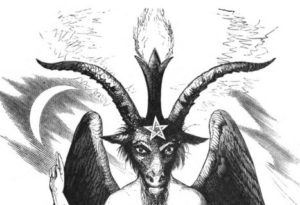
The Zohar (II, 185a) explains that the Torah prescribes sacrificing a se’ir, a particular type of hairy goat, as a way to counter the powers of witchcraft. This is because the goat is a major symbol of witchcraft and sorcery. This symbol is often combined with a pentagram, a five-pointed star. The six-pointed star of Judaism, meanwhile, is something of a “one-up” over the pentagram, to subdue the wicked powers of the Other Side. It is interesting to point out that a se’ir goat was offered on Rosh Chodesh in particular, as a “sin offering” (Numbers 28:15). This was partly a sin offering for the sins of witchcraft, since Rosh Chodesh is considered a feminine holiday, traditionally observed more stringently by women, whose bodies similarly follow a lunar-like cycle.

An 1856 depiction of the goat-headed “Baphomet”, with the moon on the side and a prominent pentagram.

Modern-day “Wiccans” and witches still use the pentagram as their main symbol, as well as the goat-headed “Baphomet”, among others. And what of the classic image of a witch wearing a pointy hat, brewing in a cauldron, with a black cat, and a flying broomstick? Historians believe this image actually emerged in the 15th and 16th centuries as a smear campaign against women who had, until then, dominated the beer-brewing industry:

Since ancient times, it was women who made and sold beer. During the Protestant Reformation in Europe, this was discouraged and women were expected to stay home, while men should engage in business and go out to the marketplace. Women who brewed beer were depicted as witches, their cauldrons holding poisons and potions instead of beer. In those days, beer-brewing women did indeed have cats with them, to keep rats and mice from eating their grains, and they did wear long, pointy hats to be more visible in the marketplace. The broomstick, too, probably came out of a need to always sweep the dust and grain chaff in their breweries. Thus, its only in recent centuries that the image of a typical female beer-brewer—with cauldron, broomstick, cat, and pointy hat—turned into the image of a typical witch!

Finally, and most importantly, we must ask the big question: is witchcraft and wizardry actually real? Might it only be an illusion or a set of false beliefs and superstitions? Perhaps the effects of witchcraft are only placebo-like, and harm only those who believe in them? The Talmud and Zohar certainly make it seem like witchcraft and sorcery are real and potent. Yet, the great rationalist Rambam (Rabbi Moshe ben Maimon, 1138-1204) was among those who held that witchcraft is nonsense. He argued that the Torah forbids it not because it has real power, but because it is just meaningless, idolatrous drivel. One should stay away from any such beliefs or ideas. It is worth concluding with the Rambam’s eloquent words:

The masters of wisdom and those of perfect knowledge know with clear proof that all these crafts which the Torah forbade are not reflections of wisdom, but rather, emptiness and vanity which attracted the feeble-minded and caused them to abandon all the paths of truth. For these reasons, when the Torah warned against all these empty matters, it advised [Deuteronomy 18:13]: “Be of perfect faith with Hashem, your God.”
(Sefer HaMadda, Hilkhot Avodah Zarah 11:16)

Medicinal Properties of Arba’at HaMinim

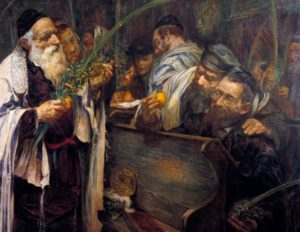
‘Sukkot in the Synagogue’ by Leopold Pilichowski (c. 1894)

As we continue to celebrate Sukkot this week and “shake” our arba’at haminim, it is worth exploring the properties of these unique four species. One of the intriguing things about them is that they all happen to be prominent players in medicine. Perhaps most well-known is the bark and leaves of the willow tree (the aravot of the four species), which is the original source for what is today aspirin. The active ingredient in aspirin is acetylsalicylic acid, a synthetic variant of salicylic acid found in high quantities in willow trees. Incredibly, archaeologists have found that teas made from willow were used medicinally as far back as ancient Sumeria (birthplace of Abraham) and ancient Egypt. The ancient Greeks used it to bring down fevers, and it was a staple medicine among Native American tribes.

It was in 1853 that French chemist Charles Frédéric Gerhardt first synthesized acetylsalicylic acid in the lab. The problem was that these types of medicines were very hard on the stomach. In 1897, a Jewish chemist named Arthur Eichengrün, working for Bayer, invented a new process for producing and purifying acetylsalicylic acid. This one was much easier on the stomach and worked extremely well. Thus, aspirin as we know it was born, and is today the most widely-used drug in the world. Things didn’t turn out so well for Eichengrün, though. When the Nazis came to power, they could not tolerate a Jewish inventor for aspirin, so they wiped his name from the history books and instead made sure to credit German scientist Felix Hoffman with the invention. Eichengrün was arrested and sent to a concentration camp. Thankfully, he survived the Holocaust. Altogether, Eichengrün held 47 patents, and also invented Protargol, which was the standard treatment for gonorrhea for over 50 years.

The way that acetylsalicylic acid actually works in the body was only discovered in 1971. It’s main mode of action is by blocking a family of enzymes called cyclooxygenases (COX), key players in the inflammatory pathway. By inactivating these enzymes, aspirin is able to reduce pain and inflammation. It also helps to block the formation of blood clots. More recently, acetylsalicylic acid has been shown to help improve the function of mitochondria—those tiny organelles within each of our cells that powers our bodies.

One of the main uses of aspirin today is to help treat and prevent heart attacks and heart disease, which is the world’s number-one killer. The main cause of heart disease is poor diet, particularly high cholesterol and saturated fats, as well as high sodium which increases blood pressure. Another major cause is smoking. Fittingly, our Sages taught that the aravot parallel the mouth, and resemble the shape of the lips. The purpose of the aravot is to both spiritually rectify the sins of the mouth, as well as to remind us to control what goes in (and out) of our mouths. We ask every morning in birkot haTorah that God should make words of Torah “pleasant-tasting” in our mouths (וְהַעֲרֶב נָא יְהֹוָה אֱלֹהֵֽינוּ אֶת־דִּבְרֵי תוֹרָתְךָ בְּפִֽינוּ) and this ties directly to the mouth-like aravot (ערבות). We should increase the use of our mouths for words of Torah, and decrease its use for the oral vices that end up harming people.

Myrtle Leaves

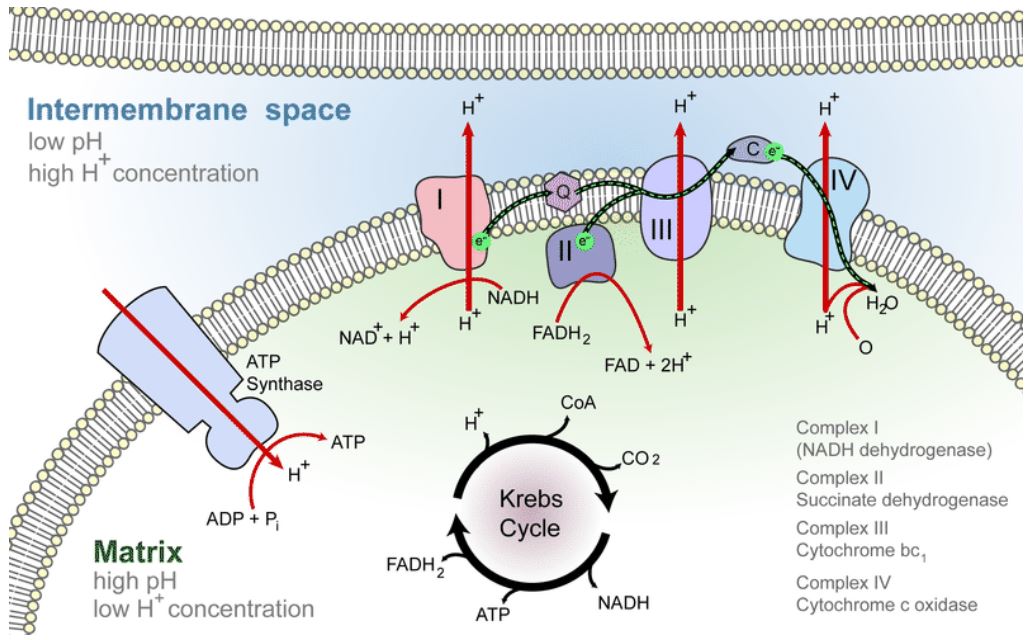
The other leaves in the four species, myrtle or hadassim, also happen to contain high amounts of salicylic acid. Additionally, they are rich in various antioxidants. Those mitochondria mentioned above use the oxygen we breathe in the production of energy. More specifically, producing the energy molecule ATP requires the movement of hydrogen ions. To keep those hydrogen ions moving in the right direction, oxygen comes in to bond with them, and pick up a pair of electrons, too, generating water. This is the main reason for why we need to breathe! The primary role of oxygen in the human body is to be an “electron acceptor”, picking up some electrons and some hydrogens so that energy production can continue.

The Electron Transport Chain within the mitochondria in our cells produces most of our energy. Water is generated at Complex IV, where oxygen comes in to serve as the final electron acceptor. Energy (in the form of ATP) is produced at the Synthase pump, driven by the movement of hydrogen ions. 

In this process, however, sometimes the oxygen molecules don’t bond properly, and form dangerous “reactive oxygen species”, or “oxidants”. These free radical oxidants can attack other structures within the cells, causing cellular damage and “oxidative stress”, strongly linked to aging and cancer. Thus, we need anti-oxidants to neutralize these troublesome free radicals. This is why you might see “antioxidants” advertised on the labels of health foods, cosmetics, and other commercial products. The leaves of hadassim naturally contain very high levels of antioxidants.

Throughout history, myrtle leaves have been used medicinally. Today, they have two main uses: One, the essential oil of myrtle is used in aromatherapy and to treat lung illnesses. Myrtle helps to open up the airway and reduce inflammation in the lungs. Second, it is used to treat and help prevent the spread of HPV, a sexually-transmitted disease. It is interesting to point out that our Sages paralleled the hadassim to the eyes. As we read in the Shema, God warns us not to follow after the lustful desires of the heart, which follow the eyes that are easily enticed by inappropriate sights and images. The Torah specifically uses the word zonim, implying sexual immorality, which begins with inappropriate sight. Thus, the use of myrtle leaves in treating sexually transmitted diseases is all the more appropriate!

Date Palms

The kapot tamarim, or lulav, is the “spine” of the date palm, and our Sages paralleled it to the spinal cord of the human. Both the fruit of the tree, and the “hearts of palm” of the lulav are highly nutritious. Their high fibre content was historically used to treat constipation. Recall that the Rambam held constipation to be a major root of poor health, writing in the Mishneh Torah that “Whoever sits comfortably and takes no exercise, holds his waste or has ‘hard’ innards, even if he eats all the best foods and follows the top medicine, all his days will be full of pain and his strength will decline.” (Hilkhot De’ot 4:14-15)

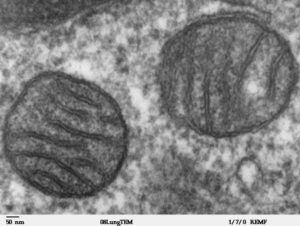
Mitochondria under a microscope.

In ancient Israel, the date palm was the source of honey. As is well-known, when the Torah speaks of Israel being a land flowing with “milk and honey”, it is referring to date honey, not bee honey. Honey is about 80% sugar, our body’s main energy source. In fact, those electrons in the mitochondria mentioned above, which drive the “electron transport chain” to produce our ATP energy, are extracted from sugar! We now see how the main ingredients in aravot, hadassim, and lulav all play a big role within our mitochondria, driving our biological life force.

Dates are also very rich in potassium—50% more than in bananas! Potassium ions play the most important role in the transmission of nerve signals. Every nerve conduction requires an exchange of sodium and potassium. So, it is appropriate that the lulav is compared to the spinal cord, the most important bundle of nerves in the body. Sefer haBahir, one of the most ancient mystical texts, states that not only does the lulav parallel the spinal cord, it also parallels the letter nun sofit (ן), which resembles a spinal cord. The value of the nun is 50, alluding to the 50 Sha’arei Binah, “Gates of Understanding”.

Etrog

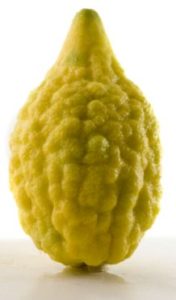
Finally, we have the citrus etrog. As expected, it has a very high vitamin C content, typically considered the most important vitamin in the body. The greatest champion of vitamin C was Nobel Prize-winner Linus Pauling. (Pauling is actually one of just four people to win two Nobel Prizes!) He was also ranked the 16th greatest scientist of all time. It was Pauling who first proposed that vitamin C can combat cold and flu infections. He later took it further and suggested vitamin C as a cure for all kinds of ailments, including cancer. His main work was in using vitamin C to treat heart disease and angina. Today, this method is still referred to as Pauling Therapy, though it remains controversial. Nonetheless, it is quite fitting since, of course, our Sages stated that the etrog parallels the heart!

The other known medicinal use of the etrog (or “citron”, in English) is as an antibiotic. Specifically, it is the rind of the etrog which is thought to contain strong antibiotic properties. This would help to explain why the Torah calls the etrog a pri etz hadar, one of the classic explanations of which is that it is a “long-lasting” fruit that doesn’t spoil quickly. Spoilage is caused by a number of factors, one of which is the proliferation of bacteria. By containing an antibiotic in its rind, the etrog stays fresh much longer than other fruits.

Related to this is that the etrog has an insecticide property. The ancient Greek scholar Theophrastus (c. 371-287 BCE) wrote that it was common to keep etrogim around clothes to repel moths and bugs. Similarly, Pliny the Elder (c. 23-79 CE) wrote in his Natural History that the etrog “is very useful in repelling the attacks of noxious insects.” (A useful tip for those of us who have to deal with wasps and mosquitos in the sukkah!) This is yet another reason for the etrog remaining fresh and long-lasting. Both Theophrastus and Pliny note how the etrog bears fruit all year round, which ties to the final reason for why the etrog is identified as the Torah’s enduring pri etz hadar. Lastly, Pliny mentions that pregnant women would chew on etrog seeds to prevent morning sickness and nausea, fitting neatly with the notion that the etrog is a potent segulah for fertility.

In short, just as the four species are physically healing, they are even more so spiritually healing. As the Zohar famously states, this lower material world is only a reflection of the higher spiritual worlds. Thus, if the four species have potent medicinal and chemical properties in this lower world, their root in the spiritual realms must be all the more powerful and effective. Something to keep in mind as we fulfil each day of Sukkot the mitzvah of netilat lulav.

Chag Sameach!

Ascending the Temple Mount

In this week’s parasha, Re’eh, we are told that a time would come when God would choose to rest His Divine Presence in one particular city in the Holy Land (Deuteronomy 12:5). This city is, of course, Jerusalem. The Torah says that it is only there that sacrifices could be brought, and this is the place to which Jews should pilgrimage thrice a year on the holidays. The pilgrimage mitzvah is referred to as re’iyah (רְאִיָּיה), “appearing” or “being seen” before God in Jerusalem. This name has a deep connection, and shares a linguistic root, with the name of this week’s parasha.

The re’iyah is the subject of the first Mishnah in the tractate Chagigah. It begins by stating that all Jews are obligated to appear in Jerusalem on the festivals, with twelve exceptions. One of these exceptions is a minor. The Mishnah then asks who is considered a “minor”? Beit Shammai held that a minor is any child who is unable to make the trip riding on his father’s shoulders as he ascends up to the Temple Mount. Beit Hillel held a more lenient opinion that a minor is any child who cannot make the trip up to the Temple Mount while holding his father’s hand. Beit Hillel reason that since the pilgrimage holidays are called regalim, literally “legs”, a person must be able to use their own legs to ascend to the Temple Mount.

Today, we have yet to rebuild the Temple, but we do have the Temple Mount, and many Jews wish to ascend it. This has generated much controversy in recent decades, with many rabbis in opposition, and others strongly in favour of Jews making their presence felt on the Temple Mount. It is worth carefully exploring the issues at hand and come to a clear conclusion regarding whether or not ascending the Temple Mount is permissible and advisable.

Where Was the Temple?

In ancient times, entering the Temple itself required one to be on the highest level of spiritual purity. Among other things, anyone who had come in contact with a corpse had to first be purified using the special mixture that contains the ashes of the red heifer. However, a person did not have to be pure to enter the Temple Mount, only the Temple proper. The Rambam rules clearly in his Mishneh Torah that “a corpse may be brought into the Temple Mount, and one who has contracted ritual impurity from a corpse may definitely enter there.” (Sefer Avodah, Hilkhot Beit haBechirah 7:15)

For the past two millennia, we have not had the red heifer mixture, so everyone is considered to carry the impurity of death by default. This means that while we cannot enter the Temple, we are still allowed to enter the Temple Mount. Now, since we do not have a Temple, there shouldn’t be any issue here at all. Nonetheless, many rabbis affirm that even though there is no Temple, a person who is impure cannot walk where the Temple once stood, since the Divine Presence has not left the area. A few big questions emerge here: Where exactly was the Temple located? And is the Divine Presence still in that area?

The Dome of the Rock overlooking the Western Wall plaza

The majority of opinions hold that the Temple stood directly where the Dome of the Rock stands today, though a minority holds otherwise. We know that the Temple was built over the Even haShetiya, the “Foundation Stone”, and our Sages state that in the Second Temple, the kohen gadol would rest the incense in the Holy of Holies atop this large rock, which protruded out of the ground (Yoma 53b). There is only one such large stone on the Temple Mount, and it currently lies beneath the Dome of the Rock.

The Muslims built the Dome of the Rock in the 7th century specifically over the site of what they believed to be Solomon’s Temple. In fact, an ancient Midrash prophesied that this would happen. Pirkei d’Rabbi Eliezer (dating back to the 1st century Rabbi Eliezer ben Hyrcanus, teacher of Rabbi Akiva) predicted that the Ishmaelites would one day conquer the Holy Land, and would do 15 major things there. One of these things is building a shrine atop the site of the Temple (see ch. 30). This is further supported by Nistarot d’Rabbi Shimon bar Yochai (an ancient text we explored in depth here), which clearly states that Ishmael “will build for himself there a place for prayer upon the site of the Foundation Stone, as Scripture says: ‘And set your nest on the rock…’” (Numbers 24:21) All of this makes it pretty much certain that the Beit HaMikdash really did sit where the Dome of the Rock is today, and not elsewhere on the Temple Mount.

Based on this, the argument of some poskim that we should not ascend the entire Temple Mount since we do not know where exactly the Temple stood doesn’t hold much water. Even if it did, we have to answer the other big question: does the Divine Presence remain where the Temple once stood? Such a position would strongly contradict a fundamental Midrash, and much more.

It is taught that when the Temple was destroyed, the Shekhinah moved on and took rest in the Kotel, the Western Wall. The Midrash prophesies that, therefore, the Western Wall would never be destroyed (see Eichah Rabbah 1:31, as well as Shemot Rabbah 2:2). This is another incredible prophecy that has come true: Jerusalem has been conquered and reconquered more than any other city in the world over the past two thousand years, and despite all the wars and changing regimes, the Western Wall remains. In fact, this is why Jews are so attached to the Western Wall, since this is where the Shekhinah currently lies, awaiting the return of the Temple.

As such, the Shekhinah probably does not remain where the Temple once stood. This is further supported by the fact that few would dare argue that the Shekhinah lies within the Dome of the Rock, a Muslim shrine. While there is no doubt that the ground retains its sanctity, it is safe to say there is no greater spiritual presence within the Dome of the Rock area—certainly no more than around the Western Wall, for which we have a clear source saying the Shekhinah rests there! Therefore, one can strongly argue that not only should Jews be allowed to enter the Temple Mount, we should even be allowed to enter the Dome of the Rock. It is worth mentioning here the position of the Raavad (Rabbi Avraham ben David, c. 1125-1198) who held that there is no longer any karet prohibition to go anywhere on the Temple Mount. Which brings us to the last big question:

Why have many gedolim today ruled against ascending the Temple Mount when the sources are quite clear that it should be permissible?

The Solution to Fear and Politics

In 1967, the Israeli army liberated Jerusalem during the Six-Day War. The commander of the Golani Brigade, Motta Gur, is the person who led the way. Gur believed that it was his life’s purpose and mission to liberate Jerusalem. In fact, he predicted he would do so all the way back in 1961, in a conversation with Rabbi Shlomo Goren. Gur thought that the reason God put him on this planet was to return the Temple Mount to the Jewish people. His vision was realized in 1967, and it was Gur who loudly declared “Har HaBayit beYadeinu!” The recording of his voice was broadcast to jubilant Jews around the world. And that’s not all.

Rabbi Shlomo Goren blows the shofar by the Western Wall during the 1967 liberation of Jerusalem.

When the Temple Mount was secured, Gur immediately ordered one of his soldiers to put an Israeli flag atop the Dome of the Rock. He wanted to make clear that Jews have regained complete sovereignty over their holiest site. Unfortunately, as soon as General Moshe Dayan saw the Israeli flag atop the Dome with his binoculars, he ordered it removed immediately. “Do you want to set the Middle East on fire?!” Dayan shouted into his radio. Dayan, like most of the Israeli government at the time, feared taking control of the Temple Mount. The fear was both of the Muslim reaction, as well as of the religious Jewish reaction. Rabbi Shlomo Goren, IDF chief rabbi, was also on-hand during the capture, and immediately began working on establishing a synagogue on the Temple Mount. (In fact, we know from historical sources that there used to be synagogues on the Temple Mount at various times during the Arab and Ottoman periods.) In response to this, Dayan instituted a ban on Jews establishing synagogues, or even just praying, on the Temple Mount.

Nonetheless, with the Temple Mount in our hands, countless Jews would undoubtedly want to ascend. Not only that, but religious Jews may want to start fulfilling other major laws. For instance, the korban pesach can be fulfilled on the Temple Mount, and does not require a Temple (and is permitted to be done even with tumat met, under certain conditions). On that note, it is vital to point out that the korban pesach is one of two positive mitzvot that results in karet if not fulfilled (the other is circumcision, see Keritot 1:1). So, while many rabbis are quick to point out that ascending the Temple Mount may result in a karet due to impurity, few mention that we are already in a de-facto state of karet since we cannot bring a korban pesach!

In short, the Israeli authorities feared what would happen if Jews were in charge of the Temple Mount: Packed synagogues? Numerous public mikvehs like in ancient times? Sheep sacrifices? Rebuilding the Temple? The ultra-secular government would never allow such a thing. They also didn’t want to stand up to the Muslim threats nor deal with any possible Muslim violence, though there really was no way of knowing how the Muslim world would actually respond. So, the government quickly gave up sovereignty back to the Muslim Waqf.

The ‘Mikveh Trail’ of the Jerusalem Archaeological Park. Over 50 different mikvehs have been uncovered around the Temple Mount, including this one most recently. (Photo Credit: Shmuel Bar-Am)

Unfortunately, many of the rabbinic authorities at the time agreed with the secular Israeli authorities, and wished to maintain the status quo. I imagine some of them thought it best to just leave it to Mashiach to deal with, whenever he would arrive. Soon, the Chief Rabbinate put up a sign warning Jews not to ascend the Temple Mount. It seems the ban had more to do with fear and politics than it did with genuine halakhah. The result was that the Muslims then (and now) took it as a sign that the Jews do not truly want this holy place, and it only bolstered the Muslim claim to the site. In reality, the Muslims have no legitimate claim to the site whatsoever, and even Muslim scholars agree that Mohammad’s “al-Quds” was nowhere near Jerusalem, and the Dome of the Rock holds no actual sanctity for Muslims. (Here’s one, for example.)

A map of the Temple Mount, and the rough position of the original Temple Mount area (“Har HaBayis”). The Temple would have stood inside of the “Raised Platform”, which pre-dates the Dome of the Rock. Credit: Gedalia Meyer and Henoch Messner. Read their excellent in-depth analysis of the Temple Mount issue here.

As such, Jews have to come together and make it clear that this is our holy site, and no one else’s. We have to take back complete sovereignty; we have to show that this site matters to us, and that we will make use of it to its full extent. Jews have to ascend the Temple Mount as much as possible, and do as many mitzvot there as we can. If you are concerned about Temple sanctity and issues of purity, then ascend and stay on the periphery—but do ascend! (The Mishnah, Middot 2:1, tells us that the original Temple Mount was 500 by 500 amot, which is less than half the size of the current Temple Mount area, so there is little chance of accidentally stepping on holy ground if you stay on the periphery, for those who are concerned.)

If we continue to avoid the Temple Mount, we will never live to see the restoration of the Temple—which we all pray for daily. The words of our prayers are empty without action. Recall that God did not split the Sea until Nachshon dove into it. The people prayed and prayed to no avail. “Then God said to Moses: ‘Why do you cry out to Me? Tell the Israelites to go forward!’” (Exodus 14:15) It is time to boldly go forward.

Our Sages had a principle, based on Psalms 119:26, et la’asot la’Hashem, heferu Toratecha! “It is a time to act for God, for they have violated your Torah!” The simple meaning of this verse is that since the Torah has been violated, it is a time to act. Our Sages interpreted this verse another way: at certain critical times, a revolutionary action is needed—one that might even violate the Torah! Rashi gives examples in his commentary on this verse. For instance, we see how Eliyahu brought a sacrifice on Mt. Carmel—which is forbidden based on the law given in this week’s parasha that sacrifices could only be brought at the Temple in Jerusalem. He did so because it was a critical time to act, and so a small violation was necessary for the greater good of Israel.

Now is another such time to act. Everyone agrees, including all gedolim, that we are in the Ikvot haMashiach. Everyone also agrees that the world is spiritually at a tremendous low point, and Israel isn’t doing so well either. We are at a moment that is very much like that of Eliyahu’s time, and like that of the Exodus. It is an unmistakable et la’asot la’Hashem, a time to act for God.

‘Going Up To The Third Temple’ by Ofer Yom Tov