
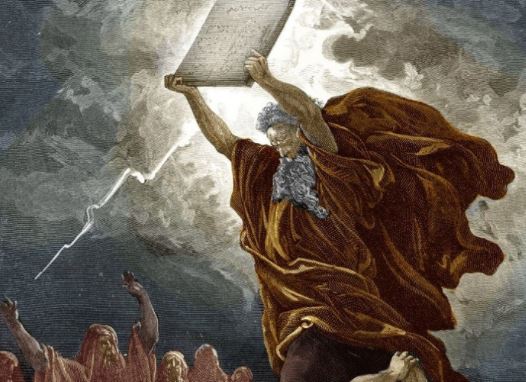
An illustrated section from Gustav Doré’s “Moses Breaking the Tablets of the Law”
In this week’s parasha, Ki Tisa, we read how Moses goes up Mount Sinai on three separate occasions. His first ascent concludes with receiving the Two Tablets, only to come down and see the horror of the Golden Calf. Following this, the Torah tells us that “Moses returned to God”, back up the mountain, to address the Calf fiasco and its aftermath (Exodus 32:31). Moses then came back down to pitch a “Tent of Meeting” (33:7) where he could more regularly communicate with God without having to ascend the Mountain, and for when the Israelites would leave Sinai to head to Israel. Moses asked to see God’s Presence directly, and God replied that no mortal can see God and live, though He would show Moses His “back”. To do this, God asked Moses to come up Sinai one last time (34:2), where a new set of tablets would be created to replace the shattered ones.
When Moses descended from Sinai for the last time to present the new Tablets, the Torah tells us that “He was there with God for forty days and forty nights; he ate no bread and drank no water…” (34:28) Moses had gone up Sinai three times, each for forty days, making 120 days total. Indeed, if one counts the days of the Jewish calendar between Shavuot and Yom Kippur, one would find 120 days, since Shavuot is the date of the initial Sinai Revelation while Yom Kippur is when God forgave the Israelites for the Golden Calf and Moses returned with the new Tablets. At the end of Moses’ three sessions of intense meditation with God, his face glowed and the people could no longer look at him directly (34:29-30). Moses would henceforth wear a mask.
The Torah motif of going up a mountain to spend time in prayer and divine meditation spread all over the world, and we find very similar descriptions in other faiths that emerged after Judaism. Buddha, for instance, spent 40 days (or 49 days) up on a mountain meditating under a bodhi tree to attain enlightenment, and also abstained from food and water during that time. Jesus is said to have spent forty days in the wilderness without food and water, and Mohammad purportedly received his first revelation while meditating and fasting for days on Mount Hira at the age of 40. Despite the fact that Moses was undoubtedly the first, meditation today is associated more with Eastern faiths, and strangely not with Judaism.
The truth is that meditation has always been central to Judaism since ancient times. In fact, it is highly likely that it was Jewish exiles who introduced meditative practices around the world after their expulsion from Israel in the 6th century BCE at the hands of the Babylonians. It is intriguing to point out that many world religions began in the century following Israel’s exile, including Buddhism and Confucianism, as well as the Pythagorean and Orphic religions in Greece. Even ancient Zoroastrianism and Hinduism were heavily influenced by spreading Torah ideas in the middle of the first millennium BCE.
Today, science has uncovered the vast benefits of regular meditation—everything from reducing stress and improving sleep, to boosting the immune system and accelerating healing, even positively impacting the expression of our genes! So, what does the Torah tradition have to teach us about meditation, and what are some specific Jewish meditative techniques we can put into practice daily to enhance our lives? Continue reading