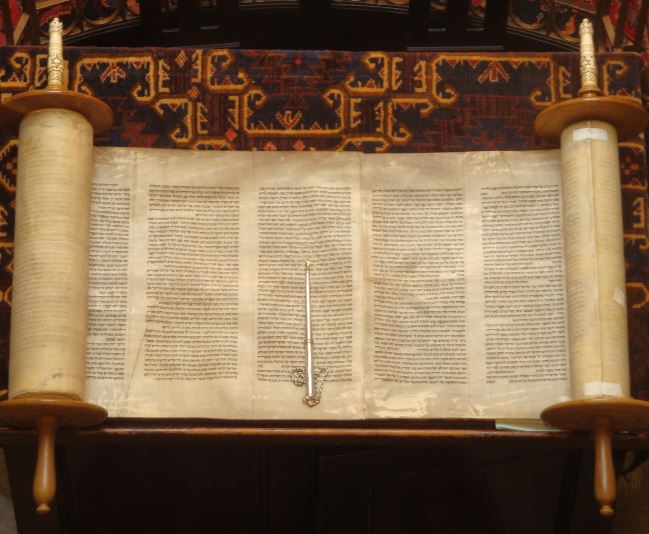
 This week’s parasha (outside of Israel) is Emor, which begins with God commanding Moses to speak to the kohanim and to teach them. This is one of the key verses having a clear reference to the Oral Torah. Moses relayed not just the five books of the Written Torah, but also many more oral teachings and explanations that were passed down over the millennia. Another source for the Oral Law is Exodus 34:27, where God tells Moses to write down the words of Torah, and then adds that al pi—literally meaning “orally” or “on the mouth”—of these words of Torah, God is making a covenant with us. The Sages point out that this is another major allusion to the Torah sh’b’al peh, the Oral Torah (see Gittin 60b).
The necessity of an Oral Torah is actually self-evident since Torah laws are very brief and usually come with no explanations or details. For instance, we are told numerous times to bind certain signs upon our arms and to tie fringes on our clothes, but there is no description of what these things should look like. Another classic example is Deuteronomy 12:21 where we are told to slaughter animals for consumption “as I have instructed you”, yet no instructions or slaughtering procedures are written anywhere in the Torah. The obvious implication is that Moses relayed many teachings and instructions that were not recorded.
Eventually, those teachings did come to be recorded in the Mishnah. The term Mishnah comes from the verb lishnot (לשנות), “to repeat”, since these laws and teachings were originally learned through constant repetition, to reinforce the knowledge and memorize it crystal clear. Less known is that, since the same exact verb is leshanot (לשנות), meaning “to change”, the Oral Law was not meant to be written down in order to keep it fluid and flexible.* Judaism is always evolving, and halakhah must change under varying circumstances and as new problems emerge. The central idea behind having an Oral Law was so that it would not come to be “set in stone” like the written law. The Torah thus remains fresh in every generation, and open to new ideas, applications, and chiddushim. This is really the beauty of the Oral Torah. (In fact, when the Arizal relates the different aspects of Torah to the mystical Sefirot, he points out that the Mishnah specifically is in Tiferet, “Beauty”, see Sha’ar Ruach HaKodesh.)
On a more mystical level, Mishnah (משנה) has the same letters and numerical value as Neshamah (נשמה), “soul”, for while the Written Torah is the “body” of Judaism, the Oral Torah is its inner dimension and true essence. (This is also why it is customary to recite Mishnayot in honour of the dead, to elevate their souls.) It is important to clarify that while the Mishnah is certainly not the entire Oral Torah, it is the first text of the Oral Torah and the foundation for the rest. Continue reading →