Tag Archives: Purim

Secrets of the Mishkan

A Modern Replica of the Mishkan in Timna, Israel

This week’s parasha, Terumah, begins with God’s command for the Israelites to build a Mishkan, an Earthly “dwelling place” for the Divine. God tells Moses (Exodus 25:2-8):

Speak to the children of Israel, and have them take for Me an offering; from every person whose heart inspires him to generosity, you shall take My offering. And this is the offering that you shall take from them: gold, silver, and copper; blue, purple, and crimson wool; linen and goat hair; ram skins dyed red, tachash skins, and acacia wood; oil for lighting, spices for the anointing oil and for the incense; shoham stones and filling stones for the ephod and for the choshen. And they shall make Me a sanctuary and I will dwell in their midst…

God requests that each person donate as much as they wish to construct a Holy Tabernacle. He concludes by stating that when the sanctuary is built, He shall dwell among them. The Sages famously point out that the Torah does not say that God will dwell in it, but in them. The sanctuary was not a literal abode for the Infinite God—that’s impossible. Rather, it is a conduit between the physical and spiritual worlds, and a channel through which holiness and spirituality can imbue our planet.

In mystical texts, we learn that the Mishkan was far more than just a temple. Every piece of the Mishkan—every pillar and curtain, altar and basin, even the littlest vessel used inside of it—held tremendous significance and represented something greater in the cosmos. In fact, the whole Mishkan was a microcosm of Creation. This is the deeper reason for why the prohibitions of Shabbat are derived from the construction of the Mishkan. The passage we cited above appears one more time in the Torah, in almost the exact same wording, ten chapters later. In that passage, we read the same command for each Israelite to donate the above ingredients to build a sanctuary. The only difference is that in the second passage, the construction of the Mishkan is juxtaposed with (Exodus 35:1-2):

Moses called the whole community of the children of Israel to assemble, and he said to them: “These are the things that God commanded to make. Six days work may be done, but on the seventh day you shall have sanctity, a day of complete rest to God; whoever performs work on this day shall be put to death…”

From this clear connection, the Sages learn that the actions required to construct and maintain the Mishkan are the same ones we must abstain from on the Sabbath. There are 39 such melakhot in all. On a more mystical level, these 39 works are said to be those same actions performed by God in creating the universe! For example, the first prohibited work (see Shabbat 7:2) is zorea, “sowing”, or seeding the earth, just as we read in the account of Creation that God said (Genesis 1:11) “Let the earth bring forth grass, herb-yielding seed, and fruit-tree bearing fruit after its kind, in which its seed is found on the earth.” Perhaps the most famous prohibition, mav’ir, “lighting” a flame, parallels God’s most famous Utterance, “Let there be light” (Genesis 1:3). Such is the case with all 39 prohibited works. In this way, when a Jew rests on the seventh day from such actions, he is mirroring the Divine Who rested from these works on the original Seventh Day.
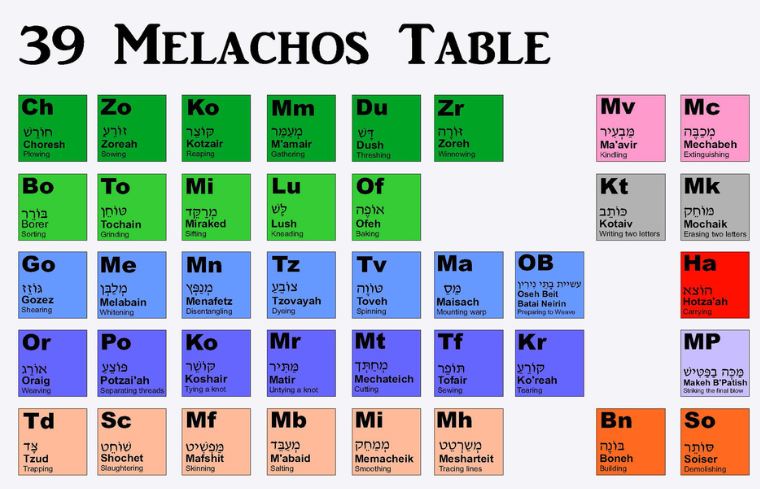
A Periodic Table of the 39 Melachos, by Anshie Kagan

The Mishkan and the Holidays

The Zohar (II, 135a) comments on this week’s parasha that the ingredients of the Mishkan symbolize the Jewish holidays. The first ingredient is gold, and this corresponds to the first holiday of the year, Rosh Hashanah. The second ingredient, silver, corresponds to Yom Kippur. This is because silver and gold represent the two sefirot of Chessed, “kindness”, and Gevurah, “restraint”. The latter is more commonly known as Din, “judgement”. In mystical texts, silver and gold (both the metals and the colours) always represents Chessed and Gevurah. Rosh Hashanah is judgement day, which is gold, and Yom Kippur is the day of forgiveness, silver.

The third ingredient, copper, corresponds to the next holiday, Sukkot. The Zohar reminds us that on Sukkot, the Torah commands the Israelites to sacrifice a total of seventy bulls, corresponding to the seventy root nations of the world. This is why the prophet Zechariah (14:16) states that in the End of Days, representatives from all nations of the world will come to Jerusalem specifically during Sukkot to worship God together with the Jews.
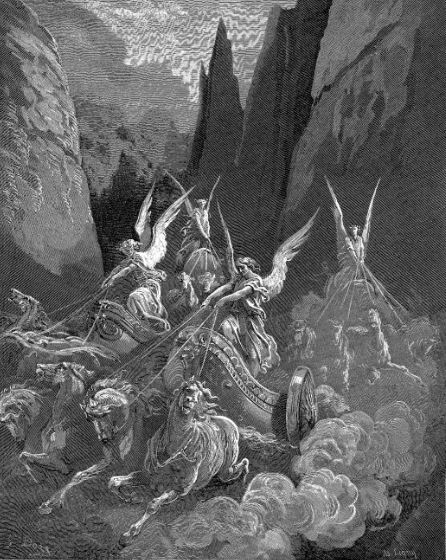
‘Vision of the Four Chariots’ by Gustave Doré

The Zohar explains that copper is Sukkot because copper (at least in those days) was the main implement of war, which the gentiles use to build their chariots and fight their battles. This, the Zohar explains, is the meaning of another verse in Zechariah (6:1), which states that “…there came four chariots out from between the two mountains; and the mountains were mountains of copper.” The Zohar concludes that the Torah prescribes the sacrifices to be brought in decreasing order (thirteen on the first day, twelve on the second, eleven on the third, etc.) to weaken the drive for war among the gentile nations.

The next ingredient is the special blue dye called techelet, which corresponds to Pesach. As the Talmud (Sotah 17a) states, techelet symbolizes the sea, and the climax of the Exodus was, of course, the Splitting of the Sea. Only at this point, the Torah states, did the Israelites believe wholeheartedly in God, and his servant Moses (Exodus 14:31). The Zohar therefore states that techelet holds the very essence of faith.

Following this is the purple dye called argaman, which is Shavuot. It isn’t quite clear why the Zohar relates these two. It speaks of purple being a fusion of right and left, perhaps referring to the fact that purple (or more accurately, magenta) is a result of a mixing of red and blue. This relates to the dual nature of Shavuot, having received on that day the two parts of the Torah (Written and Oral), and later the Two Tablets, in the month whose astrological sign is the dual Gemini. There is a theme of twos, of rights and lefts coming together. We might add that Shavuot is traditionally seen as a sort of “wedding” between God and the Jewish people, with the Torah being the ketubah, and Mt. Sinai serving as the chuppah.

The sixth ingredient, tola’at shani, red or “crimson” wool, corresponds to the little-known holiday of Tu b’Av. Although the Mishnah (Ta’anit 4:8) states that on Tu b’Av the young single ladies of Israel would go out in white dresses to meet their soulmates, the Zohar suggests that they also wore crimson wool, based on another Scriptural verse (Lamentations 4:5).

Tu b’Av is actually the last holiday that the Zohar mentions. The remaining nine ingredients correspond to the nine days after Rosh Hashanah, through Yom Kippur, ie. the “Days of Repentance”. This brings up a big question: The Zohar relates the ingredients of the Mishkan to the major Torah holidays: Rosh Hashanah and Yom Kippur, and the three Pilgrimage festivals (Pesach, Shavuot, Sukkot). Naturally, it omits Chanukah, Purim, the fasts and minor holidays, which are not explicitly spoken of in the Torah. So, why does it mention Tu b’Av? Before we even begin to answer this question, we should already recognize the huge significance of Tu b’Av, strangely one of the most oft-forgotten holidays on the Jewish calendar.

Tu b’Av: a Torah Holiday

The holidays that are not explicitly commanded by God in the Torah were all instituted by future Sages. Purim was instituted by Esther and Mordechai, and first celebrated in Persia. Yet, the Talmud tells us that the majority of the Sages in the times of Esther and Mordechai initially rejected their call to establish Purim as a holiday! (See Yerushalmi, Megillah 6b-7a.) Interestingly, historians and archaeologists have not found a single Megillat Esther among the thousands of Dead Sea Scrolls and fragments, suggesting that the Jews who lived in Qumran did not commemorate Purim. Clearly, it was still a point of contention as late as two thousand years ago.

Chanukah, meanwhile, is not found in the Tanakh at all. Although two Books of Maccabees exist, the Sages did not include them in the final compilation of the Tanakh. Similarly, the later Sages of the Mishnaic and Talmudic era did not find it fit to have a separate tractate for Chanukah, even though there is a separate tractate for every other big holiday.

The fast days are not festivals, but sad memorial days instituted by the Sages to commemorate tragic events. Tu b’Shevat appears to have no Scriptural origins. Yet, Tu b’Av does. The Talmud (Ta’anit 30b) tells us that one of the historical events that we commemorate on Tu b’Av is the fact that the tribe of Benjamin was permitted to “rejoin the congregation of Israel”. In the final chapters of the Book of Judges, we read how a civil war emerged in Israel, pitting all the tribes against Benjamin because of the horrible incident where a woman was brutally raped in Gibeah. The tribe of Benjamin was subsequently cut off from Israel, with their men forbidden from marrying women of other tribes. The ban was eventually lifted on Tu b’Av. The men of Benjamin were told:

“Behold, there is a festival of God from year to year in Shiloh, which is on the north of Bethel, on the east side of the highway that goes up from Bethel to Shechem, and on the south of Lebonah.” And they commanded the children of Benjamin, saying: “Go and lie in wait in the vineyards; and see, and, behold, if the daughters of Shiloh come out to dance in the dances, then come out of the vineyards, and take every man his wife of the daughters of Shiloh, and go to the land of Benjamin…” (Judges 21:19-21)

The Tanakh is clearly describing what the Talmud says would happen on Tu b’Av, when the young ladies would go out to dance in the vineyards to find their soulmates. The exact Scriptural wording is that this day is a chag Adonai, “festival of God”. This is precisely the term used by Moses during the Exodus (Exodus 10:9), possibly referring to Pesach, or more likely to Shavuot (as Rabbeinu Bechaye comments). It is also the term used later in the Torah to describe Sukkot (Leviticus 23:39). Thus, Tu b’Av is evidently a Torah festival, too! And this is why the Zohar singles it out from all the other, “minor” holidays. It seems Tu b’Av is not so minor after all.

The Zohar concludes its passage on Terumah by saying that although we do not have the ability to offer Terumah today, and there is no Mishkan for us to build, we nonetheless have an opportunity to spiritually offer up these ingredients when we celebrate the holidays associated with them. When one wholeheartedly observes Rosh Hashanah, it is as if they offered up gold in the Heavenly Temple, and during Yom Kippur one’s soul brings up silver. Over the days of Sukkot, there is an offering of copper up Above, and on Pesach it is techelet; on Shavuot, argaman, on Tu b’Av, tola’at shani, and on the Days of Repentance the remaining ingredients. On these special days, we help to construct the Heavenly Abode. And this is all the more amazing when we remember that Jewish tradition maintains the Third Temple will not need to physically be built as were the first two, but will descend entirely whole from Heaven.
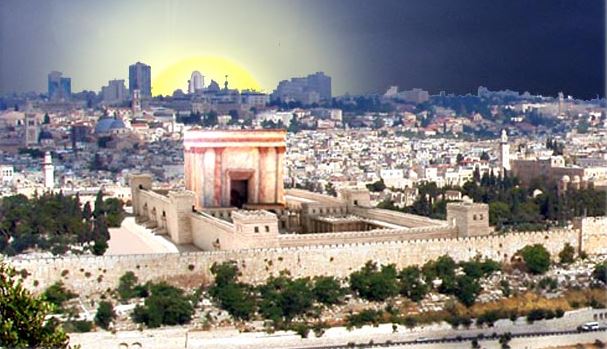
Courtesy: Temple Institute
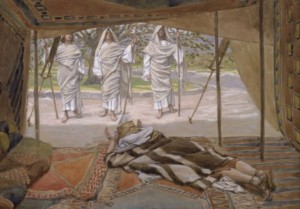
The Guardian Angels of Israel

‘Abraham and the Three Angels’ by James Tissot

This week’s parasha, Vayera, begins with Abraham being visited by a trio of angels. Jewish tradition holds that these angels were Michael, Gabriel, and Raphael. The Ba’al HaTurim (Rabbi Yakov ben Asher, c. 1269-1343)—famous for his numerological commentary—points out that the words “And behold three…” (והנה שלשה), referring to the three angels, has the same gematria (701) as “these are Michael, Gabriel, and Raphael” (אלו מיכאל גבריאל ורפאל).

Rashi (Rabbi Shlomo ben Itzchak, 1040-1105) comments that each angel came for a specific mission: Michael to bless Abraham and Sarah with news of their impending child; Gabriel to destroy Sodom (which happens right after in the Torah); and Raphael to heal Abraham from his circumcision (which happened just before). The root of Gabriel is gevurah, “strength” or “restraint”, which is why Gabriel often appears in difficult situations, or acts of destruction. The root of Raphael is refuah, “healing”, so he appears whenever a recovery is required. Michael is the guardian angel of Israel, as we are told explicitly in Daniel 12:1.

These three angels regularly appear together. They were originally depicted as the highest of the angels in the Heavens. Later mystical literature would place others above them (namely Metatron). Still, the trio of Michael, Gabriel, and Raphael remain the most well-known. What else do we know about them?

Michael: Priest and Saviour

In one mystical passage, the Talmud (Chagigah 12b) outlines the Seven Heavens. The first is called Vilon (“curtain”) and simply refers to the atmosphere stretching over the Earth like a curtain. This is the place of clouds and weather, serving no particular spiritual purpose. Then comes the Rakia, the vast realm beyond Earth’s atmosphere that includes the Sun, moon, and all the stars and planets, ie. outer space. The third Heaven is called Shechakim, which we learn from other sources is the interface between this physical universe and the spiritual realms beyond. The Sages sometimes metaphorically describe it as being composed of millstones, or slabs of pure marble. The Talmud says this is the source of the manna that the Israelites ate in the Wilderness.

The fifth, sixth, and seventh Heavens are called Ma’on, Machon, and Aravot, but it is the fourth Heaven that is of particular interest for the present discussion. Here one will find the illustrious Yerushalaim shel Ma’alah, the Heavenly Jerusalem, a spiritual version of the Jerusalem below. Mirroring the one on Earth, there is a Temple up there, too, and it is Michael who serves as its High Priest.

Michael also serves as “Prince of Israel” and our Heavenly Guardian. In this role, he stands opposite Samael, the Heavenly “Accuser” who seeks to harm Israel. Hence, Michael stands at the gates of Heaven, admitting the righteous and guiding their souls. Similarly, he was Israel’s guide during their forty years in the Wilderness, being identified with the “angel that will go before you” (Exodus 23:20, 32:34), as God has promised (see Midrash haNe’elam, Beresheet 2).

Naturally, Michael is a great saviour for the Jews. It was he who saved Abraham from the fiery furnace (Beresheet Rabbah 44:16), and protected Sarah when she was abducted by Avimelech (Pirkei d’Rabbi Eliezer 26). In one intriguing Midrash (Yalkut Shimoni, Beresheet 134), we learn that Michael saved the baby that was born from Dinah’s rape by Shechem. Michael took the baby to Egypt, into the care of a wealthy childless couple. That wealthy man was Potiphar, and the adopted baby was Osnat, future wife of Joseph!

Gabriel and the Founding of Rome

When it comes to Joseph, it was Gabriel that helped him throughout his journey. According to the Talmud (Sotah 36b), Gabriel taught Joseph overnight (or perhaps “uploaded” into his brain) knowledge of the seventy languages, which allowed him to become viceroy of Egypt. Gabriel also taught Joseph all of the esoteric mystical wisdom of the Torah (while Raphael taught the same wisdom to Isaac; see Ravad on Sefer Yetzirah).

The Talmud credits Gabriel with setting the foundations of Ancient Rome (Shabbat 56b). This happened on the very same day that King Solomon married an Egyptian princess. Although Solomon’s intensions were certainly good, his many marriages spiralled out of control, and ultimately led to his downfall. In poetic fashion, King Solomon first builds Jerusalem’s Temple, and simultaneously sows the seeds of its destruction, for Rome would go on to destroy Jerusalem’s Temple for good, ushering in an endless exile which we are still in.

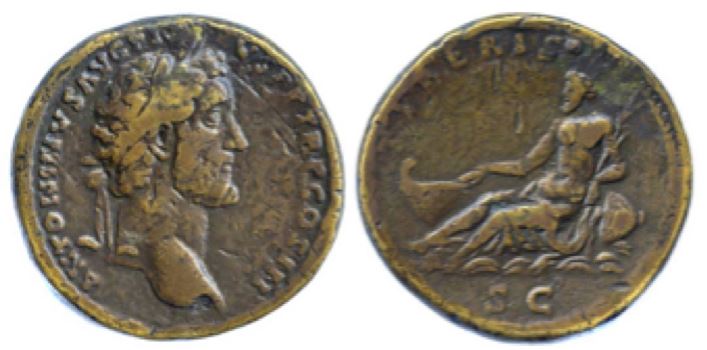
Interestingly, archaeologists have found coins bearing images depicting this version of Rome’s founding. The coins show a divine being of some sort planting reeds in the Tiber River to set the foundations of the “eternal city”, just as the Talmud describes. These coins were minted in the time of Emperor Antoninus Pius, which is most fitting because the Talmud tells us that a Roman emperor named Antoninus was good friends with Rabbi Yehudah haNasi, and the two engaged in many philosophical discussions.

Coins minted by Emperor Antoninus depicting the founding of Rome.


The above essay is an excerpt from Garments of Light, Volume Three.
To continue reading, get the book here! 

Can Women Wear Pants?

In this week’s parasha, Ki Tetze, we read that “A man’s attire shall not be on a woman, nor may a man wear a woman’s garment because whoever does these is an abomination to Hashem, your God.” (Deuteronomy 22:5) In addition to the general prohibition of cross-dressing, this verse is typically used as a source for related rules such as, for example, forbidding women to wear pants, which are considered “man’s attire”. A deeper examination of the classic commentaries reveals some surprising things.

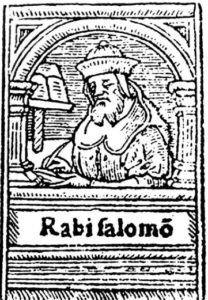
A 16th-century illustration of Rashi

Rashi (Rabbi Shlomo Itzchaki, 1040-1105) points out on this verse that cross-dressing is referring to a person who completely takes on the appearance of the opposite gender, so much so that they are able to go out among members of the opposite gender without being recognized. The ultimate purpose of this is to commit an act of adultery or some other sexual immorality. This is why the Torah says it is an “abomination”. The abomination, Rashi holds, is not the act of cross-dressing itself, but rather the abominable sexual sin that follows. So, technically, a person who wears the clothes of the opposite gender in private, without going out in public, or committing any sexual act, hasn’t sinned according to the letter of the Law. This is also one reason why many permit wearing costumes of the opposite gender on Purim, for there is no intent of sexual immorality.

On a related note, Rashi comments that for a man to shave his underarm or pubic hair is also forbidden, as this is a practice of women. Again, all depends on intent. If the man is doing so to appear feminine, it is certainly prohibited. However, if the man is doing so only for hygienic reasons, there is technically no problem.

While for a man to put on a woman’s dress (simlat ishah) is clearly forbidden by the Torah, for a woman to put on a man’s garment is not so clear. The term used is kli gever, literally a “male instrument”. The simplest interpretation is that it is referring not to clothing—which is not an instrument—but to weapons. The use of the word gever (as opposed to ish, “man”) is further proof, since the root of gever is associated with strength (gevurah) or battle. Kli gever, therefore, is very likely just a “battle instrument”.

This is how Chizkuni (Rabbi Chizkiyahu ben Menashe, c. 1250-1310) holds, and in doing so, brings as an example the Biblical Ya’el. Recall that Ya’el was the righteous woman who killed the wicked military oppressor Sisera (Judges 4-5). Chizkuni writes how Ya’el used a tent peg to kill Sisera, for it is forbidden for a woman to have implements of war. Chizkuni concludes with a further proof from an earlier commentator, the Ibn Ezra (Rabbi Avraham ben Meir ibn Ezra, 1089-1167). Ibn Ezra explained that the parasha begins by stating Ki tetze l’milchama, “When you go out to war” so the prohibition of kli gever is evidently referring to war instruments. Going out to battle, he says, is unbefitting a woman, and more gravely, would result in female and male soldiers fornicating.

Ibn Ezra also mentions the “abominable” connection to sexual immorality. Unlike Rashi, who speaks of adultery, Ibn Ezra cites those who speak of sodomy, or homosexual intercourse. A man might dress like a woman with the intention of seducing another man (or a woman of another woman). Ibn Ezra does not agree with this opinion, and says it is already abominable even without this, for one who cross-dresses is messing with “God’s Work”.

Pants or Skirts?

If the Torah does not explicitly prohibit women from wearing “male garments”, what is the issue with a woman wearing pants? In ancient times, there were no pants at all, of course. Everyone wore various tunics and robes. There were certainly pants by Rashi’s time, and one of his comments on the Talmud is particularly intriguing:

In discussing which parts of the body are immodest to expose, the Sages state that the shok is inappropriate to reveal, or to look at (Berachot 24a). The big question is: what is a shok? Some say the shok is the thigh, while others are more stringent and say the shok is the calf. In the latter case, wearing pants is actually favourable since it completely covers both legs down to the feet. Indeed, Rashi suggests in another place that women were required to wear pants for purposes of modesty!

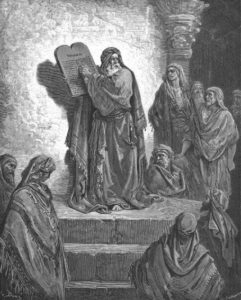
“Ezra reading the Law in the hearing of the people” by Gustav Doré

The Talmud (Bava Kamma 82a) states that Ezra the Scribe made ten decrees upon Israel:

That the Torah be read [publicly] during Minchah on Shabbat; that the Torah be read [publicly] on Mondays and Thursdays; that courts be held on Mondays and Thursdays; that clothes be washed on Thursdays; that garlic be eaten on Fridays; that the housewife rise early to bake bread; that a woman must wear a sinnar; that a woman must comb her hair before performing immersion [in a mikveh]; that merchants be allowed to travel about in the towns, He also decreed immersion to be required by those to whom “pollution” has happened.

One of Ezra’s pronouncements was that women should wear a sinnar in the interests of modesty. Rashi comments here that a “sinnar” is like michnasaim, “pants”. Apparently, pants might be more modest than skirts.

Modesty and Halacha

Perhaps the major issue of wearing pants is that of pisuk raglaim, “separating the legs”. It is immodest for a woman to do so, and this has implications in a range of areas, particularly in horseback riding, which is discussed in the Talmud (Pesachim 3a). While the Sages suggest that a woman should ride a horse, camel, or donkey by sitting side-saddle, it goes on to quote verses from the Torah which clearly depict women, including Rebecca and Tzipporah, riding in the regular way. The Talmud concludes that this is because of “fear”. They were afraid to ride side-saddle, whether because of the animals, or of the night, or some other reason. There is no clear conclusion to the passage, with two of the disciples throwing in the towel and saying the discussion has drained all their energy.

Various halachic sources use pisuk raglaim as a key proof that pants are forbidden for women to wear, since they cause a separation of the legs. Others point out that pants are only a problem if they are tight-fitting, making a clear, visible “separation of legs”. So, loose pants might be permissible. It is said that Rabbi Yosef Eliyahu Henkin (1881-1973) permitted loose pants. His grandson, Rabbi Yehuda Herzl Henkin, shows that pisuk raglaim only refers to spreading legs in a sexual nature (as in Ezekiel 16:25, where the term originates). It has nothing to do with wearing pants—or even horseback riding, for that matter. (See his Bnei Banim, Vol. 4, Siman 28, Passage 6). Meanwhile, Rav Ovadia Yosef (1920-2013) ruled that it is sometimes better for women to wear loose pants than tight or short skirts (Yabia Omer, Vol. 4, on Yoreh De’ah 14).

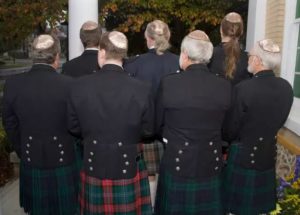
In Scotland, it is still customary to wear a kilt to a wedding. Jews in Scotland wear kilts, too. (Credit: Brian at XMarksTheScot.com)

Finally, pants are not considered exclusively for men in today’s society. Women are just as likely to wear pants as men are. A woman that wears pants, even in public, does not set off any alarms in the public eye, just as a man wearing a kilt—skirt—in 18th century Scotland wouldn’t stand out. Much depends on the surrounding society and culture. Today, Jewish men are forbidden from wearing skirts or dresses, but in ancient times it was common for them to wear skirt-like and dress-like garments. This is illustrated in the Torah itself, which warns that the altar should have ramps instead of stairs, so that the priests would not have to lift their legs and expose themselves (Exodus 20:22). There were no pants or underwear in Biblical times after all.

While mainstream society should not dictate our modesty standards, it nonetheless plays a role. And while every Jewish woman (and man) must still prioritize utmost modesty, a woman who chooses to occasionally wear loose pants (especially in situations where skirts would be uncomfortable or inappropriate like, for example, horseback riding) certainly has upon whom to rely.


For more on pisuk raglaim and the modesty of pants, see here:

http://parsha.blogspot.com/2008/08/would-rashi-necessarily-condemn-pants.html

http://parsha.blogspot.com/2008/08/does-gemara-in-nedarim-prohibit-close.html