In this week’s Torah portion, Noach, we read about how the seventy primary descendants of Noah settled the Earth after the Great Flood. Noah had three sons, and it is often said that they divided the three continents of the Old World amongst them: Yefet (Japheth) got Europe, Shem got Asia, and Ham got Africa. This is not exactly accurate.
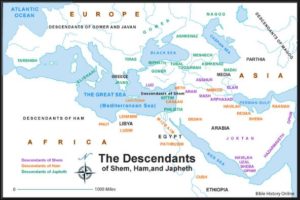
For one, Canaan is a son of Ham, but did not inhabit Africa, while Nimrod is said to be a son of Cush—also of Ham—yet we know Nimrod ruled Mesopotamia (Genesis 10:10). Another son of Ham is Mitzrayim, which is Egypt, yet Mitzrayim’s own children include Pathrusim and Caphtorim, names generally associated with Greek lands. (There is historical evidence to suggest that the early pre-Greek peoples did come from Egypt.) Yavan, the classic term for Greece, is a son of Yefet. As discussed in the past, Yavan is the same as Ionia, which is the western coast of Turkey, then inhabited by Greek-speaking peoples. (The famous city of Troy was in Ionia, in modern-day Turkey.)
In fact, essentially all of the seventy places inhabited by Noah’s descendants are places in modern Turkey or the Middle East. This makes sense, since the Torah was originally speaking to an audience that was unaware of most of Europe, the Far East, sub-Saharan Africa, and needless to say, the New World. The Torah mentions the origins of those territories that were familiar to the ancient Israelites, and that would have been their immediate neighbours. It also makes sense practically, since Noah got off the Ark in Ararat—probably somewhere in modern Turkey—and his children and grand-children would have settled lands that weren’t too far away from there.

Mt. Ararat, as seen from Yerevan, Armenia. It isn’t certain whether this Ararat is the Biblical Ararat.
 One of Noah’s descendants is named Ashkenaz (Genesis 10:3). He is a grandson of Yefet, whose children all seem to have inhabited territories in Asia Minor and Armenia. Ashkenaz, too, is in that vicinity. Even in the time of the prophet Jeremiah centuries later, Ashkenaz was a kingdom in Turkey: “Raise a banner in the land, blow the shofar among the nations, prepare the nations against her, call together against her the kingdoms of Ararat, Minni, and Ashkenaz…” (Jeremiah 51:27) The prophet goes on to call on these and other powers in the area to come upon Babylon. Ashkenaz is one of the Turkish kingdoms bordering Babylon to the north, along with Ararat.
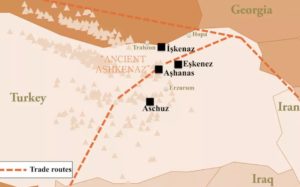
Modern-day villages in Northeastern Turkey. (Credit: theconversation.com)
Amazingly, to this day ethnic Armenians in the region name Ashkenaz as one of their ancestors! This claim is not recent; the fifth-century Armenian scholar Koryun described the Armenians as an Askanazian people. Not surprisingly then, multiple places in Northeastern Turkey today still bear similar-sounding names, including the villages of Iskenaz, Eskenez, and Ashanas.
If Ashkenaz is a place in Turkey, how did it become associated with European Jews? Did Ashkenazi Jews come from Turkey?
Debunking Khazaria
 One popular explanation for the Turkey-Ashkenaz connection points to the Kingdom of Khazaria. This was a wealthy and powerful kingdom that ruled the Caucasus, southern Russia, and parts of Turkey and Eastern Europe in the Middle Ages. Historians credit the Khazars with checking the rapid Arab conquest, and preventing a Muslim takeover of Europe from the East. It is said that around 740 CE, King Bulan grew tired of his people’s backwards pagan beliefs and converted to Judaism. According to legend, he had invited representatives of the major faiths to argue their case, and concluded that Judaism was the true faith. (This is the basis of Rabbi Yehuda haLevi’s [c. 1075-1141] famous text, Kuzari.)
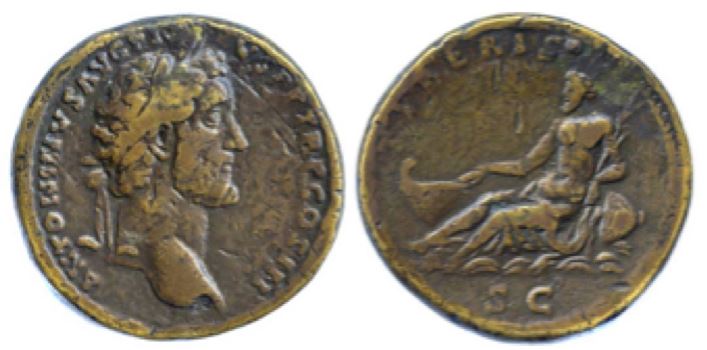
Although Bulan did not impose his new religion on anyone, it is thought that much of his kingdom had become Jewish anyway within about a century. Remarkably, a large reserve of antique Khazar coins was found in Sweden in 1999, bearing the inscription “Moses is the Prophet of God”. (Modeled on, and sometimes just refashioned from, Arab coins saying that “Muhammad is the Prophet of Allah”!) Archaeologists have found similar Khazar coins all over the Old World, from England to China, showing the tremendous extent of Khazaria’s wealth and influence.
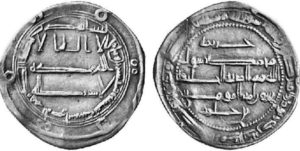
Khazar coin from c. 837 CE, with the inscription “Moses is the prophet of God”.
Like all kingdoms, Khazaria had an expiration date. It was eventually overrun by the Rus, Mongols, and others. Some say that many Jewish Khazar refugees migrated westward to Europe, and settled in the sparsely populated and resource-rich lands of Germany. Since they had come from a place traditionally known as Ashkenaz, they were labelled “Ashkenazi Jews”. This is a great story, but one that has far too many holes.
From a historical perspective, most scholars reject the Khazar hypothesis simply because there is little evidence that Khazaria experienced a mass conversion to Judaism. It is generally agreed that only a small portion of the Khazar nobility had converted, at best. Khazaria simply attracted many Jews to settle there since it was a rich kingdom with freedom of religion. In that case, any Jewish refugees that might later flee Khazaria to Europe would not be ethnic Khazars anyway.
The Schechter Letter
Then came a huge discovery from the Cairo Geniza. Now known as the Schechter Letter (as it was discovered by Solomon Schechter, 1847-1915), the text is a correspondence between a Khazari Jew and a Sephardi Jew, most likely Hasdai ibn Shaprut (c. 915-970 CE). The letter includes a brief history of Khazaria, and states that Khazaria’s Jews originally came from Persia and Armenia, from which they had fled persecution. One of their descendants, named Sabriel, eventually rose to Khazarian nobility, and finally became king. His wife, Serach, convinced him to go public with their Jewish heritage, and they did, inspiring others in the kingdom to convert to their new king’s religion.
The Schechter Letter confirms that the majority of the Jews in Khazaria were not actually Turkic converts but migrants from Persia and Armenia. Shortly after the letter was written, the Khazari Kingdom fell apart in 969 CE. (We know the letter must have been written after 941 CE, since it refers to a battle in that year for which we have other historical records.) The supposed Jewish exodus from Khazaria would have happened in the ensuing decades.
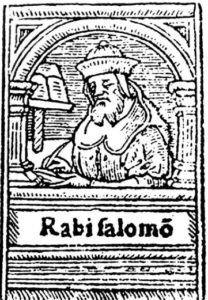
Yet, we read in the commentaries of French-born Rashi (Rabbi Shlomo Itzchaki, 1040-1135) how he learned certain things from his visits to Jewish communities in neighbouring Ashkenaz (see, for example, Ketubot 77a), and that Ashkenaz is undoubtedly German (with Rashi occasionally using German/“Ashkenazi” words, as in Sukkah 17a, for instance). This implies that by Rashi’s time—less than a century after the fall of Khazaria—a geographical region in Western Europe referred to as “Ashkenaz” was already well-known, with Jews there freely conversing in German. It is unlikely that this would happen so soon after the fall of Khazaria; Ashkenaz must have existed long before.
Besides, we know that Jews already lived in Central Europe at the time of Charlemagne (742-814 CE), who had a good relationship with his Jewish subjects. Charlemagne was born right around the time King Bulan is supposed to have converted to Judaism, and before the rise of Sabriel (whom some identify with Bulan). This alone proves that Jews were already living in Europe long before any Khazari Jews appeared on the scene.
Among the Ashkenazi Jews of the Middle Ages themselves, the tradition was that they had been there since the destruction of the Second Temple. For example, the Rosh (Rabbi Asher ben Yechiel, c. 1250-1327) wrote in one of his responsa (20, 20) that when he moved to Toledo, Spain:
I would not eat according to [Sefardi] practice, adhering as I do to our own custom and to the tradition of our blessed forefathers, the sages of Ashkenaz, who received the Torah as an inheritance from their ancestors from the days of the destruction of the Temple. Likewise the tradition of our predecessors and teachers in France is superior…

A portrait identified with Rabbeinu Asher ben Yechiel, the “Rosh”
The Rosh speaks of three distinct European Jewish communities: Sefarad, Ashkenaz, and Tzarfat (France). This makes one wonder whether Rashi would have considered himself Ashkenazi (as people typically see him today) or Tzarfati? Rashi was born and died in Troyes, France, though he spent time in Worms and Mainz in Germany, hence the reference above to his having learned things while visiting “Ashkenaz”. This implies that Rashi may not have considered himself Ashkenazi at all. (His father was called Rabbi Itzchak haTzarfati, and though he lived for a time in Worms, probably hailed from Lunel in Southern France.) Whatever the case, we see that the Sefardi, Ashkenazi, and Tzarfati Jewish communities were already firmly entrenched at the time of Khazaria’s fall.
Delving into Ashkenazi Genes
Science can shed further light on Ashkenazi origins. One study of mitochondrial DNA (mtDNA, which is passed strictly from mother to child) found that some 40% of Ashkenazi Jews come from a group of mothers in Europe, possibly converts, approximately 2000 years ago (another related study here). This would have been around the destruction of the Second Temple. We know that many Jews fled Judea (or were expelled) at the time, and settled across the Roman Empire and beyond. Similarly, a study of Y chromosomes (passed strictly from father to son) shows that most Ashkenazi Levites have a common ancestor who lived at least 1500 years ago, most likely in the Middle East or already having migrated to Europe. These scientists conclude that the Khazar hypothesis is “highly unlikely”.
Other genetic studies do appear to show high degrees of relatedness between Turkic and Iranian peoples with Ashkenazi Jews, especially males. Of course, Jews have lived and migrated just about everywhere, and undoubtedly mixed with local populations, while drawing numerous converts. One interesting study found that about 5% of Ashkenazi males are part of the Q3 haplogroup, part of the wider Q group which represents Native Americans and Asians. The researchers concluded that Q3 entered the Jewish gene pool sometime in the 1st millennium. Some say this is due to the Ashina Turks (among the Khazar elite) who converted to Judaism and took Jewish wives. Either way, it is only a tiny minority of Ashkenazis that carry such genes.*
What we see from genetic studies is that most Ashkenazi Jews today descend from ancestors that were already in Europe long before the rise of the Khazars. Historical evidence confirms the existence of widespread Jewish communities in Europe before the time of Khazaria, too. In reality, the Khazar hypothesis keeps being resurrected because it is a convenient tool for anti-Semites to attack modern Jews as “imposters” (meanwhile completely forgetting the other half of the world’s Jews which are not Ashkenazi at all!) or for anti-Zionists to deny a Jewish connection to the land of Israel.
Having said all that, we must still answer the key question: where did the “Ashkenazi” label come from?
Adapting Names
When we look at the seventy “original” nations—descendants of Noah—we find that they represent a very small geographical area. Of the seventy, fourteen come from Yefet and represent Asia Minor, Armenia, and the Aegean islands (Genesis 10:5), nine are Cushites (presumably dark-skinned people), eight of Mitzrayim, twelve are Canaanites, and twenty-six are Middle Eastern, or possibly even just Mesopotamian. As already mentioned, the Torah’s narratives are confined to a narrow geographical space that was relevant to the ancient Israelites.

A “Table of Nations” from the ArtScroll Stone Chumash
When Jews started migrating out of Israel and beyond the Middle East, they needed to come up with names for these new territories they inhabited. So, they adapted the Biblical place-names of locations that no longer existed or whose identity was no longer known. For example, Sefarad became Spain and Tzarfat became France. When scripture speaks of Sefarad or Tzarfat (as in Ovadiah 1:20), it is certainly not speaking of Spain or France! For instance, the prophet Elijah went to Tzarfat, which is described as being next to Sidon (I Kings 17:9). Sidon is, of course, a well-known ancient city, in what is now Lebanon.
For the first Jews who settled in Spain and France, they had migrated the farthest West they could possibly go at the time. For them, these new lands were the most distant from Jerusalem, so they fittingly adapted terms for places described as being exceedingly far from the Holy Land (as in Ovadiah 1:20). They couldn’t use the names of places that were still extant, but only those ancient names that were no longer relevant. In the same fashion they described Germany as “Ashkenaz”, while Bohemia was surprisingly called “Canaan”. Therefore, to say that Ashkenazi Jews are Turkish because Ashkenaz was originally a place in Turkey is like saying French Tzarfati Jews are Lebanese because Tzarfat was originally a place in Lebanon!
 It is worth pointing out here that scholars have also recently pinpointed the Biblical Sefarad. There is now strong historical evidence to identify Sefarad with the ancient town of Sardis, also in Asia Minor (modern Turkey), of course. Sardis was known to the Lydians who inhabited it as Sfard, and to the Persians as Saparda. It goes without saying that Sephardic Jewish origins have nothing to do with Turks, as don’t the origins of Lydians (probably the “Ludim” of Genesis 10:13, or the Lud of Genesis 10:22), nor the Yavanim, the Greek Ionians, all of whom inhabited that same area of Asia Minor.
The Tower of Babel

‘Turris Babel’ by Athanasius Kircher (1602-1680)
After telling us the divisions of the nations in Genesis 10, the Torah goes on to relate the narrative of Migdal Bavel. We are told that the people were all still unified at this point, speaking one tongue. They gathered in Babylon to build a tower to the Heavens, with nefarious intentions. Their plans were thwarted by God, who then scattered the people all over the world and confounded their tongues.
From a mystical perspective, at this point those seventy root nations—which originally inhabited Asia Minor and the Middle East—were spread all around the globe into a multitude of various peoples with new cultures and languages. Thus, all of the world’s thousands of nations and ethnicities, wherever they may be, are spiritually rooted in one of Noah’s seventy descendants.
Consequently, there were those who believed that Ashkenaz was dispersed to Central Europe. What’s amazing is that this was not only a Jewish belief, but a Christian one, too. The evangelical Christian pastor Ray Stedman (1917-1992) wrote:
The oldest son of Gomer was Ashkenaz. He and his descendants first settled around the Black Sea and then moved north into a land which is called Ascenia, and which later became known as the Islands of Scandia, which we now know as Scandinavia. You can trace a direct link between Ashkenaz and Scandinavia.
Basing himself on earlier sources, he lists Ashkenaz as referring to all Saxons, Scandinavians, and Germanic tribes. This argument was made at least as far back as the 4th century (long before the Khazars appeared on the scene), in Eusebius’ Historia Eccliesiastica, where Ashkenaz is Scanzia, another name for Scandinavia and/or Saxony.
Around that same time, the Talmud (Yoma 10a) identifies Gomer (the father of Ashkenaz) with Germamia. While this Germamia is possibly referring to Cimmeria, or Germanikia in Syria—which would have been more familiar to the Babylonian Sages living in the Persian Empire—it is very likely that Jews who settled in Germany would see Germamia as referring to their new land. Combined with the alliteration between “Ashkenaz” and “Saxony”/“Scanzia”, we can understand why the Jews that settled in Germany adapted the name Ashkenaz.
As an intriguing aside, the Talmud cited above holds that Yefet is a forefather of the Persians, too. The Talmud reads: “How do we know that the Persians are derived from Yefet? Because it is written: ‘The sons of Yefet: Gomer, and Magog… and Tiras’” The Sages say Tiras is Paras, Persia. Intriguingly, the Sages seem to connect Magog (of “Gog u’Magog” fame) with the Persians. That might make alarm bells go off in the heads of modern readers who see Iran as playing a central role in an End of Days armagaddeon.
To conclude, the hypothesis that Ashkenazi Jews originate among Turkish converts is completely false. While some Turkish converts certainly joined the Jewish nation in the Middle Ages, Ashkenazi Judaism predates this phenomenon by centuries. Both historical evidence and genetic analyses confirm a European Jewish presence as far back as 2000 years ago.
*Shortly after publishing this article, Kevin Brook pointed out the following to me, from his book The Jews of Khazaria (pg. 204):
Some researchers thought it was possible that these could have been inherited from the Khazars, but this idea is no longer viable. Ashkenazim belong to the Q haplogroups that were later precisely identified as Q-Y2200 (Q1b1a1a1a) and Q-YP1035 (Q1b1a1a1a2a2). On the Y chromosome tree, Q-Y2200’s parent haplogroup Q-Y2225 (Q1b1a1a1) was found in an Italian sample from Sicily, and geneticists determined that QY2225’s distant ancestors had apparently lived in the Middle East. The Ashkenazic branches of Q are very different from Q1a1b-M25 and Q1a2-M346, which are common among Turkic-speaking peoples, and the common ancestor between them all lived many thousands of years ago, far in advance of Khazaria’s existence.