This week’s parasha, Vayetze, begins with Jacob’s famous vision of the Heavenly Ladder. This occurred at a place called Beit-El (literally “House of God”), which our Sages identified with the Temple Mount, where the House of God would be built in the future. The Torah makes sure to point out that the place was originally called “Luz” (Genesis 28:19). The same word appears one more time in this week’s parasha, when Jacob stimulates his sheep to produce different spots, and uses luz as a visual cue for them (Genesis 30:37). Rashi comments that luz is a type of nut, and says that in (Old) French it is called “coldre”. The Old French Anglo-Norman Dictionary defines “coldre” as a hazelnut. In Modern Hebrew, egozei luz refers to hazelnuts, too. Alternatively, it may refer to an almond, as the Midrash (Kohelet Rabbah 12:5) says:
“…and the almond shall blossom” (Ecclesiastes 12:5) Rabbi Levi says this refers to the luz of the vertebrae. Hadrian (may his bones be crushed and his name blotted out) asked Rabbi Yehoshua ben Chananiah: “From what will man ‘blossom’ in the future?” He replied: “From the luz of the vertebrae.” He said to him: “Prove it to me.” [Rabbi Yehoshua] had one brought; he placed it in water but it did not dissolve; he put it in fire, but it was not burnt; he put it in a mill but it was not ground. He placed it on an anvil and struck it with a hammer; the anvil split and the hammer was broken but all this had no effect on the luz.
The wicked Roman emperor Hadrian (who crushed the Bar Kochva Revolt, during which Rabbi Akiva was executed, among countless others) once questioned Rabbi Yehoshua as to how people could be resurrected in the future if their bodies completely decompose. Rabbi Yehoshua answered that there is a special, tiny, nut-like bone in the human body, along the vertebrae, that is indestructible. From this bone, God will rebuild the entire person. Anatomically-speaking, which bone is this? Continue reading →
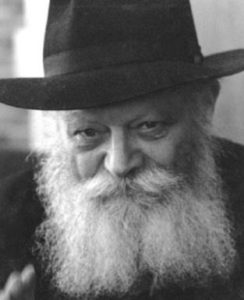
The Lubavitcher Rebbe (Photo Credit: Shlomo Vishinsky and Zev Markowitz/ chaiartgallery.com)
Today is the third of Tammuz, the yahrzeit of Rabbi Menachem Mendel Schneerson, better known as the Lubavitcher Rebbe. There is no doubt that the Rebbe was among the greatest sages of the last century (if not of all time). From the moment he took up the leadership of Chabad, the Rebbe began to make waves in the Jewish world, and quickly transformed Lubavitch into an international powerhouse. Today, Chabad finds itself in 81 countries, operating 3500 institutions.
The Rebbe himself inspired countless souls, both Jewish and non-Jewish. One of the latter was Congresswoman Shirley Chisholm (the first black woman in Congress). When Chisholm was first elected to the House of Representatives, she met fierce opposition and outright racism. Shortly after, she received a call from the Rebbe, who quelled her concerns and offered her advice on how to make the most of her situation. Chisholm went on to create programs that benefited millions of poor people, including the expansion of food stamps across the US. At her retirement breakfast, she said: “If poor babies have milk and poor children have food, it’s because this rabbi in Crown Heights had vision.”
With such vision, along with tremendous wisdom, righteousness, and charisma, it isn’t very surprising that a messianic movement would develop around the Rebbe. Despite the fact that he passed away in 1994, many within the Chabad movement continue to believe that he is Mashiach. Is there substance to this belief?
Mashiach Resurrected
One of the major arguments used by the so-called Mashichistim is a verse in the Talmud (Sanhedrin 98b) that states Mashiach can come from “among the living” or from “among the dead”. The Talmud states that if Mashiach is of the living, it would certainly be Rabbi Yehuda haNasi (who was also called, simply, Rebbi), the great compiler of the Mishnah; if of the dead, it would be the Biblical Daniel. Within Chabad, this passage is used to support the fact that despite the Rebbe’s passing, he may still return to be the messiah.
However, other texts state that Mashiach cannot be from the dead. For example, Midrash Rabbah (on Genesis 49:18) writes how Jacob saw a vision of Samson—who had the potential to be Mashiach—but when Jacob saw Samson’s death, he was saddened that Samson wouldn’t be the messiah and said, “I await Your salvation, Hashem!”
Some believe the Rebbe is not really dead (besides, if Mashiach is from “among the dead”, the Talmud already told us it would be Daniel!) but he is only “concealed”. Multiple Jewish sources state that Mashiach will come, then disappear for a certain amount of time, and then return again. For example, Midrash Rabbah (on Numbers 11:3), writes:
Just like the first redeemer, Moses, revealed himself to the Jews and then concealed himself… similarly, the final redeemer will reveal himself, then conceal himself… and then return and reveal himself again.
Thus, the Rebbe is said to only be “hidden”, and will imminently return. Of course, this isn’t very different from the Christian belief in Jesus’ eventual “second coming” (although it should be noted that Christians believe Jesus actually died, and was not simply “hidden”). Christians have been waiting eagerly for two millennia—much like some in Chabad have been waiting eagerly for over two decades.
In reality, when ancient Jewish sources speak of Mashiach’s concealment and return, they do not mean that Mashiach will disappear for millennia, or even decades. The Midrash cited above itself says that Moses was hidden from the Israelites for three months, and Mashiach would be hidden for only 45 days (though there are other opinions). And so, the potential for the Rebbe being Mashiach appears to have long expired.
The Rebbe on Being Mashiach
One of the things that the Rebbe was adamant about was studying and following the teachings of the Rambam. The Rambam makes it clear who Mashiach is: a Jewish leader who, among other things, successfully reunites the entire nation in Israel (ending the exile), defeats the nation’s enemies, and rebuilds the Temple in Jerusalem. Only one who has successfully accomplished these tasks can be titled “Mashiach”. The Rambam writes that if a person was on his way to fulfilling these, but died in the process, he is clearly not the messiah. The Rambam brings Shimon bar Kochva as an example. Although Bar Kochva was able to push the Romans out of Israel, reclaim the Temple Mount and start rebuilding the Temple, and was even proclaimed the messiah by Rabbi Akiva, he died and his messianic potential died with him.
Although the Rebbe did hint to himself possibly being the messiah in some of his talks (and his followers use those encoded statements as proof), he also said in one of his talks that one is only confirmed to be Mashiach when the Third Temple is built. Obviously, since the Rebbe did not build the Third Temple in his lifetime, he cannot be the messiah. If it turns out that the Rebbe does return somehow in the future, and accomplishes all the messianic tasks, then and only then can he be titled “Mashiach”. To do so now is premature and naïve, if not altogether wrong.
In fact, the Rebbe publicly made clear that he is not Mashiach. In his monumental biography of the Rebbe, Joseph Telushkin devotes a chapter to this question, and writes:
In 1965, Rabbi Avraham Parizh, an elder Chasid who had been with the movement from the time of the Fifth Rebbe, printed letters stating: “With great joy, we can inform you that King Messiah, for whom we have waited so many years, is already among us. He is the holy Lubavitcher Rebbe, Rabbi Menachem Mendel Schneerson, the King Messiah. His address is 770 Eastern Parkway, Brooklyn, New York. He does not need us to choose him since God has chosen him.” Rabbi Parizh printed up many of these letters and started handing them out in Israel. According to one account, Parizh also distributed these letters by dropping them out of a helicopter.
When the Rebbe learned of the letter, he instructed his secretariat to immediately dispatch a telegram to Parizh, dated June 24, 1965: “We were shocked by the letter [you wrote and handed out] and ask that you immediately cease distributing it. Gather and send to the secretariat all copies of the letter, every last one, and please confirm immediately that you have fulfilled this instruction.” Chasidim tell how Parizh spent several weeks scrounging around the streets of Tel Aviv looking for every such sheet he could find…
In 1991, Rabbi Aharon Dov Halprin, the editor of Chabad’s Israeli magazine, Kfar Chabad, wanted to print an article explaining why the Rebbe was worthy of being considered the presumed Messiah. When the Rebbe learned of this he responded sharply, “If you, God forbid, [plan to write] anything even remotely similar, it is preferable that you shut down the periodical completely.”
In an urgent audience to which the Rebbe summoned Chabad activist Rabbi Tuvia Peles, the Rebbe rebuked those who were making Messianic claims about him, saying, “They are taking a knife to my heart” and “they are tearing off parts of me.”
… Some months later, and shortly before the Rebbe’s stroke, the Alaska-based shliach, Rabbi Yosef Greenberg (author of Y’mei Bereishit), brought a letter to be given to the Rebbe in which he referred to him as “King Messiah”. Later that same day, Rabbi Groner told Greenberg that the Rebbe had looked at the letter, thrown it down in frustration, and then wrote on it, “Tell him that when the Moshiach comes, I will give him the letter.”
An even more definitive statement of the Rebbe on this same issue occurred at around the same time. An Israeli journalist, Sarah Davidowitz of the Kol Ha’ir newspaper, approached the Rebbe and said, “We appreciate you very much, we want to see you in Israel; you said soon you will be in Israel, so when will you come?” The Rebbe responded: “That depends on the Moshiach, not on me.” The journalist persisted, “You are the Moshiach!,” to which the Rebbe responded: “I am not”.
In light of this, to call the Rebbe “Mashiach” is highly inappropriate, and against his own wishes. More dangerously, it risks turning Chabad into a religion of its own. After all, Christianity developed in the very same way; in its first decades, it was nearly indistinguishable from Judaism, and was followed almost entirely by Jews. It took a couple of centuries before the divide between Judaism and Christianity was complete, and by that point, Jesus had become a God-like figure.
The same may very well happen with the Rebbe and Chabad in coming decades. Already, there are elements within Chabad who have taken to equating the Rebbe with some kind of god on Earth. Many in Chabad still write letters to the Rebbe, adorn their homes with countless images and elaborate paintings of him, and read out the Rebbe’s letters at important public events (while everyone is asked to rise in honour of the Rebbe’s “presence”, of course). It isn’t uncommon to see children saluting the Rebbe’s empty chair at 770, while worshippers ecstatically chant “long live our master, teacher, and rabbi, the king Mashiach” (see video here). If Chabad’s leaders do not rein in such activity soon, there is little doubt Lubavitch will morph into a religion of its own. And for the Rebbe—who worked so tirelessly to unite all Jews—that would be a most devastating legacy.
For a more detailed analysis of the Rebbe’s messianism, please see here.
This week’s Torah portion is Mishpatim, which is concerned with the first major set of laws that the Israelites received following the Ten Commandments. While the term mishpatim literally means “ordinances” or “judgements”, the Zohar (II, 94a) suggests a very different interpretation:
“And these are the judgements which you shall set before them…” These are the rules concerning reincarnation, the judgement of souls that are sentenced according to their acts.
The Zohar goes on to interpret the laws in the Torah with regards to the mechanisms of reincarnation. For example, whereas the Torah begins by describing a Hebrew servant who is indentured for six years of labour and must then be freed in the seventh year, the Zohar interprets that this is really speaking of souls which must reincarnate in order to repair the six middot before they could be freed. (The middot are the primary character traits: chessed, kindness; gevurah, restraint; tiferet, balance and truth; netzach, persistence and faith; hod, gratitude and humility; and yesod, sexual purity.)
While the Zohar speaks at length about reincarnation, it is the Arizal who systematically laid down the rules of reincarnation and explained the Zohar in depth. His primary disciple, Rabbi Chaim Vital, recorded these teachings in a famous treatise known as Sha’ar HaGilgulim, “Gate of Reincarnation”. The following is a brief condensation of the basic rules of reincarnation that are defined in this tremendous text, answering many of the common questions people have about spiritual transmigration.
Why Do People Reincarnate?
At the start of the eighth chapter, Rabbi Vital writes:
למה מתגלגלים. דע, כי הנשמות יתגלגלו לכמה סבות, הראשונה הוא, לפי שעבר על איזו עבירה מעבירות שבתורה, ובא לתקן. הב’ הוא, לתקן איזו מצוה שחסר ממנו. השלישית היא, שבא לצורך אחרים, להדריכם ולתקנם… לפעמים יתגלגל, ליקח את בת זוגו, כי לא זכה בראשונה לקחתה
Why do people reincarnate? Know that souls reincarnate for several reasons: The first is that one transgressed one of the prohibitions in the Torah, and returns to repair it. The second is to fulfil a mitzvah that one lacks. The third is in order to assist others, to guide them, and rectify them… Sometimes one reincarnates to marry their soulmate, which they did not merit to do in a previous life.
The Ari explains that people mainly reincarnate in order to atone for sins of past lives, or to fulfil mitzvahs that they didn’t do previously. Later, in Chapter 16, we read that people who return do not have to fulfil all the mitzvahs in one lifetime, but only have to accomplish those that their souls are still lacking. Some reincarnate not for their own rectification, but to assist others. We are told elsewhere that these are usually very righteous individuals who agree to return to this world in order to help others.
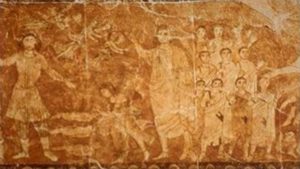
Fresco of the Resurrection of the Dead from the ancient Dura-Europos Synagogue
Some also reincarnate because they either did not marry, or married the wrong person. They must return to reunite with their true soulmate. The Arizal teaches that, unfortunately, some people are so deeply mired in kelipot, negative spiritual “husks”, that they are unable to find their soulmate in this world. These people will reunite with their other half only in Olam HaBa, the “next world” at the time of the Resurrection. With regards to finding soulmates, this is directed particularly at male souls, for it is primarily a man’s responsibility to find his soulmate.
On that note, the following chapter tells us that female souls actually reincarnate very rarely. To begin with, female souls are more refined than male ones, and are unlikely to require more rectifications. What does happen more commonly is that male souls are reincarnated into female bodies! This opens up a number of fascinating scenarios which Rabbi Chaim Vital describes.
What Do People Reincarnate Into?
In Chapter 22, we read that people can reincarnate not only into human bodies, but also animals, vegetation, and even inanimate matter. For example, a person who feeds others non-kosher food reincarnates as a tree; one who sheds blood reincarnates into water; those who transgress various sexual prohibitions reincarnate into bats, rabbits, and other animals; while proud people and those who talk too much reincarnate into bees. (We are told that this is what happened to the judge Deborah who, despite her greatness and wisdom, had a bit of pride and was required to reincarnate into a bee, hence her name devorah, which literally means “bee”!)
It is important to mention, though, that an entire human soul does not fully reincarnate into another organism. Rather, souls are complex entities made up of many different interacting sparks. It is only those sparks that require rectification that return to this world (Chapter 14). Interestingly, the Arizal teaches that when two people really dislike each other, and are constantly in conflict with one another, this is often because the two are sharing sparks from one soul!
How Many Times May One Reincarnate?
Sha’ar HaGilgulim records that a person can reincarnate thousands of times—but only on the condition that they improve at least a little bit in each incarnation. If they fail to improve, they can only reincarnate a maximum of three times. After three strikes, that particular spark is sent to Gehinnom (loosely translated as “hell”) where it will be purified. However, the souls of those who regularly learn Torah are never sent to Gehinnom, and always merit reincarnation. This is one of the incredible protective powers of regular Torah study.
In multiple places, the Arizal teaches about the reincarnations of Abel, the son of Adam. Abel (הבל) had a good side and a bad one. The good side was represented by the letter Hei (ה) of his name, and the bad by the Beit and Lamed (בל). In order to be rectified, the bad part reincarnated in Laban (לבן), the wicked father-in-law of Jacob. Laban didn’t do much better, so he was reincarnated in the gentile prophet Bilaam (בלעם). He, too, was an ungodly person, so the Beit-Lamed soul was reincarnated for the third time in Naval (נבל), the ungrateful man who rejected David. Naval was strike three, and that Beit-Lamed soul no longer returned in the same way in a human reincarnation. It did suffer a punishment at some point in the form of a stone, which is why we read in the Tanakh (I Samuel 25:37) that when Naval died, “he became a stone” secretly alluding to a reincarnation in stone!
We see from the above how a person’s name may offer tremendous hints as to their soul sparks, previous lives, tests, challenges, and character traits. When we read about the above individuals in the Tanakh, we see how similar they were. All three were very wealthy, famous, and participated in divination and sorcery. All were cunning, greedy, and deceitful individuals. The Arizal explains in detail what rectifications each was supposed to do, and how one life affected the next, weaving together these three seemingly unrelated Biblical narratives that span nearly a thousand years into one beautiful tapestry.
Which Body Will A Person Have at the End?
Perhaps the most famous question: if a soul has so many different bodies over so many different lifetimes, which body will that soul inhabit in the afterlife, or in the world of Resurrection? Rabbi Vital writes:
וכן הענין בכל נשמה ונשמה, וכאשר יהיה זמן התחיה, כל גוף וגוף יקח חלקו של נשמתו, כפי חלק הזמן שלו באיזו מדרגה היתה
And with each and every soul, when the time of the Resurrection comes, each and every body will take its corresponding soul, according to the part that it had at that particular time.
Thus, each part of the soul will have its own body, and all reincarnations will exist simultaneously as distinct individuals in Olam HaBa!
Breaking Free from Materialism
In Chapter 23, Rabbi Vital suggests that the most important thing to take from all of this is to live a meaningful, spiritual life. When a person is mired in materialism, and cares only for their physical aspects, they become so attached to their bodies that they cannot exist without one. And so, when that person’s body dies their soul is in complete disarray; frightened, pained, and unable to ascend onwards. Angels must come and quickly place the soul in a new body. As such, this person can never free themselves from endless reincarnations into this imperfect, difficult world.
However, those who in their lifetimes tap into their souls, and are comfortable with their spiritual side, are able to simply take off their dead bodies like an old garment, and move on. For such people, their wonderful portion in Olam HaBa is not too far away.
The above is an excerpt from Garments of Light: 70 Illuminating Essays on the Weekly Torah Portion and Holidays. Click here to get the book!

 The Zohar goes on to interpret the laws in the Torah with regards to the mechanisms of reincarnation. For example, whereas the Torah begins by describing a Hebrew servant who is indentured for six years of labour and must then be freed in the seventh year, the Zohar interprets that this is really speaking of souls which must reincarnate in order to repair the six middot before they could be freed. (The middot are the primary character traits: chessed, kindness; gevurah, restraint; tiferet, balance and truth; netzach, persistence and faith; hod, gratitude and humility; and yesod, sexual purity.)