Tag Archives: Splitting of the Sea

The Passover Seder and the Order of Creation

This Friday night we will be gathering to celebrate the holiday of Pesach. It will also be Shabbat, which is highly appropriate because Pesach and Shabbat are deeply intertwined. While Shabbat is mentioned multiple times in the Torah, there are two places in particular where Shabbat is commanded and explained: the two times that the Torah records the Ten Commandments. These two passages are nearly identical except for, primarily, the description of Shabbat. In the first account, Exodus 20, we read:

Remember the Sabbath day to keep it holy. Six days shall you labour, and do all your work; but the seventh day is a Sabbath unto Hashem, your God, in it you shall not do any manner of work; you, your son, your daughter, your servant, your maid, your cattle, and the stranger that is within your gates; for in six days Hashem made Heaven and Earth, the sea, and all that is in them, and He rested on the seventh day; therefore Hashem blessed the Sabbath day, and sanctified it.

In the second account, Deuteronomy 5, we read:

Observe the Sabbath day to keep it holy, as Hashem your God commanded you. Six days shall you labour, and do all your work; but the seventh day is a Sabbath unto Hashem your God, in it you shall not do any manner of work; you, your son, your daughter, your servant, your maid, your ox, your donkey, your cattle, and the stranger that is within your gates; that your servant and your maid may rest as well as you. And you shall remember that you were a slave in the land of Egypt, and Hashem your God brought you out from there by a mighty hand and by an outstretched arm; therefore Hashem your God commanded you to keep the Sabbath day.

There is one striking difference between the two passages. In the first, the reason for keeping Shabbat is to remember Creation, since God created the universe in six days and rested on the seventh. In the second, the reason for keeping Shabbat is to remember the Exodus, and that we were once slaves that worked tirelessly seven days a week, and now that God has freed us from slavery we should make sure to take a day off. We must never be slaves again, nor are we allowed to enslave others, with God insisting that even our servants and maids “rest as well as you”.

From this alone, we see a strong link between Pesach and Shabbat. In fact, each Shabbat when we recite Kiddush we mention how it is both to commemorate maase Beresheet and yetziat Mitzrayim, both Creation and the Exodus. In the Talmud (Rosh Hashanah 10b), the Sages even debate when God had created the world: was it in Tishrei, or in Nissan, the month of the Exodus? And just as Shabbat is a “mini-Pesach”, Pesach is a “mini-Shabbat”. When the Torah commands counting the Omer, it says to being the count mimachorat haShabbat, “from the day after Shabbat”, which is actually referring to Pesach, when we begin the count (on the second night).

The Kabbalists explain that the events of Pesach and the Exodus rectified all of Creation. The Ten Plagues corresponded to the Ten Utterances of Creation, and each one was meant to repair a level of Creation that the Egyptians had tarnished. (See ‘The Ten Plagues: Destroying the Idols of Egypt’ in Garments of Light.) On a mystical level, the Pesach seder reflects this, too.

The Hand of God

The seder has a total of fourteen distinct steps, easily remembered by the classic rhyme: Kadesh, Urchatz; Karpas, Yachatz; Maggid, Rochtza; Motzi Matzah; Maror, Korech; Shulchan Orekh; Tzafun, Barech; Hallel, Nirtzah. (Note that it is sometimes said that there are 15 steps to the seder, with Motzi and Matzah separated as two, even though they are one mitzvah of eating the matzah.) The fact that there are fourteen parts to the seder is not coincidental. The most common way, by far, that the Torah describes the Exodus is by saying God took us out of Egypt b’Yad chazakah, “with a strong Hand”. The term appears twelve times throughout the Tanakh. Additionally, we read of “God’s Hand” during the plague of pestilence (Exodus 9:3), and at the end of the account of the Splitting of the Sea:

And God saved Israel from the hand of Egypt [mi’yad Mitzrayim], and Israel saw the Egyptians dead upon the sea shore. And Israel saw the great Hand [haYad hagedolah] with which God acted in Egypt, and the people feared God; and they believed in God and in His servant Moses. (Exodus 14:31)

Altogether, we see the word yad used in metaphorical fashion fourteen times with regards to the Exodus, particularly in relation to God’s great “Hand”. And the gematria of yad (יד) itself is 14. I believe this is why the Sages specifically wanted to immortalize the seder with 14 steps.

Similarly, God created His universe with that same great “Hand”. When we look closer at the account of Creation, we find that there are a total of fourteen distinct actions associated with Creation itself:

First there’s “Beresheet”, which the Sages identify as the first Divine Utterance, the origin of time. Then God “hovered over the waters”, said to refer to the formation of the soul of Mashiach (see Ba’al HaTurim on Genesis 1:2, and Beresheet Rabbah 2:4). Then came (3) the creation of light, followed by (4) the division of the waters on the Second Day. On that same day, God created (5) various spiritual worlds, including the heavenly Gan Eden and Gehinnom, and populated them with all the Heavenly hosts and angels (See Yalkut Shimoni, chapter 1, passage 5, and Beresheet Rabbah 1:3). On the Third Day, God (6) gathered all the waters below, and (7) made the dry land appear, before (8) filling the earth with vegetation. Next came (9) the stars on Day Four, followed by (10) fish and birds on the Fifth Day. That day, there was an additional creation described in and of itself (11): “And God created the taninim hagedolim…” (Genesis 1:21). Then came the (12) land animals, (13) mankind, and lastly, (14) Shabbat.

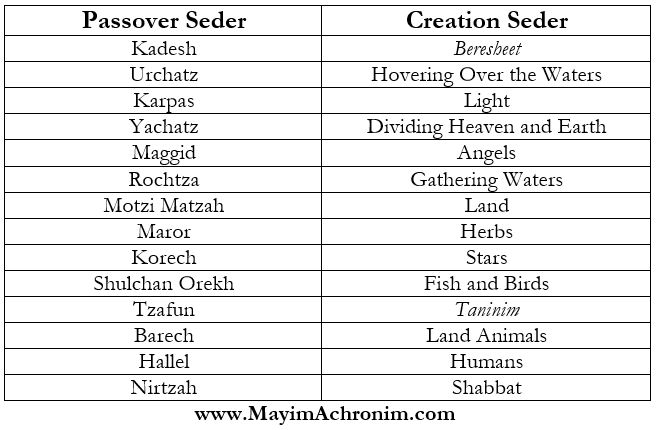
All in all, we see fourteen clear steps in the account of Creation. It is worth mentioning here that in Hebrew the account of Creation (Genesis 1:1-2:4) was traditionally referred to as Seder Beresheet Bara. Creation is a “seder”, too. And we find very clear parallels between the fourteen parts of the Pesach seder and the fourteen steps of the Creation seder.

The Seder of the First Day

The first step of the seder is Kadesh, when we recite Kiddush and drink the first cup of wine. This officially ushers in the holiday and begins the seder process, just as the first act of Creation, Beresheet, officially started time and began the Creation process.

The next step is Urchatz, washing the hands with a cup of water. This first washing is done without saying the blessing al netilat yadayim. In Creation, the second verse tells us that God’s spirit “hovered over the waters.” The connection is self-explanatory.

Eating a vegetable (Karpas) is the third step and parallels the creation of light. As we’ve written in the past, the word “karpas” appears just once in the Tanakh, in describing the great banquet of King Achashverosh at the start of Megillat Esther. It refers to a certain fabric used in the drapery of the banquet. Mystically, it alludes to the fabric of Joseph’s special coat, which was dipped in blood and presented before Jacob to “confirm” the youth’s death. Jacob hence plunged into inconsolable grief and tears. We symbolically dip the karpas into salt water “tears”. That event—the sale of Joseph—led to the young man’s rise to power in Egypt, followed by his family’s settlement there, and then their enslavement, and finally the Exodus. So, that coat—karpas—set the events of the Exodus in motion. While the sale of Joseph was a sad and tragic event, Joseph himself insisted at the end that it was meant to be and all is well.

Joseph is credited for possessing a good eye, and for always being able to see the good within each situation, no matter how terrible (this is why the Sages state that, in turn, the evil eye did not affect Joseph at all). This is the secret of the Light of the First Day. It is called Or HaGanuz, the “hidden light”, and is the light through which Tzadikim see the world. On a deeper level, it represents that hidden divine light concealed within all things. A person like Joseph can see beyond the external into the Godly light inside. Ultimately, the light of the First Day of Creation was preserved for the righteous in the World to Come (Chagigah 12a), who will bask in this divine light in their own Heavenly “banquet”, draped with hur karpas u’techelet, “white, pure, and blue fabrics” (Esther 1:6).

Becoming Angels

Step four in the seder is Yachatz, when the middle matzah is divided in half. This clearly corresponds to the next act of Creation, the division of the waters on the Second Day. On this day, God made a permanent separation between the “upper waters” (Heaven, or Shamayim in Hebrew, literally “waters there”) and the “lower waters” that cover over 70% of the Earth. The larger waters, the Heavens, were concealed by God, just as the larger piece of matzah from the Yachatz is concealed for the afikoman.

Next comes Maggid, when we relate the Exodus story. This corresponds to the other major event of the Second Day. Though not mentioned explicitly in the Torah, the Sages state that God populated the Heavens with angels on this day. Appropriately, the term maggid is actually used to refer to angels that communicate with people. Throughout history, multiple rabbis described how they received mystical secrets from Heaven through a “speaking angel”, a Maggid. The most famous example of this is Rabbi Yosef Karo (1488-1575), the compiler of the Shulchan Arukh, who was visited by a Maggid and recorded some of these teachings in a book called Maggid Mesharim. An angel is first and foremost a messenger, and our job during the Maggid portion of the seder is to act as messengers in relaying the Exodus experience to our children.

Water, Land, and Passover Stars

After Maggid, we get up to wash netilat yadayim, this time with a blessing, because we then sit down to eat the matzah. We say the regular blessing of hamotzi lechem min ha’aretz, as well as the extra blessing al achilat matzah. These two steps, Rochtza and Motzi Matzah, parallel the next two steps of Creation (Genesis 1:9-10):

And God said: “Let the waters under the Heavens be gathered together unto one place, and let the dry land appear.” And it was so. And God called the dry land “Earth” [eretz], and the gathering together of the waters He called “Seas” [yamim]; and God saw that it was good.

Washing the hands is an allusion to the gathering of the waters, and eating the “bread of the earth” (lechem min ha’aretz) alludes to the formation of the earth, eretz.

Right after this, still on the Third Day, God seeded the earth with various grasses, herbs, and vegetation. Needless to say, this corresponds to the next part of the seder, Maror, eating the bitter herbs.

Then comes the “sandwich”, Korech, a combination of matzah, maror, and charoset. As we read in the Haggadah, this step was instituted by Hillel, who would make a sandwich from the matzah, maror, and korban pesach, the Passover lamb, since the Torah explicitly states that the lamb should be eating al matzot u’merorim. Today, we don’t have the Passover lamb, but we do still make a korech. What does the Passover lamb have to do with the next act of Creation, the formation of stars?
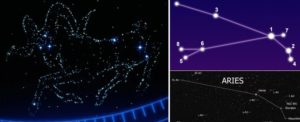
Images of the constellation Ares, including a stylized version in the shape of a ram.

The Sages teach that God’s command to take sheep specifically was not without meaning. This is because the Egyptians were idol worshippers and astrologers, and the sheep was one of their main idols and astrological signs. In fact, this bit of astrology remains with us to this day, for the astrological sign of the month of Nissan (or April) is Ares, a constellation in the shape of a ram or sheep. God wanted us to barbeque sheep in particular to once again show the folly of the Egyptians’ idolatrous beliefs. God created the stars as chronological markers for “the holidays, days, and years” (Genesis 1:14), not for them to be worshipped.

Completing the Seder, Completing Creation

We now enter Shulchan Orekh, the great feast. We traditionally begin with eggs and fish. In fact, in olden days some had the custom to place an egg and fish on the seder plate itself (today we retain the egg, but not the fish). These represent what was created next, on the Fifth Day: fish and birds.

The Torah then states that God created taninim gedolim. There is much discussion about the identity of these mysterious creatures. Is the Torah speaking about whales (which, though in the seas, are not fish so they are listed as a separate creation)? Perhaps they are dinosaurs, since the most literal translation would be “large reptiles”? The Sages say that these actually refer to two great monsters or dragons (see Rashi on Genesis 1:21). God created a pair of them, male and female, but they were so terrible that He slayed one immediately afterwards so that the two wouldn’t reproduce. The remaining Leviathan is hidden away, perhaps prowling the deep seas.
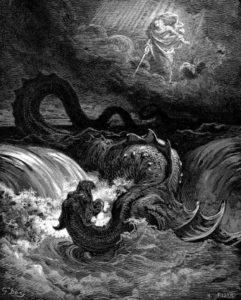
‘Destruction of Leviathan’ by Gustav Doré

The taninim correspond to Tzafun, the consumption of the afikoman. The hidden half of the matzah is finally revealed and eaten to end the meal. This alludes to the meal at the End of Days, the so-called “Feast of Leviathan”, where the righteous will join Mashiach in partaking of the Leviathan’s flesh. (For more on the connection between Mashiach and the afikoman, see here.)

With the meal officially over, we recite Birkat Hamazon, and drink the third cup of wine with it. Our rabbis state that on holiday feasts one should especially partake of meat, which is the centrepiece of the holiday meal. (There is even a halachic debate whether one fulfils the mitzvah of a holiday meal if they did not consume meat, and another discussion of whether poultry is okay.) In Temple times, the major part of the meal was the roasted lamb itself. Having consumed our fill of meat, we say Barech to thank Hashem for it. This corresponds to the creation of land animals on the Sixth Day, without which we wouldn’t have the meat to begin with.

We then recite Hallel, to literally “praise” God. This corresponds to the creation of man, who was made for this very purpose. Unlike all other creations, man alone is capable of contemplating Hashem, serving Him, and connecting to Him.

Finally, there’s Nirtzah, where we declare our hope for the Final Redemption, and that next year we will be able to celebrate our complete freedom in Jerusalem. This is a wish for the coming of the great age at the End of Days that will be kulo Shabbat, an everlasting “Sabbath”. Of course, it parallels the final act of Creation: Shabbat.

In these ways, the Passover seder neatly parallels the seder of Creation. To summarize:
Chag Pesach Kasher v’Sameach!


The above essay is adapted from Garments of Light, Volume Three.
Get the book here! 
Red Sea or Reed Sea: Where is Mount Sinai?

This week’s parasha, Beshalach, recounts the Splitting of the Sea. It is common knowledge that this was the Red Sea, called yam suf in Hebrew. Yet, in recent decades scholars have tried to “debunk” that notion, preferring to associate yam suf with a smaller lake of some sort. They often start by pointing out that yam suf literally means “sea of reeds”. It is the Reed Sea, not the Red Sea. There are indeed several shallow, marshy lakes with reeds in that vicinity of Egypt, around the modern Suez Canal. The fact that the Torah speaks of the “Reed Sea” being near places like Pi-Hahirot, whose location is believed to be known, is used as further proof of yam suf not being the Red Sea.

Of course, this serves to diminish the great miracle of the Splitting of the Sea. It almost implies that the Israelites waded through a shallow lake, as opposed to crossing a vast expanse. The reality is that such a hypothesis does not at all fit with the descriptions we receive in the Torah. A careful look reveals what yam suf actually is, and further helps to locate an even bigger prize: Mount Sinai.  

A Sea or a Lake?

From the Torah’s description of the Splitting of the Sea, we learn that the waters stood as large walls to the left and right of the Israelites, and that the Egyptians later drowned in its depths (see, for instance, Exodus 14:28-29, 15:4, 8). This implies a deep sea, not a shallow, marshy lake.

Yam suf is mentioned well over twenty times in the Tanakh. When going through these verses and their context, one will find that it is a major geographical entity, not a small lake. For example, Numbers 14:25 says that the Amalekites and Canaanites live near yam suf, while Numbers 21:4 says the Edomites are near it, too. If it was a small lake somewhere in the Sinai Peninsula, or by the Suez Canal, this wouldn’t make much sense.

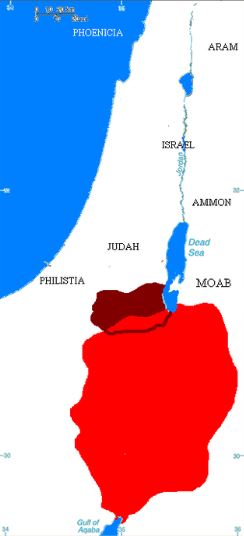
The Biblical lands of Edom, stretching down to the Red Sea (Credit: Briangotts)

In fact, the land of Edom is known to be in the area of what is today the Negev desert, roughly southern Israel and Jordan, going down to what is today Eilat. This is confirmed by I Kings 9:26, where we read that “King Solomon made a navy of ships in Etzion-Geber, which is beside Elot, on the shore of yam suf, in the land of Edom.” King Solomon built a navy-yard in a port near Elot (אֵלוֹת), undoubtedly related to today’s Eilat. And, like today’s Eilat, is in on the shore of yam suf, the Red Sea, in the land of Edom. This verse solves the entire puzzle. Scholars wonder why the sea became known as the Red Sea, when the answer might be right there in the Torah: to the Israelites, this was the sea by the land of Edom, which literally means “red”. It was the Edomite Sea, the “Red Sea”. And it is the selfsame body of water as yam suf.  

On that note, some have proposed that is isn’t yam suf, but yam sof, literally the sea “at the end”, since it is at the southernmost tip of Israel. Yet another idea is that it is yam sufa, “Storm Sea”, referring to the great wind storm that God sent to part the waters (Exodus 14:21). Whatever the case, there is little doubt that the Israelites did indeed cross what we know today as the Red Sea.

The bigger question is: where exactly did they cross?

Some believe that the Red Sea got its name from the red blooms of sea sawdust, Trichodesmium erythraeum (a type of cyanobacteria), that occasionally happen there.

Sinai or Saudi Arabia?

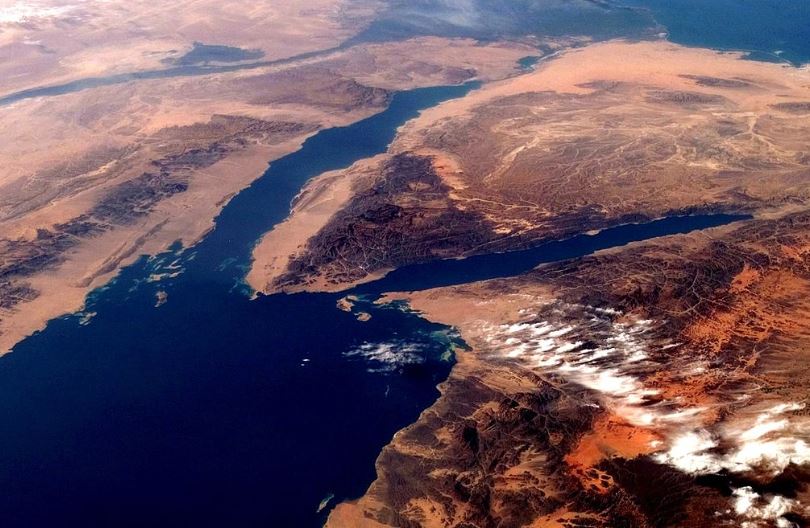
NASA Satellite Image of the Sinai Peninsula

It is commonly thought that Mount Sinai is somewhere in what is today called the Sinai Peninsula. In fact, back in the 6th century, Christians built a monastery on a mountain in the Peninsula which they believed to be Sinai. It still operates today as Saint Catherine’s Monastery, and is among the oldest Christian monasteries in the world. The only problem is that it isn’t anywhere near the real Mt. Sinai.

First off, the Torah introduces us to Mount Sinai when Moses is living far from Egypt in Midian. Recall that Moses had fled Egypt, and eventually ended up living among the Bedouins of Midian… This already confirms that Mount Sinai was probably not in today’s Sinai Peninsula, which would have still been under Egyptian control in those days. In fact, we know from historical and archaeological evidence that in those days, the Egyptians ruled at least as far as Canaan itself. Moses fled outside of Egypt’s domain, across the Red Sea, to what is today Saudi Arabia. This is the land traditionally associated with the Midianites. And the Torah tells us that Mt. Sinai is there (Exodus 3:1-2):

And Moses was shepherding the flock of Jethro, his father-in-law, the priest of Midian; and he led the flock to the farthest end of the wilderness, and came to the mountain of God, unto Horev. And the angel of God appeared unto him in a flame of fire out of the midst of a bush; and he looked, and, behold, the bush burned with fire, and the bush was not consumed…

The Torah famously tells us that Moses saw a burning bush during his first encounter on the “mountain of God”. In Hebrew, it is called a s’neh, which gives rise to the name Mount Sinai. This mountain is in the wilderness around Midian, in a land call Horev. Later on, the Israelites cross the Red Sea and journey towards this same mountain, where they receive the Ten Commandments. This implies that the Israelites crossed somewhere in the Gulf of Aqaba, ending up in what is today Saudi Arabia. This makes all the more sense since they can journey from there to the wilderness “on the other side of the Jordan”, where they spent forty years before crossing the Jordan River—from the East—into Israel.

Amazingly, there is a mountain in Saudi Arabia which is completely sealed off by the authorities, and off limits to any historians or archaeologists…


The above is an excerpt from Garments of Light, Volume Two. To continue reading, get the book here

How Many Soulmates Do You Have?

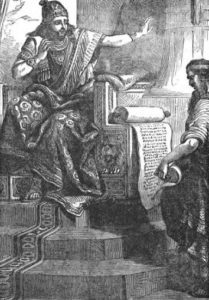
An 1873 illustration of King Josiah (Yoshiyahu) listening to a reading of the Torah

In this week’s parasha, Shoftim, the Torah relates the laws pertaining to Jewish kings. According to the Torah, the king of the Jews is not, and should not be, like the king of other nations. His primarily role is not to be a dictator or a conqueror. Rather, he must act like a divine messenger of God, and his duty is to ensure the observance of Torah law throughout the Holy Land. This is why we read across the Tanakh how the best Jewish kings—like Hezekiah and Josiah—were the ones that expunged idolatry from Israel and restored proper spirituality.

It is also why we see on several occasions in the Book of Shoftim (not to be confused with this week’s parasha of the same name) that the time before kings was lawless: “…there was no king in Israel; every man did that which was right in his own eyes.” (Judges 21:25) The Jewish king, therefore, is like God’s representative on Earth. In this regard, he is likened to an angel, which is why the term for a king, melekh (מלך), is nearly identical and shares the same root with the word for an angel, malakh (מלאך).

Not surprisingly, the Jewish king is held to a very high standard. The Torah (Deuteronomy 17:16-20) tells us that he:

may not acquire many horses for himself… And he shall not take many wives for himself, and his heart must not turn away, and he shall not acquire much silver and gold for himself. And it will be, when he sits upon his royal throne, that he shall write for himself two copies of this Torah on a scroll, before the priests. And it shall be with him, and he shall read it all the days of his life, so that he may learn to fear Hashem, his God, to keep all the words of this Torah and these statutes, to perform them, so that his heart will not be haughty over his brothers, and so that he will not turn away from the commandment, either to the right or to the left, in order that he may prolong [his] days in his kingdom, he and his sons, among Israel.

The Talmud discusses the finer points of these rules. One of the questions the Sages ask is: How many wives is too many? (Sanhedrin 21a) The Mishnah states the maximum is eighteen wives. Rav Yehuda then opines that a king can take more wives, as long as they will not “turn his heart astray”. Rabbi Shimon insists that even a single wife might turn her husband’s heart astray, and thus, the king must not take more than eighteen “even if they be women like Abigail”. Abigail, of course, was one of the righteous wives of King David, who is listed among the seven female prophetesses of Judaism.

In fact, the Talmud derives the maximum of eighteen wives from the case of King David:

Whence do we deduce the number eighteen? From the verse, “And unto David were sons born in Hebron; and his firstborn was Amnon of Ahinoam the Jezraelite; the second, Khilav of Abigail, the [former] wife of Naval the Carmelite; the third, Avshalom the son of Maacah; and the fourth, Adoniyah the son of Hagit; and the fifth, Shefatiah the son of Avital; and the sixth, Ithream of Eglah, David’s wife. These were born to David in Hebron.” (II Samuel 3:2-5) And of them the Prophet [Nathan] said: “And if that were too little, then would I add unto thee the like of these, and the like of these” (II Samuel 12:8), each “these” implying six, which, with the original six, makes eighteen in all.

Scripture tells us that David had six wives while he reigned from Hebron during his first seven years: Ahinoam, Abigail, Maacah, Hagit, Avital, and Eglah. When his court prophet Nathan recounted how he had once blessed him, he said he would multiply the king’s wealth (and wives) kahena v’kahena, more and more “like these”. This implies that David would have, or potentially could have, eighteen wives.

The Talmud continues to cite the opinion of Ravina, who believed that each kahena refers not to six, but twelve. He holds that David had six wives, the blessing was to double that to twelve, and “if that were too little”—as Nathan said—then he would multiple them kahena v’kahena. Thus, Ravina reasons that the maximum is twenty-four wives, not eighteen. The Talmud admits that there is an alternate Mishnaic teaching that 24 is the maximum, and yet another teaching that the maximum is 48. The latter comes from the fact that there is a letter vav in the term, meaning 24 and another 24! Nonetheless, the accepted tradition is a maximum of 18 wives, and no more.

The Talmud interestingly points out a potential flaw: wasn’t David also married to Michal, the daughter of King Saul, while in Hebron? The Sages conclude that Michal is the same person as Eglah. They then raise the following issue: how could Michal be Eglah if the Tanakh states Michal was childless while Eglah gave David a son? In a classic Talmudic interpretation, the Sages take the verse “Michal the daughter of Saul had no child until the day of her death” (II Samuel 6:23) to mean that she did not have children until her death, and died in childbirth. So, she finally had a child on the day of her death.

The Kabbalah of Soulmates

The Arizal (Rabbi Itzchak Luria, 1534-1572) gives a deeper, mystical answer to why the maximum number of wives for a king is eighteen. The implications of his teachings are not just relevant to kings, but to every Jew. While we generally think of a person as having a single soulmate, the Arizal explains that a person actually has eighteen soulmates (see, for example, Sha’ar HaMitzvot on this week’s parasha). Why would a person need eighteen soulmates?

The Talmud (Sotah 2a) famously states that “forty days before conception a Bat Kol [Heavenly Voice] proclaims: the daughter of so-and-so is destined for so-and-so…” The same passage states that pairing a person with their soulmate is “as difficult as the Splitting of the Sea”. The Midrash adds to this that ever since the Splitting of the Sea, God is busy making matches between people (Pesikta d’Rav Kahana 2:4). The Sages conclude that a person’s first match is pre-destined, while a second or subsequent match (if the first marriage fell through) becomes as difficult as splitting a sea.

The central issue that all of this rests on is free will. While a person does have a perfect, pre-destined match, free will can very easily get in the way and ruin things. For example, person A is destined to be with person B, but A makes some really poor decisions in life and ends up in a bad place (or dead). Does that mean B is now condemned to spend the rest of their life without their rightful soulmate? Must they now hopelessly struggle in search of the “right one” or be miserable in a series of failed relationships for the rest of their life, through no fault of their own? Surely, the Most Merciful God would not allow this to happen. And so, He spends all of His time “making matches”, finding alternate soulmates.

For this reason, a person has up to 18 different soulmates designated for them. If, due to free will, the match of A and B doesn’t work, there is always A and C. And if C, too, decides to move to the other side of the world, there’s a D behind them. Granted, the Arizal puts the soulmates in hierarchical fashion: D is not as good as C, nor is C as good as B—but they are all matching souls for A nonetheless. Of course, each of B, C, and D have 18 of their own soulmates, so one can see how complicated this matchmaking game becomes—“as difficult as the Splitting of the Sea”. The Arizal notes that 18 is a maximum, and not necessarily will there be 18 soulmates for a person alive all at once. Elsewhere, the Arizal explains that a person who does not find one of their soulmates will reincarnate to try again in a future life, as might one who needs to unite with a better soulmate, higher up on the chain of 18.

This brings us back to the first question: why is a king allowed up to, but no more than, 18 wives? A king, like every person, has up to 18 soulmates. He may choose to seek out and find all 18 of them, to unite with all of his soulmates. However, he must not take even a single wife more, for a nineteenth wife would certainly not be a soulmate. A king should not be taking a wife or concubine solely for pleasure. He may have more than one (and this may even be a political necessity), but only on the condition that she is one of his soulmates anyway.

The Kabbalah of David and Batsheva

The above discussion helps to explain the Talmudic dictum that one who believes David sinned with Batsheva is mistaken (Shabbat 56a). Recall that Batsheva was the wife of Uriah the Hittite, one of David’s generals. When Uriah was away in battle, David spotted Batsheva bathing and ended up sleeping with her. She would become pregnant, and to hide the sin, David ultimately placed Uriah in a situation where he would die in battle.

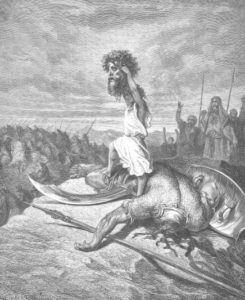
‘David and Goliath’ by Gustave Doré

From a mystical perspective, Batsheva was one of David’s 18 soulmates. In fact, she was his #1, and the two had been matched by God all the way back in the “six days of Creation” (Sanhedrin 107a). The Midrash relates that it was David’s own hubris that prevented him from marrying her. When David had defeated Goliath, he wanted (or needed) to decapitate the giant with his own sword. At the time, Uriah the Hittite happened to be the attendant of Goliath. David promised Uriah the best woman in Israel if Uriah would only provide him with Goliath’s sword. Uriah did so. He later became a righteous convert, and one of David’s greatest warriors. (This is why he is called a Hittite, for he was not originally Jewish.)

At the same time that David made the promise to Uriah, God made a decree in Heaven: Because of David’s haughty and immodest offer to distribute the daughters of Israel, God will mete out his punishment by giving away his very own soulmate to Uriah! What David did with Batsheva was certainly a sin, and the Talmud (ibid.) recounts how severely he was punished, including six months of intense leprosy in addition to the punishments already enumerated in Scripture. Yet, Batsheva was his rightful soulmate, and would go on to produce his rightful heir, King Solomon. The Talmud concludes that David simply rushed to be with her. Uriah was destined to die soon enough anyway, and then David could marry Batsheva with no issues.

The Kabbalists see David and Batsheva rushing to be with each other as a replay of Adam and Eve rushing to consume the Forbidden Fruit. Had Adam and Eve waited until Shabbat, they would have been permitted to eat from the Tree of Knowledge. David and Batsheva, too, needed only to wait a little longer. The connection between the two couples is deeper than that, for David and Batsheva were none other than the reincarnations of Adam and Eve. They had the opportunity to complete a great tikkun, a rectification for that primordial sin. (In some ways, so does every young couple that must wait until marriage to be intimate in holiness.) Alas, they failed, and the same souls will return one last time in Mashiach and his wife to finally fulfil the task.

(For more on the Adam-David-Mashiach connection, see here.)


The above essay is adapted from Garments of Light, Volume Three.
Get the book here!