Tag Archives: Zechariah

20 Things That Will Happen When Mashiach Comes

This week’s parasha, Vayikra, begins the third book of the Torah. The parasha is unique in that it is only one of two parashas (along with next week’s Tzav) where the word Mashiach appears. All four cases of the word in the Torah refer to the anointed High Priest, not to the messiah at the End of Days. Nonetheless, on a deeper level it certainly is alluding to the messiah of the End of Days. All the verses in question deal with the anointed High Priest (“HaKohen HaMashiach”) atoning for sins—both his own and the people’s—and purifying his nation. Indeed, one of the roles of Mashiach will be to prepare Israel for that final purification at the End of Days. This includes identifying one last Red Cow to produce those special waters which alone are capable of removing the impurity of death.

The early Christians saw these verses as allusions to their purported saviour, Jesus. In one place, for example, they wrote:

the Law [ie. the Torah] made those high priests who had infirmity, and who needed daily to offer up sacrifices, first for their own sins, and then for the people’s; but our high priest, Christ Jesus, was holy, harmless, undefiled, and separate from sinners, and made higher than the heavens. (Hebrews 7:27-28)

For the Christians, Jesus was the ultimate anointed high priest. Yet, Jesus accomplished essentially nothing of what Mashiach is supposed to. This was perhaps best explained in the 16th century by Isaac ben Abraham of Troki (1533-1594). He was a Karaite Jew, and a renowned Karaite scholar. His magnum opus was a book called Hizzuk Emunah, “Strengthening of Faith”, written to debunk Christianity, silence missionaries, and convince Jews to remain Jewish. The book was so popular that it spread like wildfire, not just among Karaites but all Jews, and even Christians. In fact, it played an important role in the start of the Enlightenment, leading countless Christians to abandon their faith. One of these was the French philosopher Voltaire (1694-1778), who called the Latin translation of Hizzuk Emunah (first published in 1681) a “masterpiece”.

Because it was a Karaite text, traditional rabbis were wary of consulting it. The great Rabbi Menashe ben Israel (Manoel Dias Soeiro, 1604-1657), who opened the first Hebrew printing press in Amsterdam in 1626, ultimately refused to print it. Still, Abba Hillel Silver, in his A History of Messianic Speculation in Israel (pg. 225), points out how Troki’s text borrowed from earlier Rabbinic texts, including Mashmia Yeshua, “Announcing Salvation”, of Rabbi Isaac Abarbanel (1437-1508).

Silver goes on to summarize the sixth chapter of Troki’s Hizzuk Emunah, which includes a list of twenty clear prophecies in Scripture that must be fulfilled upon the coming of Mashiach—none of which were fulfilled by Jesus (thereby necessitating for Christians some future “second coming” yet to materialize after nearly two millennia). Briefly going over these twenty events is enlightening both as a reminder for why Jesus could not be the messiah, and for what to expect when the true Mashiach does come.

Living Waters and Dead Waters
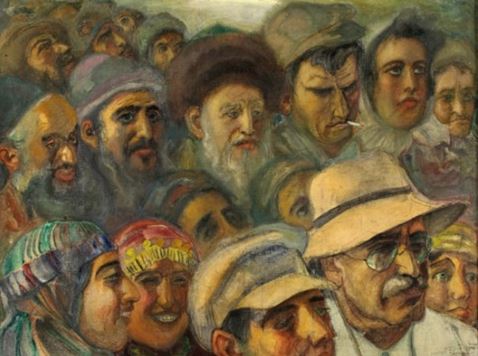
‘Israelis – The Ingathering of the Exiles’ by Saul Raskin (1878-1966)

The first prophecy is the return of the Lost Tribes of Israel. In ancient times, following the reign of King Solomon, the Twelve Tribes of Israel split into two kingdoms: the southern Judah and the northern Israel (or Ephraim). The more sinful northern kingdom was eventually overrun by the Assyrians, who exiled its tribes. These are sometimes referred to as the Ten Lost Tribes. It should be noted, though, that they weren’t necessarily ten tribes, nor were the tribes completely expunged. In reality, there were many Benjaminites, Simeonites, and Levites already living inside the Kingdom of Judah, and members of all the northern tribes fled to Judah when the northern kingdom was destroyed.

What happened was that all the tribes eventually assimilated into the larger, ruling tribe of Judah. Over time, the tribes lost knowledge of their lineage, and today everyone is simply a Yehudi, a Judahite, or Jew. (Levites, because of their unique role, retain knowledge of their ancestry). One of the prophesied events of the End of Days is that the identity of the Lost Tribes will once more be known. Though this idea is much more developed in later Rabbinic literature, it comes from numerous places in Scripture. Troki chooses to use Ezekiel 37:15-22:

And the word of God came to me, saying: “And you, son of man, take one stick, and write upon it: For Judah, and for the children of Israel his companions; then take another stick, and write upon it: For Joseph, the stick of Ephraim, and of all the house of Israel his companions; and join them one to another into one stick, that they may become one in your hand… And say to them: ‘Thus says the Lord God: Behold, I will take the children of Israel from among the nations, wherever they have gone, and will gather them on every side, and bring them into their own land…’”

Related to this is the second great prophecy, that of Gog u’Magog. This refers to the great world war at the End of Days, described in detail in Ezekiel 38, among other places. During the course of this war, Zechariah 14:4 states that the Mount of Olives in Jerusalem will be split in half. Then, new “living waters” will go out of Jerusalem to make Israel flourish (Zechariah 14:8).
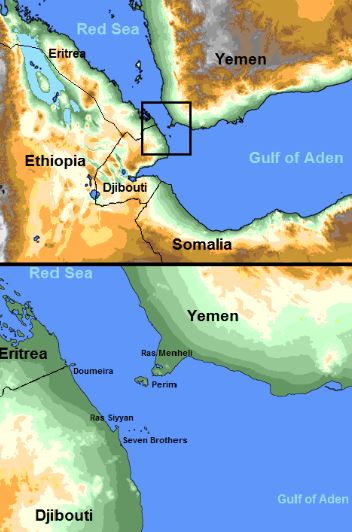
Bab-el-Mandeb Strait (Credit: Skilla1st)

Meanwhile, Isaiah 11:15 states that God “will utterly destroy the tongue of the Egyptian Sea; and with His scorching wind will He shake His hand over the River, and will smite it into seven streams, and cause men to march over dry-shod.” The identity of the “Egyptian Sea” and the “River” is unclear, though Silver has it as the Red Sea and the Euphrates. On the possibility of the Red Sea drying up, we know today from geological records that the Red Sea had once (and possibly more than once) become a dry chunk of land due to the narrow and shallow Bab-el-Mandeb closing up.

As for the “River”, in context it would make more sense if it referred to the Nile, the lifeline of Egypt. Today, we are indeed seeing the Nile drying up rapidly, and the Washington Post recently reported that the Nile Delta is losing as much as 20 metres per year in some areas. With this in mind, when Isaiah prophesies that the “tongue of the Egyptian Sea” will be destroyed, it may be referring to the Nile Delta, which opens up into the Egyptian Mediterranean, ie. the “Egyptian Sea”. The Post article is quite an accurate realization of Isaiah’s prophecy, with images of men that “march over dry-shod”.

(Having said that, the Euphrates River isn’t doing much better than the Nile, so whether Isaiah meant the Nile or the Euphrates is irrelevant in light of the mass devastation that has plagued both rivers.)

A Renewed Jerusalem

The sixth prophecy in Troki’s list is also from Zechariah (8:23):

Thus said the Lord of Hosts: “In those days it shall come to pass, that ten men shall take hold, out of all the languages of the nations, shall take hold of the garment of him that is a Jew, saying: We will go with you, for we have heard that God is with you.”

The tremendous anti-Semitism that Jews have experienced throughout history, into the present day, will finally end. The nations will be at peace with the Jews, and wish to learn from them. This is related to another prophecy: that gentiles from all over the world will come to Jerusalem to worship the God of Israel on every Rosh Chodesh and every Shabbat (Isaiah 66:20-23):

“…upon horses, and in chariots, and in litters, and upon mules, and upon swift beasts, to My holy mountain Jerusalem,” said God, “as the children of Israel bring their offering in a clean vessel into the house of God. And of them also will I take for the priests and for the Levites,” said God. “For as the new heavens and the new earth, which I will make, shall remain before Me,” said God, “so shall your seed and your name remain. And it shall come to pass, that from one new moon to another, and from one Sabbath to another, all flesh shall come to worship before Me, said God.

The gentiles—“all flesh”—will come to Jerusalem, upon every kind of transport. One of these is a rekhev, “chariot” in ancient Hebrew, and “vehicle” in Modern Hebrew. Another two of the transports are unique words that aren’t found elsewhere in Scripture and are impossible to translate: a tzab, and a kirkar. It is possible that the former refers to some kind of slow transport (as the word is written the same as that for a “turtle”) while the latter conversely refers to a very fast form of transport. In our day and age we have no shortage of either.

Troki lists separately a related prophecy from Zechariah (14:16): “And it shall come to pass, that every one that is left of all the nations that came against Jerusalem shall go up from year to year to worship the King, the Lord of Hosts, and to keep the feast of tabernacles.” Once a year, during the holiday of Sukkot, those nations that warred against Israel at the End of Days will come to Jerusalem to worship. The fact that it must be during Sukkot is no coincidence, for it is during Sukkot that our Sages say the offerings in the Temple atone for all the gentiles. This is why the Torah requires seventy bulls to be offered over the course of the holiday, corresponding to the seventy root nations of the world.

A Renewed World

If all the nations are coming to worship the God of Israel in Jerusalem, there is certainly no need for any “idols… false prophets… and unclean spirits” which God will entirely “cut off” (Zechariah 13:2). Zechariah further adds: “And God [YHWH] shall be King over all the earth; in that day God shall be One, and His name one.” (14:9) There will be world peace (Isaiah 2:4, Micah 4:3), which will be ensured and enforced by Israel, to whom all the kings and nations will listen (Isaiah 60:10-12, Daniel 7:27). Even the animals will be at peace with each other, as Isaiah (11:6-8) famously writes:

And the wolf shall dwell with the lamb, and the leopard shall lie down with the kid; and the calf and the young lion and the fatling together; and a little child shall lead them. And the cow and the bear shall feed; their young ones shall lie down together; and the lion shall eat straw like the ox…

On that last prophecy there is an interesting debate. Will the animals miraculously stop fighting and consuming one another? Or, is the prophecy only metaphorical and the natural order will remain? The Rambam (Rabbi Moshe ben Maimon, 1135-1204) held by the latter. Silver translates here that peace will be “between wild and domestic animals”. When reading Isaiah’s verses, this makes perfect sense: a wolf with a lamb, a leopard with a goat; calf and lion, cow and bear. So perhaps what Isaiah meant is that farmers and ranchers will no longer have to worry about wild animals devouring their livestock—once a common, and particularly disturbing, problem. (Or maybe there will be no need to raise livestock at all, for we are now at the dawn of the synthetic meat revolution.)

Israel will finally be completely righteous and free of sin (Deuteronomy 30:6, Isaiah 60:21, Ezekiel 36:25), and lead the rest of the world in doing the same (Jeremiah 3:17). There will no longer be any kind of suffering or sorrow in Israel, for the prophet said “the voice of weeping shall be no more heard in her, nor the voice of crying” (Isaiah 65:19).
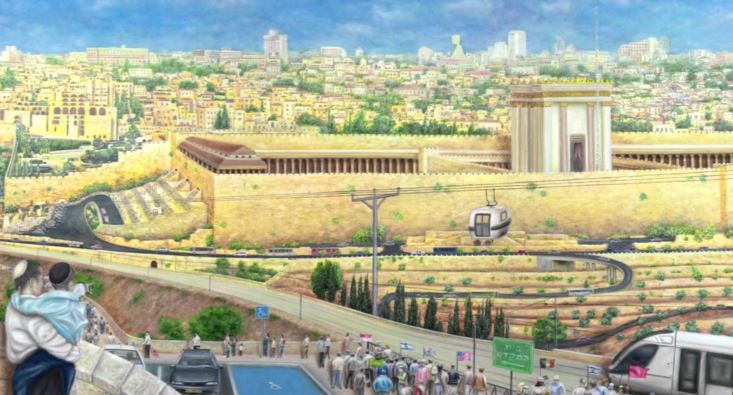
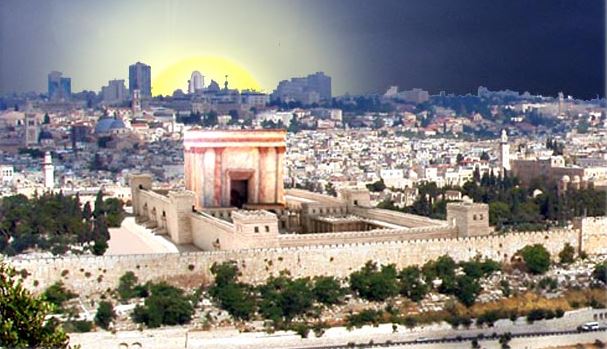
‘Going Up To The Third Temple’ by Ofer Yom Tov

Finally, the prophet Eliyahu will return (Micah 3:24), and the Temple will be rebuilt (Ezekiel 40-45). The Shekhinah will return to Israel (Ezekiel 37:26), as will the ability to prophecy (Jeremiah 31:32-33), and there will be great knowledge in the world (Isaiah 11:9). The Holy Land will be redistributed among the Twelve Tribes of Israel (Ezekiel 47:13). Lastly, at the very end, will come the long-awaited Resurrection of the Dead (Daniel 12:2).

To summarize:

  1. Return of the Lost Tribes
  2. Gog u’Magog
  3. Mount of Olives splitting
  4. Egyptian Sea and River destroyed
  5. Living waters emerge from Jerusalem
  6. Gentiles declaring to Jews “we will go with you”
  7. Israel’s former enemies coming to Jerusalem each year on Sukkot
  8. Gentile pilgrims coming to Jerusalem to worship on the new moons and Sabbaths
  9. Destruction of all idols, false prophets, and unclean spirits
  10. One religion around the world, and recognition of one God
  11. Israel’s recognized leadership on the international stage
  12. World peace
  13. Peace between wild and domesticated animals
  14. A sinless Israel and a sinless world
  15. No more suffering or sorrow in the Land of Israel and for the Jewish people
  16. Shekhinah and prophecy return
  17. Eliyahu reappears
  18. Rebuilding of the Temple in Jerusalem
  19. Redistribution of the Holy Land among the restored Twelve Tribes
  20. Resurrection of the Dead

Secrets of the Mishkan

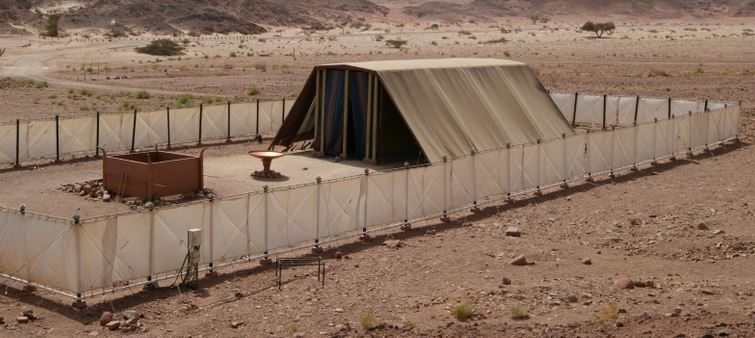
A Modern Replica of the Mishkan in Timna, Israel

This week’s parasha, Terumah, begins with God’s command for the Israelites to build a Mishkan, an Earthly “dwelling place” for the Divine. God tells Moses (Exodus 25:2-8):

Speak to the children of Israel, and have them take for Me an offering; from every person whose heart inspires him to generosity, you shall take My offering. And this is the offering that you shall take from them: gold, silver, and copper; blue, purple, and crimson wool; linen and goat hair; ram skins dyed red, tachash skins, and acacia wood; oil for lighting, spices for the anointing oil and for the incense; shoham stones and filling stones for the ephod and for the choshen. And they shall make Me a sanctuary and I will dwell in their midst…

God requests that each person donate as much as they wish to construct a Holy Tabernacle. He concludes by stating that when the sanctuary is built, He shall dwell among them. The Sages famously point out that the Torah does not say that God will dwell in it, but in them. The sanctuary was not a literal abode for the Infinite God—that’s impossible. Rather, it is a conduit between the physical and spiritual worlds, and a channel through which holiness and spirituality can imbue our planet.

In mystical texts, we learn that the Mishkan was far more than just a temple. Every piece of the Mishkan—every pillar and curtain, altar and basin, even the littlest vessel used inside of it—held tremendous significance and represented something greater in the cosmos. In fact, the whole Mishkan was a microcosm of Creation. This is the deeper reason for why the prohibitions of Shabbat are derived from the construction of the Mishkan. The passage we cited above appears one more time in the Torah, in almost the exact same wording, ten chapters later. In that passage, we read the same command for each Israelite to donate the above ingredients to build a sanctuary. The only difference is that in the second passage, the construction of the Mishkan is juxtaposed with (Exodus 35:1-2):

Moses called the whole community of the children of Israel to assemble, and he said to them: “These are the things that God commanded to make. Six days work may be done, but on the seventh day you shall have sanctity, a day of complete rest to God; whoever performs work on this day shall be put to death…”

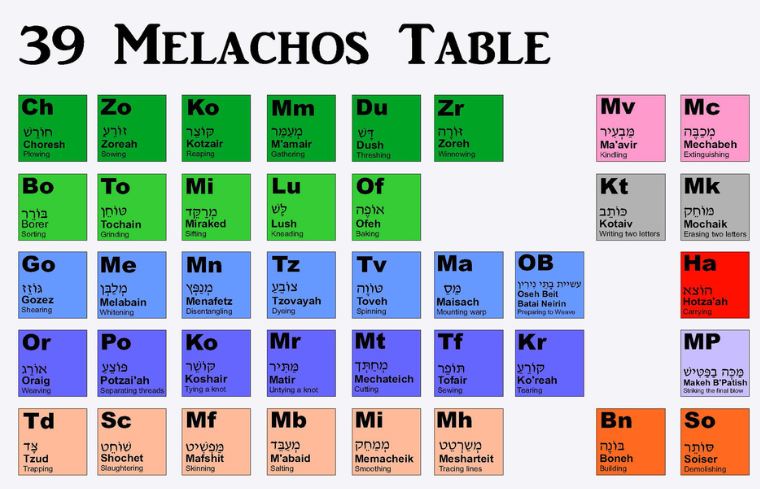
From this clear connection, the Sages learn that the actions required to construct and maintain the Mishkan are the same ones we must abstain from on the Sabbath. There are 39 such melakhot in all. On a more mystical level, these 39 works are said to be those same actions performed by God in creating the universe! For example, the first prohibited work (see Shabbat 7:2) is zorea, “sowing”, or seeding the earth, just as we read in the account of Creation that God said (Genesis 1:11) “Let the earth bring forth grass, herb-yielding seed, and fruit-tree bearing fruit after its kind, in which its seed is found on the earth.” Perhaps the most famous prohibition, mav’ir, “lighting” a flame, parallels God’s most famous Utterance, “Let there be light” (Genesis 1:3). Such is the case with all 39 prohibited works. In this way, when a Jew rests on the seventh day from such actions, he is mirroring the Divine Who rested from these works on the original Seventh Day.

A Periodic Table of the 39 Melachos, by Anshie Kagan

The Mishkan and the Holidays

The Zohar (II, 135a) comments on this week’s parasha that the ingredients of the Mishkan symbolize the Jewish holidays. The first ingredient is gold, and this corresponds to the first holiday of the year, Rosh Hashanah. The second ingredient, silver, corresponds to Yom Kippur. This is because silver and gold represent the two sefirot of Chessed, “kindness”, and Gevurah, “restraint”. The latter is more commonly known as Din, “judgement”. In mystical texts, silver and gold (both the metals and the colours) always represents Chessed and Gevurah. Rosh Hashanah is judgement day, which is gold, and Yom Kippur is the day of forgiveness, silver.

The third ingredient, copper, corresponds to the next holiday, Sukkot. The Zohar reminds us that on Sukkot, the Torah commands the Israelites to sacrifice a total of seventy bulls, corresponding to the seventy root nations of the world. This is why the prophet Zechariah (14:16) states that in the End of Days, representatives from all nations of the world will come to Jerusalem specifically during Sukkot to worship God together with the Jews.

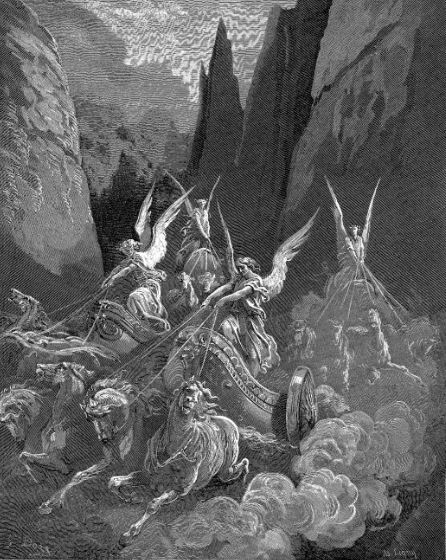
‘Vision of the Four Chariots’ by Gustave Doré

The Zohar explains that copper is Sukkot because copper (at least in those days) was the main implement of war, which the gentiles use to build their chariots and fight their battles. This, the Zohar explains, is the meaning of another verse in Zechariah (6:1), which states that “…there came four chariots out from between the two mountains; and the mountains were mountains of copper.” The Zohar concludes that the Torah prescribes the sacrifices to be brought in decreasing order (thirteen on the first day, twelve on the second, eleven on the third, etc.) to weaken the drive for war among the gentile nations.

The next ingredient is the special blue dye called techelet, which corresponds to Pesach. As the Talmud (Sotah 17a) states, techelet symbolizes the sea, and the climax of the Exodus was, of course, the Splitting of the Sea. Only at this point, the Torah states, did the Israelites believe wholeheartedly in God, and his servant Moses (Exodus 14:31). The Zohar therefore states that techelet holds the very essence of faith.

Following this is the purple dye called argaman, which is Shavuot. It isn’t quite clear why the Zohar relates these two. It speaks of purple being a fusion of right and left, perhaps referring to the fact that purple (or more accurately, magenta) is a result of a mixing of red and blue. This relates to the dual nature of Shavuot, having received on that day the two parts of the Torah (Written and Oral), and later the Two Tablets, in the month whose astrological sign is the dual Gemini. There is a theme of twos, of rights and lefts coming together. We might add that Shavuot is traditionally seen as a sort of “wedding” between God and the Jewish people, with the Torah being the ketubah, and Mt. Sinai serving as the chuppah.

The sixth ingredient, tola’at shani, red or “crimson” wool, corresponds to the little-known holiday of Tu b’Av. Although the Mishnah (Ta’anit 4:8) states that on Tu b’Av the young single ladies of Israel would go out in white dresses to meet their soulmates, the Zohar suggests that they also wore crimson wool, based on another Scriptural verse (Lamentations 4:5).

Tu b’Av is actually the last holiday that the Zohar mentions. The remaining nine ingredients correspond to the nine days after Rosh Hashanah, through Yom Kippur, ie. the “Days of Repentance”. This brings up a big question: The Zohar relates the ingredients of the Mishkan to the major Torah holidays: Rosh Hashanah and Yom Kippur, and the three Pilgrimage festivals (Pesach, Shavuot, Sukkot). Naturally, it omits Chanukah, Purim, the fasts and minor holidays, which are not explicitly spoken of in the Torah. So, why does it mention Tu b’Av? Before we even begin to answer this question, we should already recognize the huge significance of Tu b’Av, strangely one of the most oft-forgotten holidays on the Jewish calendar.

Tu b’Av: a Torah Holiday

The holidays that are not explicitly commanded by God in the Torah were all instituted by future Sages. Purim was instituted by Esther and Mordechai, and first celebrated in Persia. Yet, the Talmud tells us that the majority of the Sages in the times of Esther and Mordechai initially rejected their call to establish Purim as a holiday! (See Yerushalmi, Megillah 6b-7a.) Interestingly, historians and archaeologists have not found a single Megillat Esther among the thousands of Dead Sea Scrolls and fragments, suggesting that the Jews who lived in Qumran did not commemorate Purim. Clearly, it was still a point of contention as late as two thousand years ago.

Chanukah, meanwhile, is not found in the Tanakh at all. Although two Books of Maccabees exist, the Sages did not include them in the final compilation of the Tanakh. Similarly, the later Sages of the Mishnaic and Talmudic era did not find it fit to have a separate tractate for Chanukah, even though there is a separate tractate for every other big holiday.

The fast days are not festivals, but sad memorial days instituted by the Sages to commemorate tragic events. Tu b’Shevat appears to have no Scriptural origins. Yet, Tu b’Av does. The Talmud (Ta’anit 30b) tells us that one of the historical events that we commemorate on Tu b’Av is the fact that the tribe of Benjamin was permitted to “rejoin the congregation of Israel”. In the final chapters of the Book of Judges, we read how a civil war emerged in Israel, pitting all the tribes against Benjamin because of the horrible incident where a woman was brutally raped in Gibeah. The tribe of Benjamin was subsequently cut off from Israel, with their men forbidden from marrying women of other tribes. The ban was eventually lifted on Tu b’Av. The men of Benjamin were told:

“Behold, there is a festival of God from year to year in Shiloh, which is on the north of Bethel, on the east side of the highway that goes up from Bethel to Shechem, and on the south of Lebonah.” And they commanded the children of Benjamin, saying: “Go and lie in wait in the vineyards; and see, and, behold, if the daughters of Shiloh come out to dance in the dances, then come out of the vineyards, and take every man his wife of the daughters of Shiloh, and go to the land of Benjamin…” (Judges 21:19-21)

The Tanakh is clearly describing what the Talmud says would happen on Tu b’Av, when the young ladies would go out to dance in the vineyards to find their soulmates. The exact Scriptural wording is that this day is a chag Adonai, “festival of God”. This is precisely the term used by Moses during the Exodus (Exodus 10:9), possibly referring to Pesach, or more likely to Shavuot (as Rabbeinu Bechaye comments). It is also the term used later in the Torah to describe Sukkot (Leviticus 23:39). Thus, Tu b’Av is evidently a Torah festival, too! And this is why the Zohar singles it out from all the other, “minor” holidays. It seems Tu b’Av is not so minor after all.

The Zohar concludes its passage on Terumah by saying that although we do not have the ability to offer Terumah today, and there is no Mishkan for us to build, we nonetheless have an opportunity to spiritually offer up these ingredients when we celebrate the holidays associated with them. When one wholeheartedly observes Rosh Hashanah, it is as if they offered up gold in the Heavenly Temple, and during Yom Kippur one’s soul brings up silver. Over the days of Sukkot, there is an offering of copper up Above, and on Pesach it is techelet; on Shavuot, argaman, on Tu b’Av, tola’at shani, and on the Days of Repentance the remaining ingredients. On these special days, we help to construct the Heavenly Abode. And this is all the more amazing when we remember that Jewish tradition maintains the Third Temple will not need to physically be built as were the first two, but will descend entirely whole from Heaven.

Courtesy: Temple Institute

Who is Samael?

In this week’s parasha, Vayishlach, we read of Jacob’s famed battle with the angel. According to many sources, Jacob battled Esau’s guardian angel. While the identity of the angel is concealed in the plain text of the Torah, Jewish tradition associates this angel with Samael. That name is one of the most famous—or infamous—of all angelic entities, not just in Judaism, but also in Christianity, Gnosticism, and other Near Eastern traditions. Who is Samael?

‘Jacob Wrestling with an Angel’ by Charles Foster

The Primordial Serpent

One of the most ancient Jewish mystical works is Sefer HaBahir. At the very end of the text (ch. 200), we are told that Samael was the angel that came down to the Garden of Eden in the form of a serpent. We read here that one of his punishments was to become the guardian angel of the wicked Esau. The Bahir explains that Samael was jealous of man, and disagreed with the fact that God gave man dominion over the earth. He came down with the mission of corrupting mankind.

The Midrash (Pirkei d’Rabbi Eliezer, ch. 14) seems to agree, describing how God “cast down Samael and his troop from their holy place in Heaven.” In the previous chapter of the same Midrash, we read how Samael is unique in that, while other angels have six wings, Samael has twelve, and “commands a whole army of demons”. The Arizal (Rabbi Isaac Luria, 1534-1572) adds that Samael is in charge of all the “male” demons, called Mazikim, while his “wife” Lilith is in charge of all the “female” demons, called Shedim (Sha’ar HaPesukim on Tehilim). He further associates Lilith with the sword of the “Angel of Death”.

A little-known apocryphal text called the Ascension [or Testament] of Moses (dating back at least to the early 1st century CE) states that Samael is the one “who takes the soul away from man”, directly identifying him with the Angel of Death. This ties neatly into his name, since Samael (סמאל) literally means “poison of God”. Indeed, the Talmud (Avodah Zarah 20b) states that the Angel of Death takes a person away by standing over them with his sword, before a drop of poison falls from the tip of the sword into the victim’s mouth. Elsewhere, the Talmud (Bava Batra 16a) tells us that the Angel of Death is the same entity as Satan, and as the source of the yetzer hara (the Evil Inclination).

In his Kabbalah (pg. 385), Gershom Scholem brings a number of sources that state Satan and Samael are one and the same, together with another figure called Beliar, or Belial. There are those who say that while Satan simply means “prosecutor”, and is only a title, Samael is actually his proper name. The Zohar (on parashat Shoftim) appears to agree, stating that the two main persecuting forces in Heaven are Samael and the Serpent. Some sources depict Samael as actually riding upon the Serpent!

Belial, meanwhile, is a term that appears many times in the Tanakh. It is first found in Deuteronomy 13:14, in a warning that certain bnei Belial will come out to tempt Israel into idolatry. While the simple meaning (and the way it is generally translated) is “base” or “wicked men”, the Kabbalistic take is that it refers to impure spirits that come to lure Israel to sin. Note that the Torah says these bnei Belial will emerge from among our own people.

Not surprisingly, the Zohar (Raya Mehemna on Ki Tetze) says that there are a very small group of “Jewish” imposters who actually worship Samael. These are the ones that give all Jews a bad name, and aim to reverse all the good that Jews do in the world. We have written much of this small group of imposters before, as they are more commonly referred to as the Erev Rav. The Zohar states that Samael and Lilith were once good angels before their “fall”, and began to be worshipped as deities in their own right in the pre-Flood generation. The people in those days worshipped them in order to manipulate them to do their bidding. The Erev Rav aims to do the same today. Thankfully, God will destroy them all in the End of Days, and this is the deeper meaning of Zechariah 13:2:

“And it shall come to pass in that day,” says the Lord of Hosts, “that I will cut off the names of the idols out of the land, and they shall no more be remembered; and also I will cause the prophets and the unclean spirit to pass out of the land.”

Which prophets is God referring to? Those leaders of the Erev Rav that attempt to convince the masses that they are “prophets”, only to lead the people astray.

With this in mind, Jacob’s battle with Samael takes on a whole new meaning. It reminds us that the job of each Jew is to fight Samael and all his evil minions—the bnei Belial, the Erev Rav—tooth and nail, unceasingly, all through the dark night, as Jacob did. We must always stand on the side of light and truth, holiness and Godliness. This makes us Israel, as Jacob was renamed, the ones who fight alongside God. The Jewish people are meant to be God’s holy warriors in this world.

Battling 365 Days of the Year

Commenting on this week’s parasha, the Zohar states that there are 365 angels ruling over each of the 365 days of the solar year. These further correspond to the 365 gidim (“sinews”, or more accurately, major nerves) of the human body, as Jewish tradition maintains. In Jacob’s battle, Samael struck him in the thigh, on his gid hanashe, the sciatic nerve. For this reason, the Torah tells us, the Jewish people do not eat the sciatic nerve “until this day” (Genesis 32:33). Removing this sinew is a key part of koshering meat. In most places, since removing it is so difficult, they simply do not include the back half of the cow or sheep in the kosher meat process.

The Zohar says that since there are 365 days corresponding to 365 sinews, the gid hanashe corresponds to a specific day of the year, too, of course. Which day is that? Tisha b’Av, the most tragic day in Jewish history. The Zohar concludes that Samael is the angel that rules over this day, which is why it is so “unlucky” and sad. At the same time, it suggests that Jacob fought Samael on that same day, so even when Samael is at his strongest, each Jew has the power to defeat him.

Interestingly, the Talmud has a different approach. There we read that Satan rules 364 days of the year! (Nedarim 32b) This is why the gematria of HaSatan (השטן, the way it appears in the Tanakh) is 364. According to the Talmud, the one day a year that Satan “rests” is Yom Kippur. Thus, Yom Kippur is a particularly favourable day to repent and to have God accept our prayers. The Midrash (Pirkei d’Rabbi Eliezer, ch. 46) takes it one step further and states that not only does Satan rest on Yom Kippur, but he actually crosses the floor in the Heavenly Court and joins the defense!

How do we reconcile the seeming contradiction between the Talmud and the Zohar? Perhaps Samael, before his “fall”, was originally appointed to rule over Tisha b’Av. After his rebellion, he sought to dominate as much of the year as possible, and remains at large 364 days of the calendar, being particularly strong on Tisha b’Av. Only on Yom Kippur does God make sure that Satan has no dominion at all.

This should remind us that, at the end of the day, God is infinite and omnipotent, and there is none that can stand before Him. Satan or Samael can be winked out of existence instantaneously if God so willed it. Alas, the impure spirits still have a role to play in history. They will soon meet their end:

Kabbalistic texts state that Satan will lead one last battle in the End of Days, against Mashiach. He will come as the dreaded Armilus. In Sefer Zerubavel, Armilus is identified with Satan himself in bodily form, while in Nistarot d’Rabbi Shimon bar Yochai, he is the son of Satan. He will seek to kill Mashiach, and he may succeed in killing Mashiach ben Yosef, before being in turn extinguished by Mashiach ben David. This is why the Arizal instituted a custom to insert a short prayer for Mashiach ben Yosef, that he should survive, in the blessing for Jerusalem in the Amidah. We have written elsewhere, though, why Mashiach ben Yosef must die to accomplish an important tikkun (see ‘Secrets of the Akedah’ in Garments of Light).

Until then, how do we keep Samael away? The Arizal (Sha’ar HaMitzvot on Shemot) taught not to pronounce his name out loud, for this attracts him. In Jewish tradition, we instead say the letters ס״ם, “samekh-mem”. The Ramak (Rabbi Moshe Cordovero, 1522-1570) stated that eating too much red meat during the week gives power to Samael. It is generally best to leave red meat consumption for Shabbat and holidays if possible. It goes without saying that one should eat kosher meat to avoid the gid hanashe. Meanwhile, the Talmud (Shabbat 30b) famously recounts how David kept the Angel of Death at bay by constantly being immersed in Torah study. We should be focused on study of holy texts, prayer, repentance, doing mitzvot and good deeds. Finally, we must do everything we can to defeat our own inner evil inclinations, struggling as long as it takes, unrelenting, as Jacob did in his battle. In the same passage where the Talmud speaks of the death of Mashiach ben Yosef (Sukkah 52a), it tells us:

In the time to come, the Holy One, blessed be He, will bring the Evil Inclination and slay it in the presence of the righteous and the wicked. To the righteous it will have the appearance of a towering hill, and to the wicked it will have the appearance of a hair thread. Both the former and the latter will weep: the righteous will weep saying, “How were we able to overcome such a towering hill?!” The wicked also will weep saying, “How is it that we were unable to conquer this hair thread?!” And the Holy One, blessed be He, will also marvel together with them, as it is said, “Thus says the Lord of Hosts, ‘If it be marvellous in the eyes of the remnant of this people in those days, it shall also be marvellous in My eyes…’” [Zechariah 8:6]