
Author Archives: Efraim Palvanov

A Brief Summary of Tithes and Charity

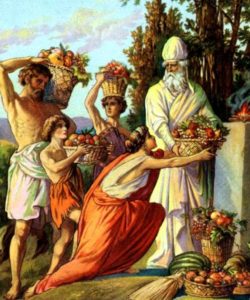
An illustration of bringing bikkurim to the kohen (from the Providence Lithograph Company)

This week’s double parasha, Behar and Bechukotai, begins with the laws of Sabbaticals and Jubilees, and ends with some laws related to tithes. We see here the Torah’s incredible concern for public welfare and social justice—far ahead of its time. The Torah outlines a lengthy system of rules to ensure that the impoverished and the disadvantaged are taken care of, that people have equal opportunities, and that both wealth and land is redistributed to address the disparity between rich and poor, which inevitably results in most societies.

We see, for instance, that at the Jubilee year (every 50th), all lands reverted to their original owners. In Biblical times, when a person purchased land, they were really only leasing it for a number of years, no more than the number of years left until the next Jubilee. So, even if a family had become destitute in the intervening years, and had to sell off all of their land, they could rest assured knowing that they would eventually get their ancestral plot of land back, and have an opportunity to rebuild their wealth. This would ensure that the mega-rich do not swallow up land and grow ever richer (as we unfortunately see all too often today, such as Bill Gates being the largest owner of farmland in America, and Mark Zuckerberg buying nearly an entire Hawaiian island despite the protest of locals). Continue reading
The Hidden Connection Between Lag b’Omer and Yom Yerushalayim

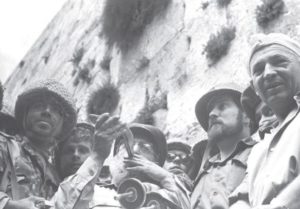
Rabbi Shlomo Goren blows the shofar by the Western Wall during the 1967 liberation of Jerusalem.

This Thursday evening, the 18th of Iyar, we mark the mystical holiday of Lag b’Omer. Ten days later, on the 28th of Iyar, we commemorate Yom Yerushalayim, when Jerusalem was liberated and reunified in 1967 during the miraculous Six-Day War. At first glance, these two events may seem completely unrelated. However, upon deeper examination, there is actually a profound and fascinating connection between the two. To get to the bottom of it, we must first clarify what actually happened on these dates in history to uncover their true spiritual significance. Continue reading

What are the True Borders of Israel?

This week we read another double portion, Acharei Mot and Kedoshim. The latter, literally meaning “holies”, instructs us on the key mitzvot that make us especially holy. Of course, while all of the Torah’s mitzvot serve to make us holier, the ones in Kedoshim particularly have special merits. The list starts with revering one’s parents and observing the Sabbath (Leviticus 19:3). It peaks with the famous mitzvot of judging others favourably (v. 15), not gossiping (v. 16) nor bearing a grudge (v. 18), and loving your fellow as yourself. Other big mitzvot include not wearing shaatnez (v. 19, a mixture of wool and linen), and not getting tattooed (v. 28). Finally, there is a list of prohibited sexual relationships, before God says: Continue reading