Category Archives: Torah & Science

Time Travel in the Torah

This week’s parasha is Ki Tisa, in which we read of Moses’ return from Mt. Sinai where he had spent forty days with God. During that time, he had composed the first part of the Torah and received the Two Tablets. The Talmud (Menachot 29b) tells us of another incredible thing that happened:

…When Moses ascended on High, he found the Holy One, Blessed be He, sitting and tying crowns on the letters of the Torah. Moses said before God: “Master of the Universe, who is preventing You from giving the Torah [without these additions]?” God said to him: “There is a man who is destined to be born after many generations, and Akiva ben Yosef is his name. He is destined to derive from each and every tip of these crowns mounds upon mounds of halakhot.” [Moses] replied: “Master of the Universe, show him to me.” God said to him: “Return behind you.”

Moses went and sat at the end of the eighth row [in Rabbi Akiva’s classroom] and did not understand what they were saying. Moses’ strength waned, until [Rabbi Akiva] arrived at the discussion of one matter, and his students said to him: “My teacher, from where do you derive this?” [Rabbi Akiva] said to them: “It is an halakha transmitted to Moses from Sinai.” When Moses heard this, his mind was put at ease…
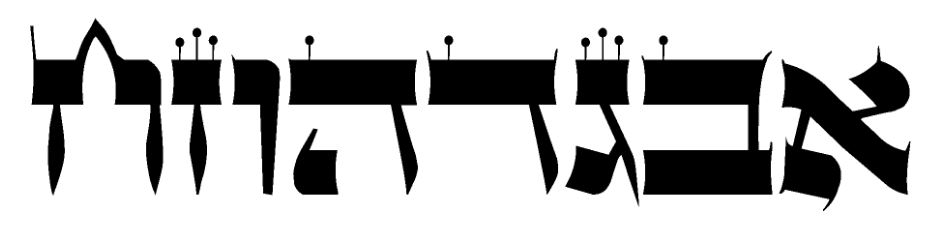
Up on Sinai, Moses saw a vision of God writing the Torah—this is how Moses himself composed the Torah, as he was shown what to inscribe by God—and he saw God adding the little tagim, the crowns that adorn certain Torah letters. Moses was puzzled by the crowns, and asked why there were necessary. God replied that in the future Rabbi Akiva would extract endless insights from these little crowns.

Moses then asked to see Rabbi Akiva, and was permitted to sit in on his class. Moses could not follow the discussion! In fact, the Talmud later says how Moses asked God: “You have such a great man, yet you choose to give the Torah through me?” At the end of the lesson, Rabbi Akiva’s students ask him where he got that particular law from, and he replied that it comes from Moses at Sinai. Moses was comforted to know that even what Rabbi Akiva would teach centuries later is based on the Torah that Moses would compose and deliver to Israel.

This amazing story is often told to affirm that all aspects of Torah, both Written and Oral, and those lessons extracted by the Sages and rabbis, stems from the Divine Revelation at Sinai, and from Moses’ own teachings. It is a central part of Judaism that everything is transmitted in a chain starting from Moses at Sinai, down through the prophets, to the Anshei Knesset HaGedolah, the “Men of the Great Assembly” and the earliest rabbis, all the way through to the present time.

What is usually not discussed about this story, though, is the deeper and far more perplexing notion that Moses travelled through time! The Talmud does not say that Moses saw a vision of Rabbi Akiva; it says that he literally went and sat in his classroom. He was there, sitting inconspicuously at the end of the eighth row. As a reminder, Moses received the Torah in the Hebrew year 2448 according to tradition, which is 3331 years ago. Rabbi Akiva, meanwhile, was killed during the Bar Kochva Revolt, 132-136 CE, less than 2000 years ago. How did Moses go 1400 years into the future?

Transcending Time and Space

In his commentary on Pirkei Avot (Magen Avot 5:21), Rabbi Shimon ben Tzemach Duran (1361-1444) explains:

Moshe Rabbeinu, peace be upon him, while standing on the mountain forty days and forty nights, from the great delight that he had learning Torah from the Mouth of the Great One, did not feel any movement, and time did not affect him at all.

As we read at the end of this week’s parasha, Moses “was there with God for forty days and forty nights; he ate no bread and drank no water, and He inscribed upon the tablets the words of the Covenant…” (Exodus 34:28) At Sinai, Moses had no need for any bodily functions. Rabbi Duran explains that from his Divine union with God, Moses transcended the physical realm. In such a God-like state, he was no longer subject to the limitations of time and space.

In this regard, Moses became like a photon of light. Modern physics has shown that light behaves in very strange ways, and does not appear to be subject to time and space. Fraser Cain of Universe Today explains how

From the perspective of a photon, there is no such thing as time. It’s emitted, and might exist for hundreds of trillions of years, but for the photon, there’s zero time elapsed between when it’s emitted and when it’s absorbed again. It doesn’t experience distance either.

Light transcends time and space. In this way, Moses was like light. And this is quite fitting, for this week’s parasha ends with the following (Exodus 34:29-33):

And it came to pass when Moses descended from Mount Sinai, and the Two Tablets of the Testimony were in Moses’ hand when he descended from the mountain, and Moses did not know that the skin of his face had become radiant while He had spoken with him. And Aaron and all the children of Israel saw Moses, and behold, the skin of his face had become radiant, and they were afraid to come near him… When Moses had finished speaking with them, he placed a covering over his face.

Moses glowed with a bright light, so much so that the people couldn’t look at him, and he would wear a mask over his face. Moses had become light. And light doesn’t experience time and space like we do. There is something divine about light. It therefore isn’t surprising that the Kabbalists referred to God as Or Ain Sof, “light without end”, an infinite light, or simply Ain Sof, the “Infinite One”. Beautifully, the gematria of Ain Sof (אין סוף) is 207, which is equal to light (אור)!

Travelling to the Future

While Moses was instantly teleported into the future, we currently have no scientifically viable way for doing so. However, the notion of travelling into the future is a regular fixture of modern science fiction, and the way it usually presents itself is through some form of “cryosleep”. This is when people are either frozen or placed into a state of deep sleep, or both, for a very long time (usually because they are flying to distant worlds many light years away), and are reanimated in the distant future. For this there is a good scientific foundation, as there are species of frogs in Siberia, for example, that are able to freeze themselves for the winter, and thaw in the spring. They can do this without compromising the integrity of their cellular structure, in a process not yet fully understood. If we could mimic this biological process, then humans, too, could potentially freeze themselves for long periods of time, “thawing” in the future. And this, too, has a precedent in the Talmud (Ta’anit 23a):

[Honi the Circle-Drawer] was throughout the whole of his life troubled about the meaning of the verse, “A song of ascents, when God brought back those that returned to Zion, we were like them that dream.” [Psalms 126:1] Is it possible for a man to dream continuously for seventy years? One day he was journeying on the road and he saw a man planting a carob tree. He asked him: “How long does it take [for this tree] to bear fruit?” The man replied: “Seventy years.” He then further asked him: “Are you certain that you will live another seventy years?” The man replied: “I found [ready-grown] carob trees in the world; as my forefathers planted these for me so I too plant these for my children.”

Honi sat down to have a meal and sleep overcame him. As he slept a rocky formation enclosed upon him which hid him from sight and he continued to sleep for seventy years. When he awoke he saw a man gathering the fruit of the carob tree and he asked him: “Are you the man who planted the tree?” The man replied: “I am his grandson.” Thereupon he exclaimed: “It is clear that I slept for seventy years!” He then caught sight of his donkey who had given birth to several generations of mules, and he returned home. He there enquired: “Is the son of Honi the Circle-Drawer still alive?” The people answered him: “His son is no more, but his grandson is still living.” Thereupon he said to them: “I am Honi the Circle-Drawer”, but no one would believe him.

He then went to the Beit Midrash and overheard the scholars say: “The law is as clear to us as in the days of Honi the Circle-Drawer”, for whenever he used to come to the Beit Midrash he would settle for the scholars any difficulty that they had. Whereupon he called out: “I am he!” but the scholars would not believe him nor did they give him the honour due to him. This hurt him greatly and he prayed [for death] and he died…
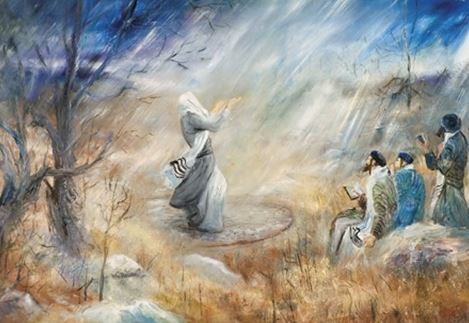
“Honi HaMeagel”, by Huvy. Honi is famous for drawing a circle in the ground around him and not moving away until God would make it rain. Josephus wrote that Honi was killed during the Hasmonean civil war, around 63 BCE. The Maharsha (Rabbi Shmuel Eidels, 1555-1631) said that people thought he was killed in the war, but actually fell into a deep sleep as the Talmud records.

Honi HaMa’agel, “the Circle-Drawer”, who was renowned for his ability to have his prayers answered, entered a state of deep sleep for seventy years and thereby journeyed to the future! This type of time travel is, of course, not true time travel, and he was unable to go back to his own generation. He prayed for death and was promptly answered.

Travelling back in time, meanwhile, presents far more interesting challenges.

Back to the Future

In 2000, scientists at Princeton University found evidence that it may be possible to exceed the speed of light. As The Guardian reported at the time, “if a particle could exceed the speed of light, the time warp would become negative, and the particle could then travel backwards in time.” This is one of several ways proposed to scientifically explain the possibility of journeying back in time.

The problem with this type of travel is as follows: what happens when a person from the future changes events in the past? The result may be what is often referred to as a “time paradox” or “time loop”. The classic example is a person who goes back to a time before they were born and kills their parent. If they do so, they would never be born, so how could they go back in time to do it?

Remarkably, just as I took a break from writing this, I saw that my son had brought a book from the library upstairs. Out of over 500 books to choose from, he happened to bring Harry Potter and the Prisoner of Azkaban. Now, he is far too young to have read it, or to even known who Harry Potter is. And yet, this is the one book in the Harry Potter series—and possibly the one book in our library—that presents a classic time paradox!

In Prisoner of Azkaban, we read how Harry is about to be killed by a Dementor when he is suddenly saved by a mysterious figure who is, unbeknownst to him, his own future self. After recovering from the attack, he later gets his hands on a “time turner” and goes back in time. It is then that he sees his past self about to be killed by a Dementor, and saves his past self. The big problem, of course, is that Harry could have never gone back in time to save himself had he not already gone back in time to save himself in the first place!

Perhaps a more famous example is James Cameron’s 1984 The Terminator. In this story, John Connor is a future saviour of humanity who is a thorn in the side of the evil, world-ruling robots. Those evil robots decide to send one of their own back to a time before John Connor was born in order to kill his mother—so that John could never be born. Aware of this, Connor sends one of his own soldiers back in time to protect his mother. The soldier and the mother fall in love, and the soldier impregnates her, giving birth to John Connor! In other words, future John Connor sent his own father back in time to protect his mother and conceive himself! This is a time paradox.

Could we find such a time paradox in the Torah? At first glance, there doesn’t appear to be anything like this. However, a deeper look reveals that there may be such a case after all.

When God Wanted to “Kill” Moses

In one of the most perplexing passages in the Torah, we read that when Moses took his family to head back to Egypt and save his people, “God encountered him and sought to kill him.” (Exodus 4:24) To save Moses, his wife Tziporah quickly circumcises their son, sparing her husband’s life. The standard explanation for this is that Moses’ son Eliezer was born the same day that he met God for the first time at the Burning Bush. Moses spent seven days communicating with God, then descended on the eighth day and gathered his things to go fulfil his mission.

However, the eighth day is when he needed to circumcise his son, as God had already commanded his forefather Abraham generations earlier. Moses intended to have the brit milah when they would stop at a hotel along the way, but got caught up with other things. An angel appeared, threatening Moses for failing to do this important mitzvah, so Tziporah took the initiative and circumcised her son. Alternatively, some say it was the baby whose life was at risk.

Whatever the case, essentially all the commentaries agree that God had sent an angel to remind Moses of the circumcision. Who was that angel? It may have been a persecuting angel, and some say he took the form of a frightening snake. Others, like the Malbim (Rabbi Meir Leibush Weisser, 1809-1879) say it was an “angel of mercy” as Moses was entirely righteous and meritorious. Under the circumstances, one’s natural inclination might point to it being the angel in charge of circumcision, as suggested by Sforno (Rabbi Ovadiah ben Yakov, 1475-1550). Who is the angel in charge of circumcision? Eliyahu! In fact, Sforno proposes that the custom of having a special kise kavod, chair of honour, or “chair of Eliyahu” (though Sforno doesn’t say “Eliyahu” by name), might originate in this very Torah passage. Every brit milah today has such an Eliyahu chair, for it is an established Jewish tradition that the prophet-turned-angel Eliyahu visits every brit.
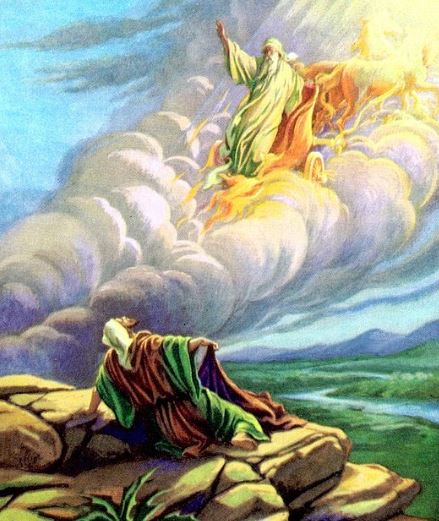
‘Elijah Taken Up to Heaven’

Yet, Eliyahu could not have been there at the brit of Moses’ son, for Eliyahu would not be born for many years! Eliyahu lived sometime in the 9th century BCE. He was a prophet during the reign of the evil king Ahab and his even-more-evil wife Izevel (Jezebel). The Tanakh tells us that Eliyahu never died, but was taken up to Heaven in a fiery chariot (II Kings 2). As is well-known, he transformed into an angel.

The Zohar (I, 93a) explains that when Eliyahu spoke negatively of his own people and told God that the Jews azvu britekha, “have forsaken Your covenant” (I Kings 19:10), God replied:

I vow that whenever My children make this sign in their flesh, you will be present, and the mouth which testified that the Jewish people have abandoned My covenant will testify that they are keeping it.

He henceforth became known as malakh habrit, “angel of the covenant” (Pirkei D’Rabbi Eliezer, 29), a term first used by the later prophet Malachi (3:1).

If Eliyahu is Malakh haBrit, and is present at every circumcision, does this only apply to future circumcisions after his earthly life, or all circumcisions, even those before his time? As an angel that is no longer bound by physical limitations, could he not travel back in time and be present at brits of the past, too? God certainly does transcend time and space, and exists in past, present, and future all at once. This is in God’s very name, a fusion of haya, hoveh, and ihyeh, “was, is, will be”, all in one (see Zohar III, 257b, as well as the Arizal’s Etz Chaim, at the beginning of Sha’ar Rishon, anaf 1). And we already saw how God could send Moses to the distant future and bring him right back to the past. Could He have sent Eliyahu back to the brit of Moses’ son? Such a scenario would result in a classic time loop. How could Eliyahu, a future Torah prophet, save Moses, the very first Torah prophet? Eliyahu could not exist without Moses!

It is important to note here that there were those Sages who believed that Eliyahu was always an angel, from Creation, and came down into bodily form for a short period of time during the reign of Ahab. This is why the Tanakh does not describe Eliyahu’s origins. It does not state who his parents were, or even which tribe he hailed from. Others famously state that “Pinchas is Eliyahu”, ie. that Eliyahu was actually Pinchas, the grandson of Aaron. Pinchas was blessed with eternal life, and after leaving the priesthood, reappeared many years later as Eliyahu to save the Jewish people at a difficult time. He was taken up to Heaven alive as God promised. In the Torah, we read how God blessed Pinchas with briti shalom (Numbers 25:12). Again, that key word “brit” appears—a clue that Pinchas would become Eliyahu, malakh habrit.

While it is hard to fathom, or accept, the possibility of an Eliyahu time paradox, there is one last time paradox that deserves mention. And on this time paradox, all of our Sages do agree…


The above essay is an excerpt from Garments of Light, Volume Three.
To continue reading, get the book here! 

What is Tekhelet?

At the beginning of this week’s parasha, Tetzave, the Torah describes the special garments worn by the Kohanim. Making these garments requires the use of three unique dyed fabrics: tekhelet, argaman, v’tola’at shani, “blue, purple, and crimson wool”. Last year, we discussed tola’at shani and the practice of wearing a red string on the wrist. This year we will explore the other two ingredients: tekhelet and argaman. What are they and where do they come from?

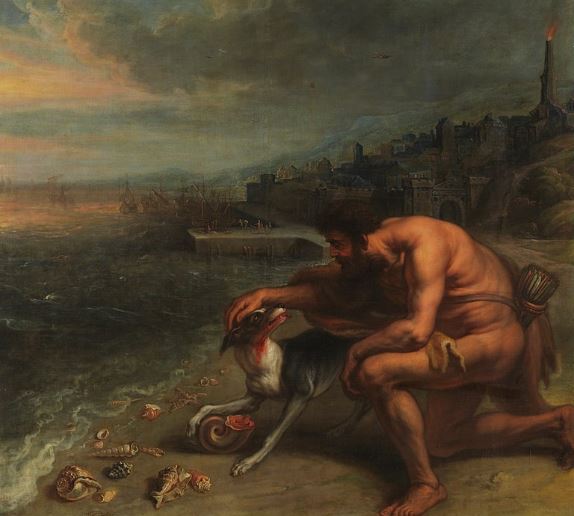
In Greek mythology, the hero Hercules discovered Tyrian purple when his dog chewed on sea snails, as depicted here in Peter Paul Rubens’ “Hercules’ Dog Discovers Purple Dye”

Argaman is more commonly known as “Tyrian purple” or “royal purple”, a famous and prized dye in ancient times. Historical records and archaeological findings show that as early as 3500 years ago, trade in Tyrian purple was widespread across the Mediterranean and the Middle East. It was the Phoenicians who were experts in its production, and carried it around the region. (In fact, the root of the term Phoenician means “purple” in Greek. Similarly, some scholars have found evidence that Canaan means “dye merchant”.) Tyrian purple was worth at least as much as silver, and in some points in history, more than gold.

By the Roman Era, it was so expensive and prized that it was essentially only worn by royalty, hence “royal purple”. An average Roman, or even a Roman senator, would wear a toga pura, plain white, while magistrates and priests wore a toga praetexta, with a purple stripe or hem. Only the emperor would wear a toga picta, one that was entirely dyed purple, with gold embroidery. (Such a toga might also be worn by high ranking generals during their victory processions, as well as by the consuls.)

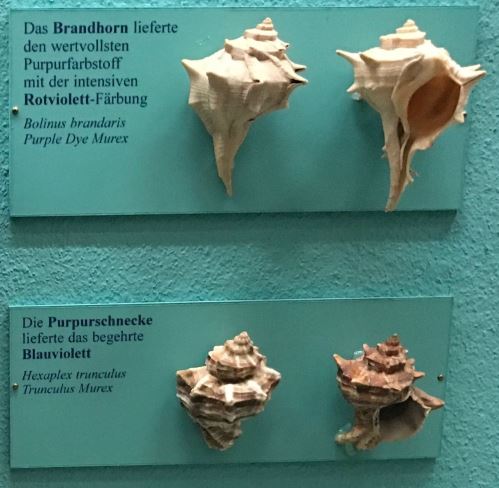
Shells of the Murex snails that produce purple and blue dye. (Credit: U.Name.Me)

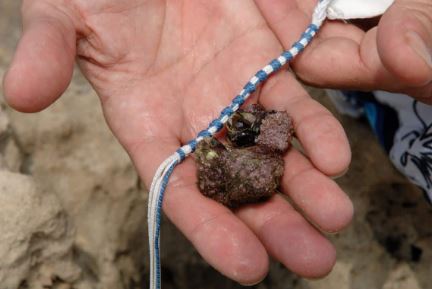
How did the Phoenicians produce argaman? It was extracted from the glands of shellfish on the Phoenician shores of the Eastern Mediterranean. These Murex snails make the dye as a defense mechanism, spraying it on potential predators (just as squids and octopuses, their mollusc relatives, famously do). Research shows that the snails also use the dye for their own predatory behaviour when catching prey, and also as an antimicrobial to protect their eggs. To extract the dye, the snails are either “milked”, which takes a very long time, or more commonly, pierced through their shells to have the glands removed. It would take over 10,000 snails to produce just a few grams of dye!

Tekhelet was made the same way. Though not nearly as popular in ancient times, it was known as “royal blue”. The Phoenicians made it the same way, extracted from a snail. Some say it was derived from a different species of snail, while others point out that the same Tyrian purple, when exposed to large amounts of UV radiation (sunlight), becomes blue.

The Talmud (Menachot 44a) states that the dye was made from chilazon, a snail “whose body resembles the sea, and its form resembles a fish, and it comes up once in seventy years, and with its blood one dyes tekhelet, and therefore its blood is expensive.” It’s not quite the blood of the snail that makes the dye, of course, nor do the snails emerge only once in seventy years. This bit probably entered the Talmud because by that point in history, tekhelet production among Jews had long ended, and knowledge of its exact extraction forgotten. It was probably difficult, if not entirely impossible, for Jews to get their hands on it.

Tzitzit with tekhelet (Credit: Tekhelet.com)

Dr. Baruch Sterman, in a paper for B’Or HaTorah (vol. 11, pg. 185), points out that by the 4th century CE it was actually a crime for a commoner to wear tekhelet across the Roman world. It is highly likely that it was then, for this reason, that most Jews stopped using tekhelet in their tzitzit. Dr. Sterman brings proof from the Talmud (Sanhedrin 12a), where we read how two rabbis were arrested by the Romans for possessing tekhelet. Wealthy Jews living in the Persian Empire continued to pay exorbitant rates to import and use it, until sometime in the middle of the 7th century. It was then, likely due to the rise of Islam and the rapid Arab conquest of the region, that use of tekhelet among all Jews essentially ceased. This is why until today the majority of Jews do not use tekhelet in their tzitzit (as the Torah commands). However, in recent decades, the Murex snails have been rediscovered, and tekhelet is once again available.

Having said all that, Karaite Jews—a small group that rejects the Talmud—believe that tekhelet (and argaman) could not have been derived from snails. And they actually have a couple of seemingly valid points.

The Problem of Karaite Tekhelet

The Karaites believe that tekhelet cannot come from a snail because the Torah would not command something so important to come from a non-kosher animal. They also argue that royal blue tekhelet from snails would have been far too expensive for the average Israelite. Finally, they point out that God commanded this to the Israelites in the Wilderness—so where would they find sea snails in the middle of the desert? Instead, Karaite scholars proposed that tekhelet came from an indigo plant, such as the Indian Indigofera tinctoria (incidentally, this is the indigo once used to dye jeans blue).

Another, more likely, possibility is the woad plant, Isatis tinctoria, which contains the same indigo dye. This plant actually grows in Israel, and was once known as “Asp of Jerusalem”. Interestingly, the Mishnah (Megillah 4:7) states how Kohanim are forbidden from blessing the congregation if their hands are stained with “istis”, ie. the Isatis tinctoria dye. The Bartenura (Rabbi Ovadiah of Bartenura, c. 1445-1515) confirms that istis is a dye “whose colour resembles tekhelet”. This makes it clear that Kohanim in the ancient Holy Temple did use woad as a blue dye, though for what purpose is unclear.

Karaite Jews today continue to make tekhelet from indigo or woad to dye their tzitzit. Since Karaites hold strictly to the Written Torah, they maintain that tzitzit must be blue (and cannot be entirely white like most current “Rabbinic” tzitzit). They hold that any blue dye is fine, since the Torah does not explicitly say that other blue dyes are forbidden. The Talmud, meanwhile, states that a person who uses plant-derived blue dyes instead of authentic tekhelet is sinning, and God declares that He will “exact retribution” from such a person (Bava Metzia 61b, see also Tosefta on Menachot 9:6). And here the Karaites should take heed, for when it comes to tekhelet they are absolutely mistaken.

The big problem for the Karaites is basically everyone else. Aristotle (384-322 BCE) wrote in his History of Animals about the production of blue and purple dyes from snails, as did the Roman philosopher and historian Pliny the Elder (23-79 CE) in his Natural History. These were the choicest and best dyes for clothes and fabrics. While tekhelet and argaman were expensive for the distant Greeks and Romans to procure, they would not have been expensive for the ancient Israelites. After all, these dyes were only expensive to purchase; there is no indication that they were expensive to produce. And the Israelites, like the Phoenicians and Canaanites, were the producers. They made the dyes cheaply, and exported them far and wide, for a healthy profit.

It was only in later centuries, when Israel was no longer an independent entity and was subject to a series of foreign empires, that Jews lost control of the means of tekhelet production. Tekhelet became rarer, and more expensive, and eventually forbidden. This development only occurred in the late Second Temple era, and possibly later. Still, when chemists in the 1990s analyzed blue fabrics uncovered at the Masada archaeological site, they discovered that the fabrics were indeed dyed with Murex snail tekhelet. Even in the late Second Temple era, tekhelet was available and used widely. Besides, the average Israelite in those days would have needed only a minute amount to dye a handful of strings to fulfil the mitzvah of tzitzit.

Another bit of evidence for the fact that snail dye was the real tekhelet comes from the Tanakh itself. While we’ve already seen how historical and archaeological records make it clear that the ancient Phoenicians were experts in snail dyes (not any plant-based blue dyes), we mustn’t forget that these same Phoenicians were heavily involved in the production of Israelite holy items, too! We read in the haftarah for last week’s parasha (I Kings 5:26-6:13) how King Solomon made an agreement with the Phoenician King Hiram, and the latter’s workers played an instrumental role in the construction of the Holy Temple. Granted, this was not the Mishkan of the Wilderness, but the later Temple was based on the earlier Mishkan, and the items were fashioned to the same specifications.

Where was Hiram’s capital city? The Tanakh always refers to him as melekh tzor, “King of Tyre”. This is the selfsame Tyre as the Tyre of Tyrian purple and Tyrian royal blue. We read how “Hiram, king of Tyre, sent his servants to Solomon…” (I Kings 5:15) It is hard to believe that it’s only a coincidence that the Tyrians renowned around the ancient world for their snail dyes are the same ones that the Tanakh tells us worked in Jerusalem! The evidence is therefore quite strong that tekhelet and argaman are the same as the snail-derived Tyrian dyes.

Tekhelet in the Wilderness

The nail on the coffin comes from an even more ancient historical text. Long before Pliny, Aristotle, and even Hiram, the ancient Egyptian Papyrus Anastasi I—dated back to the Nineteenth Dynasty (c. 1292-1189 BCE)—mentions how a royal blue dye is made from sea creatures and smells like putrid fish. This is particularly important because the Nineteenth Dynasty was the time of Pharaoh Ramses II, who is the one most associated with the Exodus. Ramses II built a new capital city which, of course, he named after himself, and which archaeologists have uncovered and refer to as Pi-Ramesses. This is the same city that the Torah mentions the Israelite slaves built (Exodus 1:11). Putting the pieces together, we now have an answer to the question posed by the Karaites: how did the Israelites find tekhelet and argaman in the Wilderness?

The Torah tells us that when the Israelites left Egypt, God commanded them to ask the Egyptians to give them precious materials: “And the children of Israel did according to the word of Moses, and they asked of the Egyptians jewels of silver, and jewels of gold, and raiment.” (Exodus 12:35) The Israelites got tekhelet and argaman from the same place they got their gold and silver (also used in constructing the Mishkan): from the Egyptians. The Papyrus of Anastasi proves that the ancient Egyptians, too, produced blue and purple dyes from Mediterranean snails. They made “raiment”, garments and fabrics dyed with these colours. The Torah informs us that the Israelites took these fabrics with them. And this is how they had them available for the Mishkan in the Wilderness!

Despite all that’s been said, the Orthodox world today has been very slow in readapting the use of tekhelet. Some rabbis maintain that these Murex snails are not the right ones. The Radziner Rebbe (Rabbi Gershon Henoch Leiner, 1839–1891) didn’t know about the snails at all and instead consulted chemists to produce a blue dye from the common cuttlefish, Sepia officinalis. The problem is that the cuttlefish only produces black ink, and turning it blue was a long chemical process that required adding iron filings. When later analyzed by experts, it was found that the Radziner Rebbe’s dye was basically synthetic, and the blue was simply a result of the added iron. (For more, see Dr. Sterman’s article in B’Or haTorah, cited above.) Meanwhile, Rabbi Isaac Herzog (1888-1959, Israel’s first Ashkenazi Chief Rabbi) was an early proponent of snail-derived dyes.

In recent decades, more and more researchers have explored the subject, and today everything points to tekhelet being the blue dye of the Murex trunculus snail. The scientists at Masada confirmed it chemically, and although some state that there is no chemical difference between woad, indigo, and Murex blue, there are small differences in their molecular structure. One with a chemistry background will agree that the addition of even a single atom can dramatically change the nature of a substance. Still, many rabbis are reluctant to adopt tekhelet, and have decided it is best to wait until Mashiach comes just to be sure.

Comparing the chemistry of blue dyes: though looking similar to the untrained eye, the chemical structure of plant-based Indigotin (top left) is different from synthetic indigo (bottom left) and the indigo of Murex snails (bottom right).

And as for the Karaite argument that the Torah wouldn’t command something derived from a non-kosher animal, this argument falls apart when considering the third ingredient that always goes along with tekhelet and argaman: tola’at shani. The word is literally translated as a “crimson worm” or, more accurately, “red insect”. Tola’at definitely refers to a bug of some sort, as we read in Exodus 16:20 how leftover manna was infested with tola’im.

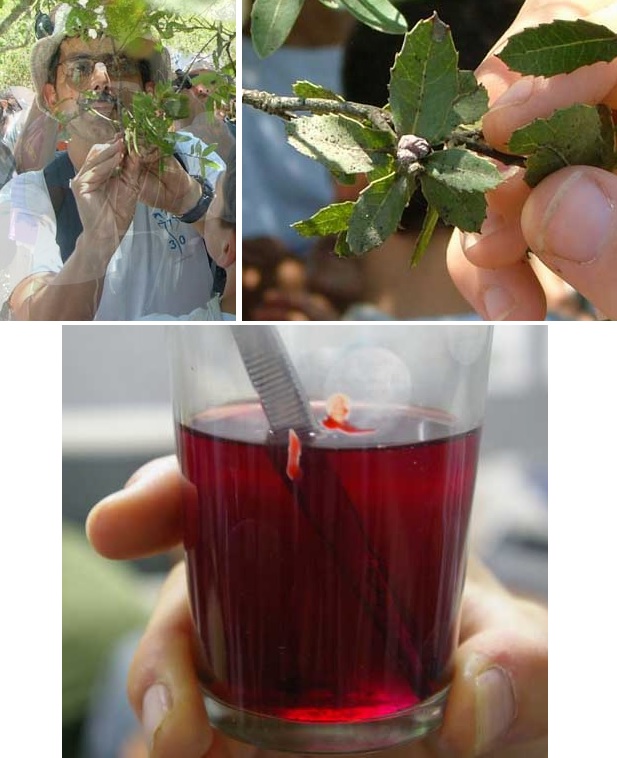
Tola’at shani is undoubtedly referring to the common carmine dye used around the world, and known commercially in food as E120. This dye is derived from a variety of scale insects, most commonly the cochineal family of bugs. Professor Zohar Amar of Bar Ilan University spent many years researching tola’at shani and concluded that it is unquestionably a red insect, which nests in the common Israeli oak tree. In fact, the Temple Institute has already begun harvesting these insects to produce an authentic avnet, the priestly belt that requires the red dye, in preparation for Mashiach’s coming and the return of priestly service in the forthcoming Third Temple.

Clockwise from top left: Professor Amar leads the Temple Institute’s Tola’at Shani harvest; the “crimson worm” on a branch of an Israeli oak tree; Professor Amar holds a cup of crimson water produced by crushing a single worm.


The above essay is adapted from Garments of Light, Volume Three.
Get the book here! 

The Origins of Ashkenazi Jews

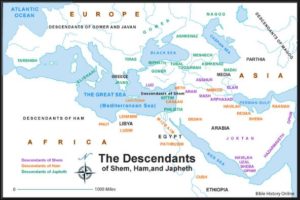
In this week’s Torah portion, Noach, we read about how the seventy primary descendants of Noah settled the Earth after the Great Flood. Noah had three sons, and it is often said that they divided the three continents of the Old World amongst them: Yefet (Japheth) got Europe, Shem got Asia, and Ham got Africa. This is not exactly accurate.

For one, Canaan is a son of Ham, but did not inhabit Africa, while Nimrod is said to be a son of Cush—also of Ham—yet we know Nimrod ruled Mesopotamia (Genesis 10:10). Another son of Ham is Mitzrayim, which is Egypt, yet Mitzrayim’s own children include Pathrusim and Caphtorim, names generally associated with Greek lands. (There is historical evidence to suggest that the early pre-Greek peoples did come from Egypt.) Yavan, the classic term for Greece, is a son of Yefet. As discussed in the past, Yavan is the same as Ionia, which is the western coast of Turkey, then inhabited by Greek-speaking peoples. (The famous city of Troy was in Ionia, in modern-day Turkey.)

In fact, essentially all of the seventy places inhabited by Noah’s descendants are places in modern Turkey or the Middle East. This makes sense, since the Torah was originally speaking to an audience that was unaware of most of Europe, the Far East, sub-Saharan Africa, and needless to say, the New World. The Torah mentions the origins of those territories that were familiar to the ancient Israelites, and that would have been their immediate neighbours. It also makes sense practically, since Noah got off the Ark in Ararat—probably somewhere in modern Turkey—and his children and grand-children would have settled lands that weren’t too far away from there.

Mt. Ararat, as seen from Yerevan, Armenia. It isn’t certain whether this Ararat is the Biblical Ararat.

One of Noah’s descendants is named Ashkenaz (Genesis 10:3). He is a grandson of Yefet, whose children all seem to have inhabited territories in Asia Minor and Armenia. Ashkenaz, too, is in that vicinity. Even in the time of the prophet Jeremiah centuries later, Ashkenaz was a kingdom in Turkey: “Raise a banner in the land, blow the shofar among the nations, prepare the nations against her, call together against her the kingdoms of Ararat, Minni, and Ashkenaz…” (Jeremiah 51:27) The prophet goes on to call on these and other powers in the area to come upon Babylon. Ashkenaz is one of the Turkish kingdoms bordering Babylon to the north, along with Ararat.
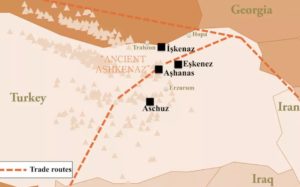
Modern-day villages in Northeastern Turkey. (Credit: theconversation.com)

Amazingly, to this day ethnic Armenians in the region name Ashkenaz as one of their ancestors! This claim is not recent; the fifth-century Armenian scholar Koryun described the Armenians as an Askanazian people. Not surprisingly then, multiple places in Northeastern Turkey today still bear similar-sounding names, including the villages of Iskenaz, Eskenez, and Ashanas.

If Ashkenaz is a place in Turkey, how did it become associated with European Jews? Did Ashkenazi Jews come from Turkey?

Debunking Khazaria

One popular explanation for the Turkey-Ashkenaz connection points to the Kingdom of Khazaria. This was a wealthy and powerful kingdom that ruled the Caucasus, southern Russia, and parts of Turkey and Eastern Europe in the Middle Ages. Historians credit the Khazars with checking the rapid Arab conquest, and preventing a Muslim takeover of Europe from the East. It is said that around 740 CE, King Bulan grew tired of his people’s backwards pagan beliefs and converted to Judaism. According to legend, he had invited representatives of the major faiths to argue their case, and concluded that Judaism was the true faith. (This is the basis of Rabbi Yehuda haLevi’s [c. 1075-1141] famous text, Kuzari.)
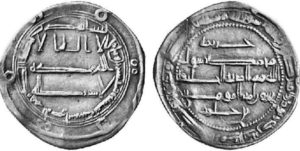
Although Bulan did not impose his new religion on anyone, it is thought that much of his kingdom had become Jewish anyway within about a century. Remarkably, a large reserve of antique Khazar coins was found in Sweden in 1999, bearing the inscription “Moses is the Prophet of God”. (Modeled on, and sometimes just refashioned from, Arab coins saying that “Muhammad is the Prophet of Allah”!) Archaeologists have found similar Khazar coins all over the Old World, from England to China, showing the tremendous extent of Khazaria’s wealth and influence.

Khazar coin from c. 837 CE, with the inscription “Moses is the prophet of God”.

Like all kingdoms, Khazaria had an expiration date. It was eventually overrun by the Rus, Mongols, and others. Some say that many Jewish Khazar refugees migrated westward to Europe, and settled in the sparsely populated and resource-rich lands of Germany. Since they had come from a place traditionally known as Ashkenaz, they were labelled “Ashkenazi Jews”. This is a great story, but one that has far too many holes.

From a historical perspective, most scholars reject the Khazar hypothesis simply because there is little evidence that Khazaria experienced a mass conversion to Judaism. It is generally agreed that only a small portion of the Khazar nobility had converted, at best. Khazaria simply attracted many Jews to settle there since it was a rich kingdom with freedom of religion. In that case, any Jewish refugees that might later flee Khazaria to Europe would not be ethnic Khazars anyway.

The Schechter Letter

Then came a huge discovery from the Cairo Geniza. Now known as the Schechter Letter (as it was discovered by Solomon Schechter, 1847-1915), the text is a correspondence between a Khazari Jew and a Sephardi Jew, most likely Hasdai ibn Shaprut (c. 915-970 CE). The letter includes a brief history of Khazaria, and states that Khazaria’s Jews originally came from Persia and Armenia, from which they had fled persecution. One of their descendants, named Sabriel, eventually rose to Khazarian nobility, and finally became king. His wife, Serach, convinced him to go public with their Jewish heritage, and they did, inspiring others in the kingdom to convert to their new king’s religion.

The Schechter Letter confirms that the majority of the Jews in Khazaria were not actually Turkic converts but migrants from Persia and Armenia. Shortly after the letter was written, the Khazari Kingdom fell apart in 969 CE. (We know the letter must have been written after 941 CE, since it refers to a battle in that year for which we have other historical records.) The supposed Jewish exodus from Khazaria would have happened in the ensuing decades.

Yet, we read in the commentaries of French-born Rashi (Rabbi Shlomo Itzchaki, 1040-1135) how he learned certain things from his visits to Jewish communities in neighbouring Ashkenaz (see, for example, Ketubot 77a), and that Ashkenaz is undoubtedly German (with Rashi occasionally using German/“Ashkenazi” words, as in Sukkah 17a, for instance). This implies that by Rashi’s time—less than a century after the fall of Khazaria—a geographical region in Western Europe referred to as “Ashkenaz” was already well-known, with Jews there freely conversing in German. It is unlikely that this would happen so soon after the fall of Khazaria; Ashkenaz must have existed long before.

Besides, we know that Jews already lived in Central Europe at the time of Charlemagne (742-814 CE), who had a good relationship with his Jewish subjects. Charlemagne was born right around the time King Bulan is supposed to have converted to Judaism, and before the rise of Sabriel (whom some identify with Bulan). This alone proves that Jews were already living in Europe long before any Khazari Jews appeared on the scene.

Among the Ashkenazi Jews of the Middle Ages themselves, the tradition was that they had been there since the destruction of the Second Temple. For example, the Rosh (Rabbi Asher ben Yechiel, c. 1250-1327) wrote in one of his responsa (20, 20) that when he moved to Toledo, Spain:

I would not eat according to [Sefardi] practice, adhering as I do to our own custom and to the tradition of our blessed forefathers, the sages of Ashkenaz, who received the Torah as an inheritance from their ancestors from the days of the destruction of the Temple. Likewise the tradition of our predecessors and teachers in France is superior…

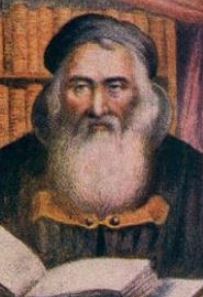
A portrait identified with Rabbeinu Asher ben Yechiel, the “Rosh”

The Rosh speaks of three distinct European Jewish communities: Sefarad, Ashkenaz, and Tzarfat (France). This makes one wonder whether Rashi would have considered himself Ashkenazi (as people typically see him today) or Tzarfati? Rashi was born and died in Troyes, France, though he spent time in Worms and Mainz in Germany, hence the reference above to his having learned things while visiting “Ashkenaz”. This implies that Rashi may not have considered himself Ashkenazi at all. (His father was called Rabbi Itzchak haTzarfati, and though he lived for a time in Worms, probably hailed from Lunel in Southern France.) Whatever the case, we see that the Sefardi, Ashkenazi, and Tzarfati Jewish communities were already firmly entrenched at the time of Khazaria’s fall.

Delving into Ashkenazi Genes

Science can shed further light on Ashkenazi origins. One study of mitochondrial DNA (mtDNA, which is passed strictly from mother to child) found that some 40% of Ashkenazi Jews come from a group of mothers in Europe, possibly converts, approximately 2000 years ago (another related study here). This would have been around the destruction of the Second Temple. We know that many Jews fled Judea (or were expelled) at the time, and settled across the Roman Empire and beyond. Similarly, a study of Y chromosomes (passed strictly from father to son) shows that most Ashkenazi Levites have a common ancestor who lived at least 1500 years ago, most likely in the Middle East or already having migrated to Europe. These scientists conclude that the Khazar hypothesis is “highly unlikely”.

Other genetic studies do appear to show high degrees of relatedness between Turkic and Iranian peoples with Ashkenazi Jews, especially males. Of course, Jews have lived and migrated just about everywhere, and undoubtedly mixed with local populations, while drawing numerous converts. One interesting study found that about 5% of Ashkenazi males are part of the Q3 haplogroup, part of the wider Q group which represents Native Americans and Asians. The researchers concluded that Q3 entered the Jewish gene pool sometime in the 1st millennium. Some say this is due to the Ashina Turks (among the Khazar elite) who converted to Judaism and took Jewish wives. Either way, it is only a tiny minority of Ashkenazis that carry such genes.*

What we see from genetic studies is that most Ashkenazi Jews today descend from ancestors that were already in Europe long before the rise of the Khazars. Historical evidence confirms the existence of widespread Jewish communities in Europe before the time of Khazaria, too. In reality, the Khazar hypothesis keeps being resurrected because it is a convenient tool for anti-Semites to attack modern Jews as “imposters” (meanwhile completely forgetting the other half of the world’s Jews which are not Ashkenazi at all!) or for anti-Zionists to deny a Jewish connection to the land of Israel.

Having said all that, we must still answer the key question: where did the “Ashkenazi” label come from?

Adapting Names

When we look at the seventy “original” nations—descendants of Noah—we find that they represent a very small geographical area. Of the seventy, fourteen come from Yefet and represent Asia Minor, Armenia, and the Aegean islands (Genesis 10:5), nine are Cushites (presumably dark-skinned people), eight of Mitzrayim, twelve are Canaanites, and twenty-six are Middle Eastern, or possibly even just Mesopotamian. As already mentioned, the Torah’s narratives are confined to a narrow geographical space that was relevant to the ancient Israelites.

A “Table of Nations” from the ArtScroll Stone Chumash

When Jews started migrating out of Israel and beyond the Middle East, they needed to come up with names for these new territories they inhabited. So, they adapted the Biblical place-names of locations that no longer existed or whose identity was no longer known. For example, Sefarad became Spain and Tzarfat became France. When scripture speaks of Sefarad or Tzarfat (as in Ovadiah 1:20), it is certainly not speaking of Spain or France! For instance, the prophet Elijah went to Tzarfat, which is described as being next to Sidon (I Kings 17:9). Sidon is, of course, a well-known ancient city, in what is now Lebanon.

For the first Jews who settled in Spain and France, they had migrated the farthest West they could possibly go at the time. For them, these new lands were the most distant from Jerusalem, so they fittingly adapted terms for places described as being exceedingly far from the Holy Land (as in Ovadiah 1:20). They couldn’t use the names of places that were still extant, but only those ancient names that were no longer relevant. In the same fashion they described Germany as “Ashkenaz”, while Bohemia was surprisingly called “Canaan”. Therefore, to say that Ashkenazi Jews are Turkish because Ashkenaz was originally a place in Turkey is like saying French Tzarfati Jews are Lebanese because Tzarfat was originally a place in Lebanon!

It is worth pointing out here that scholars have also recently pinpointed the Biblical Sefarad. There is now strong historical evidence to identify Sefarad with the ancient town of Sardis, also in Asia Minor (modern Turkey), of course. Sardis was known to the Lydians who inhabited it as Sfard, and to the Persians as Saparda. It goes without saying that Sephardic Jewish origins have nothing to do with Turks, as don’t the origins of Lydians (probably the “Ludim” of Genesis 10:13, or the Lud of Genesis 10:22), nor the Yavanim, the Greek Ionians, all of whom inhabited that same area of Asia Minor.
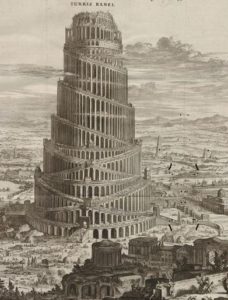
The Tower of Babel

‘Turris Babel’ by Athanasius Kircher (1602-1680)

After telling us the divisions of the nations in Genesis 10, the Torah goes on to relate the narrative of Migdal Bavel. We are told that the people were all still unified at this point, speaking one tongue. They gathered in Babylon to build a tower to the Heavens, with nefarious intentions. Their plans were thwarted by God, who then scattered the people all over the world and confounded their tongues.

From a mystical perspective, at this point those seventy root nations—which originally inhabited Asia Minor and the Middle East—were spread all around the globe into a multitude of various peoples with new cultures and languages. Thus, all of the world’s thousands of nations and ethnicities, wherever they may be, are spiritually rooted in one of Noah’s seventy descendants.

Consequently, there were those who believed that Ashkenaz was dispersed to Central Europe. What’s amazing is that this was not only a Jewish belief, but a Christian one, too. The evangelical Christian pastor Ray Stedman (1917-1992) wrote:

The oldest son of Gomer was Ashkenaz. He and his descendants first settled around the Black Sea and then moved north into a land which is called Ascenia, and which later became known as the Islands of Scandia, which we now know as Scandinavia. You can trace a direct link between Ashkenaz and Scandinavia.

Basing himself on earlier sources, he lists Ashkenaz as referring to all Saxons, Scandinavians, and Germanic tribes. This argument was made at least as far back as the 4th century (long before the Khazars appeared on the scene), in Eusebius’ Historia Eccliesiastica, where Ashkenaz is Scanzia, another name for Scandinavia and/or Saxony.

Around that same time, the Talmud (Yoma 10a) identifies Gomer (the father of Ashkenaz) with Germamia. While this Germamia is possibly referring to Cimmeria, or Germanikia in Syria—which would have been more familiar to the Babylonian Sages living in the Persian Empire—it is very likely that Jews who settled in Germany would see Germamia as referring to their new land. Combined with the alliteration between “Ashkenaz” and “Saxony”/“Scanzia”, we can understand why the Jews that settled in Germany adapted the name Ashkenaz.

As an intriguing aside, the Talmud cited above holds that Yefet is a forefather of the Persians, too. The Talmud reads: “How do we know that the Persians are derived from Yefet? Because it is written: ‘The sons of Yefet: Gomer, and Magog… and Tiras’” The Sages say Tiras is Paras, Persia. Intriguingly, the Sages seem to connect Magog (of “Gog u’Magog” fame) with the Persians. That might make alarm bells go off in the heads of modern readers who see Iran as playing a central role in an End of Days armagaddeon.

To conclude, the hypothesis that Ashkenazi Jews originate among Turkish converts is completely false. While some Turkish converts certainly joined the Jewish nation in the Middle Ages, Ashkenazi Judaism predates this phenomenon by centuries. Both historical evidence and genetic analyses confirm a European Jewish presence as far back as 2000 years ago.


*Shortly after publishing this article, Kevin Brook pointed out the following to me, from his book The Jews of Khazaria (pg. 204):

Some researchers thought it was possible that these could have been inherited from the Khazars, but this idea is no longer viable. Ashkenazim belong to the Q haplogroups that were later precisely identified as Q-Y2200 (Q1b1a1a1a) and Q-YP1035 (Q1b1a1a1a2a2). On the Y chromosome tree, Q-Y2200’s parent haplogroup Q-Y2225 (Q1b1a1a1) was found in an Italian sample from Sicily, and geneticists determined that QY2225’s distant ancestors had apparently lived in the Middle East. The Ashkenazic branches of Q are very different from Q1a1b-M25 and Q1a2-M346, which are common among Turkic-speaking peoples, and the common ancestor between them all lived many thousands of years ago, far in advance of Khazaria’s existence.


The above essay is adapted from Garments of Light, Volume Three.
Get the book here!