Category Archives: Torah & Science

A Mystical Map of Your Soul

This week, outside of Israel, we read the parasha of Acharei Mot. (In Israel, since Pesach is seven days and finished last Friday, Acharei Mot was read on Shabbat and this week the following parasha, Kedoshim, is read. For the next few months, the weekly parasha read in the Diaspora will be different than that read in Israel.) In Acharei Mot, we are commanded:

And any man of the House of Israel or of the foreigner that lives among them, who eats any blood, I will set My countenance upon the soul who eats the blood, and I will cut him off from among his people. For the soul of the flesh is in the blood, and I have therefore given it to you [to be placed] upon the altar, to atone for your souls. For it is the blood that atones for the soul. (Leviticus 17:10-11)

Many recipes call for the use of “kosher salt”. Chefs like it because the larger grains allow them to season their meals more precisely. Jews use koshering salt to remove the tiniest drops of blood that may have remained after draining.

The Jewish people are absolutely forbidden from consuming any kind of blood, whether in a juicy steak or even the tiniest drop inside an egg. It is quite ironic that one of the most disgusting anti-Semitic accusations thrown upon the Jews is that Jews, God forbid, consume the blood of children. (It is all the more ironic that this “blood libel” originates among Catholics who, when taking communion, believe they are drinking the blood of Jesus—who was a Jew!) In reality, Jews obsess over ensuring that we consume no blood whatsoever, and one of the requirements of kosher meat is that all of the blood has been completely removed.

The Torah explains that we should not consume blood because nefesh habasar b’dam hi, the “soul of the flesh is in the blood”. If we eat meat, it is in order to obtain the nutrients in the flesh, not to absorb the spirit of the animal. The animal’s soul is, as the Torah commands, to be placed “upon the altar”. The Kabbalists explain that by doing so, the soul of the animal is allowed to return to the spiritual worlds from which it originates.

In precisely balanced language, the verses cited above state that a Jew who consumes any blood within which is soul, nefesh, will be “cut off” from his nation, and God will personally set His wrath upon that Jewish soul, nefesh. The same word is used to refer to the soul of the Jew and that of the animal. People sometimes forget that animals, too, have souls, and it is forbidden to harm animals in any way.

Having said that, there is of course a great difference between the soul of an animal and the soul of a human. In fact, we find in the Tanakh that five different words are used to refer to the soul. Our Sages explain that a person actually has five souls, or more accurately, five parts or levels to their soul. (The Ba’al HaTurim, Rabbi Yakov ben Asher [1269-1343], states that the five prayer services of Yom Kippur, and the five times that the Kohen Gadol would immerse in the mikveh that day, is in order to purify all five souls; see his commentary on this week’s parasha, Leviticus 16:14.) These five souls are in ascending order, and correspond to the spiritual universes of Creation and to the divine Sefirot. Each soul is itself made up of even smaller, intertwining parts. Understanding the soul and its dynamics is a central part of Jewish mysticism, and what follows is a brief overview of that spiritual map.

The First Three Souls
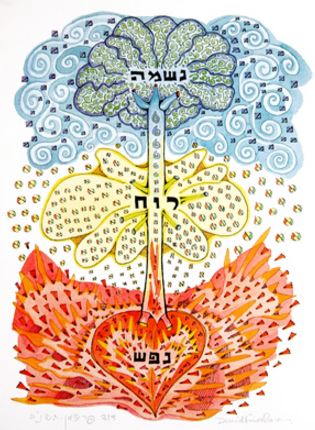
The first and lowest of the souls is the nefesh. As we have already seen, this soul is associated with the blood, and is the “life force” of a living organism. Above that is the soul called ruach, literally “wind” or “spirit”. We find this term right at the beginning of the Torah (Genesis 1:2) in referring to the Spirit of God (Ruach Elohim) and in many other places to refer to the souls of great people, such as Joshua (Numbers 27:18). Above that is the neshamah, literally “breath”, which we are first introduced to during the creation of Adam, where God breathes a nishmat chayim, “soul of life” into the first civilized man (Genesis 2:7).

These first three souls—nefesh, ruach, and neshamah; often abbreviated as naran—are spoken of widely across Jewish holy texts, from the Tanakh through the Talmud and the Zohar. For example, the Talmud (Niddah 31a) states how there are three partners in the creation of a person: the father is the primary source of five “white” things (bones, nerves, nails, brain, eyeball), the mother is the primary source of five “red” things (blood, skin, flesh, hair, iris), and God gives ten things, including the ruach and neshamah. (The nefesh presumably goes together with the blood from the mother.)

The Zohar (I, 205b-206a) elaborates that the neshamah is greater than the ruach, which is greater than the nefesh, and that a person only accesses higher levels of their soul if they are worthy. Sinners do not have access to their neshamas at all. They are just living nefesh, like animals. Based on this, the Zohar has a unique perspective on Genesis 7:22-23:

All in whose nostrils was the breath of the spirit of life [nishmat ruach], whatsoever was in the dry land, died. And He blotted out every living substance which was upon the face of the ground, both man, and cattle, and creeping thing, and fowl of the sky; and they were blotted out from the earth; and Noah alone was left, and they that were with him in the ark.

The Zohar sees these two verses as distinct. First, all those people who did merit a ruach and neshamah (meaning they weren’t completely sinful and didn’t deserve to perish in the Flood) died of natural causes. Only after this did God “blot out” all that remained, including animals and people who were so sinful they were essentially like animals, bearing only a nefesh.

With these three souls in mind, many aspects of life can be better understood. For example, when one is asleep only the nefesh remains in the body (to keep it alive), while the higher souls may migrate. This is why a sleeping body is unconscious and likened to a corpse, and why sometimes dreams can be prophetic, as the higher souls may be accessing information from the Heavens, or through interaction with other souls.

Another intriguing example is from Ibn Ezra (Rabbi Abraham ben Meir ibn Ezra, 1089-1167) who relates the three souls to three major purposes of sexual intercourse. The first and simplest is for procreation, something that even animals do, and naturally corresponds to nefesh. The second is for good health, corresponding to ruach. The third is for love and intimacy, fusing the souls of husband and wife, corresponding to the neshamah.

In addition to naran, the Zohar sometimes speaks of additional, even higher souls, such as “nefesh of Atzilut” and “neshamah of Aba and Ima” (see II, 94b). To make sense of these, we must turn to the Arizal.

Earning Your Higher Souls

In multiple places, Rabbi Chaim Vital (1543-1620), the primary disciple of the Arizal (Rabbi Isaac Luria, 1534-1572) and the one who recorded the bulk of his teachings, describes the anatomy of the soul (see, for example, the first passages of Sha’ar HaGilgulim or Derush Igulim v’Yosher 3 in Etz Chaim). At birth, a baby only contains a full nefesh. As the Torah states, the nefesh is in the blood, and the Arizal adds that since the liver filters blood and is full of it, it is the organ most associated with nefesh. By the age of bar or bat mizvah, a person now has the ability to fully access their ruach. The organ of ruach is the heart (also stated in the Zohar, III, 29b, Raya Mehemna), associated with one’s drives, and both inclinations, the yetzer hatov and the yetzer hara. Only at age 20 does the neshamah become fully available (in most cases). The neshamah is housed in the brain, and is associated with the mind.

Today, we know how scientifically precise those statements are. For example, at any given time the liver (the body’s largest internal organ) contains about 10% of the body’s blood volume, and filters about a quarter of all blood each minute. As well, we know today that the majority of the brain’s development ends around age 20 (though minor changes continue for at least another decade, if not longer). It therefore isn’t surprising that teenagers are so good at making bad decisions. We can also understand why being a teenager is so difficult emotionally, as this is when the ruach is in full force in the heart, and one struggles with their desires and inclinations.

Reinforcing what was said in the Zohar, the Arizal taught that one does not automatically have full access to these souls, but must work on themselves and merit to attain them. Unfortunately, a great many people spend their entire lives stuck in nefesh, living very materialistic and animalistic lives, never overcoming their desires and inclinations (ruach), or achieving any kind of mental greatness (neshamah). The potential is there, though never realized.

For those who do grow ever-higher, they may be able to access even loftier soul levels: the chayah and yechidah. In the Torah, we see many places where the soul is referred to as chayah, including right at the start where God breathes a soul into Adam and makes him l’nefesh chayah (Genesis 2:7). The chayah is sometimes described as an aura. It is not housed within the body, but glows outward, and plays an important role in the interactions between people. (Conversely, some early sources speak of the chayah as being within the body, and serving as its life force. See, for example, Beresheet Rabbah 14:9.)

Above it is the highest level of soul, the yechidah, “singular one”, which connects a person directly with God. It is like a divine umbilical cord, and one who realizes it and senses it may certainly draw through it information from Above. The yechidah, too, has Scriptural basis, for example in Psalms 22:21 and 35:17 where David asks God to save his nefesh and yechidah from danger.

Souls Intertwined With Universes

In Etz Chaim, Rabbi Vital cites the Talmud (Berakhot 10a) as the source for the concept of five souls, as well as the five olamot, spiritual universes. (The mystical Sefer HaBahir adds that this is the secret of the letter hei, which has a numerical value of five.) There in the Talmud, the Sages point out how David’s Barchi Nafshi, Psalms 103-104, uses the phrase Barchi nafshi et Hashem, “May my soul bless God” five times. These, the Sages state, correspond to the five olamot, “worlds” or “universes” that David inhabited. Though the Talmud goes on to present a more physical explanation of what these worlds are, it is possible to read deeper between the lines, and the Kabbalists find allusions to five cosmic, spiritual universes, which are: Asiyah, Yetzirah, Beriah, Atzilut, and Adam Kadmon. While explaining these worlds in depth is a topic for another time, we can state that the five souls correspond to these five universes.

In fact, the Arizal teaches that one can identify the soul elevation of another by studying the colour of their aura: black is the colour of Asiyah, the lowest, physical realm which we visibly inhabit. The higher world of Yetzirah, the domain of angels and spirits, is red. Even higher is Beriah, literally “Creation”, where the very spiritual foundations of Creation exist. It is white. Above this is Atzilut, “divine emanation”, which is pure, brilliant light. These worlds, and souls, correspond to the letters of God’s Name. The final hei is Asiyah/Nefesh, the vav is Yetzirah/Ruach, the first hei is Beriah/Neshamah, the yud is Atzilut/Chayah, and the “crown” atop the yud is Adam Kadmon/Yechidah.
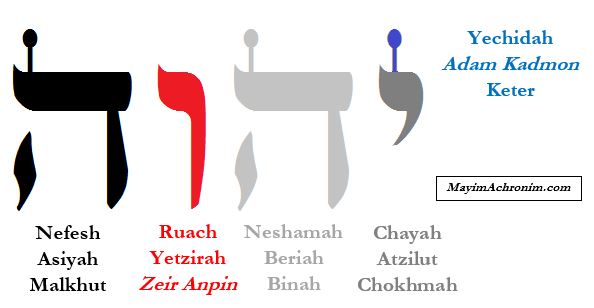
How the letters of God’s Ineffable Name relate to the five levels of soul, the five “universes”, and the Ten Sefirot. (Zeir Anpin refers to the middle six Sefirot from Chessed to Yesod.)

All of these also correspond to the major branches of Torah study. Learning Tanakh is in Asiyah, while Mishnah is in Yetzirah. Talmud is in Beriah, while Kabbalah is in Atzilut. When one learns these texts, they are putting on a spiritual “garment” for that soul level, rectifying it and elevating it further, and this garment will remain with them in the World to Come (see Sha’ar HaPesukim on Tehilim). This is the deeper meaning of Psalm 19:8, which states that God’s Torah is temimah, meshivat nafesh, is “pure and restores the soul”.

Adam Kadmon is left out of the above (and in general is made distinct from the other four universes) because that level is where one has mastered all of the Torah branches, has refined their soul to the highest degree, and is a perfectly righteous person. This level may be equated to the super-lofty soul of Nefesh d’Atzilut which we previously mentioned from the Zohar. Such a rare person is referred to as a malakh, an “angel”, and this was the case with people like Eliyahu, Yehudah, Hezekiah, and Enoch (Sha’ar HaGilgulim, ch. 39).
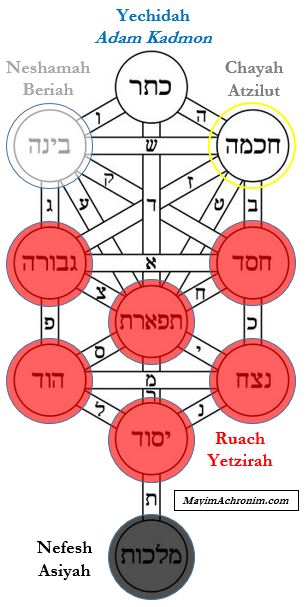
How the souls and universes relate to the “Tree of Life” which depicts the 32 Paths of Creation – the 10 Sefirot and the 22 Hebrew letters.

Emptying The Universe’s Soul

In case it wasn’t complicated enough just yet, the Arizal taught that each of the five souls is itself composed of five souls. So, within the nefesh, ruach, neshamah, chayah, and yechidah (abbreviated as naran chai) there is an inner nefesh, ruach, neshamah, chayah, and yechidah! That makes 25 smaller parts to the soul. Furthermore, each of these parts is composed of 613 sparks corresponding to the 613 mitzvot. Each of those sparks is further composed of 600,000 even smaller sparks. Multiplying them all together, we get 9.195 billion sparks.

In the same place where he writes this (Sha’ar HaGilgulim, ch. 11), Rabbi Vital explains that all of these sparks were contained within Adam. We may assume that it probably isn’t the case that each person has 9 billion or more sparks, but that Adam’s original soul divided up into so many sparks. Since it is said that in the same way all people are physical descendants of Adam, they are also his spiritual descendants, we might conclude that the world should expect to have a population of up to 9.195 billion people. Interestingly, demographers are currently predicting that Earth’s population will actually top out around 9 billion, and will then start to decline. This prediction is quite amazing in light of one famous Talmudic teaching:

In Yevamot 62a, the Sages state that Mashiach will not come until all souls are born. They describe a Heavenly repository of souls called Guf, literally “body”. Only when Guf is empty can Mashiach arrive. The Guf may be mystically referring to that first “body” of Adam which contained all souls within it. Once all of those sparks are born, all souls from the beginning of time will be alive simultaneously so that everyone can witness the tremendous Final Redemption. It appears we are inching ever closer to that moment.


The above essay is adapted from Garments of Light, Volume Three.
Get the book here! 

For more about soul dynamics, see the following:
Time Travel in the Torah

This week’s parasha is Ki Tisa, in which we read of Moses’ return from Mt. Sinai where he had spent forty days with God. During that time, he had composed the first part of the Torah and received the Two Tablets. The Talmud (Menachot 29b) tells us of another incredible thing that happened:

…When Moses ascended on High, he found the Holy One, Blessed be He, sitting and tying crowns on the letters of the Torah. Moses said before God: “Master of the Universe, who is preventing You from giving the Torah [without these additions]?” God said to him: “There is a man who is destined to be born after many generations, and Akiva ben Yosef is his name. He is destined to derive from each and every tip of these crowns mounds upon mounds of halakhot.” [Moses] replied: “Master of the Universe, show him to me.” God said to him: “Return behind you.”

Moses went and sat at the end of the eighth row [in Rabbi Akiva’s classroom] and did not understand what they were saying. Moses’ strength waned, until [Rabbi Akiva] arrived at the discussion of one matter, and his students said to him: “My teacher, from where do you derive this?” [Rabbi Akiva] said to them: “It is an halakha transmitted to Moses from Sinai.” When Moses heard this, his mind was put at ease…

Up on Sinai, Moses saw a vision of God writing the Torah—this is how Moses himself composed the Torah, as he was shown what to inscribe by God—and he saw God adding the little tagim, the crowns that adorn certain Torah letters. Moses was puzzled by the crowns, and asked why there were necessary. God replied that in the future Rabbi Akiva would extract endless insights from these little crowns.

Moses then asked to see Rabbi Akiva, and was permitted to sit in on his class. Moses could not follow the discussion! In fact, the Talmud later says how Moses asked God: “You have such a great man, yet you choose to give the Torah through me?” At the end of the lesson, Rabbi Akiva’s students ask him where he got that particular law from, and he replied that it comes from Moses at Sinai. Moses was comforted to know that even what Rabbi Akiva would teach centuries later is based on the Torah that Moses would compose and deliver to Israel.

This amazing story is often told to affirm that all aspects of Torah, both Written and Oral, and those lessons extracted by the Sages and rabbis, stems from the Divine Revelation at Sinai, and from Moses’ own teachings. It is a central part of Judaism that everything is transmitted in a chain starting from Moses at Sinai, down through the prophets, to the Anshei Knesset HaGedolah, the “Men of the Great Assembly” and the earliest rabbis, all the way through to the present time.

What is usually not discussed about this story, though, is the deeper and far more perplexing notion that Moses travelled through time! The Talmud does not say that Moses saw a vision of Rabbi Akiva; it says that he literally went and sat in his classroom. He was there, sitting inconspicuously at the end of the eighth row. As a reminder, Moses received the Torah in the Hebrew year 2448 according to tradition, which is 3331 years ago. Rabbi Akiva, meanwhile, was killed during the Bar Kochva Revolt, 132-136 CE, less than 2000 years ago. How did Moses go 1400 years into the future?

Transcending Time and Space

In his commentary on Pirkei Avot (Magen Avot 5:21), Rabbi Shimon ben Tzemach Duran (1361-1444) explains:

Moshe Rabbeinu, peace be upon him, while standing on the mountain forty days and forty nights, from the great delight that he had learning Torah from the Mouth of the Great One, did not feel any movement, and time did not affect him at all.

As we read at the end of this week’s parasha, Moses “was there with God for forty days and forty nights; he ate no bread and drank no water, and He inscribed upon the tablets the words of the Covenant…” (Exodus 34:28) At Sinai, Moses had no need for any bodily functions. Rabbi Duran explains that from his Divine union with God, Moses transcended the physical realm. In such a God-like state, he was no longer subject to the limitations of time and space.

In this regard, Moses became like a photon of light. Modern physics has shown that light behaves in very strange ways, and does not appear to be subject to time and space. Fraser Cain of Universe Today explains how

From the perspective of a photon, there is no such thing as time. It’s emitted, and might exist for hundreds of trillions of years, but for the photon, there’s zero time elapsed between when it’s emitted and when it’s absorbed again. It doesn’t experience distance either.

Light transcends time and space. In this way, Moses was like light. And this is quite fitting, for this week’s parasha ends with the following (Exodus 34:29-33):

And it came to pass when Moses descended from Mount Sinai, and the Two Tablets of the Testimony were in Moses’ hand when he descended from the mountain, and Moses did not know that the skin of his face had become radiant while He had spoken with him. And Aaron and all the children of Israel saw Moses, and behold, the skin of his face had become radiant, and they were afraid to come near him… When Moses had finished speaking with them, he placed a covering over his face.

Moses glowed with a bright light, so much so that the people couldn’t look at him, and he would wear a mask over his face. Moses had become light. And light doesn’t experience time and space like we do. There is something divine about light. It therefore isn’t surprising that the Kabbalists referred to God as Or Ain Sof, “light without end”, an infinite light, or simply Ain Sof, the “Infinite One”. Beautifully, the gematria of Ain Sof (אין סוף) is 207, which is equal to light (אור)!

Travelling to the Future

While Moses was instantly teleported into the future, we currently have no scientifically viable way for doing so. However, the notion of travelling into the future is a regular fixture of modern science fiction, and the way it usually presents itself is through some form of “cryosleep”. This is when people are either frozen or placed into a state of deep sleep, or both, for a very long time (usually because they are flying to distant worlds many light years away), and are reanimated in the distant future. For this there is a good scientific foundation, as there are species of frogs in Siberia, for example, that are able to freeze themselves for the winter, and thaw in the spring. They can do this without compromising the integrity of their cellular structure, in a process not yet fully understood. If we could mimic this biological process, then humans, too, could potentially freeze themselves for long periods of time, “thawing” in the future. And this, too, has a precedent in the Talmud (Ta’anit 23a):

[Honi the Circle-Drawer] was throughout the whole of his life troubled about the meaning of the verse, “A song of ascents, when God brought back those that returned to Zion, we were like them that dream.” [Psalms 126:1] Is it possible for a man to dream continuously for seventy years? One day he was journeying on the road and he saw a man planting a carob tree. He asked him: “How long does it take [for this tree] to bear fruit?” The man replied: “Seventy years.” He then further asked him: “Are you certain that you will live another seventy years?” The man replied: “I found [ready-grown] carob trees in the world; as my forefathers planted these for me so I too plant these for my children.”

Honi sat down to have a meal and sleep overcame him. As he slept a rocky formation enclosed upon him which hid him from sight and he continued to sleep for seventy years. When he awoke he saw a man gathering the fruit of the carob tree and he asked him: “Are you the man who planted the tree?” The man replied: “I am his grandson.” Thereupon he exclaimed: “It is clear that I slept for seventy years!” He then caught sight of his donkey who had given birth to several generations of mules, and he returned home. He there enquired: “Is the son of Honi the Circle-Drawer still alive?” The people answered him: “His son is no more, but his grandson is still living.” Thereupon he said to them: “I am Honi the Circle-Drawer”, but no one would believe him.

He then went to the Beit Midrash and overheard the scholars say: “The law is as clear to us as in the days of Honi the Circle-Drawer”, for whenever he used to come to the Beit Midrash he would settle for the scholars any difficulty that they had. Whereupon he called out: “I am he!” but the scholars would not believe him nor did they give him the honour due to him. This hurt him greatly and he prayed [for death] and he died…

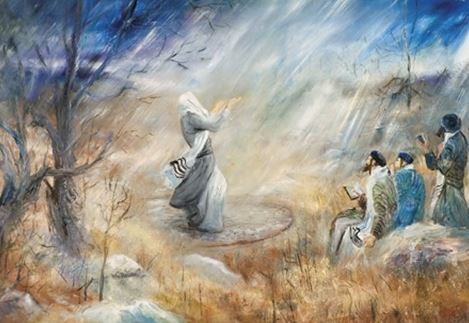
“Honi HaMeagel”, by Huvy. Honi is famous for drawing a circle in the ground around him and not moving away until God would make it rain. Josephus wrote that Honi was killed during the Hasmonean civil war, around 63 BCE. The Maharsha (Rabbi Shmuel Eidels, 1555-1631) said that people thought he was killed in the war, but actually fell into a deep sleep as the Talmud records.

Honi HaMa’agel, “the Circle-Drawer”, who was renowned for his ability to have his prayers answered, entered a state of deep sleep for seventy years and thereby journeyed to the future! This type of time travel is, of course, not true time travel, and he was unable to go back to his own generation. He prayed for death and was promptly answered.

Travelling back in time, meanwhile, presents far more interesting challenges.

Back to the Future

In 2000, scientists at Princeton University found evidence that it may be possible to exceed the speed of light. As The Guardian reported at the time, “if a particle could exceed the speed of light, the time warp would become negative, and the particle could then travel backwards in time.” This is one of several ways proposed to scientifically explain the possibility of journeying back in time.

The problem with this type of travel is as follows: what happens when a person from the future changes events in the past? The result may be what is often referred to as a “time paradox” or “time loop”. The classic example is a person who goes back to a time before they were born and kills their parent. If they do so, they would never be born, so how could they go back in time to do it?

Remarkably, just as I took a break from writing this, I saw that my son had brought a book from the library upstairs. Out of over 500 books to choose from, he happened to bring Harry Potter and the Prisoner of Azkaban. Now, he is far too young to have read it, or to even known who Harry Potter is. And yet, this is the one book in the Harry Potter series—and possibly the one book in our library—that presents a classic time paradox!

In Prisoner of Azkaban, we read how Harry is about to be killed by a Dementor when he is suddenly saved by a mysterious figure who is, unbeknownst to him, his own future self. After recovering from the attack, he later gets his hands on a “time turner” and goes back in time. It is then that he sees his past self about to be killed by a Dementor, and saves his past self. The big problem, of course, is that Harry could have never gone back in time to save himself had he not already gone back in time to save himself in the first place!

Perhaps a more famous example is James Cameron’s 1984 The Terminator. In this story, John Connor is a future saviour of humanity who is a thorn in the side of the evil, world-ruling robots. Those evil robots decide to send one of their own back to a time before John Connor was born in order to kill his mother—so that John could never be born. Aware of this, Connor sends one of his own soldiers back in time to protect his mother. The soldier and the mother fall in love, and the soldier impregnates her, giving birth to John Connor! In other words, future John Connor sent his own father back in time to protect his mother and conceive himself! This is a time paradox.

Could we find such a time paradox in the Torah? At first glance, there doesn’t appear to be anything like this. However, a deeper look reveals that there may be such a case after all.

When God Wanted to “Kill” Moses

In one of the most perplexing passages in the Torah, we read that when Moses took his family to head back to Egypt and save his people, “God encountered him and sought to kill him.” (Exodus 4:24) To save Moses, his wife Tziporah quickly circumcises their son, sparing her husband’s life. The standard explanation for this is that Moses’ son Eliezer was born the same day that he met God for the first time at the Burning Bush. Moses spent seven days communicating with God, then descended on the eighth day and gathered his things to go fulfil his mission.

However, the eighth day is when he needed to circumcise his son, as God had already commanded his forefather Abraham generations earlier. Moses intended to have the brit milah when they would stop at a hotel along the way, but got caught up with other things. An angel appeared, threatening Moses for failing to do this important mitzvah, so Tziporah took the initiative and circumcised her son. Alternatively, some say it was the baby whose life was at risk.

Whatever the case, essentially all the commentaries agree that God had sent an angel to remind Moses of the circumcision. Who was that angel? It may have been a persecuting angel, and some say he took the form of a frightening snake. Others, like the Malbim (Rabbi Meir Leibush Weisser, 1809-1879) say it was an “angel of mercy” as Moses was entirely righteous and meritorious. Under the circumstances, one’s natural inclination might point to it being the angel in charge of circumcision, as suggested by Sforno (Rabbi Ovadiah ben Yakov, 1475-1550). Who is the angel in charge of circumcision? Eliyahu! In fact, Sforno proposes that the custom of having a special kise kavod, chair of honour, or “chair of Eliyahu” (though Sforno doesn’t say “Eliyahu” by name), might originate in this very Torah passage. Every brit milah today has such an Eliyahu chair, for it is an established Jewish tradition that the prophet-turned-angel Eliyahu visits every brit.

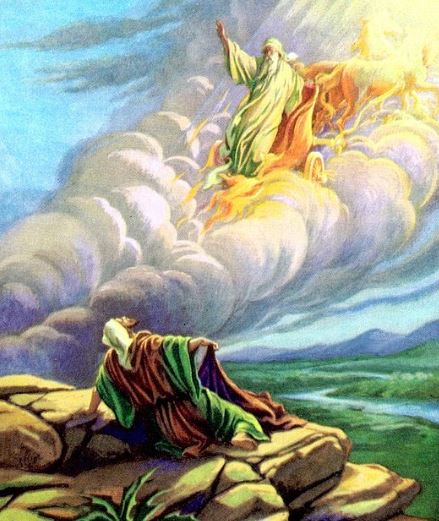
‘Elijah Taken Up to Heaven’

Yet, Eliyahu could not have been there at the brit of Moses’ son, for Eliyahu would not be born for many years! Eliyahu lived sometime in the 9th century BCE. He was a prophet during the reign of the evil king Ahab and his even-more-evil wife Izevel (Jezebel). The Tanakh tells us that Eliyahu never died, but was taken up to Heaven in a fiery chariot (II Kings 2). As is well-known, he transformed into an angel.

The Zohar (I, 93a) explains that when Eliyahu spoke negatively of his own people and told God that the Jews azvu britekha, “have forsaken Your covenant” (I Kings 19:10), God replied:

I vow that whenever My children make this sign in their flesh, you will be present, and the mouth which testified that the Jewish people have abandoned My covenant will testify that they are keeping it.

He henceforth became known as malakh habrit, “angel of the covenant” (Pirkei D’Rabbi Eliezer, 29), a term first used by the later prophet Malachi (3:1).

If Eliyahu is Malakh haBrit, and is present at every circumcision, does this only apply to future circumcisions after his earthly life, or all circumcisions, even those before his time? As an angel that is no longer bound by physical limitations, could he not travel back in time and be present at brits of the past, too? God certainly does transcend time and space, and exists in past, present, and future all at once. This is in God’s very name, a fusion of haya, hoveh, and ihyeh, “was, is, will be”, all in one (see Zohar III, 257b, as well as the Arizal’s Etz Chaim, at the beginning of Sha’ar Rishon, anaf 1). And we already saw how God could send Moses to the distant future and bring him right back to the past. Could He have sent Eliyahu back to the brit of Moses’ son? Such a scenario would result in a classic time loop. How could Eliyahu, a future Torah prophet, save Moses, the very first Torah prophet? Eliyahu could not exist without Moses!

It is important to note here that there were those Sages who believed that Eliyahu was always an angel, from Creation, and came down into bodily form for a short period of time during the reign of Ahab. This is why the Tanakh does not describe Eliyahu’s origins. It does not state who his parents were, or even which tribe he hailed from. Others famously state that “Pinchas is Eliyahu”, ie. that Eliyahu was actually Pinchas, the grandson of Aaron. Pinchas was blessed with eternal life, and after leaving the priesthood, reappeared many years later as Eliyahu to save the Jewish people at a difficult time. He was taken up to Heaven alive as God promised. In the Torah, we read how God blessed Pinchas with briti shalom (Numbers 25:12). Again, that key word “brit” appears—a clue that Pinchas would become Eliyahu, malakh habrit.

While it is hard to fathom, or accept, the possibility of an Eliyahu time paradox, there is one last time paradox that deserves mention. And on this time paradox, all of our Sages do agree…


The above essay is an excerpt from Garments of Light, Volume Three.
To continue reading, get the book here! 

What is Tekhelet?

At the beginning of this week’s parasha, Tetzave, the Torah describes the special garments worn by the Kohanim. Making these garments requires the use of three unique dyed fabrics: tekhelet, argaman, v’tola’at shani, “blue, purple, and crimson wool”. Last year, we discussed tola’at shani and the practice of wearing a red string on the wrist. This year we will explore the other two ingredients: tekhelet and argaman. What are they and where do they come from?

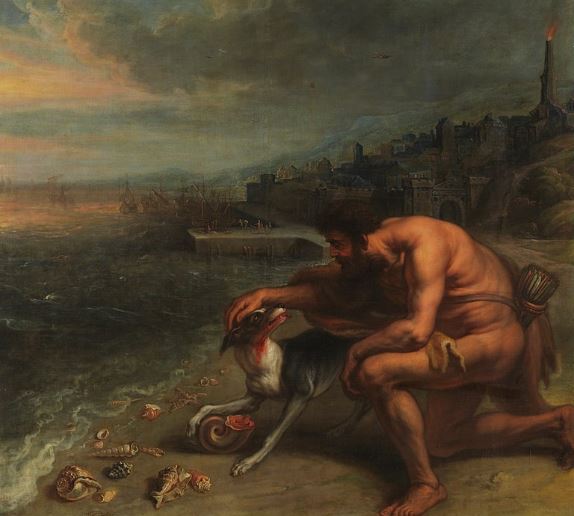
In Greek mythology, the hero Hercules discovered Tyrian purple when his dog chewed on sea snails, as depicted here in Peter Paul Rubens’ “Hercules’ Dog Discovers Purple Dye”

Argaman is more commonly known as “Tyrian purple” or “royal purple”, a famous and prized dye in ancient times. Historical records and archaeological findings show that as early as 3500 years ago, trade in Tyrian purple was widespread across the Mediterranean and the Middle East. It was the Phoenicians who were experts in its production, and carried it around the region. (In fact, the root of the term Phoenician means “purple” in Greek. Similarly, some scholars have found evidence that Canaan means “dye merchant”.) Tyrian purple was worth at least as much as silver, and in some points in history, more than gold.

By the Roman Era, it was so expensive and prized that it was essentially only worn by royalty, hence “royal purple”. An average Roman, or even a Roman senator, would wear a toga pura, plain white, while magistrates and priests wore a toga praetexta, with a purple stripe or hem. Only the emperor would wear a toga picta, one that was entirely dyed purple, with gold embroidery. (Such a toga might also be worn by high ranking generals during their victory processions, as well as by the consuls.)

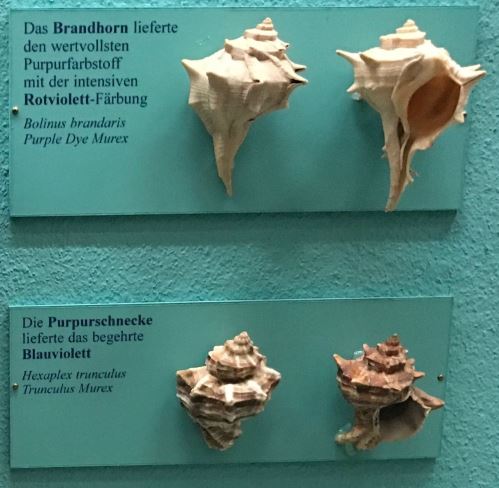
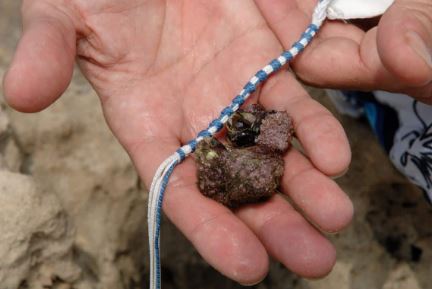
Shells of the Murex snails that produce purple and blue dye. (Credit: U.Name.Me)

How did the Phoenicians produce argaman? It was extracted from the glands of shellfish on the Phoenician shores of the Eastern Mediterranean. These Murex snails make the dye as a defense mechanism, spraying it on potential predators (just as squids and octopuses, their mollusc relatives, famously do). Research shows that the snails also use the dye for their own predatory behaviour when catching prey, and also as an antimicrobial to protect their eggs. To extract the dye, the snails are either “milked”, which takes a very long time, or more commonly, pierced through their shells to have the glands removed. It would take over 10,000 snails to produce just a few grams of dye!

Tekhelet was made the same way. Though not nearly as popular in ancient times, it was known as “royal blue”. The Phoenicians made it the same way, extracted from a snail. Some say it was derived from a different species of snail, while others point out that the same Tyrian purple, when exposed to large amounts of UV radiation (sunlight), becomes blue.

The Talmud (Menachot 44a) states that the dye was made from chilazon, a snail “whose body resembles the sea, and its form resembles a fish, and it comes up once in seventy years, and with its blood one dyes tekhelet, and therefore its blood is expensive.” It’s not quite the blood of the snail that makes the dye, of course, nor do the snails emerge only once in seventy years. This bit probably entered the Talmud because by that point in history, tekhelet production among Jews had long ended, and knowledge of its exact extraction forgotten. It was probably difficult, if not entirely impossible, for Jews to get their hands on it.

Tzitzit with tekhelet (Credit: Tekhelet.com)

Dr. Baruch Sterman, in a paper for B’Or HaTorah (vol. 11, pg. 185), points out that by the 4th century CE it was actually a crime for a commoner to wear tekhelet across the Roman world. It is highly likely that it was then, for this reason, that most Jews stopped using tekhelet in their tzitzit. Dr. Sterman brings proof from the Talmud (Sanhedrin 12a), where we read how two rabbis were arrested by the Romans for possessing tekhelet. Wealthy Jews living in the Persian Empire continued to pay exorbitant rates to import and use it, until sometime in the middle of the 7th century. It was then, likely due to the rise of Islam and the rapid Arab conquest of the region, that use of tekhelet among all Jews essentially ceased. This is why until today the majority of Jews do not use tekhelet in their tzitzit (as the Torah commands). However, in recent decades, the Murex snails have been rediscovered, and tekhelet is once again available.

Having said all that, Karaite Jews—a small group that rejects the Talmud—believe that tekhelet (and argaman) could not have been derived from snails. And they actually have a couple of seemingly valid points.

The Problem of Karaite Tekhelet

The Karaites believe that tekhelet cannot come from a snail because the Torah would not command something so important to come from a non-kosher animal. They also argue that royal blue tekhelet from snails would have been far too expensive for the average Israelite. Finally, they point out that God commanded this to the Israelites in the Wilderness—so where would they find sea snails in the middle of the desert? Instead, Karaite scholars proposed that tekhelet came from an indigo plant, such as the Indian Indigofera tinctoria (incidentally, this is the indigo once used to dye jeans blue).

Another, more likely, possibility is the woad plant, Isatis tinctoria, which contains the same indigo dye. This plant actually grows in Israel, and was once known as “Asp of Jerusalem”. Interestingly, the Mishnah (Megillah 4:7) states how Kohanim are forbidden from blessing the congregation if their hands are stained with “istis”, ie. the Isatis tinctoria dye. The Bartenura (Rabbi Ovadiah of Bartenura, c. 1445-1515) confirms that istis is a dye “whose colour resembles tekhelet”. This makes it clear that Kohanim in the ancient Holy Temple did use woad as a blue dye, though for what purpose is unclear.

Karaite Jews today continue to make tekhelet from indigo or woad to dye their tzitzit. Since Karaites hold strictly to the Written Torah, they maintain that tzitzit must be blue (and cannot be entirely white like most current “Rabbinic” tzitzit). They hold that any blue dye is fine, since the Torah does not explicitly say that other blue dyes are forbidden. The Talmud, meanwhile, states that a person who uses plant-derived blue dyes instead of authentic tekhelet is sinning, and God declares that He will “exact retribution” from such a person (Bava Metzia 61b, see also Tosefta on Menachot 9:6). And here the Karaites should take heed, for when it comes to tekhelet they are absolutely mistaken.

The big problem for the Karaites is basically everyone else. Aristotle (384-322 BCE) wrote in his History of Animals about the production of blue and purple dyes from snails, as did the Roman philosopher and historian Pliny the Elder (23-79 CE) in his Natural History. These were the choicest and best dyes for clothes and fabrics. While tekhelet and argaman were expensive for the distant Greeks and Romans to procure, they would not have been expensive for the ancient Israelites. After all, these dyes were only expensive to purchase; there is no indication that they were expensive to produce. And the Israelites, like the Phoenicians and Canaanites, were the producers. They made the dyes cheaply, and exported them far and wide, for a healthy profit.

It was only in later centuries, when Israel was no longer an independent entity and was subject to a series of foreign empires, that Jews lost control of the means of tekhelet production. Tekhelet became rarer, and more expensive, and eventually forbidden. This development only occurred in the late Second Temple era, and possibly later. Still, when chemists in the 1990s analyzed blue fabrics uncovered at the Masada archaeological site, they discovered that the fabrics were indeed dyed with Murex snail tekhelet. Even in the late Second Temple era, tekhelet was available and used widely. Besides, the average Israelite in those days would have needed only a minute amount to dye a handful of strings to fulfil the mitzvah of tzitzit.

Another bit of evidence for the fact that snail dye was the real tekhelet comes from the Tanakh itself. While we’ve already seen how historical and archaeological records make it clear that the ancient Phoenicians were experts in snail dyes (not any plant-based blue dyes), we mustn’t forget that these same Phoenicians were heavily involved in the production of Israelite holy items, too! We read in the haftarah for last week’s parasha (I Kings 5:26-6:13) how King Solomon made an agreement with the Phoenician King Hiram, and the latter’s workers played an instrumental role in the construction of the Holy Temple. Granted, this was not the Mishkan of the Wilderness, but the later Temple was based on the earlier Mishkan, and the items were fashioned to the same specifications.

Where was Hiram’s capital city? The Tanakh always refers to him as melekh tzor, “King of Tyre”. This is the selfsame Tyre as the Tyre of Tyrian purple and Tyrian royal blue. We read how “Hiram, king of Tyre, sent his servants to Solomon…” (I Kings 5:15) It is hard to believe that it’s only a coincidence that the Tyrians renowned around the ancient world for their snail dyes are the same ones that the Tanakh tells us worked in Jerusalem! The evidence is therefore quite strong that tekhelet and argaman are the same as the snail-derived Tyrian dyes.

Tekhelet in the Wilderness

The nail on the coffin comes from an even more ancient historical text. Long before Pliny, Aristotle, and even Hiram, the ancient Egyptian Papyrus Anastasi I—dated back to the Nineteenth Dynasty (c. 1292-1189 BCE)—mentions how a royal blue dye is made from sea creatures and smells like putrid fish. This is particularly important because the Nineteenth Dynasty was the time of Pharaoh Ramses II, who is the one most associated with the Exodus. Ramses II built a new capital city which, of course, he named after himself, and which archaeologists have uncovered and refer to as Pi-Ramesses. This is the same city that the Torah mentions the Israelite slaves built (Exodus 1:11). Putting the pieces together, we now have an answer to the question posed by the Karaites: how did the Israelites find tekhelet and argaman in the Wilderness?

The Torah tells us that when the Israelites left Egypt, God commanded them to ask the Egyptians to give them precious materials: “And the children of Israel did according to the word of Moses, and they asked of the Egyptians jewels of silver, and jewels of gold, and raiment.” (Exodus 12:35) The Israelites got tekhelet and argaman from the same place they got their gold and silver (also used in constructing the Mishkan): from the Egyptians. The Papyrus of Anastasi proves that the ancient Egyptians, too, produced blue and purple dyes from Mediterranean snails. They made “raiment”, garments and fabrics dyed with these colours. The Torah informs us that the Israelites took these fabrics with them. And this is how they had them available for the Mishkan in the Wilderness!

Despite all that’s been said, the Orthodox world today has been very slow in readapting the use of tekhelet. Some rabbis maintain that these Murex snails are not the right ones. The Radziner Rebbe (Rabbi Gershon Henoch Leiner, 1839–1891) didn’t know about the snails at all and instead consulted chemists to produce a blue dye from the common cuttlefish, Sepia officinalis. The problem is that the cuttlefish only produces black ink, and turning it blue was a long chemical process that required adding iron filings. When later analyzed by experts, it was found that the Radziner Rebbe’s dye was basically synthetic, and the blue was simply a result of the added iron. (For more, see Dr. Sterman’s article in B’Or haTorah, cited above.) Meanwhile, Rabbi Isaac Herzog (1888-1959, Israel’s first Ashkenazi Chief Rabbi) was an early proponent of snail-derived dyes.

In recent decades, more and more researchers have explored the subject, and today everything points to tekhelet being the blue dye of the Murex trunculus snail. The scientists at Masada confirmed it chemically, and although some state that there is no chemical difference between woad, indigo, and Murex blue, there are small differences in their molecular structure. One with a chemistry background will agree that the addition of even a single atom can dramatically change the nature of a substance. Still, many rabbis are reluctant to adopt tekhelet, and have decided it is best to wait until Mashiach comes just to be sure.

Comparing the chemistry of blue dyes: though looking similar to the untrained eye, the chemical structure of plant-based Indigotin (top left) is different from synthetic indigo (bottom left) and the indigo of Murex snails (bottom right).

And as for the Karaite argument that the Torah wouldn’t command something derived from a non-kosher animal, this argument falls apart when considering the third ingredient that always goes along with tekhelet and argaman: tola’at shani. The word is literally translated as a “crimson worm” or, more accurately, “red insect”. Tola’at definitely refers to a bug of some sort, as we read in Exodus 16:20 how leftover manna was infested with tola’im.

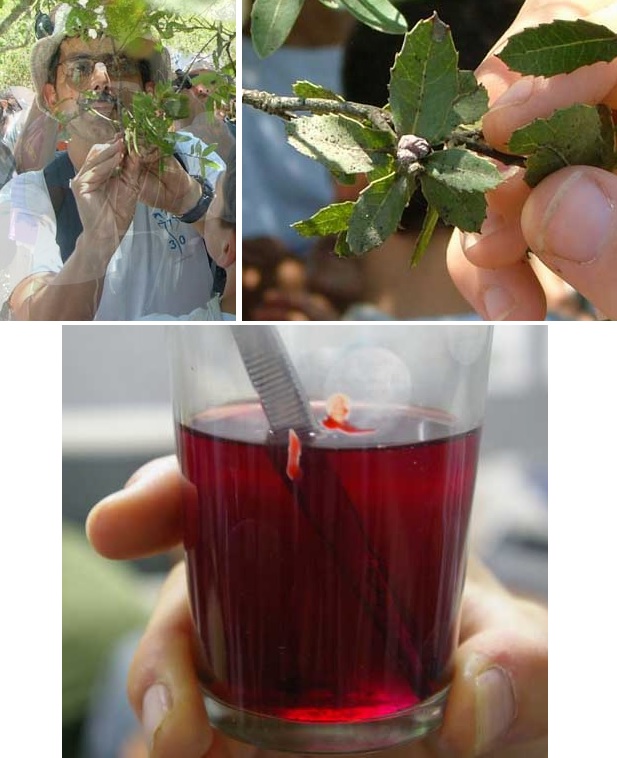
Tola’at shani is undoubtedly referring to the common carmine dye used around the world, and known commercially in food as E120. This dye is derived from a variety of scale insects, most commonly the cochineal family of bugs. Professor Zohar Amar of Bar Ilan University spent many years researching tola’at shani and concluded that it is unquestionably a red insect, which nests in the common Israeli oak tree. In fact, the Temple Institute has already begun harvesting these insects to produce an authentic avnet, the priestly belt that requires the red dye, in preparation for Mashiach’s coming and the return of priestly service in the forthcoming Third Temple.

Clockwise from top left: Professor Amar leads the Temple Institute’s Tola’at Shani harvest; the “crimson worm” on a branch of an Israeli oak tree; Professor Amar holds a cup of crimson water produced by crushing a single worm.


The above essay is adapted from Garments of Light, Volume Three.
Get the book here!