Category Archives: Torah & Science

The Origins of Ashkenazi Jews

In this week’s Torah portion, Noach, we read about how the seventy primary descendants of Noah settled the Earth after the Great Flood. Noah had three sons, and it is often said that they divided the three continents of the Old World amongst them: Yefet (Japheth) got Europe, Shem got Asia, and Ham got Africa. This is not exactly accurate.
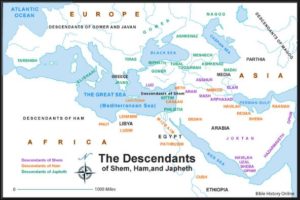
For one, Canaan is a son of Ham, but did not inhabit Africa, while Nimrod is said to be a son of Cush—also of Ham—yet we know Nimrod ruled Mesopotamia (Genesis 10:10). Another son of Ham is Mitzrayim, which is Egypt, yet Mitzrayim’s own children include Pathrusim and Caphtorim, names generally associated with Greek lands. (There is historical evidence to suggest that the early pre-Greek peoples did come from Egypt.) Yavan, the classic term for Greece, is a son of Yefet. As discussed in the past, Yavan is the same as Ionia, which is the western coast of Turkey, then inhabited by Greek-speaking peoples. (The famous city of Troy was in Ionia, in modern-day Turkey.)

In fact, essentially all of the seventy places inhabited by Noah’s descendants are places in modern Turkey or the Middle East. This makes sense, since the Torah was originally speaking to an audience that was unaware of most of Europe, the Far East, sub-Saharan Africa, and needless to say, the New World. The Torah mentions the origins of those territories that were familiar to the ancient Israelites, and that would have been their immediate neighbours. It also makes sense practically, since Noah got off the Ark in Ararat—probably somewhere in modern Turkey—and his children and grand-children would have settled lands that weren’t too far away from there.

Mt. Ararat, as seen from Yerevan, Armenia. It isn’t certain whether this Ararat is the Biblical Ararat.

One of Noah’s descendants is named Ashkenaz (Genesis 10:3). He is a grandson of Yefet, whose children all seem to have inhabited territories in Asia Minor and Armenia. Ashkenaz, too, is in that vicinity. Even in the time of the prophet Jeremiah centuries later, Ashkenaz was a kingdom in Turkey: “Raise a banner in the land, blow the shofar among the nations, prepare the nations against her, call together against her the kingdoms of Ararat, Minni, and Ashkenaz…” (Jeremiah 51:27) The prophet goes on to call on these and other powers in the area to come upon Babylon. Ashkenaz is one of the Turkish kingdoms bordering Babylon to the north, along with Ararat.
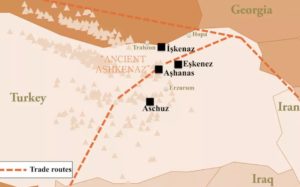
Modern-day villages in Northeastern Turkey. (Credit: theconversation.com)

Amazingly, to this day ethnic Armenians in the region name Ashkenaz as one of their ancestors! This claim is not recent; the fifth-century Armenian scholar Koryun described the Armenians as an Askanazian people. Not surprisingly then, multiple places in Northeastern Turkey today still bear similar-sounding names, including the villages of Iskenaz, Eskenez, and Ashanas.

If Ashkenaz is a place in Turkey, how did it become associated with European Jews? Did Ashkenazi Jews come from Turkey?

Debunking Khazaria

One popular explanation for the Turkey-Ashkenaz connection points to the Kingdom of Khazaria. This was a wealthy and powerful kingdom that ruled the Caucasus, southern Russia, and parts of Turkey and Eastern Europe in the Middle Ages. Historians credit the Khazars with checking the rapid Arab conquest, and preventing a Muslim takeover of Europe from the East. It is said that around 740 CE, King Bulan grew tired of his people’s backwards pagan beliefs and converted to Judaism. According to legend, he had invited representatives of the major faiths to argue their case, and concluded that Judaism was the true faith. (This is the basis of Rabbi Yehuda haLevi’s [c. 1075-1141] famous text, Kuzari.)

Although Bulan did not impose his new religion on anyone, it is thought that much of his kingdom had become Jewish anyway within about a century. Remarkably, a large reserve of antique Khazar coins was found in Sweden in 1999, bearing the inscription “Moses is the Prophet of God”. (Modeled on, and sometimes just refashioned from, Arab coins saying that “Muhammad is the Prophet of Allah”!) Archaeologists have found similar Khazar coins all over the Old World, from England to China, showing the tremendous extent of Khazaria’s wealth and influence.
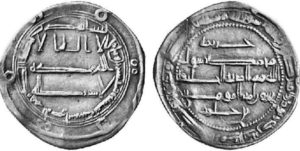
Khazar coin from c. 837 CE, with the inscription “Moses is the prophet of God”.

Like all kingdoms, Khazaria had an expiration date. It was eventually overrun by the Rus, Mongols, and others. Some say that many Jewish Khazar refugees migrated westward to Europe, and settled in the sparsely populated and resource-rich lands of Germany. Since they had come from a place traditionally known as Ashkenaz, they were labelled “Ashkenazi Jews”. This is a great story, but one that has far too many holes.

From a historical perspective, most scholars reject the Khazar hypothesis simply because there is little evidence that Khazaria experienced a mass conversion to Judaism. It is generally agreed that only a small portion of the Khazar nobility had converted, at best. Khazaria simply attracted many Jews to settle there since it was a rich kingdom with freedom of religion. In that case, any Jewish refugees that might later flee Khazaria to Europe would not be ethnic Khazars anyway.

The Schechter Letter

Then came a huge discovery from the Cairo Geniza. Now known as the Schechter Letter (as it was discovered by Solomon Schechter, 1847-1915), the text is a correspondence between a Khazari Jew and a Sephardi Jew, most likely Hasdai ibn Shaprut (c. 915-970 CE). The letter includes a brief history of Khazaria, and states that Khazaria’s Jews originally came from Persia and Armenia, from which they had fled persecution. One of their descendants, named Sabriel, eventually rose to Khazarian nobility, and finally became king. His wife, Serach, convinced him to go public with their Jewish heritage, and they did, inspiring others in the kingdom to convert to their new king’s religion.

The Schechter Letter confirms that the majority of the Jews in Khazaria were not actually Turkic converts but migrants from Persia and Armenia. Shortly after the letter was written, the Khazari Kingdom fell apart in 969 CE. (We know the letter must have been written after 941 CE, since it refers to a battle in that year for which we have other historical records.) The supposed Jewish exodus from Khazaria would have happened in the ensuing decades.

Yet, we read in the commentaries of French-born Rashi (Rabbi Shlomo Itzchaki, 1040-1135) how he learned certain things from his visits to Jewish communities in neighbouring Ashkenaz (see, for example, Ketubot 77a), and that Ashkenaz is undoubtedly German (with Rashi occasionally using German/“Ashkenazi” words, as in Sukkah 17a, for instance). This implies that by Rashi’s time—less than a century after the fall of Khazaria—a geographical region in Western Europe referred to as “Ashkenaz” was already well-known, with Jews there freely conversing in German. It is unlikely that this would happen so soon after the fall of Khazaria; Ashkenaz must have existed long before.

Besides, we know that Jews already lived in Central Europe at the time of Charlemagne (742-814 CE), who had a good relationship with his Jewish subjects. Charlemagne was born right around the time King Bulan is supposed to have converted to Judaism, and before the rise of Sabriel (whom some identify with Bulan). This alone proves that Jews were already living in Europe long before any Khazari Jews appeared on the scene.

Among the Ashkenazi Jews of the Middle Ages themselves, the tradition was that they had been there since the destruction of the Second Temple. For example, the Rosh (Rabbi Asher ben Yechiel, c. 1250-1327) wrote in one of his responsa (20, 20) that when he moved to Toledo, Spain:

I would not eat according to [Sefardi] practice, adhering as I do to our own custom and to the tradition of our blessed forefathers, the sages of Ashkenaz, who received the Torah as an inheritance from their ancestors from the days of the destruction of the Temple. Likewise the tradition of our predecessors and teachers in France is superior…
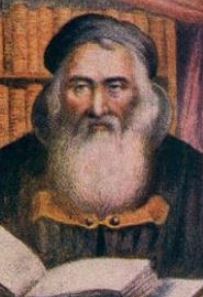
A portrait identified with Rabbeinu Asher ben Yechiel, the “Rosh”

The Rosh speaks of three distinct European Jewish communities: Sefarad, Ashkenaz, and Tzarfat (France). This makes one wonder whether Rashi would have considered himself Ashkenazi (as people typically see him today) or Tzarfati? Rashi was born and died in Troyes, France, though he spent time in Worms and Mainz in Germany, hence the reference above to his having learned things while visiting “Ashkenaz”. This implies that Rashi may not have considered himself Ashkenazi at all. (His father was called Rabbi Itzchak haTzarfati, and though he lived for a time in Worms, probably hailed from Lunel in Southern France.) Whatever the case, we see that the Sefardi, Ashkenazi, and Tzarfati Jewish communities were already firmly entrenched at the time of Khazaria’s fall.

Delving into Ashkenazi Genes

Science can shed further light on Ashkenazi origins. One study of mitochondrial DNA (mtDNA, which is passed strictly from mother to child) found that some 40% of Ashkenazi Jews come from a group of mothers in Europe, possibly converts, approximately 2000 years ago (another related study here). This would have been around the destruction of the Second Temple. We know that many Jews fled Judea (or were expelled) at the time, and settled across the Roman Empire and beyond. Similarly, a study of Y chromosomes (passed strictly from father to son) shows that most Ashkenazi Levites have a common ancestor who lived at least 1500 years ago, most likely in the Middle East or already having migrated to Europe. These scientists conclude that the Khazar hypothesis is “highly unlikely”.

Other genetic studies do appear to show high degrees of relatedness between Turkic and Iranian peoples with Ashkenazi Jews, especially males. Of course, Jews have lived and migrated just about everywhere, and undoubtedly mixed with local populations, while drawing numerous converts. One interesting study found that about 5% of Ashkenazi males are part of the Q3 haplogroup, part of the wider Q group which represents Native Americans and Asians. The researchers concluded that Q3 entered the Jewish gene pool sometime in the 1st millennium. Some say this is due to the Ashina Turks (among the Khazar elite) who converted to Judaism and took Jewish wives. Either way, it is only a tiny minority of Ashkenazis that carry such genes.*

What we see from genetic studies is that most Ashkenazi Jews today descend from ancestors that were already in Europe long before the rise of the Khazars. Historical evidence confirms the existence of widespread Jewish communities in Europe before the time of Khazaria, too. In reality, the Khazar hypothesis keeps being resurrected because it is a convenient tool for anti-Semites to attack modern Jews as “imposters” (meanwhile completely forgetting the other half of the world’s Jews which are not Ashkenazi at all!) or for anti-Zionists to deny a Jewish connection to the land of Israel.

Having said all that, we must still answer the key question: where did the “Ashkenazi” label come from?

Adapting Names

When we look at the seventy “original” nations—descendants of Noah—we find that they represent a very small geographical area. Of the seventy, fourteen come from Yefet and represent Asia Minor, Armenia, and the Aegean islands (Genesis 10:5), nine are Cushites (presumably dark-skinned people), eight of Mitzrayim, twelve are Canaanites, and twenty-six are Middle Eastern, or possibly even just Mesopotamian. As already mentioned, the Torah’s narratives are confined to a narrow geographical space that was relevant to the ancient Israelites.

A “Table of Nations” from the ArtScroll Stone Chumash

When Jews started migrating out of Israel and beyond the Middle East, they needed to come up with names for these new territories they inhabited. So, they adapted the Biblical place-names of locations that no longer existed or whose identity was no longer known. For example, Sefarad became Spain and Tzarfat became France. When scripture speaks of Sefarad or Tzarfat (as in Ovadiah 1:20), it is certainly not speaking of Spain or France! For instance, the prophet Elijah went to Tzarfat, which is described as being next to Sidon (I Kings 17:9). Sidon is, of course, a well-known ancient city, in what is now Lebanon.

For the first Jews who settled in Spain and France, they had migrated the farthest West they could possibly go at the time. For them, these new lands were the most distant from Jerusalem, so they fittingly adapted terms for places described as being exceedingly far from the Holy Land (as in Ovadiah 1:20). They couldn’t use the names of places that were still extant, but only those ancient names that were no longer relevant. In the same fashion they described Germany as “Ashkenaz”, while Bohemia was surprisingly called “Canaan”. Therefore, to say that Ashkenazi Jews are Turkish because Ashkenaz was originally a place in Turkey is like saying French Tzarfati Jews are Lebanese because Tzarfat was originally a place in Lebanon!

It is worth pointing out here that scholars have also recently pinpointed the Biblical Sefarad. There is now strong historical evidence to identify Sefarad with the ancient town of Sardis, also in Asia Minor (modern Turkey), of course. Sardis was known to the Lydians who inhabited it as Sfard, and to the Persians as Saparda. It goes without saying that Sephardic Jewish origins have nothing to do with Turks, as don’t the origins of Lydians (probably the “Ludim” of Genesis 10:13, or the Lud of Genesis 10:22), nor the Yavanim, the Greek Ionians, all of whom inhabited that same area of Asia Minor.

The Tower of Babel

‘Turris Babel’ by Athanasius Kircher (1602-1680)

After telling us the divisions of the nations in Genesis 10, the Torah goes on to relate the narrative of Migdal Bavel. We are told that the people were all still unified at this point, speaking one tongue. They gathered in Babylon to build a tower to the Heavens, with nefarious intentions. Their plans were thwarted by God, who then scattered the people all over the world and confounded their tongues.

From a mystical perspective, at this point those seventy root nations—which originally inhabited Asia Minor and the Middle East—were spread all around the globe into a multitude of various peoples with new cultures and languages. Thus, all of the world’s thousands of nations and ethnicities, wherever they may be, are spiritually rooted in one of Noah’s seventy descendants.

Consequently, there were those who believed that Ashkenaz was dispersed to Central Europe. What’s amazing is that this was not only a Jewish belief, but a Christian one, too. The evangelical Christian pastor Ray Stedman (1917-1992) wrote:

The oldest son of Gomer was Ashkenaz. He and his descendants first settled around the Black Sea and then moved north into a land which is called Ascenia, and which later became known as the Islands of Scandia, which we now know as Scandinavia. You can trace a direct link between Ashkenaz and Scandinavia.

Basing himself on earlier sources, he lists Ashkenaz as referring to all Saxons, Scandinavians, and Germanic tribes. This argument was made at least as far back as the 4th century (long before the Khazars appeared on the scene), in Eusebius’ Historia Eccliesiastica, where Ashkenaz is Scanzia, another name for Scandinavia and/or Saxony.

Around that same time, the Talmud (Yoma 10a) identifies Gomer (the father of Ashkenaz) with Germamia. While this Germamia is possibly referring to Cimmeria, or Germanikia in Syria—which would have been more familiar to the Babylonian Sages living in the Persian Empire—it is very likely that Jews who settled in Germany would see Germamia as referring to their new land. Combined with the alliteration between “Ashkenaz” and “Saxony”/“Scanzia”, we can understand why the Jews that settled in Germany adapted the name Ashkenaz.

As an intriguing aside, the Talmud cited above holds that Yefet is a forefather of the Persians, too. The Talmud reads: “How do we know that the Persians are derived from Yefet? Because it is written: ‘The sons of Yefet: Gomer, and Magog… and Tiras’” The Sages say Tiras is Paras, Persia. Intriguingly, the Sages seem to connect Magog (of “Gog u’Magog” fame) with the Persians. That might make alarm bells go off in the heads of modern readers who see Iran as playing a central role in an End of Days armagaddeon.

To conclude, the hypothesis that Ashkenazi Jews originate among Turkish converts is completely false. While some Turkish converts certainly joined the Jewish nation in the Middle Ages, Ashkenazi Judaism predates this phenomenon by centuries. Both historical evidence and genetic analyses confirm a European Jewish presence as far back as 2000 years ago.


*Shortly after publishing this article, Kevin Brook pointed out the following to me, from his book The Jews of Khazaria (pg. 204):

Some researchers thought it was possible that these could have been inherited from the Khazars, but this idea is no longer viable. Ashkenazim belong to the Q haplogroups that were later precisely identified as Q-Y2200 (Q1b1a1a1a) and Q-YP1035 (Q1b1a1a1a2a2). On the Y chromosome tree, Q-Y2200’s parent haplogroup Q-Y2225 (Q1b1a1a1) was found in an Italian sample from Sicily, and geneticists determined that QY2225’s distant ancestors had apparently lived in the Middle East. The Ashkenazic branches of Q are very different from Q1a1b-M25 and Q1a2-M346, which are common among Turkic-speaking peoples, and the common ancestor between them all lived many thousands of years ago, far in advance of Khazaria’s existence.


The above essay is adapted from Garments of Light, Volume Three.
Get the book here! 
Are “Torah Codes” Legit?

This week’s Torah portion, Tzav, has a total of 96 verses. It just so happens that the numerical value of the world “Tzav” (צו) is also 96. This is a good example of a classic gematria, the Jewish numerology technique which the Mishnah describes as a “condiment to wisdom” (Avot 3:18). Over the centuries, gematria has become more and more common, and is now an inseparable part of Judaism. Rabbi Aaron Kornfeld (1795-1881) even elucidated 300 laws using the gematrias of their corresponding Torah verses (see his Tziunim l’Divrei HaKabbalah). Indeed, the ancient Baraita of Rabbi Eliezer lists gematria as one of the 32 valid principles of Torah interpretation. The Ba’al HaTurim (Rabbi Yakov ben Asher, 1269-1343), who uses gematria extensively in his commentary on the Torah, points out on the verse כִּי לֹא-דָבָר רֵק הוּא מִכֶּם, “it is not an empty thing for you” (Deuteronomy 32:47), that it equals the value of גימטריות, “gematrias”. In other words, gematria is not an empty or meaningless practice! Gematriot are the original “Torah codes” dating back to millennia-old teachings.

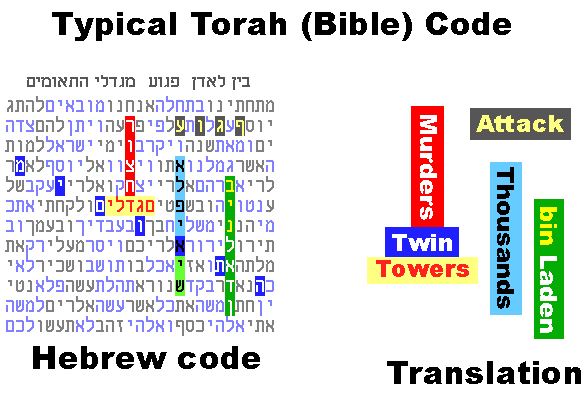
Meanwhile, in recent decades a new phenomenon has emerged and usurped the title of “Torah codes”. Today, when people think of “Torah codes” they are referring to the so-called “equidistant letter sequences” (ELS) method, often called in Hebrew (perhaps erroneously, as we shall see below) dilug, “skipping”. This method involves searching the Torah text for words that appear spaced out across large intervals. Here is one “Torah code”, courtesy of www.torahcodes.net:

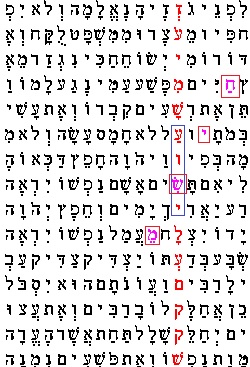
Codes found in Moby Dick. Click here for more Moby Dick “codes”.

Apparently, the Torah encoded within it the terrible events of September 11, 2001. Such “codes” have been found for just about everything. Indeed, those who use the method claim that this just proves that the Torah really does literally encode all of human history within it, as per tradition. The reality, though, is that you can find everything in Torah codes because the method is inherently flawed, and when you have a text with so many letters, you will naturally be able to find just about anything you look for. Similar “prophecies” have been found in Moby Dick, and in English translations of the Bible. Worse yet, the code has been used to “prove” that Jesus is the messiah:

Professor A.M. Hasofer has pointed out that the word “Yeshua” appears hundreds of times when using ELS, and twice appears overlapped with “navi sheker”, or “false prophet”! (See Hasofer’s article in B’Or Ha’Torah #11, “Torah Code Abuse”, for a thorough analysis and debunking of Torah codes.)

This alone should be enough to debunk Torah codes for good. (See here for why Jesus is not the messiah.) Yet, such codes are still widely spread and taught by well-meaning people. Just weeks ago on Purim I received one that claims skipping 12,196 letters from the mem in the term מור דרור (which our Sages say hints to Mordechai) will spell out מרדכי, “Mordechai”; and skipping the same 12,196 letters from the aleph in the term אסתיר פני (which our Sages say hints to Esther), will spell out אסתר, “Esther”. The kicker at the end is that supposedly Megillat Esther has exactly 12,196 letters. Immediately I went on the computer to check if this is true. Opening up a “Torah code” program, I found that if one skips 12,196 letters from either of the above, they will not get the claimed words. As I did more research, I found that the Megillah may not even have 12,196 letters. I found a similar claim that says the Megillah actually has 12,110 letters, and that the codes are from different words entirely. This one, too, did not work out in the search program! Finally, an article on Chabad.org explained the origin of the claim, dating it back to Rabbi Chaim Michoel Dov Weissmandl, “the Father of Torah Codes”, who is equally famous for his heroic efforts to save Jews in the Holocaust. According to the anecdote here, Rabbi Weissmandel taught that one gets “Esther” if they count from the Torah’s first aleph, and “Mordechai” from מור דרור. Funny enough, in a footnote at the very end, Chabad.org admits that they were

not able to duplicate the above results from the same starting places, but they did find “Esther” and “Mordechai” at the cited interval in different locations. Also, some “codes” programs yield a different number of letters for Megilat Esther, such as 13,408 and 12,110. “Esther” and “Mordechai” can be found at these intervals too.

In other words, the code is completely bogus. (Why Chabad.org—otherwise a terrific resource—would publish a story and admit at the end that it is based on something false eludes me.)

True Torah Codes

In his Pardes Rimonim, the great Ramak (Rabbi Moshe Cordovero, 1522-1570) does mention a practice called dilug, along with similar practices like gematria, roshei and sofei tevot, and letter permutations. Of course, he is not at all speaking about the ELS method, which is essentially impossible without a computer, and would have been unknown to the Ramak. The dilug he speaks of is where a word emerges from letter skipping within a verse or short passage—not hundreds of letters apart, or across different chapters, parashas, or even books, as is common in ELS.

For example, there is the old story of the apostate Avner, a former student of the Ramban (which we’ve discussed before). The story ends with the Ramban showing that Avner’s name is embedded within a verse in parashat Ha’azinu; a verse that speaks specifically of God destroying the memory of those who oppose Him, like Avner.* Such small codes—with short skips in verses that actually relate to the topic at hand—may certainly be valid. Still, the Ramban himself points out (in the first gate of Sefer haGeulah) that these kinds of practices must be based on a proper tradition going back to Sinai; a person should not conjure their own gematrias and codes, for in such a way a person will be able to “prove” just about anything.

When Barack Obama was elected, many pointed out that his name appears when skipping to every seventh letter from the aleph in the word “nasi” or “president” in the famous apocalyptic passage of Gog u’Magog (Ezekiel 38:2-3). Apparently, Obama did not fulfil his “prophesied” role of bringing the apocalypse.

“Bible Codes” abound on YouTube. This video has a code suggesting Mashiach would come during Chanukah of 5778 (ie. December 2017). The same YouTube channel still has videos going back to at least 5774 with codes proving each year to be an auspicious time for Mashiach to come!

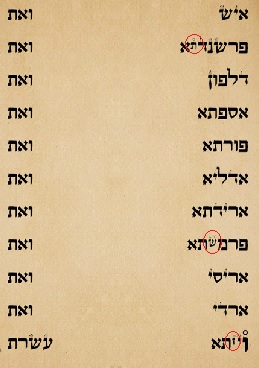
Having debunked one supposed “Purim code”, let’s conclude with a better-known Purim code. This one actually does work quite well and would be valid in the time of the Ramak, too (since it appears within one small passage, requires no computers, and is in context). It was Rabbi Weissmandl who once again first pointed it out. At the end of Megillat Esther, we read how Haman’s ten sons were hanged. The scroll shifts to a unique appearance here in listing the names of the ten sons. Traditionally, three letters in this list are written smaller than normal. Such smaller or larger letters always carry great significance wherever they appear in Scripture. The three here make up תש״ז, as if alluding to the year 5707, corresponding to the year 1946-47.

Amazingly, it was right at that time that the Nuremberg Trials concluded with the hanging of ten of the Nazi elite. In the Scroll itself we read how Esther was asked what to do with the hanged sons of Haman, and she responded: “If it please the king, let it be granted to the Jews that are in Shushan to do tomorrow also according to this day’s decree, and let Haman’s ten sons be hanged upon the gallows.” (9:13) Esther perplexingly asks for the ten sons to be hanged again!

Centuries later, ten of Hitler’s “sons”—some of his closest confidantes and co-conspirators—were hanged on the gallows, forbidden to go by firing squad as would be normal for military men.** And it’s almost as if they were aware of it all: it was reported that among the last words of the despicable Julius Streicher were: “Purimfest 1946”.

The cover of the October 28, 1946 edition of Newsweek. In its coverage of the Nuremberg executions, it states: “Only Julius Streicher went without dignity. He had to be pushed across the floor, wild-eyed and screaming: ‘Heil Hitler!’ Mounting the steps he cried out: ‘And now I go to God.’ He stared at the witnesses facing the gallows and shouted” ‘Purimfest, 1946.’ (Purim is a Jewish feast) … A groan came from inside the scaffold. Critics suggested afterward that Streicher was clumsily hanged and that the rope may have strangled him instead of breaking his neck.”


*The Avner code is actually not an ELS at all. Rather, the Ramban said that the third letter of each word spells “Avner”. These letters are not equidistant.

**The Talmud (Megillah 16a) states that Haman also had a daughter who committed suicide. In 1946, Hermann Göring was sentenced to death as well, but committed suicide the night before. Interestingly, Göring was known to be a cross-dresser. The hangings took place on October 16, 1946, just days after Rosh Hashanah 5707 (תש״ז) and fittingly, on the holiday of Hoshana Rabbah, the “Great Salvation”.

An Honest Look at the Talmud

Earlier this week we discussed the necessity of the Talmud, and of an oral tradition in general, to Judaism. We presented an overview of the Talmud, and a brief description of its thousands of pages. And we admitted that, yes, there are some questionable verses in the Talmud (very few when considering the vastness of it). Here, we want to go through some of these, particularly those that are most popular on anti-Semitic websites and publications.

An illustration of Rabbi Akiva from the Mantua Haggadah of 1568

By far the most common is that the Talmud is racist or advocates for the destruction of gentiles. This is based on several anecdotes comparing non-Jews to animals, or the dictum of Rabbi Shimon bar Yochai that “the best of gentiles should be killed”. First of all, we have to be aware of the linguistic style of the Talmud, which often uses strong hyperbole that is not to be taken literally (more on this below). More importantly, we have to remember that these statements were made in a time where Jews were experiencing a tremendous amount of horrible persecution. Rabbi Shimon’s teacher, Rabbi Akiva was tortured to death by being flayed with iron combs. This is a man who never hurt anyone, who raised the status of women, sought to abolish servitude, preached that the most important law is “to love your fellow as yourself”, and taught that all men are made in God’s image (Avot 3:14). For no crime of his own, he was grotesquely slaughtered by the Romans. Rabbi Shimon himself had to hide from the Romans in a cave for 13 years with his son, subsisting off of nothing but carobs. The Jews in Sassanid Persia didn’t fare too much better. So, the anger and resentment of the Sages to their gentile oppressors sometimes come out in the pages of Talmud. Yet, the same Talmud insists “Before the throne of the Creator there is no difference between Jews and gentiles.” (TY Rosh Hashanah 57a). Moreover, a non-Jew who is righteous, and occupies himself with law and spirituality, is likened to a kohen gadol, the high priest (Bava Kamma 38a).

In fact, the contempt that the Sages sometimes had for gentiles is not simply because they were not Jewish, for we see that the Sages had the same contempt, if not more so, for certain other Jews! The Talmud (Pesachim 49b) warns never to marry an ‘am ha’aretz, an unlearned or non-religious Jew, and even compares such Jews to beasts. In the same way that gentiles are sometimes compared to animals, and in the same way Rabbi Shimon said they should “be killed”, Rabbi Shmuel said that the ‘am ha’aretz should be “torn like a fish”! Why such harsh words for other Jews? Because they, too, do not occupy themselves with moral development, with personal growth, or with the law. Therefore, they are more likely to be drawn to sin and immorality. After all, the very purpose of man in this world “is to perfect himself”, as Rabbi Akiva taught (Tanchuma on Tazria 5), and how can one do so without study? Still, the Sages conclude (Avot d’Rabbi Natan, ch. 16) that

A man should not say, “Love the pupils of the wise but hate the ‘am ha’aretẓ,” but one should love all, and hate only the heretics, the apostates, and informers, following David, who said: “Those that hate You, O Lord, I hate” [Psalms 139:21]

Rabbi Akiva is a particularly interesting case, because he was an ‘am ha’aretz himself in the first forty years of his life. Of this time, he says how much he used to hate the learned Jews, with all of their laws and apparent moral superiority, and that he wished to “maul the scholar like a donkey”. Rabbi Akiva’s students asked why he said “like a donkey” and not “like a dog”, to which Akiva replied that while a dog’s bite hurts, a donkey’s bite totally crushes the bones! We can learn a lot from Rabbi Akiva: it is easy to hate those you do not understand. Once Akiva entered the realm of the Law, he saw how beautiful and holy the religious world is. It is fitting that Rabbi Akiva, who had lived in both worlds, insisted so much on loving your fellow. And loving them means helping them find God and live a holy, righteous life, which is why Rabbi Shmuel bar Nachmani (the same one who said that the ‘am ha’aretz should be devoured like a fish) stated that:

He who teaches Torah to his neighbour’s son will be privileged to sit in the Heavenly Academy, for it is written, “If you will cause [Israel] to repent, then will I bring you again, and you shall stand before me…” [Jeremiah 15:19] And he who teaches Torah to the son of an ‘am ha’aretz, even if the Holy One, blessed be He, pronounces a decree against him, He annuls it for his sake, as it is written, “… and if you shall take forth the precious from the vile, you shall be as My mouth…” [Bava Metzia 85a]

Promiscuity in the Talmud

Another horrible accusation levelled against the rabbis of the Talmud is that they were (God forbid) promiscuous and allowed all sorts of sexual indecency. Anyone who makes such a claim clearly knows nothing of the Sages, who were exceedingly modest and chaste. They taught in multiple places how important it is to guard one’s eyes, even suggesting that looking at so much as a woman’s pinky finger is inappropriate (Berakhot 24a). Sexual intercourse should be done only at night or in the dark, and in complete privacy—so much so that some sages would even get rid of any flies in the room! (Niddah 17a) Most would avoid touching their private parts at all times, even while urinating (Niddah 13a). The following page goes so far as to suggest that one who only fantasizes and gives himself an erection should be excommunicated. The Sages cautioned against excessive intercourse, spoke vehemently against wasting seed, and taught that “there is a small organ in a man—if he starves it, it is satisfied; if he satisfies it, it remains starved.” (Sukkah 52b)

Anti-Semitic and Anti-Talmudic websites like to bring up the case of Elazar ben Durdya, of whom the Talmud states “there was not a prostitute in the world” that he did not sleep with (Avodah Zarah 17a). Taking things out of context, what these sites fail to bring up is that the Talmud, of course, does not at all condone Elazar’s actions. In fact, the passage ends with Elazar realizing his terribly sinful ways, and literally dying from shame.

Another disgusting accusation is that the Talmud permits pederasty (God forbid). In reality, what the passage in question (Sanhedrin 54b) is discussing is when the death penalty for pederasty should be applied, and at which age a child is aware of sexuality. Nowhere does it say that such a grotesque act is permitted. The Sages are debating a sensitive issue of when a death penalty should be used. Shmuel insists that any child over the age of three is capable of accurately “throwing guilt” upon another, and this would be valid grounds for a death penalty. Elsewhere, the Talmud states that not only do pederasts deserve to be stoned to death, but they “delay the coming of the Messiah” (Niddah 13b).

The Talmud is similarly accused of allowing a three year old girl to be married. This is also not the whole picture. A father is allowed to arrange a marriage for his daughter, but “it is forbidden for one to marry off his daughter when she is small, until she grows up and says ‘this is the one I want to marry.’” (Kiddushin 41a) Indeed, we don’t see a single case of any rabbi in the Talmud marrying a minor, or marrying off their underage daughter. Related discussions appear in a number of other pages of the Talmud. In one of these (Yevamot 60b), Rabbi Shimon bar Yochai states that a girl who was converted to Judaism before three years of age is permitted to marry a kohen, although kohanim are generally forbidden from marrying converts. This, too, has been twisted as if Rabbi Shimon allowed a kohen to marry a three-year old. He did not say this at all, rather stating that a girl under three who is converted to Judaism (presumably by her parents, considering her young age) is actually not considered a convert but likened to a Jew from birth. Once again we see the importance of proper context.

Science in the Talmud

Last week we already addressed that scientific and medical statements in the Talmud are not based on the Torah, and are simply a reflection of the contemporary knowledge of that time period. As we noted, just a few hundred years after the Talmud’s completion, Rav Sherira Gaon already stated that its medical advice should not be followed, nor should its (sometimes very strange) healing concoctions be made. The Rambam (Moreh Nevuchim III, 14) expanded this to include the sciences, particularly astronomy and mathematics, which had come a long way by the time of the Rambam (Rabbi Moshe ben Maimon, 1135-1204). The Rambam did not state that the Sages are necessarily wrong on scientific matters—for indeed we see that they are often quite precise—nonetheless:

You must not expect that everything our Sages say respecting astronomical matters should agree with observation, for mathematics were not fully developed in those days: and their statements were not based on the authority of the Prophets, but on the knowledge which they either themselves possessed or derived from contemporary men of science.

Some scientific statements of the Talmud which have been proven wrong include: The earth’s crust is 1000 cubits thick (Sukkot 53b)—today we have mines that go down four kilometres, which is well over 5000 cubits at least! Lions, bears, and elephants have a gestation period of three years (Bekhorot 8a)—while the Talmud is right by previously stating that cows have a nine-month gestation period, lions actually have gestation of 110 days, bears of 95-220 days depending on the species, and elephants of 22 months.

On the other hand, the Talmud is accurate, for example, when describing the water cycle (Ta’anit 9a), with Rabbi Eliezer explaining that water evaporates from the seas, condenses into clouds, and rains back down. It is also surprisingly close when calculating the number of stars in the universe (Berakhot 32b), with God declaring:

… twelve constellations have I created in the firmament, and for each constellation I have created thirty hosts, and for each host I have created thirty legions, and for each legion I have created thirty cohorts, and for each cohort I have created thirty maniples, and for each maniple I have created thirty camps, and to each camp I have attached three hundred and sixty-five thousands of myriads of stars, corresponding to the days of the solar year, and all of them I have created for your sake.

Doing the math brings one to 1018 stars. This number was hard to fathom in Talmudic times, and even more recently, too (I personally own a book published in the 1930s which states that scientists estimate there are about a million stars in the universe), yet today scientists calculate similar numbers, with one estimate at 1019 stars.

History in the Talmud

When it comes to historical facts the Talmud, like most ancient books, is not always accurate. Historical knowledge was extremely limited in those days. There was no archaeology, no linguistics, and no historical studies departments; neither were there printing presses or books to easily preserve or disseminate information. This was a time of fragile and expensive scrolls, typically reserved for Holy Scriptures.

All in all, the Talmud doesn’t speak too much of history. Some of its reckonings of kings and dynasties are certainly off, and this was recognized even before modern scholarship. For example, Abarbanel (1437-1508) writes of the Talmud’s commentaries on the chronology in Daniel that “the commentators spoke falsely because they did not know the history of the monarchies” (Ma’ayanei HaYeshua 11:4).

The Talmud has also been criticised for exaggerating historical events. In one place (Gittin 57b), for instance, the Talmud suggests that as many as four hundred or four thousand myriads (or forty million) Jews were killed by the Romans in Beitar. This is obviously impossible, and there is no doubt the rabbis knew that. It is possible they did not use the word “myriads” to literally refer to 10,000 (as is usually accepted) but simply to mean “a great many”, just as the word is commonly used in English.

Archaeological remains of the Beitar fortress.

Either way, as already demonstrated the Talmud is known to use highly exaggerated language as a figure of speech. It is not be taken literally. This is all the more true for the stories of Rabbah Bar Bar Chanah, which are ridiculed for their embellishment. Bar Bar Chanah’s own contemporaries knew it, too, with Rabbi Shimon ben Lakish even refusing to take his helping hand while nearly drowning in the Jordan River! (Yoma 9b) Nonetheless, the Talmud preserves his tall tales probably because they carry deeper metaphorical meanings.

Having said that, there are times when the Talmud is extremely precise in its historical facts. For example, it records (Avodah Zarah 9a) the historical eras leading up to the destruction of the Second Temple:

…Greece ruled for one hundred and eighty years during the existence of the Temple, the Hasmonean rule lasted one hundred and three years during Temple times, the House of Herod ruled one hundred and three years. Henceforth, one should go on counting the years as from the destruction of the Temple. Thus we see that [Roman rule over the Temple] was two hundred and six years…

We know from historical sources that Alexander conquered Israel around 331 BCE. The Maccabees threw off the yoke of the Greeks around 160 BCE, and Simon Maccabee officially began the Hasmonean dynasty in 142 BCE. That comes out to between 171 and 189 years of Greek rule, depending on where one draws the endpoint, right in line with the Talmud’s 180 years. The Hasmoneans went on to rule until 37 BCE, when Herod took over—that’s 105 years, compared to the Talmud’s 103 years. And the Temple was destroyed in 70 CE, making Herodian rule over the Temple last about 107 years. We also know that Rome recognized the Hasmonean Jewish state around 139 BCE, taking a keen interest in the Holy Land thereafter, and continuing to be involved in its affairs until officially taking over in 63 BCE. They still permitted the Hasmoneans and Herodians to “rule” in their place until 92 CE. Altogether, the Romans loomed over Jerusalem’s Temple for about 209 years; the Talmud states 206 years. Considering that historians themselves are not completely sure of the exact years, the Talmud’s count is incredibly precise.

Understanding the Talmud

Lastly, it is important never to forget that the Talmud is not the code of Jewish law, and that Judaism is far, far more than just the Talmud. There are literally thousands of other holy texts. Jews do not just study Talmud, and even centuries ago, a Jew who focused solely on Talmud was sometimes disparagingly called a hamor d’matnitin, “Mishnaic donkey”. The Talmud itself states (Kiddushin 30a) that one should spend a third of their time studying Tanakh, a third studying Mishnah (and Jewish law), and a third studying Gemara (and additional commentary). The Arizal prescribes a study routine that begins with the weekly parasha from the Five Books of Moses, then progresses to the Nevi’im (Prophets) and Ketuvim, then to Talmud, and finally to Kabbalah (see Sha’ar HaMitzvot on Va’etchanan). He also states emphatically that one who does not study all aspects of Judaism has not properly fulfilled the mitzvah of Torah study.

A Torah scroll in its Sephardic-style protective case, with crown.

Those who claim that Jews have replaced the Tanakh with the Talmud are entirely mistaken: When Jews gather in the synagogue, we do not take out the Talmud from the Holy Ark, but a scroll of Torah. It is this Torah which is so carefully transcribed by hand, which is adorned with a crown to signify its unceasing authority, and before which every Jew rises. After the Torah reading, we further read the Haftarah, a selection from the Prophets. At no point is there a public reading of Talmud. As explained previously, the Talmud is there to help us understand the Tanakh, and bring it to life.

Ultimately, one has to remember that the Talmud is a continuing part of the evolution of Judaism. We wrote before how we were never meant to blindly follow the Torah literally, but rather to study it, develop it, grow together with it, and extract its deeper truths. The same is true of the Talmud—the “Oral” Torah—and of all others subjects within Judaism, including Midrash, Kabbalah, and Halacha. Judaism is constantly evolving and improving, and that’s the whole point.

For more debunking of lies and myths about the Talmud, click here.