
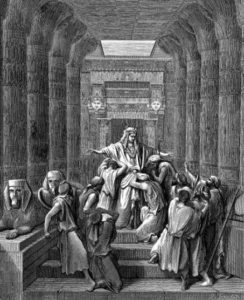
‘Joseph Makes Himself Known to His Brethren’ by Gustav Doré
In this week’s parasha, Vayigash, we read how Joseph finally reveals himself to the sons of Israel in Egypt, and they are shocked and stupefied to behold their long-lost brother. How exactly it is that Joseph reveals himself is not clear. Was he wearing a mask or Egyptian headdress that he took off? Was it simply his declaration “I am Joseph, is my father still alive?” (Genesis 45:3) Did he have to show them his brit milah to prove it, as Rashi comments on the next verse? Or was it the fact that he now switched to speak Hebrew? Previously, he had spoken in Egyptian and there was a “translator” between them (42:23)—identified as Joseph’s son Menashe. Now Joseph revealed that he himself speaks Hebrew—a language only spoken by Jacob’s household and a select few. Rashi says this, too, later on 45:12, when the brothers are still stunned after Joseph’s speech. Joseph tells his brothers to see “the mouth that is speaking to you”. This is what ultimately convinces them that it is really Joseph. Such is the power of Hebrew in that it is a central identifying marker of a true son of Israel.
In fact, Hebrew was our language from the very beginning—Abraham himself spoke Hebrew and passed it down to Isaac, and then to Jacob and his family. The ancient Book of Jubilees describes how the divine language was lost following the Tower of Babel, when God confounded the tongues of the people, and He only restored it by teaching it directly to Abraham (Jubilees 12:25, or 12:31 in other versions). It goes on to say that Hashem even provided Abraham with ancient mystical Hebrew scrolls for him to learn from. The family continued to speak Hebrew, even throughout their servitude in Egypt. The Midrash (Lekach Tov on Ki Tavo) states that Israel was redeemed from Egypt in the merit of three things: “they did not change their clothing, their diet, or their language”, while a parallel Midrash (Vayikra Rabbah 32:5) says it was in the merit of four things: “they did not change their names, nor their language, and they did not speak lashon hara or engage in licentiousness”. The one thing common to both lists is that the Israelites preserved the Hebrew tongue. Such is the power of Hebrew in that its use hastens the Redemption!
That said, in our day and age, when we are so close to the Final Redemption, we must do everything we can to revert to using the divine Hebrew language as much as possible. Thankfully, this has already been greatly accelerated in the last two centuries by the Zionist push to revive Hebrew as the vernacular of the Jewish people, and making Hebrew the official language of the State of Israel. It is important to note that, contrary to popular belief, Hebrew was never a “dead” language, and Jews have always used it throughout history. Sephardic Jews in particular devoted a lot of time to studying the Hebrew language and writing Hebrew grammar books, as well as Hebrew poetry and piyyutim.
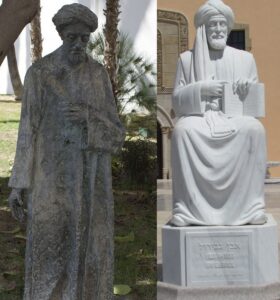
Statues of Ibn Gabirol in his hometown of Malaga, Spain, and in Caesarea, Israel
One such Sephardic Jew was Solomon ibn Gabirol (c. 1021-1070), who wrote a 400-verse book on the rules of Hebrew grammar when he was just 19 years old. He went on to write multiple renowned books of poetry, proverbs, and philosophy (in both Hebrew and Arabic). Today, there is a major busy street in Tel-Aviv called Ibn Gvirol named after him (where I was once lived as a child). Another key figure was the Ramchal (Rabbi Moshe Chaim Luzzatto, 1707-1746), who put together a textbook on Hebrew language and grammar called Leshon Limmudim. He also wrote many poems and psalms in Hebrew, and even a Hebrew opera! The Ramchal was an inspiration not just to countless rabbis and mystics, but even to secular Jewish scholars and Haskalah writers, who often referred to him as “the father of modern Hebrew literature”.
Nonetheless, for much of the past 2500 years (until recently), Jews typically retained Hebrew as a religious language for prayers and holy texts, to be used in the beit knesset and beit midrash, and for correspondence between rabbis and merchants who came from different lands and needed a common language. The day-to-day vernacular was usually from whatever locale the Jews lived in. Two thousand years ago it was Aramaic and Greek; today it might be English, Russian, Spanish, or French. Along the way, Jews also developed their own dialects by fusing together local languages and adding in some Hebrew. The two most well-known are Ladino (among Sephardic Jews) and Yiddish (among Ashkenazi Jews). There are others, including my own community’s Bukharian, or the Juhuri of Kavkazi Jews.
Today, people often lament the decline of these “Jewish” languages. While it is true that it’s never a bad thing to know another language (and my knowledge of Bukharian is really helpful when I’m around Iranians or Afghans), the truth is that Jews have no need for these foreign tongues. Our language is Hebrew, and always has been, and we have to use Hebrew first and foremost. The focus should be on mastery of Hebrew, not any other language. If a Jew does not yet know Hebrew, he has no business learning another tongue! Only when a Jew can speak God’s language fluently should he move on to learn others. Considering how important the use of Hebrew is in ushering in the Redemption (as we see from ancient Egypt), the still-common Hasidic practice to raise children in Yiddish is counter-productive. At its core, Yiddish is just a blend of German and Russian (two peoples who have never treated us particularly well), so it makes little sense to insist on using it. Like other “Jewish” languages, it is a tongue of exile and oppression, of punishing galut. There is no doubt that every Jew should switch to Hebrew, the language of God, Torah, and geulah.
The prophet Zephaniah told us this long ago: “For then I will make the peoples pure of speech, so that they all invoke Hashem by name and render service with one accord… The remnant of Israel shall do no wrong and speak no falsehood; a false tongue shall not be in their mouths…” (3:9-13) If we are truly one nation, we should have one language, and any two Jews in the world should be able to converse freely in Hebrew. (Reminds me of a conversation I once had with a Hasidic Jew who only spoke Yiddish. He was born and raised in Israel, but his Hebrew was so poor and so accented I could barely understand him!) We all know well that if we want to see geulah, we need to have ahavat hinam and unite as the singular people we are meant to be. This is not possible if we can’t even speak the same language or understand each other.
It is worth noting here the Sapir-Whorf Hypothesis, that the language we use directly influences the way we think, and how we see the world. A classic example is that Russian children tend to be better at recognizing different shades of blue compared to English children because the Russian language actually has two distinct words for shades of “blue” (sini and goluboy). Inuit peoples have many more words for different types of “snow”, making them better at understanding this weather phenomenon and its many variations. Based on the same line of reasoning, one could argue that since Hebrew has many different words for “God”, a Hebrew-speaker who knows these nuances would be much better at understanding God, too. Although there are scholars who reject the Sapir-Whorf Hypothesis, one could make a strong case that children who are raised with a galut language will have a galut mindset, while those who are raised in Hebrew will have a more liberating, more Torah-true geulah mindset.
Finally, it is vital to dispel two common myths and counter-arguments to the common use of Hebrew. First, that Hebrew is “too holy” to use as a vernacular language, and should not be used for mundane conversations. This is silly, first because Hebrew was the common language of the Israelites for centuries. The Tanakh records the conversations of our forefathers and Biblical figures in Hebrew, whether for holy matters or mundane ones, during the performance of mitzvot or transgressions, for blessings and for curses, in political intrigue, adulterous affairs, military conquest, or even in describing idolatrous practices. King Solomon wrote Shir haShirim which doesn’t seem to speak of religious things at all and, at least on the surface, graphically depicts the deeply passionate love of a young couple.
Shir HaShirim would pave the way for later rabbis to write Hebrew love poetry, including the great Rabbi Yehuda haLevi (c. 1075-1141, most famous for his philosophical Kuzari). In addition to religious poetry, many others wrote secular Hebrew poetry, too, including Dunash ibn Labrat (c. 920-990) and both Moshe ibn Ezra (1055-1138) and Avraham ibn Ezra (1092-1167). Meanwhile, the great Kabbalah master Rabbi Itzchak Luria (1534-1572, “Arizal”) tried to always speak Hebrew, being especially careful with this on Shabbat, and only using the vernacular if necessary to explain something to others (See Sefer Toldot haAri). One could well argue that not only is Hebrew okay to use for day-to-day speech, it is actually a very good thing that will infuse some holiness into even the most mundane conversations!
The second myth to dispel is the argument that no one speaks “proper” Biblical Hebrew today, and Modern Hebrew is an “illegitimate” offshoot. In the Ultra-Orthodox world, it is common to hear that Hebrew and Lashon haKodesh are not the same thing. The main reason for this is, supposedly, that Modern Hebrew devised many new, non-Biblical words, and often used Aramaic, Arabic, or others as the foundation for these new terms. While this is true, it does not present a problem at all. Hebrew has always been a living and evolving language that borrowed from others. The Talmud (Sanhedrin 4b) goes so far as to say that even a mysterious Torah word like totafot, used to describe Tefillin in Exodus 13:16 and Deuteronomy 6:8, comes from two ancient “African” languages that mean “two and two”, to teach that Tefillin should have four sections.
The Torah names Aharon and Pinchas seem to mean nothing in Hebrew, but in ancient Egyptian aha-rw meant a “warrior lion” while Panahesy was a common Egyptian name meaning something like “bronze-skinned” or “Nubian”. The Talmud itself is in Aramaic, and is peppered with Greek words. Sanhedrin is the word for a Jewish supreme court, but comes from the Greek synedrion, “sitting together”. The Talmud explains that the now-Hebrew prosbul comes from the Greek pros bulei u’butei, “for the benefit of rich and poor” (Gittin 36b-37a). It uses the word pardes to refer to “the Heavens” in its account of four rabbis who ascended to the upper worlds (Chagigah 14b), giving rise to the English word “paradise”. Its earliest origin, though, is the ancient Persian-Avestan word for a park, paraideza, which made its way into one place in Tanakh (in Shir haShirim 4:13) as pardes, now the common Hebrew word for an “orchard”.
Another amazing example of the evolution of Hebrew is given by Rabbi Yitzchak Ginsburgh (see Breath of Life, pg. 72): the Talmud uses the Greek word androgynous to refer to a person with biologically indistinct gender—when it is not clear whether the person is a zakhar or nekevah, male or female, based on their anatomy. Rav Ginsburgh points out that, incredibly, the Hebrew gematria of “androgynous” (אנדרוגינוס) is 390, exactly equal to zakhar v’nekevah (זכר ונקבה). Of course, the word gematria itself, referring to Hebrew numerology, is of Greek origin!
So, the fact that Modern Hebrew has devised new words along the way, as necessary, even if based on other languages, is not problematic at all. This has always existed throughout the history of Israel, all the way back to the Torah itself. The reality is that society evolves, things change, and new words need to be coined. This happened in Biblical times, and in Talmudic times, and is continuing to happen today. Besides, many “Modern Hebrew” words are actually based on Biblical roots, including rakevet (רכבת) for a “train”, based on the Biblical rekhev (רכב) or merkava (מרכבה) for “chariot”; and chashmal (חשמל) for “electricity”, based on the lightning-like chashmal “electrum” described by the prophet Ezekiel in his opening chapter. (The modern chashmal was coined by Yehuda Leib Gordon [1830-1892], a child prodigy who reportedly knew the whole Tanakh and Talmud by heart. For more on the fascinating world of chashmal, see here.)
To conclude, Hebrew is the language of Hashem and the language of Creation, inseparable from Torah, from Judaism, and from the Jewish people. Hebrew has been our tongue for thousands of years, for both holy and secular purposes, and we need it now more than ever. It was the use of Hebrew that confirmed for the sons of Israel that the mysterious person in front of them was truly Joseph, teaching us that Hebrew speech is the mark of a true Israelite. It was the use of Hebrew that brought the people of Israel in Egypt the merit to be redeemed and saved. So too now, when we are awaiting the Final Redemption, it is in the merit of Hebrew, Hashem’s divine language, that we will get there.
Shabbat Shalom!